Did someone call?

There are a number of ways of laying out the proportion of drawers. The three I know a bit about are called the Arithmetic Progression, the Geometric Progression and Hambridge Rectangles.
1. Arithmetic Progressions
This is when each drawer is a fixed size bigger than the one above it. So if the top drawer is 125mm deep, the one below it might be 150mm, the one below that 175mm, and so on.
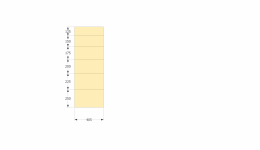
2. Geometric Progressions
This is when each drawer is fixed FRACTION of the one above it. So starting with our 100mm top drawer, the one below it might be 20% deeper at 120mm, the one below that 20% deeper than that at 144, the next at 173mm, then 207mm etc.
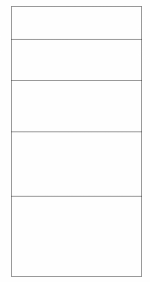
They both have their advantages, but if you have many tiers, the bottom drawer can become very deep very quickly with a geometric progression.
3. My favourite is the Hambridge Rectangle or modifications of it. It's easier to do than to describe, but I'll have a go.
i) Start with a square the width of your chest of drawers. This square will be erased at the end of this but we need it as a starting point. The BL corner of this square is a pivot point and that pivot point never changes. Extend the L and RH sides of the square upwards - these will be the sides of your COD.
ii) With you compasses set to the diagonal, swing an arc from the TR corner of that square anti-clockwise until it is vertically above the LH side of drawers. Draw a line horizontally across to the RH side to give you the bottom drawer of your chest.
iii) Now reset you compasses to the diagonal from the Pivot point to the TR corner of your new rectangle and repeat; swing CCW, draw horizontal line to give second drawer, and so on.
When you have as many drawers as you want, remove the original square.
You can, if you wish, use Hambridge to define the vertical spacing, but adjust the horizontal dimension afterwards to suit a narrow chest of drawers (RH image)

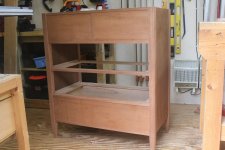
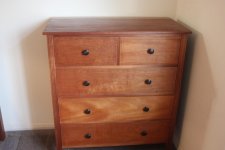
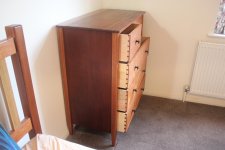
I have a bedroom COD on the TUIT list to complement my Mackintosh wardrobe I made 18 months ago. I shall use Hambridge for that.