Mike G
Petrified Pine
I received a saw a number of years ago as part of a bundle of tools, and I mentioned it on here because it was so small. I put it on one side for future restoration, and that day arrived yesterday. I was looking for a saw with a coarser cut than my normal 10 TPI saws, but not as harsh as my rip saw which has 4 TPI, and this one is the only one I could find. It advertised itself as 6TPI:

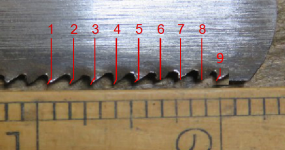
However, if you count, it's actually 8 TPI. That must mean it has been refiled at some stage, or that it was mis-stamped originally. Or, it actually says 9 and I can't count. That photo, by the way, is after I had sharpened it. I've never seen such appalling teeth as this had before I filed them. I wonder whether it had been used for cutting masonry.
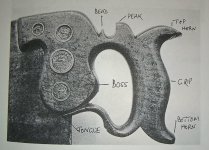
These photos were all taken in one batch after I had spent some time working on restoring this saw to working condition, so I'm afraid there isn't one of the "before" state. BUt just to give you an idea, this is the handle, and it was like this when I got it:

Someone had obviously tried and failed to take this apart previously.......and I can see why. The saw nuts wouldn't unscrew! They would turn, but not come apart. In the end I levered them off with screwdriver and pincers, and then could see why they didn't unscrew:


There's no thread. These are press-fitted, more like a fancy rivet. Has anyone here seen that before?
The handle was an awful thing in beech, in really poor condition (split along the line of the saw plate, and vandalised as you've seen), but worst of all, tiny:

That's it on top of a normal saw. Along with the really short plate....:

......(18" if you can't make it out in the photo), it's clearly built for a child. It has the stamp of a Skulnick and Son in Liverpool:


They had a business in London Rd Liverpool between 1926 and 1955, so aging the saw isn't difficult.
Anyway, the handle isn't salvageable, so I have made one from bog oak, opened out slightly between the "wings" (top and bottom) of the original so that I can use it with my bigger-than-average hands. I can't see it getting an awful lot of use as it is so small, but now and then, when 8TPI is necessary, it will get a run-out.
However, if you count, it's actually 8 TPI. That must mean it has been refiled at some stage, or that it was mis-stamped originally. Or, it actually says 9 and I can't count. That photo, by the way, is after I had sharpened it. I've never seen such appalling teeth as this had before I filed them. I wonder whether it had been used for cutting masonry.
These photos were all taken in one batch after I had spent some time working on restoring this saw to working condition, so I'm afraid there isn't one of the "before" state. BUt just to give you an idea, this is the handle, and it was like this when I got it:
Someone had obviously tried and failed to take this apart previously.......and I can see why. The saw nuts wouldn't unscrew! They would turn, but not come apart. In the end I levered them off with screwdriver and pincers, and then could see why they didn't unscrew:
There's no thread. These are press-fitted, more like a fancy rivet. Has anyone here seen that before?
The handle was an awful thing in beech, in really poor condition (split along the line of the saw plate, and vandalised as you've seen), but worst of all, tiny:
That's it on top of a normal saw. Along with the really short plate....:
......(18" if you can't make it out in the photo), it's clearly built for a child. It has the stamp of a Skulnick and Son in Liverpool:
They had a business in London Rd Liverpool between 1926 and 1955, so aging the saw isn't difficult.
Anyway, the handle isn't salvageable, so I have made one from bog oak, opened out slightly between the "wings" (top and bottom) of the original so that I can use it with my bigger-than-average hands. I can't see it getting an awful lot of use as it is so small, but now and then, when 8TPI is necessary, it will get a run-out.