• Hi all and welcome to TheWoodHaven2 brought into the 21st Century, kicking and screaming! We all have Alasdair to thank for the vast bulk of the heavy lifting to get us here, no more so than me because he's taken away a huge burden of responsibility from my shoulders and brought us to this new shiny home, with all your previous content (hopefully) still intact! Please peruse and feed back. There is still plenty to do, like changing the colour scheme, adding the banner graphic, tweaking the odd setting here and there so I have added a new thread in the 'Technical Issues, Bugs and Feature Requests' forum for you to add any issues you find, any missing settings or just anything you'd like to see added/removed from the feature set that Xenforo offers. We will get to everything over the coming weeks so please be patient, but add anything at all to the thread I mention above and we promise to get to them over the next few days/weeks/months. In the meantime, please enjoy!

Circular table apron

Mike G

Petrified Pine
Joined
Jul 30, 2014
Messages
12,424
Reaction score
2,937
Location
Suffolk
Name
Mike
I am about to start on a small round oak table......say 600 or 700 in diameter.... and I want a circular rather than square apron. Do I laminate, cut from the solid and hide the joins at the legs, or steam bend the full thickness? Or, some other way?
 
Any way that you have mentioned would work, obviously cutting from solid timber would result in a lot of waste and short grain so it's not a preferred method aside from being fast because there is no steaming or jigging involved. Steam bending is good but requires a decent steam box and jigging to clamp up while it dries, whilst laminating only requires ripping down to thin strips and gluing to a form/jig. Steam bending wins out over laminating where both the face and edge are visible because nobody likes to see lots of glue lines, but if only the face is commonly visible as with a table apron laminating would be the better choice as @Malc2098 said.

Something I've become aware of recently is "compressed wood" where they take relatively wet timber and compress it in length to somehow make it flexible, quite interesting. http://compwood.com/processen/
 
Nothing very useful found and if you’re like me you’ll shy away from veneer, so that just leaves a solid piece with a thousand cuts to the back.
How wide/deep/high a piece are you thinking for the apron?
 
Last edited:
Something I've become aware of recently is "compressed wood" where they take relatively wet timber and compress it in length to somehow make it flexible, quite interesting. http://compwood.com/processen/

That looks a bit of fun. I notice that it is steamed immediately prior to compression. Compression seems to be a way of storing the flexibility that steaming gives, for up to a year if you keep the wood wet.
 
Another vote for laminating. Making a 700mm diameter segmentally would either have many joints or lots of end grain cut on an angle.
 
I'm frightened that this is going to mean steaming AND laminating. Even with 2 or 3mm thick oak, I can see lots of failures happening bending to that radius without steam.
 
What wood will be used for this apron?
How about trying to cut a thin piece of the desired circumference and see if it could be bent into a circle or at least a half circle. If it can be achieved then laminate around a former.
 
Mine looks like being about 240mm radius, and 360 degrees.......and I'll have the problem of trimming the pieces to length so they butt end-to-end in each layer. That suggests a trial fit to mark the length......for each layer. I can't begin to think how that will work with clamps all over the place.
 
Sounds like you need to laminate 4 sections slightly more than 90deg trim to length and join at legs, assumng its a 4 leg table.

Pete

bit late to the party again!
 
Having never laminated anything larger than a chair back I speak not from experience but that will not stop me thinking out loud in what we used to call brainstorming.

Make a former from MDF just few inches longer than half the circumference . Cut two laminations to half circumference and glue together around the former. When dry set aside. Cut two more laminations and repeat. When dry place both half circles on the former so they meet in the middle. Glue the next lamination centred over the join. Repeat on the other side of the circle and in my head anyway you’ll have a rigid circle. Keep building up the layers until the desired thickness is reached.
 
Hmmm. I don't think I'd try to go the full circle to start. I'd be inclined to go in stages of the thickness around parts of the circumference, overlapping and scarfing as I go, if that makes sense, till you fill both the thickness and the circumference.
 
My suggested method would be to cut a full size template in 12 mm plywood and use that as a base for three layers of solid blocks with staggered joints to make the 70 mm height before bending a single 2mm thick laminate round the outer face after cleaning up the outer face with band saw and hand tools.
 
I think laminating is probably your best bet, and, as said above, I think four, or at least 2, sections would be the way to go. I don't think you'll need to steam them.

One issue you might face is that it's much easier to make the laminations if you have, or can borrow, a drum sander. Using a thicknesser might work but you run the risk of destroying the thin laminations. Also, when making the legs for my table, I found that the finish from the thicknesser wasn't smooth enough. The ridges from the planer knives locked against each other when being clamped which made gap free laminations difficult. Of course, if you've only got a few laminations to make, then you could do them by hand, perhaps making some kind of thicknessing jig to get them even. I had to make 176 laminations and didn't really fancy doing that by hand.

You'd need to make a mould to bend them around. I made an eliptical apron for a demi-lune table and used ratchet straps to bend the laminations around the mould, but that wasn't very successful. It left some gaps in the laminations. They didn't affect the strength very much and couldn't be seen so not a big issue, but still not ideal. The clamping method I used for the table legs was much better.

IMG_2924.jpeg

Another option would be to build up a substructure using the "brick" technique and then veneering the outer surface. Blocks of wood are glued in a curved brick pattern. The outer face is then shaped before being veneered.

I still think laminating is the way to go though.
 

Attachments

  • IMG_2782.jpeg
    IMG_2782.jpeg
    240 KB · Views: 2
As I think some one has already said, NickM had a thread on UKworkshop (assuming you can bear to go there) on his demi-lune table. That has a couple of pictures of mine of existing tables that are built with the curved blocks method (but, alas for you, veneered, as you say you don’t do that).

The only curved work I have done I did by kerfing (if that is the right term) about every 10mm in maybe 15mm thick timber. Leaving just a few mm intact. Circle maybe 600mm diameter. Rough work, but I was surprised how good the external surface was. Living in the back woods of Sweden I did it all by hand, but a powered saw would make it very easy/quicker. Filled the kerf cuts with glue and pulled into shape. I think I did it in two halves. No noticeable springback, but I wasn’t that bothered for my application.
 
As mentioned above, cutting from the solid will incur waste but on a relatively small table such as yours it would be pretty minimal? The internal off cuts can be fashioned into handy sanding blocks for the inside surfaces. Solid is less work than laminating too and the shape accuracy of each part is much more certain. Compass plane at the ready!
 
Last edited:
Do you really want the look of a curved rail? It would look normal in walnut or mahogany, but could be a bit of a visual anomaly in oak, I suspect.

Does it have to be circular? could you do something clever based on an octagon?
 
I agree with AndyT on this, octagonal with a cock bead around the bottom edge would look good... more oaky.
 
I was wondering what would look right on the empty corners though. A mitre is the obvious choice, but I think Mike doesn't like them. A secret mitre dovetail would be stronger but might look a bit "empty".
I daren't suggest some sort of gothic roofing boss in case he thinks I'm being facetious. :(

Maybe there's some mileage in making the octagon have four long sides and four short ones.

Mike, how far ahead is your thinking on the overall style of this table? What else does it need to be seen next to?
 
Perhaps a (vertically grained) little angled post that stood out 3 or 4mm in each joint that was biscuited? probably too small to embellish much though.
 
I was wondering what would look right on the empty corners though. A mitre is the obvious choice, but I think Mike doesn't like them. A secret mitre dovetail would be stronger but might look a bit "empty".
I daren't suggest some sort of gothic roofing boss in case he thinks I'm being facetious. :(

Maybe there's some mileage in making the octagon have four long sides and four short ones.

Mike, how far ahead is your thinking on the overall style of this table? What else does it need to be seen next to?
I was planning on starting this week, Andy, but I think I'm back to square one. It's for a conservatory table, and given all the oak out there, there is no question of what it needs to be made of. It's to sit between two cane/ rush chairs. I'm revisting the idea of a turned central spindle-thing, with 3 legs emanating from the bottom, and crossed braces under a skirtless top. It would have to be somewhat smaller than my original proposal.
 
This sort of thing, but without turned legs and fancy top, was my original idea:

Screenshot 2024-11-25 at 14-58-48 Rustic Wood Spindle Leg End Table with Sunburst Top.png

I might have to reconsider something like this:

Screenshot 2024-11-25 at 15-04-00 round oak pedestal side table at DuckDuckGo.png
 
I doubt there would be much of a problem laminating 4 separate quarters of the apron.
 
Interesting... I thought I remembered seeing a design I liked when I visited the furniture in the museum in Cheltenham, many years ago.

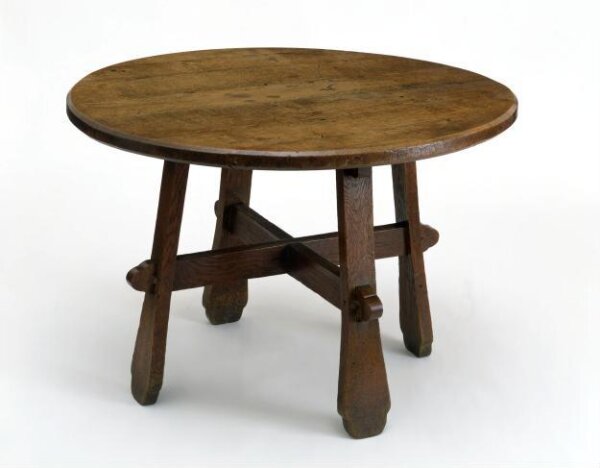
I think this might be what I remembered, by Gordon Russel in yew, which has some interesting transitions in the shape of the legs and (presumably) a cross-frame rather than a circular rail:

wwwopac.ashx


but I also found this one by Peter Waals in walnut, which I think looks quite ok with a square frame:

wwwopac.ashx


or this bigger one, also by him, also in walnut

wwwopac.ashx


All these are in the museum's searchable catalogue here
 
If you decide you really want a curved rail the easiest would probably be to laminate oak constructional veneers available at the Mundy link at either 1.2 or 2.4 mm thickness. It was constructional veneers that were used in the cherry table below, which saved a lot of waste and time faffing about making my own laminates. Slainte.

AD-Table-1896-700px.jpg
 
Apologies for the brain fade. This was the one I was looking for, by GE Street, with a circular top, made in oak, with joints that you could make with your eyes shut, but some nice angles and details to it:

6.jpg


Details here https://victorianweb.org/art/architecture/street/6.html

Better images (but no view of the underside) here at the V&A:

 
Last edited:
If you want to go with the original deep circular apron idea, perhaps have a look at the methods used for creating grand piano rims. There is a lot of info on line. Steinway claim to have invented it though most manufacturers use a variant of either a stem press or the gradual peg method. I've seen it done at the Steingreaber facility where they bend with the peg and board method for their 7ft and 9ft grands and it looks doable. Bosendorfer are an outlier as they use a block construction for their (very thick) rims in their concert grands and then run a sheet of veneer round it. If it were me I would probably do the latter as it is less risky on a DIY basis. The section inside the veneer would not have to be oak. You could resaw veneers yourself that would do this.
 
I think I may have posted something of this type before in another place, when you were considering your dining table. However...

Lorimer, oak. Curved aprons. Sold at auction by L&T about 5 years ago for c.£8k. I quite like them, although some may find the legs a bit clunky.


Lorimer side table.jpg


Anyway, just another idea.
 
Interesting, GarF, but that's all rather alien to me. One day, when I'm a grown up........
 
I'm frightened that this is going to mean steaming AND laminating. Even with 2 or 3mm thick oak, I can see lots of failures happening bending to that radius without steam.

I picked up a off-rip of 4mm x 75mm kiln-dried American White Oak off the floor today and with this thread in mind and out of curiosity, I managed to bend it to around a 150mm radius in my hands without it breaking. It obviously depends on the particular piece and the grain orientation more than anything but I imagine you would have fewer issues with air-dried English Oak which has more life and spring to it than the kilned-to-death AWO.

Cricket Tables are quite a traditional style if you're moving away from laminating. They can be very plain and clearly made by non-professional woodworkers such as farmers making them out of season for extra income, or they can get quite elaborate with turnings and intricate carvings produced by professional craftsmen.

1732559203767.jpeg1732559176187.jpeg
 
An ex cricketing buddy of mine is a great collector of early oak furniture, and has a cricket table in his collection in the Peak District. We've got a photo somewhere of two ex cricketers sitting at a cricket table, talking about............tables. Not cricket. His has a tilting top, pegged open with a loose peg, and the first thing I turned when I got a lathe was a new peg to replace his 6" nail doing the job temporarily. But yes, a cricket table is an idea.
 
Back
Top