• Hi all and welcome to TheWoodHaven2 brought into the 21st Century, kicking and screaming! We all have Alasdair to thank for the vast bulk of the heavy lifting to get us here, no more so than me because he's taken away a huge burden of responsibility from my shoulders and brought us to this new shiny home, with all your previous content (hopefully) still intact! Please peruse and feed back. There is still plenty to do, like changing the colour scheme, adding the banner graphic, tweaking the odd setting here and there so I have added a new thread in the 'Technical Issues, Bugs and Feature Requests' forum for you to add any issues you find, any missing settings or just anything you'd like to see added/removed from the feature set that Xenforo offers. We will get to everything over the coming weeks so please be patient, but add anything at all to the thread I mention above and we promise to get to them over the next few days/weeks/months. In the meantime, please enjoy!

Circular table apron

We have a cricket table. Made by my maternal grandfather Chris who was a cricketer and (womaniser I discovered ....) and then switched to bowls in his later years. It's a tad rustic. Tad being generous. Not entirely clear why it needed a tilt top. In ours he fitted a little net sling underneath, which I suspect was a snooker cue pocket. Not a clue why and he's long dead.
 
So I was wondering why you aren’t keen on the Apron made from solid and lots of kerf cuts allowing it to bend. I came to the thought that it might not be very strong where it joins to the legs, so how about this, viewed from underneath, not in proportion as it was the only round objects to hand.
The strength comes from the crossed pieces hidden underneath, and the bent pieces are just glued into short slots in the legs.
Must admit I’ve never bent by kerf cuts but it’s fairly common and seems to work well.
Ian
B4380A34-7851-41E0-9146-42ACF9B3D89D.jpeg
 
Had to look up cricket table. Seems the origin stems not from the sport

From https://woodworkersinstitute.com/making-a-cricket-table/

There are several words thought to be the origins of the term cricket or creckett that link to this style of table. All are perfectly plausible given the established traderoutes between England and its immediate European neighbours from the 15th century onwards. For example, the French term used to describe a wooden post was criquet while in Old English a cryce or cricc described a crutch or staff. As the earliest three-legged stools and low tables consisted of three sticks driven into round mortises bored into a slab of wood, it’s probably safe to assume the reference then was to the stick and not a game.

Adding weight to that theory is the Middle Dutch word krickstoel used to describe a low long stool used for kneeling in church; krick being the Middle for stick. Variations exist in regional dialects across England such as crickit, crackett and cracket of which the first recorded use was in 1635 describing a low three-legged stool; an item widely used throughout Europe at the time. Low stools and back stools aren’t necessarily indicative of a nation short in stature.
 
So I was wondering why you aren’t keen on the Apron made from solid and lots of kerf cuts allowing it to bend. I came to the thought that it might not be very strong where it joins to the legs, so how about this, viewed from underneath, not in proportion as it was the only round objects to hand.
The strength comes from the crossed pieces hidden underneath, and the bent pieces are just glued into short slots in the legs.
Must admit I’ve never bent by kerf cuts but it’s fairly common and seems to work well.
Ian
View attachment 30049
In the days when I had a radial arm saw, that would have been feasible. Nowadays, I'd have to cut all those kerfs by hand. Not only would that be tiring, but because a hand saw kerf is so narrow, I'd have to do a lot more of them.
 
In the days when I had a radial arm saw, that would have been feasible. Nowadays, I'd have to cut all those kerfs by hand. Not only would that be tiring, but because a hand saw kerf is so narrow, I'd have to do a lot more of them.
Why did my mind suddenly conjure up a radial arm saw frame with a narrow wooden dado plane instead of the saw...? :unsure: :LOL:
Have I morphed into an AI bot :eek:
I suppose using one manually and gang cutting the four parts wouldn't be too tiring would it?
Cheers, Andy
 
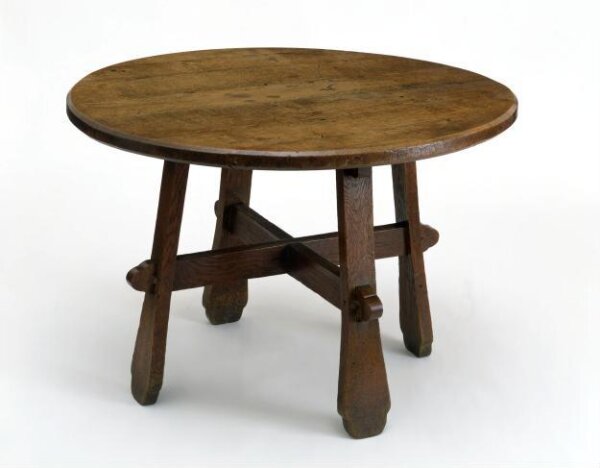
Apologies for the brain fade. This was the one I was looking for, by GE Street, with a circular top, made in oak, with joints that you could make with your eyes shut, but some nice angles and details to it:

6.jpg


Details here https://victorianweb.org/art/architecture/street/6.html

Better images (but no view of the underside) here at the V&A:

We've had a design team meeting, and this design is the winner, I'm told......much to my suprise So, I will be doing a version of this in the next little while. I'm going to need to think of how to be a bit "rustic" with my lines and edges. Maybe a finish straight from the draw knife, and the top scrub planed and then scraped, without using a smoother. I'm a little curious as to what goes on at the top of the legs, under the table top, but a long cross-grain sliding dovetail is in my mind.
 
Last edited:
In the days when I had a radial arm saw, that would have been feasible. Nowadays, I'd have to cut all those kerfs by hand. Not only would that be tiring, but because a hand saw kerf is so narrow, I'd have to do a lot more of them.

I know you're already moving away from this with the design change. For academic interest however, is there any reason you'd have to do it with a saw? I'd have thought a narrow blade in a plough plane of some sort (with a "nicker" to cut across the grain or just do it every couple of strokes with a knife) would be easier and make a thicker (3 mm or 1/8"?) kerf at a more consistent depth than you'd manage with a saw.
 
Great choice! I'm sure you will do it justice.
And designed by an architect too.

I suspect a simple pair of cross pieces, halved together and fixed to the top with screws in holes enlarged to slots. Pity it's not on display - but maybe you don't want another reason to visit London...
 
I see that the V & A description says that the top isn’t exactly circular.

PHYSICAL DESCRIPTIONOak table, Gothic Revival style. Table top is slightly oval-shaped. Through tenons on the frame. Four legs.

I’ve given them feedback via the website and requested more photos and text on the construction. It’s a nice table.
 
I know you're already moving away from this with the design change. For academic interest however, is there any reason you'd have to do it with a saw? I'd have thought a narrow blade in a plough plane of some sort (with a "nicker" to cut across the grain or just do it every couple of strokes with a knife) would be easier and make a thicker (3 mm or 1/8"?) kerf at a more consistent depth than you'd manage with a saw.
Interesting question, Al. It never occured to me than planing these "kerfs" would be do-able. Is there even such a thing as a 3mm (1/8") plough plane which could plough a groove say 17 or 18mm deep?
 
.... a simple pair of cross pieces, halved together and fixed to the top with screws in holes enlarged to slots.....

I think I might do the cross-grain one as a secret sliding dovetail.
 
Interesting question, Al. It never occured to me than planing these "kerfs" would be do-able. Is there even such a thing as a 3mm (1/8") plough plane which could plough a groove say 17 or 18mm deep?
Most definitely Mike, mind you I've only ever seen and got one.
Very delicate....
Cheers, Andy
 
Had to look up cricket table. Seems the origin stems not from the sport

From https://woodworkersinstitute.com/making-a-cricket-table/

There are several words thought to be the origins of the term cricket or creckett that link to this style of table. All are perfectly plausible given the established traderoutes between England and its immediate European neighbours from the 15th century onwards. For example, the French term used to describe a wooden post was criquet while in Old English a cryce or cricc described a crutch or staff. As the earliest three-legged stools and low tables consisted of three sticks driven into round mortises bored into a slab of wood, it’s probably safe to assume the reference then was to the stick and not a game.

Adding weight to that theory is the Middle Dutch word krickstoel used to describe a low long stool used for kneeling in church; krick being the Middle for stick. Variations exist in regional dialects across England such as crickit, crackett and cracket of which the first recorded use was in 1635 describing a low three-legged stool; an item widely used throughout Europe at the time. Low stools and back stools aren’t necessarily indicative of a nation short in stature.
I found that very interesting thank you, so presumably the game gets its name from the three sticks, also known as a wicket? which sounds a lot like cricket, strange.
 
I think I might do the cross-grain one as a secret sliding dovetail.
I have some brass racetrack washers they are oval with a slot down the middle to allow for movement.
I was going to post a picture but I can't find one on line.

Pete
 
I just have a yen to do this table without any modern fixings, Pete.
 
The original is quite a big table at 1m diameter.
Mike, are you going to do it the same size as the original or scale it down to your first stated size?
 
I was just looking at the top of the legs, can’t see but it’s possible it just has a peg though same as below. But if it were me I would have a T Bridle joint at the top of the leg I think.
Not sure just where your sliding Dovetail goes Mike.
 
Interesting question, Al. It never occured to me than planing these "kerfs" would be do-able. Is there even such a thing as a 3mm (1/8") plough plane which could plough a groove say 17 or 18mm deep?
I don't really know. I'm not sure what the maximum depth my #45 would go; I think that can handle a 3 mm cutter but I could be wrong.
 
Not sure just where your sliding Dovetail goes Mike.

On the top of the cross-grain cross piece, holding it onto/ into the underside of the table-top. In other words, it will be about half a metre long, securing the cross-halved undercarriage to the top.
 
I don't really know. I'm not sure what the maximum depth my #45 would go; I think that can handle a 3 mm cutter but I could be wrong.
Yes, it should have a 1/8" cutter with it and can go down 3/4" max, as mentioned here


Personally, I think if anyone was contemplating multiple kerfs by hand, the quickest option would be to use a saw and make a few more cuts.

There's a systematic approach I've seen written about somewhere, where you make a couple of test cuts and see how much curve they produce, then multiply it up somehow for the complete arc you require.

(Back when coffins were made by hand, the bend at the shoulder was made by kerfing, with an extra long backsaw. Charles Hayward recalled spending all day doing it, as an apprentice.)
 
The kerfed linings of musical instruments are made like that. The curve of the upper bout of a ukulele is quite short, probably around 25mm radius.

There are jigs that some luthiers use to make their own, such that both the depth of the kerf cut and the space between them are the same every time. And I think most are done on a bandsaw.
 
(Back when coffins were made by hand, the bend at the shoulder was made by kerfing, with an extra long backsaw. Charles Hayward recalled spending all day doing it, as an apprentice.)
Somewhat related but not to handcraft, I have seen a photo somewhere though I can't remember exactly where I saw it (probably in one of the catalogues) of a "coffin-maker's radial arm saw" which was a radial arm saw with an extra long arbour so that you could affix a dozen blades or so for cutting the kerfs in a coffin side. It must have been quite an intimidating machine to use.

I suppose with Hayward it was very good practice in sawing and filing for an apprentice, keeping the saw square to the piece so that the kerfs bent properly rather than in a sort of spiral, and such repetitious work would require the saw sharpening often.
 
Sounds like a reason to make a spare coffin asap!

Here's a place to read the kerfing story:


I'm sure Mike will be along to screen the main feature very soon, but meanwhile we can all enjoy a wide variety of short documentaries! ;)
 
Back
Top