• Hi all and welcome to TheWoodHaven2 brought into the 21st Century, kicking and screaming! We all have Alasdair to thank for the vast bulk of the heavy lifting to get us here, no more so than me because he's taken away a huge burden of responsibility from my shoulders and brought us to this new shiny home, with all your previous content (hopefully) still intact! Please peruse and feed back. There is still plenty to do, like changing the colour scheme, adding the banner graphic, tweaking the odd setting here and there so I have added a new thread in the 'Technical Issues, Bugs and Feature Requests' forum for you to add any issues you find, any missing settings or just anything you'd like to see added/removed from the feature set that Xenforo offers. We will get to everything over the coming weeks so please be patient, but add anything at all to the thread I mention above and we promise to get to them over the next few days/weeks/months. In the meantime, please enjoy!

Cleaning up lipping

I know many have advised against veneered MDF due to the thinness of the veneer, but as a counter to that we had a unit built by around the time our youngest was born so 8-9 years. It was a big toy / wardrobe / bookcase with a toddler height section that they could use to play on and also climb to get to books. A lot of wooden toys scraped over it. Then more recently it was no longer in service and was repurposed for 3 years as a makeshift TV unit. Now it’s not needed for that I’ve cut and sanded some of it to build in to a space as a wood store!

Yes I’ll be painting it due to holes I’ve filled where shelving went but when I sanded it pretty much all scratches came out and I didn’t go through the veneer! You don’t strike me as someone who’d be careless and I reckon the veneered MDF would work well.
 
Thanks Matt. I think I'll take a look at some in the flesh, so to speak, before making up my mind.
 
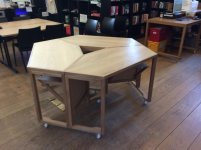
Another example if it helps you make up your mind Mike, computer tables I made a couple years ago, all done with a hand plane as described earlier, in public use and still looking as good as when I finished them, even with people writing in Biro straight onto them, three coats of water-based polyurethane varnish is pretty hard wearing. Ian
2D346EDD-C474-4CA6-A784-8C98D273B849.jpeg
 
That's lovely, Ian. You do produce some really interesting designs.

-

I reckon that the odds are I'll do this in veneered MDF. One of the most compelling reasons is that my local builders merchant has it, and remains open, but my timberyard is closed for the lockdown and thus a solid timber alternative would be delayed.
 
spb":1be8hnxo said:
That's probably true, at least for a certain section of the market, but they'd probably be using edge banding more than solid lipping. I'd be approaching it as an odd-shaped table top, to be honest, where again most of the mass market would be veneered panel products but most people making their own would use solid wood.

As an aside, if it's a computer desk then I'd question whether 600 is enough depth - it's what I've got at the moment and I find it's not enough. As soon as I have the workshop bandwidth available I'll be replacing it with something 750 deep (which is what my previous cheap desk was, just not wide enough). Obviously disregard this if you've got your preferred setup on a 600 deep surface already, but it makes more of a difference than you might think.
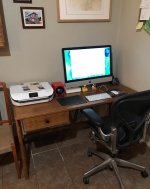
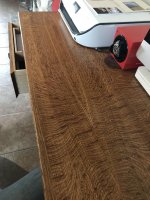
This is my 'pooter desk made in quarter sawn Brown Oak about three years ago;

IMG_5193.jpg

It's an interpretation of Wenger's classic 'Wishbone Desk' and you can just make out a single 'V' on the back rail. The top is 3mm thick :shock: qs bandsawn veneer and the overall dims are 1430 x 600mm with a 25mm edge lipping. The top is pretty much 'bullet proof'. It was made to fit a specific space and as you can see, 600mm is adequate - Rob
 
Thank you Mike that’s very nice of you to say so.
Hopefully Trevanian will upload a video of mine later today (My skills don’t extend to computers unfortunately) which I think you will find interesting as well, not saying any more at the moment ha ha. Ian
 
That’s a lovely desk Rob, I have some wonderful planks brown oak just waiting for the right job, I love the stuff – beefsteak tiger stripe if I’ve remembered it right. I’m presuming you resawed the veneers on a bandsaw, so how wide were they before you joined them together on that top pls? Ian
 
image.jpeg

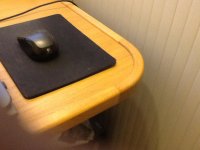
This is the easiest way of edging veneered sheet material without risk to the veneer. I use It often on boat work where sharp edges are not a good idea but "fiddle "rails are
 

Attachments

  • image.jpeg
    image.jpeg
    224 KB · Views: 4,948
Woodbloke":3sbnzrze said:
PAC1":3sbnzrze said:
OK 8' by 2' without a press is a challenge.
I do a lot of bag press veneering and 8' x 2' is a definite challenge, almost impossible I'd say. Even the industrial heated platten presses I used years ago would struggle iIrc with 8'! - Rob


I did some work for a company years ago who veneered PB. (could also do MDF)
Standard size was 9' by 6' either in flitch sheets or rotary peeled.
I also did a supplier audit on a veneer supplier mill in Slovenia. Their whole process was geared to 9x6.
They did flitches and peeled. Peeled mainly on Pine.

Mike 0.6mm veneer Is very thin for a work top. Could someone not bandsaw you some 3mm or 5mm veneer? Glue them in strips of 3 depending on width, hold them down with a sheet of MDF clamps and weights?
A loose thought ............. :?
 
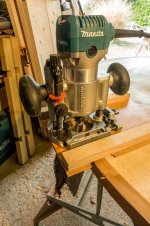
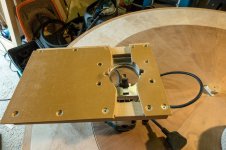
Mike - I tackled a similar problem with a router and scraper card. I made a false base for the router with a gap for the width of the exposed lipping.

DSC07565-1.jpg

DSC07567-1.jpg

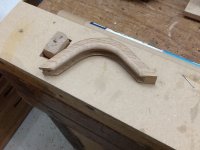
You can set the depth of the cutter to withing a hairs breadth of the surface, and then a scraper card makes short work of the rest. Whilst the example in the photos was to bring a curved edge down to the level of a 2mm thick veneer, I've used the same technique on commercially veneered ply and MDF where the veneer is wafer thin, and it's been just as effective.

On a separate note, you really are going to have to grasp the vacuum bagging nettle sometime. :eusa-doh: I make up my own bags using heavy gauge polythene sheet from Screwfix, and stick the sides down with "tacky tape". Cheap as chips! :eusa-whistle:
 
You really do see some interesting stuff here. I like that library computer desk Ian. Very nice work and I am sure a cost effective solution there.
 
If you go with the MDF then get some hard wearing varnish my current favourite hard wearing variety is Ronseal (Yes I did say Ronseal) Diamond Hard Floor varnish. I first used it on my workshop floor 20 years ago and you would still think it was varnished last week. Since then I have used it on a Birch faced ply desk extension and lever arch file book case and been happy with the long term result. It really does do what it says on the can.
 
Cabinetman":2qjsan54 said:
That’s a lovely desk Rob, I have some wonderful planks brown oak just waiting for the right job, I love the stuff – beefsteak tiger stripe if I’ve remembered it right. I’m presuming you resawed the veneers on a bandsaw, so how wide were they before you joined them together on that top pls? Ian
Thanks, measuring the veneers sat here as I type, each one finished is 140mm wide, so I guess a 150mm board would be fine for the bandsaw.

IMG_5195.jpg

I kept the best matched pairs for the front, at the back they're not quite so good but the 'pooter and printer cover them so I ain't bovvered :lol: The pic also shows the applied drawer front with mitred edges which was rather tricky :eusa-whistle: to sort out

- Rob
 
RogerM":3mxtgfns said:
On a separate note, you really are going to have to grasp the vacuum bagging nettle sometime. :eusa-doh: I make up my own bags using heavy gauge polythene sheet from Screwfix, and stick the sides down with "tacky tape". Cheap as chips! :eusa-whistle:
I used a large polythene bag for donkey's years and the thing was awful; the welded seams kept on coming apart and refused point blank to be stuck together. It was a very 'hit n'missy' affair as to whether I could get the bloody thing to close up and take a vacuum :evil: so I treated myself a while back to the 'dog's danglies' and bought a proper, 600micron thick, polyurethane one from AirPress at Downton, 20mins down the road from me.
Next time you go up to Surrey, take a detour through Salisbury (call in for a brew) and drive on to Downton and the boss will cut you off a lump from the roll. Buy the fasteners for each end and you're sorted.
You may need to talk to SWIMBO very nicely before you raid the piggy bank :lol: - Rob
 
AJB Temple":2pk2ackg said:
You really do see some interesting stuff here. I like that library computer desk Ian. Very nice work and I am sure a cost effective solution there.
Thanks, and space effective as well, it was only after I drew it up I realised it was the NatWest bank logo. Ha.
Ps you ain’t seen nothing yet!
 
Rob

Those veneers are amazing. It gives me something to aspire to (I started learning to veneer late, about 2 years ago). Also it just shows what can be done with native timbers rather than fancy rain forrest depleting wood
 
PAC1":jgzuuaar said:
Rob

Those veneers are amazing. It gives me something to aspire to (I started learning to veneer late, about 2 years ago). Also it just shows what can be done with native timbers rather than fancy rain forrest depleting wood

Thanks, those veneers came out of just one board as I recollect, which shows the advantage of using your own bandsawn stuff. Once laid, they can effectively be treated as solid timber but a disadvantage is that it's quite awkward to obtain a decent book match as they're pretty thick and the bandsaw kerf removes a fair bit of sawdust - Rob
 
RogerM":ab6ka0ht said:
......you really are going to have to grasp the vacuum bagging nettle sometime....

There are aspects of woodwork which have just totally passed me by, due entirely to the auto-didactic nature of my woodworking education. Carving, until recently, was one such, inlaying is another, and veneering is the main one. I have literally never, not once, done any. The thing is, all this bog oak I've got, with all its fissures, cracks and irregularities, would really lend itself to veneering.......but that would mean a huge upgrade on the bandsaw and a sanding machine like Rob's.
 
Mike, I would like to think that there are a few bandsaws in this parish, and drum sanders, with willing and able operators that could help you for a few beer tokens.
 
I'm sure there are, Andy. My point wasn't so much that, rather that I am a complete and utter beginner when it comes to veneering, and that I am not yet geared up to do anything about it.
 
Mike G":2hx66ewx said:
I'm sure there are, Andy. My point wasn't so much that, rather that I am a complete and utter beginner when it comes to veneering, and that I am not yet geared up to do anything about it.

I'd always shied away from veneering, but I have some samples that are so nice I really want to do something with them. It sounds like a big learning curve though, which makes me put it to the back of my mind until I've mastered the other stuff.
 
Ok. I have a suggestion.
Veneering is obviously a skilled and difficult thing to master, but sticking two pieces of wood together or laminating is not.
So put a shout out to see if someone will resaw your bog oak into 12” wide 1/4” thick boards ( not veneers ;) ) or even thicker. I feel sure you have the skill to edge joint them by hand.
Then simply glue to your chosen substrate, lip and hand plane or scrape to your hearts content.

Or am I guilty of over simplifying things?
 
Mike G":27yzgpgr said:
I'm sure there are, Andy. My point wasn't so much that, rather that I am a complete and utter beginner when it comes to veneering, and that I am not yet geared up to do anything about it.
To be fair, you can learn how to veneer with 0.6mm commercial veneer, which is how I started off. That then means you don't need a bandsaw, drum sander or p/t.

What you do need is a way of shooting both mating edges. Bob9f squishes the veneer(s) between two known straight edges (a couple of bits of mdf from the side of a new board are fine) and then bearing cuts them with a router. I use a super long shooting board with 'Big Woody' (sole of 26" in old money) or you can cut directly with a über-sharp, single bevel knife and straight edge, but this way is a lot harder as the veneer is prone to splinter and not cut to the straight edge.

Spread the glue onto the substrate (mdf or whatever) with a 100mm foam radiator roller and apply pressure with lots of G/F cramps between cauls, remembering if possible to veneer both sides at the same time - Rob
 
Rob that describes about where I am on the veneering journey except I learnt you can have too much glue on a veneer and then it floats and will not sit still no matter how much pressure you exert. I have made a Federal Table using 0.6mm Mahogany veneer. That is a good project to learn both veneering and inlaying bandings etc. The next step is a sunburst Demilune table. I have bought a small vacuum press kit and so I am learning the ropes with that.
 
PAC1":p4tcc23i said:
Rob that describes about where I am on the veneering journey except I learnt you can have too much glue on a veneer and then it floats and will not sit still no matter how much pressure you exert. I have made a Federal Table using 0.6mm Mahogany veneer. That is a good project to learn both veneering and inlaying bandings etc. The next step is a sunburst Demilune table. I have bought a small vacuum press kit and so I am learning the ropes with that.
That's where a foam roller is great; it's really hard to put too much on. There should be an even film on the substrate so that you can just see it underneath the glue. Too much and it appears as an opaque, thick white film. Bandings and inlay etc have never interested me unduly, but I have made the very occasional piece where a bit of ebony inlay was essential. Vacuum pressing is easy in a hobbyist (and pro) 'shop and I'd also suggest you buy a electric heated mat (the sort that goes on top of the mattress and under the bottom sheet) to give some additional heat to the pressing in the cold weather; to conserve the heat and make the job really toasty, throw an old duvet on top as well. Cuts down the time in the bag by at least 50% - Rob
 
The thickness of veneer on boards can vary greatly from 1 supplier to another. I think you get what you pay for. I boughts some fairly cheap ash veneered ply and even with a scraper you had to be really carefull. Some oak veneered birch ply at best part of £100 a sheet (adds up for 10 sheets!) the veneer is much thicker and I have no concerns with going through. I thickness the lippings 1mm thicker than the sheet. Use a biscuit jointer on the lipping and them put a 0.5mm shim under the fence when biscuiting the sheet. This leaves 0.5mm each side. A quick swipe with a plane and then a cabinet scraper.
 
AndyT":27627p16 said:
I have done this a couple of times, decades ago before we had the internet to expose us to lots of better options. In both cases, I just planed the oak lipping, with my plane resting on the veneered board, cutting out into space. Obviously I needed to be careful and not break off the unsupported edge.

But my point is that it worked, well enough, even though I wasn't as good at sharpening back then.

I don't have the kitchen units any more but I can provide some pics of the bookcase if it helps.

So I would say, don't overthink it, just plane it.


What Andy said, word for word.

For beefy lippings I actually use a Cantex, but only because I do a lot of this. Before I got the Cantex I'd just a use a bench plane with the heel running on the veneer (depending on the veneer you may want to tape a sheet of paper to the heel of the plane as protection or run some masking tape on the veneer). For smaller lipping I still use a plane. If you use a card scraper you absolutely must put some masking tape on the inboard corner, I know a couple of craftsmen who have a dedicated card scraper for lipping with the corners ground away.

Does it make a difference with 0.6mm knife cut veneer versus thicker band sawn veneer? Not really. Firstly because most band sawn veneer ends up around 1.0-1.2mm (unless you're say cladding legs because you can't get 75mm stock), so there's not exactly loads in it, and secondly don't forget that you're flushing off, so its really irrelevant how thick the veneer is.

Incidentally, I did a small veneering job recently with your Bog Oak, I know you've got a lot of different boards but if this sample is representative then you're in for a treat, it really behaved itself and in fact was pretty much bombproof.

Good luck!
 
And a HUGE welcome, Custard. Cracking first post ! Great to see you hear.

Roger
 
And welcome from me too (and not just because you agreed with me, but because you are really helpful and know what you are talking about!)
 
Custard!! Yay.......my day is complete. Welcome. :eusa-dance: :eusa-dance: :eusa-dance:
 
Yes a huge welcome, and quite relieved that I had recommended to do what you then said to do, I should hate to suggest something messed up half a sheet of veneered MDF. Ian
Canter? is that for trimming edge banding?
 
Welcome custard. 5 years since you joined but worth the wait.
I have seen you around elsewhere but as you are here. Where does the moniker come from?
 
I've split off the forum members names posts into a separate thread so as not to completely derail Mike's thread.

You'll find it in the Woodmangler's.
 
Back
Top