

- Joined
- Jul 21, 2014
- Messages
- 10,414
- Reaction score
- 165
Quite a few shop vacs and one or two other devices have built in sensors to detect when current is being drawn from a tool and switch on the vacuum. Sadly sometimes these fail and are not an easy/practical repair.
Also a stand alone box to do the job can be handy too.
In another thread there was mention of such a failure and I came across a module available from variety of suppliers and for wide range of prices.
My eye settled on one via Ali-Express for little money £7.63 (actual prices do go up and down with various currencies) Todays price is £7.48
The part number to search for is SZC 23-NO-AL-CH
I thought I'd buy one to play with.

The body is about 45mm square x 25 thick plus a couple mounting lugs which can be cut off if they get in the way.
On the top are a pair of leds red for on and green for off, a sensitivity adjustment and a pair of isolated terminals that go low resistance of about 4 ohms when the current threshold is exceeded.
The current sensing is performed by passing a wire through the hole in the body which is about 8.5mm diameter.
Do realise that just one wire from the load passes through here NOT the whole cable because in a complete live and neutral cable to any device there is no net current flowing. -think about it!
Here is a photo of my test set up.

Im using my 50 watt thermostatic soldering iron as a test load.
The power is coming in from the left on the white cable and the clip on ammeter is showing 0.25 amp.
I have the sensor module in the middle and you can just see/imagine the red led is on. The module is driving a relay which conveniently also has a red led built in. On the right is the weller iron itself.
As the iron gets to the right temperature, it switches off the heater.
In the next photo we see the heater is off.

We see that the current has dropped to 0.16 amps, the sensor green led is on showing the current is below threshold and less obviously the led on the relay is in fact not illuminated.
A couple of points from this.
1) the switching threshold can easily be set to differentiate between 0.16amps and 0.25 amps which is a strong feature.
2) Not all mains powered devices drop their current to zero when switched off. This does not mean they are consuming any/much power when off (for reasons I won't explain here - see me afterwards !) but it does men that a sensing module must be able to be adjusted to correctly indicate the difference between on and off to give us the effect we want.
I did some other experiments to see how low I could set the threshold. The module label says 0.2 amps and much below this it does not work reliably. The maximum current it suggests is 30 amps - more than enough for most requirements.
All in all this is a good value module that seems stable and readily adjusted. It gets my vote!
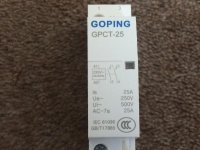
The two output terminals K1 and K2 are capable of switching AC or DC upto 240volts at a maximum of 0.5 amps. Therefore a relay or contactor is needed to carry the sort of currents needed to switch on a secondary machine. My preference would be to suggest you use a contactor. these a rugged and very cheap also from Ali Express. look for DIN rail contactors which come in 16, 20, 25 40 amp flavours all in a the same size din rail housing and much the same price. I'd use a 25amp one routinely unless I knew I needed anything bigger. a bit of margin is always a good design feature. They start at about £4 post free.
Here is a typical one
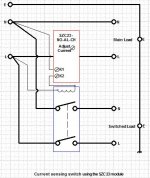
Finally here is the circuit diagram to follow to build your own current sensing switch.
Not much to say about it really. The red box is the sensor and blue box the contactor. The contactor will have a diagram printed on it to show the connections - just match it to my diagram.
I hope this is useful.
Bob
Also a stand alone box to do the job can be handy too.
In another thread there was mention of such a failure and I came across a module available from variety of suppliers and for wide range of prices.
My eye settled on one via Ali-Express for little money £7.63 (actual prices do go up and down with various currencies) Todays price is £7.48
The part number to search for is SZC 23-NO-AL-CH
I thought I'd buy one to play with.
The body is about 45mm square x 25 thick plus a couple mounting lugs which can be cut off if they get in the way.
On the top are a pair of leds red for on and green for off, a sensitivity adjustment and a pair of isolated terminals that go low resistance of about 4 ohms when the current threshold is exceeded.
The current sensing is performed by passing a wire through the hole in the body which is about 8.5mm diameter.
Do realise that just one wire from the load passes through here NOT the whole cable because in a complete live and neutral cable to any device there is no net current flowing. -think about it!
Here is a photo of my test set up.
Im using my 50 watt thermostatic soldering iron as a test load.
The power is coming in from the left on the white cable and the clip on ammeter is showing 0.25 amp.
I have the sensor module in the middle and you can just see/imagine the red led is on. The module is driving a relay which conveniently also has a red led built in. On the right is the weller iron itself.
As the iron gets to the right temperature, it switches off the heater.
In the next photo we see the heater is off.
We see that the current has dropped to 0.16 amps, the sensor green led is on showing the current is below threshold and less obviously the led on the relay is in fact not illuminated.
A couple of points from this.
1) the switching threshold can easily be set to differentiate between 0.16amps and 0.25 amps which is a strong feature.
2) Not all mains powered devices drop their current to zero when switched off. This does not mean they are consuming any/much power when off (for reasons I won't explain here - see me afterwards !) but it does men that a sensing module must be able to be adjusted to correctly indicate the difference between on and off to give us the effect we want.
I did some other experiments to see how low I could set the threshold. The module label says 0.2 amps and much below this it does not work reliably. The maximum current it suggests is 30 amps - more than enough for most requirements.
All in all this is a good value module that seems stable and readily adjusted. It gets my vote!
The two output terminals K1 and K2 are capable of switching AC or DC upto 240volts at a maximum of 0.5 amps. Therefore a relay or contactor is needed to carry the sort of currents needed to switch on a secondary machine. My preference would be to suggest you use a contactor. these a rugged and very cheap also from Ali Express. look for DIN rail contactors which come in 16, 20, 25 40 amp flavours all in a the same size din rail housing and much the same price. I'd use a 25amp one routinely unless I knew I needed anything bigger. a bit of margin is always a good design feature. They start at about £4 post free.
Here is a typical one
Finally here is the circuit diagram to follow to build your own current sensing switch.
Not much to say about it really. The red box is the sensor and blue box the contactor. The contactor will have a diagram printed on it to show the connections - just match it to my diagram.
I hope this is useful.
Bob


