• Hi all and welcome to TheWoodHaven2 brought into the 21st Century, kicking and screaming! We all have Alasdair to thank for the vast bulk of the heavy lifting to get us here, no more so than me because he's taken away a huge burden of responsibility from my shoulders and brought us to this new shiny home, with all your previous content (hopefully) still intact! Please peruse and feed back. There is still plenty to do, like changing the colour scheme, adding the banner graphic, tweaking the odd setting here and there so I have added a new thread in the 'Technical Issues, Bugs and Feature Requests' forum for you to add any issues you find, any missing settings or just anything you'd like to see added/removed from the feature set that Xenforo offers. We will get to everything over the coming weeks so please be patient, but add anything at all to the thread I mention above and we promise to get to them over the next few days/weeks/months. In the meantime, please enjoy!

Cutting ply with a flush trimming bit.

Mike G

Petrified Pine
Joined
Jul 30, 2014
Messages
12,481
Reaction score
3,033
Location
Suffolk
Name
Mike
I've always used straight-fluted cutters (mainly because all my cutters are somewhere between old and very old). I've heard of these new-fangled up-cutting and down-cutting spiral cutters, but never seen one, and never tried one. So, what is going to give me the neatest cut in ply? I can organise to rout from the show side, or the hidden side.
 
I personally only ever use the straight cutters because I get good results from them and I follow good practice in regards to grain direction (difficult on plywood :lol:), but spiral up, down or combination compression cutting bits do get a lot of praise for their clean cutting, particularly with awkward grain or cutting completely against the grain, which would also translate into cutting plywood.

I think it depends on how you do your flush trimming too, with a handheld router you can use both up-cut and down-cut because the weight of the router itself will keep it on the workpiece, but I have seen examples on router tables where a down-cutting bit in combination with quite a heavy cut has caused the workpiece to lift off the table resulting in severe kickback as the stability is lost during the feeding. If you're using a table I would recommend sticking to the up-cut bits for that reason and keep in mind that the top surface will be the cleanest. In a handheld router, up-cut bits result in the bottom surface being the cleanest and down-cut bits result in the top surface being the cleanest.
 
Same as Phil:

I needed to clean up some templated stringers in mahogany and teak for a garden bench seat repair. The Wealden one I bought produced a beautiful finish (shame it's covered by the seat slats!).

They do a really posh one with upcut and downcut edges interleaved, but I got the ordinary one and it's really good. It's 'downcut', pushing the chips towards the end bearing (cuts up/out of a router table).

Given it's ply I doubt you need a lot of thickness, but if you did, I think the bottom bearing will come off with the aid of a 2mm Allen key, so you can take multiple bites, but in my experience, even with careful setup it's hard not to leave a line between the passes.

Not a good picture, but taken with my tablet over the breakfast table (I think I got away with it but the flash upset her!).
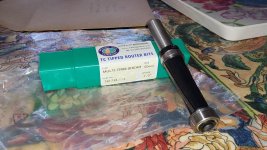
20220718_080255.jpg

PS: I hear what Trevanion says about downcut knives, but you'd have to be taking a really heavy pass to have any appreciable lifting effect, unless you were trench cutting with an unguided spiral bit. I have some of those but they're small and I haven't used them yet so can't comment. In the case of the job I bought it for, I didn't bother about grain direction but just followed the template and it was fine - I put this down to the slicing action of the spiral.

All that said, obviously there's no fence anywhere near (just a lead-on pin), so it does chuck dust around magnificently. Various people (including Rob S. (Woodbloke) I think) have made extraction hoods for this sort of task, which rap around most of the cutter and let you attach a vacuum hose. With hindsight, I think it's a really good idea!
 
I haven’t tried the spiral cutters but I do regularly cut and edge plane veneered block board before lipping.
I frequently use some recycled worktop cutters previously used by my son until the edges are dull, after a trip to the saw doctors they are used with a 30mm guide bush and grooved template. When the edge gets blunt you simply use the next part of the cutter by plunging to a different depth. I always cut the board about 2 mm oversize ant just trim with the router.
Block board edges are not nice to plane by hand so I use the spindle moulder with a TCT block as a horizontal planer with a 1 mm step between the fences. I see no reason why this method shouldn’t be used with a router table.
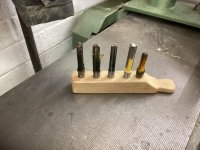
Speaking of elderly cutters, mine have been waiting so long now that the saw doctors protective coating is peeling off!DD710E1B-1159-46FD-B995-11818D6613A8.jpeg
 
The proposed use is in a hand-held router, working on large workpieces. I mentioned I am planning to build a small caravan.....well, that's the task I'm planning for at the moment. Cutting out the overall shape and then window and door openings using a template is the plan. Most of the ply will be thin, but there will also be some trimming of cedar strips once they've been glued up, which will be used to form the outside walls.
 
I would have thought a compression router cutter is best to use on ply as it will give a clean cut on each face whereas a down or up cut will only be clean on one of the faces?
 
Mike G":1x6rx8je said:
The proposed use is in a hand-held router, working on large workpieces. I mentioned I am planning to build a small caravan.....well, that's the task I'm planning for at the moment. Cutting out the overall shape and then window and door openings using a template is the plan. Most of the ply will be thin, but there will also be some trimming of cedar strips once they've been glued up, which will be used to form the outside walls.
Sounds interesting Mike, my ex brother-in-law once built a Dutch designed yacht in T & G Cedar, it involved a lot of a two-part mix varnish, sorry can’t remember the make. Ian
 
Before I fell ill, I started switching to compression bits for trimming as they give a clean edge on both sides with no tear out or chipping so far. Perfect for edge lipping and preventing telegraphing when adding a veneer.
 
Blackswanwood":3pfrfa61 said:
I would have thought a compression router cutter is best to use on ply as it will give a clean cut on each face whereas a down or up cut will only be clean on one of the faces?

I've never heard the term before. What is a "compression" cutter?
 
It's a down-cut spiral cutter on the top half, and an up-cut spiral on the bottom. As long as you set the height properly for the thickness of your workpiece, both surfaces get 'inward' cuts on them and both end up as clean as possible.

Example here - you can see the spiral flutes change direction near the tip.
 
I've never used a compression cutter, but I've used a sprial down cutter to hand rout a groove in the surface of a table to take a 3mm and 6mm string. As I sometimes suffer from deep pockets and short arms I tried straight cutters first in a test piece but wasn't enthused by the crispness of the cut, even with newish cutters. Having reached deeper into my pockets, a new Wealden spiral down cutter was the DB's and for work where a clean cut is essential, I wouldn't use anything else.
 
Back
Top