• Hi all and welcome to TheWoodHaven2 brought into the 21st Century, kicking and screaming! We all have Alasdair to thank for the vast bulk of the heavy lifting to get us here, no more so than me because he's taken away a huge burden of responsibility from my shoulders and brought us to this new shiny home, with all your previous content (hopefully) still intact! Please peruse and feed back. There is still plenty to do, like changing the colour scheme, adding the banner graphic, tweaking the odd setting here and there so I have added a new thread in the 'Technical Issues, Bugs and Feature Requests' forum for you to add any issues you find, any missing settings or just anything you'd like to see added/removed from the feature set that Xenforo offers. We will get to everything over the coming weeks so please be patient, but add anything at all to the thread I mention above and we promise to get to them over the next few days/weeks/months. In the meantime, please enjoy!

Dans Shed - Large(ish) workshop construction...

Dan0741

Sapling
Joined
Aug 9, 2015
Messages
392
Reaction score
0
Location
nn6
Hi all!

I have finally got around to posting some details of the shed I have been thinking about for the last few years and have been doing the preparatory work for the lasts few months. I am by no means an expert in any sense as regards any aspect of this build. Im finding out as I go. I have spent a long time thinking about it, researching it online and taking advice. I have already made mistakes! I am happy to receive any type of feedback as the learning and experience of others has already proved invaluable. I will post questions and quandaries online as part of this as the collective experience available on this forum is very beneficial to me as I go. I am currently at slab stage (cant change 4 cubed meters of reinforced concrete!) but will post the steps that got me there in order to demonstrate the steps I took. I have tried to catch it all in photos. As I say - im a beginner at this, I am committed to a fairly heavy workload with my day job so progress may be slow and am happy to have any feedback you may have so here goes...

Dan
 
Hi Dan

We love pictures as you will know from other threads.

Have you checked out Mike G's shed build 'How To'? You will find everything you need to know in there, pretty much! ;)

Cheers
Mark
 
....so it started life as a 8x18 shed from a local supplier on slabs.....but as always seems to be the case with me I wanted something a bit better than that and thought I could build something better, so I held of purchase and looked at having the shed built (by them) on a concrete raft I could build giving a sturdier base that I could use as a finished floor. Then I managed to get my hands on some excess insulation sheets from work, that I would fit to keep warm, only trouble was the shed I wanted was built with framing on 400 centers with timber 50mm square, the insulation was 100-50mm deep (assorted). Hmmmmm. Then I started reading about timber framing and airgaps and osb... and it sounded like 4x2 was probably what was needed as a minimum.

I live next to farm land and on a slope, much of the water that falls on the fields drains towards the house, only ever causes a puddle on the patio in freak weather, but its damp none the less. I needed a way to drain the water away from the shed, and also deal with water that fell on the roof. This got me thinking about rainwater harvesting and water for my newly built raised beds, water being the price it is these days, and some moanin from the oracle.

I have always been interested in woodwork, from many years as a youngster in a freezing workshop in winter with father building boats furniture and god knows what else. The shed gave me an idea that I could torture my son (five) with the same experience that will prove invaluable later in life.

So it seemed that I needed to build my own shed (I call it that because it then doesn't ring alarm bells with the oracle) who still has visions of a posh garden shed with a rake and mower inside!

The last thing was that I needed somewhere to rest my eyes (not sleep you understand) but when I am on nights the house is a noisy place and would be helpful if I can get some rest away from the chaos that my house degenerates to when I am trying to (rest my eyes).

Bringing me on neatly to planning... I originally planned to build within 1 meter of the boundary and accept the 2.5 meter restriction, thus to minimise the space used by shed. However the day the digger came I chickened out and came away from boundary 2.2 meters (2m + eaves) to allow me the 4m total height restriction. Glad I did.

I only ruminate on all this so as to give some indication that this build is most of all an evolution. I accept that this may cause me issues at some point, but it seems to have worked so far, I get to a problem and ruminate for a week or so, read a few forums and chat to others and come up with a solution that works for me. The slab height is an example of the mistakes this approach can cause, more of that later...

BTW - im a bit of a biff with technology so may get things wrong as I go on this forum - pls point me right if this occurs, I understand there is quite an etiquette these days!
 
By golly ive done it I think! Here's the first photo, I started with the fact that I would have had a huge amount of earth to move, 50 tonnes in all! So on that basis, and because im getting old I decided to build some raised beds, (to fill with earth# already benefitting - eating beans and other veg daily. Other important point to mention is that access to the rear of my house if extremely confined 720mm wide! So anything moving etc is hard work #wheelbarrow req).

I bought 35 sleepers and started laying out on the patio, this I found heavy work on my own, but all sorted in the end.


I layed up three beds the same and filled up with about half of the soil...


The garden is on a slight slope so moving soil hardcore etc is a real chore. The shed base is pegged out to the right of the beds.
 
I then managed to get a digger in through a gap in the fence and we started digging the hole, I went with a shed base of 22x11. This was about as big as I could go to get the requisite space around the shed that I thought I would need. I went with the fact that the base would end up being about 400 deep - hardcore insulation, dpm and reinforced slab. On the basis that I wanted the overall roof height to be as low as I could, I decided to dig down to achieve this. On reflection this was a mistake, but I was still harbouring thoughts of the 2.5m limit and trying to get closer than 2m to boundary, anyhoo, it will look better from the front without a massive step up. I will have to grade the area around now that is all.


And more digging... All the spoil I couldn't get in the raised beds went in a trailer supplied by a fine local farmer!


We ended up with a relatively square and level hole...


Then came 6 tonnes of scalpings and a petrol whacker plate that seemed to have a mind of its own!!


In this last photo you can see the 8 tonnes of gravel sand and pipe bedding for the drainage - more of that to come...
 
Well done Dan, both on the ground works so far and getting to grips with the forum.

Good idea on using some of the excess soil in those raised beds.
 
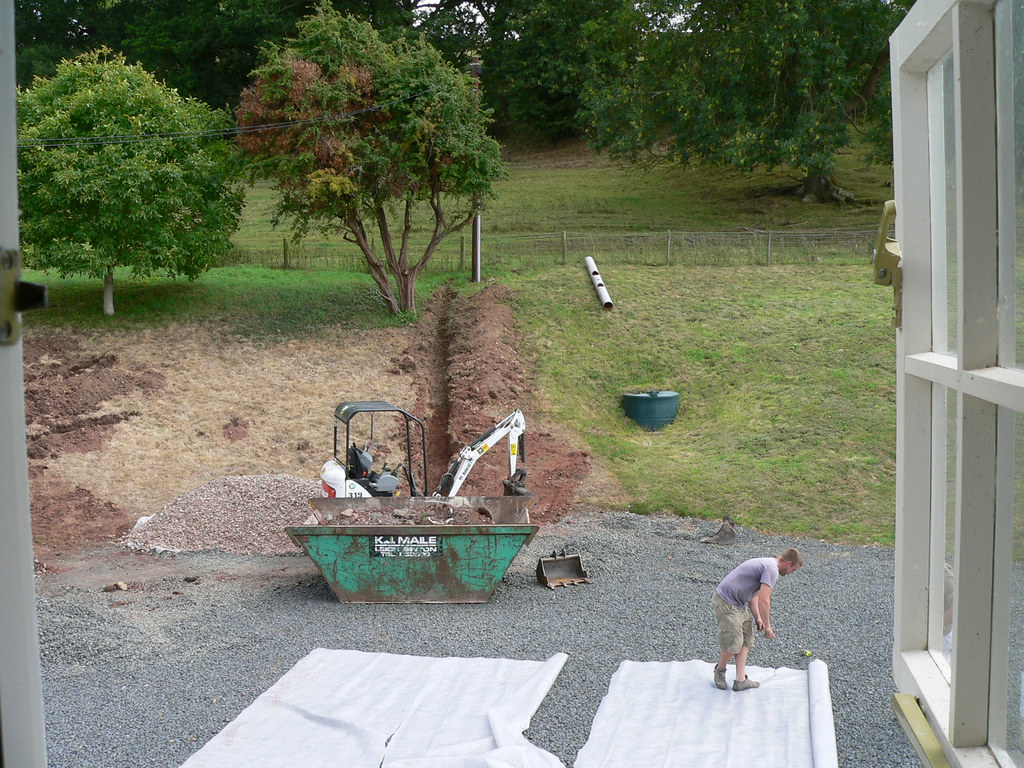
So - Drainage - where we live the back garden is backed onto basically by fields, the slope that extends up our garden also extends beyond the fence line for about a mile. In the winter when it rains there is a considerable amount of water about and although it doesn't seem to run off on the surface, I think it seems to traverse along strata not too far from the surface. It doesn't help that next door have an old large garden barn that doesn't have a gutter that pours into the fence line between her property and mine. I was also aware that there was going to be water poring off the roof of my new building that I needed to get rid of. On this basis I decided to put some drainage in. Effectively two soakaways, one near to the new shed and another nearer to the house to catch anything that the first one doesn't, or that overflows from the first. I used soakaway crates never used them before, and they are very straightforward. So we dug two holes 2.5 meters deep and long enough for the crates. I put 4 crates in the main soakaway and then two in the second. I dug a trench about 12 inches wide and 3 feet deep.


As you can see at about 2 meters deep we hit grey sand, and it really is like beach sand and hasn't seen the light of day for millennia!

 
The soakaway crates were easy to fit together and wrap - like big xmas presents! And were placed in the holes basically surrounded by 100mm of gravel in each direction, up down and both sides. Because the soil where we are has some clay in it I have doubled up on the membrane in some places and also put the perforated pipe in a membrane sock.

Wrapping soakaway...


And then placed in hole... Quite big when you have 4 fixed together, luckily I didn't have any observers!


Then I poured gravel all around so as to leave the top of the soakaway 600mm below finished surface level. I put an extra sheet of membrane over the top to act as an umbrella due to the very small sediment size we have.

All connected up with perforated membrane pipe 80mm dia


The pipe that you can see leaving this soakaway is still exposed, I intend to run this around the slab to deal with any water that reached the slab either across the surface or from the shed itself. This will be the uphill side and should catch anything that could present a moisture threat from the ground. Will be set in about 12 inches of gravel all around the slab.

This is the smaller of the two - the "safety net" just wrapped in slightly different membrane..


I have installed an overflow from the smaller one towards the house drainage, should it be needed I will connect it up, but I will be very surprised if that is so. I only did it is with the trench dug it made sense to do all at once.
 
TrimTheKing":jity6a5a said:
Hi Dan

We love pictures as you will know from other threads.

Have you checked out Mike G's shed build 'How To'? You will find everything you need to know in there, pretty much! ;)

Cheers
Mark

Yup - Mike is the cause of this post..! I thought having learnt so much it was worth repaying for others interest. Mike, I have added myself to the back of the queue of people who owe you a beer!

Dan
 
RogerS":rt9nhai6 said:
Excellent update thanks, Dan. Great pictures. Friendly local farmers are a Godsend.


I couldn't be without mine - I owe him a princes ransom in favours. A true Gentleman.

Dan
 
9fingers":1koce16i said:
Good to see proper preparation of the site and consideration of special needs such as the field drainage.

Great start to the project.!


Bob


I asked a commercial drainage professional mate of mine to give me his view on what I have done - he said " well its belt and braces!" I take it that he thinks I wont be getting wet! From the bottom up anyway!

Dan
 
I filled the trench with gravel and wrapped the whole lot in membrane.


On top of the drainage by about 500mm and to the left and right of it I have dropped ducting in for any services once finished...I don't really know what I will want but I have dropped two ducts in so home that will be enough...


...and at the shed end have installed two toilet waste pipes to pass the ducting through so I don't have any holes in the walls or outer shell.


I have put warning tape in at the required depth...


Then graded over the top, I have since seeded and its the best part of the lawn!


The Bedouin tent in the background is so I can arrange the shuttering in the rain! I picked the only two days in the month that it rained...
 
That is some of the neatest digging and groundworks I have ever seen! Congratulations. The soak-away is exemplary, as are the drains from what I can see. This looks like a really great start to a project. I'm looking forward to watching this grow..........and of course, if you want any help (design-wise), just shout.
 
You're lucky with your soil, Dan. If it was clay (like ours) then there is only one sure way of getting rid of excess water. An open ditch.
 
And this all brings us to the slab...

So first the insulation I got free from work - horrible fibreglass cover to it! All placed in sections and leaving a 200mm gap around the side so that the deeper concrete formed a stronger section similar to a ring beam...


and then setting the rebar (A142) - haven't put the DPM in yet but just sizing the rebar so I can ensure 50mm coverage on all exposed steel work..


Then the big day. I paid a bloke (concrete contractor) to help me as I was conscious that concrete is a fickle mistress and generally a one hit deal. He did a super job as you will hear..

First we had to arrange a pump as the alternative was 100 wheelbarrow runs..


Which then went straight over the roof...


And here was the first lesson. As you can see, the pipe was rested on boards at the joints. This proved invaluable - we had 4 blockages before we got a barrowful of the stuff out! It was torture, the sun was redders, I had had 3 hours sleep off a nightshift and the pump bloke blamed the mix, the concrete bloke blamed the pump and my contractor blamed both. In the end we had to disconnect each time, at the right pump junction, and let it spew forth 3 wheelbarrow loads of concrete slurry all over the lawn and boards... And as I said - this occurred x4!!!

In the end the bloke I had hired sorted it all out with my help and we got the concrete flowing...


....and in the end a slab I am proud of. Skip floated - I didn't want anything power floated as it will be the finished floor and for me will be more practical having the non slip aspect.


One mistake though!


Well not really a mistake - I thought I was being really smart, and its actually Mike G's fault. I purchased at great expense 20 10 mm stainless J bolts and I set them in the concrete so that I could bolt the sole plate to it. Really neat and smart.... Well no actually because I have; since reading posts by those much more experienced than me decided to put a very short dwarf wall around the slab that I will build the wooden frame upon - only because it is a much better idea than I was going to use....hey ho - its all learning... :D
 
RogerS":3u2elfyw said:
You're lucky with your soil, Dan. If it was clay (like ours) then there is only one sure way of getting rid of excess water. An open ditch.


Its got some clay in it! Hoping its good enough -winter will let me know!
 
Mike G":2m7kbr9w said:
That is some of the neatest digging and groundworks I have ever seen! Congratulations. The soak-away is exemplary, as are the drains from what I can see. This looks like a really great start to a project. I'm looking forward to watching this grow..........and of course, if you want any help (design-wise), just shout.

Mike - I have a list that already has 14 questions on it, was going to do them all at once rather that a question a day for the next fortnight! Does that suit you Sir?

Dan
 
Don't waste those cast-in bolts. Depending on their location you should be able to use them with straps to hold the plate onto the plinth wall.
 
Dan0741":2khfgroj said:
Mike G":2khfgroj said:
That is some of the neatest digging and groundworks I have ever seen! Congratulations. The soak-away is exemplary, as are the drains from what I can see. This looks like a really great start to a project. I'm looking forward to watching this grow..........and of course, if you want any help (design-wise), just shout.

Mike - I have a list that already has 14 questions on it, was going to do them all at once rather that a question a day for the next fortnight! Does that suit you Sir?

Dan

It doesn't matter how you do them, Dan, the answers will only come when I get a moment. I'm a bit busy these days. :) I'll do my best. Ask them in the order that you need the answers, and if there is anything urgent, send me a PM reminder.
Cheers

Mike
 
Mike G":1x636kfg said:
Dan0741":1x636kfg said:
Mike G":1x636kfg said:
That is some of the neatest digging and groundworks I have ever seen! Congratulations. The soak-away is exemplary, as are the drains from what I can see. This looks like a really great start to a project. I'm looking forward to watching this grow..........and of course, if you want any help (design-wise), just shout.

Mike - I have a list that already has 14 questions on it, was going to do them all at once rather that a question a day for the next fortnight! Does that suit you Sir?

Dan

It doesn't matter how you do them, Dan, the answers will only come when I get a moment. I'm a bit busy these days. :) I'll do my best. Ask them in the order that you need the answers, and if there is anything urgent, send me a PM reminder.

Cheers

Mike

Will do, Thank you.

Dan
 
Dan0741":b261z0rk said:
RogerS":b261z0rk said:
You're lucky with your soil, Dan. If it was clay (like ours) then there is only one sure way of getting rid of excess water. An open ditch.


Its got some clay in it! Hoping its good enough -winter will let me know!

Well, fingers crossed for you. I am not a fan of French drains because in my experience, sure the membrane stops soil finings entering the pipework or gravel but you end up with the finings sitting on top of the membrane thus creating a pretty good impermeable membrane! Then later on, the stone/gravel gets filled up/silted up and so the French drain stops working.

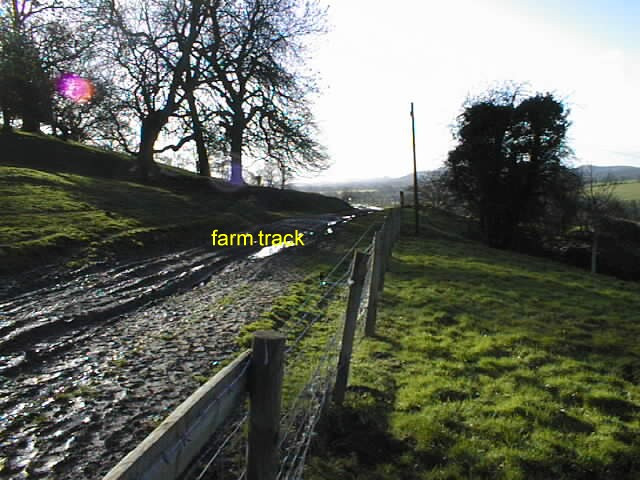
Like you we have runoff onto our property from this farm track. And this farm track gets runoff from the hill behind and so when the monsoons came we soon knew all about it.


So while I was having some hard landscaping done I got a very large 15" or so diameter pipe laid which feeds into a proper 6" yellow land drain pipe that takes the water away to the stream further down the hill. Along the fence line we have an open ditch that feeds the large pipe.The guy doing the work recommended putting down that soppy membrane and even put some over the end of the pipe at the ditch.

A few months later, we had the monsoon to end all monsoons and I went outside to find the back awash with 3-6" of water, a cascade coming down the bank, mole holes spouting water 3 ft in the air. Why? That soppy membrane was stopping the water flow. I ripped it all away, there was an almighty sound of rushing water as the ditch emptied itself in seconds.

Sorry..slight hijack there !
 
Don't think that's a hijack! .....But it is a boggy track!

Well I hope it all works! Its taken me ages, and cost a fortune! I don't think the scale of my water problem is the same as yours and I am no expert so I followed the advice I was could get my hands on. Ultimately the pipe and membrane down the middle is polish, the amount of water I get should percolate effectively though the gravel alone - if I am honest the bit I am unsure about is if the soakaways will disperse the quantity of water that I will have, its a fine balancing act between excessive drainage and cost and a dryish slab. My solution is for a bit of damp ground that I didn't want to affect the slab and yours seems an agricultural type format. As I said in my post, the water only ever pools on the patio during freak weather events once or twice a year so I thought that what I have done is way in excess of what was needed. Even in winter the lawn in that area didn't pool it just became a bit soft.

My water plan for the shed roof is still in development. Current iteration is that I will have roof drainage into a large galvanised trough - 2x2x10 feet which I will use to irrigate the veg beds. I want something I can dip a watering can into. This will hold quite a quantity and will have an overflow into the soakaway. I did think of some 1000 litre IBC behind the shed and a pump system but im not currently sure of the supply/demand aspects of the water system. Ie will I get enough water to make this viable in the summer months (today not being a typical example!) Basically I just want to use the water I get off the roof 7x4m usefully and avoid costs that are only ever going to increase... any suggestions gratefully received.

Because of the slope, if the drainage doesn't work as I said I have the option already dug in to feed to mains drainage, but obviously that becomes complicated....another option was tip my son out every weekend over the winter with a 50m hosepipe and syphon instructions!
 
MCLUMA":1nze8rvp said:
Its looking good,

what float did you use on the concrete?

Skip float- so I was told - I had a bloke in to manage the process as a pump was involved - he told me it would be perfect save a line down the middle - it isn't that good but plenty good enough for my needs...

A tense day!

Dan
 
pouring concrete is the most stressful thing in your life, even getting children, - being there at birth - is that stressful

however, having said that, i now no longer use ready mixed concrete trucks, as these truck drivers are not worth living.

I use now these people that mix on site, with the big trucks, not the ones they shovel everything in the mixer on the back but these big 8 wheelers. they wait while you work, and get a super finish, no rush, at all, and they do not mind waiting for the next wheel barrow to arrive. you only pay what you use, not like with these big companies, where they just dump on your drive anything that has not been used.

as you understand from above, i had my share of experience of the big companies

the worst one was when on a 6 truck concrete job, they forgot to send the last 2 trucks, they had already gone home at 3 o clock on friday, - You can understand the frustration

I have in the coming weeks another garage floor to do 8 by 5 and was thinking of hiring a powerfloat to get a super smooth finish
 
I'm sure if you had advice you are going about it the right way.
I used to know all the formulas for run-offs, soakaways etc but have long forgotten them.
(1" of rain over the flood plain or something like that??)
French drains work well if properly designed, constructed and built in the correct place though may need some maintenance in the future?
Time will tell [emoji3]

Watching the WIP with interest.

Rod
 
OK, so have been thinking re the build, and am after any pointers or guidance that anyone may have. I have an exam I am studying for in Oct so there will be a pause between now and then whilst I do the revision I should have done already! But it does provide thinking time..

The plinth – I intend to use hollow concrete blocks - the ones that are 150mm wide. There will only be one course of these and I will screw some nuts on the J bolts already set in the slab to give them some grip and pour concrete into the holes in the blocks so that the J bolts fix the plinth to the slab. I will then set more J bolts in the concrete in the holes in the top of the plinth to fix the sole plate to with a DPM in between - then fix the frame to the sole plate.

Any observations/errors with this?

The wall construction… I want to build a timber frame with 4x2, I will make this in several smaller parts so I can handle them on my own, and fix together. I have (obtained free) some insulation celotex (or similar) insulation panels that I will be inserting between the studs. I intend to put OSB on the outside of this for the sheathing and then building paper, battens (and hence 25mm air gap) and then shiplap or TG on the battens. On the inside I intend to use reclaimed wooden boards (similar to but not pallet wood) to line the inside of the stud wall, because this will look better and I intend to mix up the types so the overall effect will be good I think. This also means if I want to add anything inside or change it I can, also fit extra wires etc I can do that without it being too much of a chore, I can remove a board and refit.
Questions - Is this a sensible wall construction - I intend to use all year round and heat this in the winter with a stove. OSB – does it need to be OSB 3 (will be covered by building paper) and of a particular thickness? Cost is an issue but also weight, I will be doing the job on my own so installing the thicker sheets will be harder work. I note some constructions have OSB on the inside – I don’t want this for the reasons given above but accept it is structurally required in the overall makeup.

Last wall framing question – I intend to put a 5/6 foot wide door in one end. How big will my header need to be – will x2 4x2 with a ply insert do it or will it need to be bigger. I intend to put a (fairly) hefty roof on it made of 6x2 rafters, but will get to the roof design next week!
Any observations good/bad gratefully received Gents.

Cheers

Dan
 
Dan,

concrete blocks will always look like concrete blocks. You'll improve your overall look many-fold by using bricks instead. There is nothing difficult about laying bricks, and you'll be pleased you did it whereas for ever after you'll be looking at those blocks..........

Now, the walls. I did a thread many years ago on some other forum somewhere called Build a Shed Mike's Way, or something like that. That has a reasonable drawing of the wall arrangements, and is well worth a look. Otherwise, have a look at my workshop thread here. It is absolutely essential to have your OSB on the correct side of the insulation.......the inside. Not the outside. The thing is, OSB (like ply, but more so) contains a huge amount of glue, and is virtually vapour-impermeable. It would be like putting a vapour barrier around the outside of a building, rather than inside. The warmed air inside the building holds more water vapour than the cold air outside, which will condense on the (cold) inside face of the OSB. You will get damp and mould, and eventually even rot, within your wall structure if you put the OSB where you propose. The OSB can be 10mm. You might get away with 6mm if you do studs at 400 centres.

Your lintel should be doubled up 6x2s if spanning 5/6 feet.

A further point about your frame design. On a shed like this you can have studs at 600 centres. However, you must double-up around openings. You then have a choice of either placing your rafters directly over your stud locations, or doubling up the top plate and being free to put your rafters anywhere.

Please reconsider your wall design. It's a really nice idea to line the inside with timber as you propose, but you really shouldn't line the outside with OSB. An alternative is to build in some diagonal bracing to all your walls, and omit the OSB altogether. There is quite a lot more work in this though.

Finally, I never like to see anything piercing the DPC. It is easy to run straps up the plinth and over the plate, or perhaps align them with the studs and fix them to the face of those. It is poor practice to just bolt down through the DPC. Strapping is actually far less important than people imagine. My previous workshop was about 6 metres by 4 metres, and when I moved out I discovered that I had overlooked fixing the straps to the wall (they were cast into the concrete base). The building was just sitting there under the weight of gravity.....and hadn't moved a millimetre in 20 years.
 
Mike G":30i6ff4y said:
Dan,

concrete blocks will always look like concrete blocks. You'll improve your overall look many-fold by using bricks instead. There is nothing difficult about laying bricks, and you'll be pleased you did it whereas for ever after you'll be looking at those blocks..........

Now, the walls. I did a thread many years ago on some other forum somewhere called Build a Shed Mike's Way, or something like that. That has a reasonable drawing of the wall arrangements, and is well worth a look. Otherwise, have a look at my workshop thread here. It is absolutely essential to have your OSB on the correct side of the insulation.......the inside. Not the outside. The thing is, OSB (like ply, but more so) contains a huge amount of glue, and is virtually vapour-impermeable. It would be like putting a vapour barrier around the outside of a building, rather than inside. The warmed air inside the building holds more water vapour than the cold air outside, which will condense on the (cold) inside face of the OSB. You will get damp and mould, and eventually even rot, within your wall structure if you put the OSB where you propose. The OSB can be 10mm. You might get away with 6mm if you do studs at 400 centres.

Your lintel should be doubled up 6x2s if spanning 5/6 feet.

A further point about your frame design. On a shed like this you can have studs at 600 centres. However, you must double-up around openings. You then have a choice of either placing your rafters directly over your stud locations, or doubling up the top plate and being free to put your rafters anywhere.

Please reconsider your wall design. It's a really nice idea to line the inside with timber as you propose, but you really shouldn't line the outside with OSB. An alternative is to build in some diagonal bracing to all your walls, and omit the OSB altogether. There is quite a lot more work in this though.

Finally, I never like to see anything piercing the DPC. It is easy to run straps up the plinth and over the plate, or perhaps align them with the studs and fix them to the face of those. It is poor practice to just bolt down through the DPC. Strapping is actually far less important than people imagine. My previous workshop was about 6 metres by 4 metres, and when I moved out I discovered that I had overlooked fixing the straps to the wall (they were cast into the concrete base). The building was just sitting there under the weight of gravity.....and hadn't moved a millimetre in 20 years.

Thank you Mike – very grateful for the guidance.

Plinth - I’m still undecided about the blocks, but the plan was going to be to run battens down the full face of the wall including the blocks so they wouldn’t be seen, I’ve never laid a single brick and didn’t want to take the risk, after all it needs to be level and square to kick off the build. It looks like quite a skill! I understand the risks here that the plinth is designed to keep the wood away from the ground but wanted a single material on the wall, was toying with cedar and couldn’t really find any bricks that would work with the cedar silver colour once weathered. I’ve looked everywhere!

Walls – Understood re the OSB. I’m just keen to stick with the plank interior as whist very practical, and aesthetically pleasing it will be easy. I want to leave the flexibility to change things without a big issue and this seemed a way of doing it. Also should we move and the new owner wants to do something different with the space it will be easier. I have reviewed both threads now and see the OSB issue. Diagonal bracing option – if I applied extra timber to the outside of the structure, at a 45 degree angle would this resolve the structural issue caused by omitting the OSB? I could put them on 1000mm centres at 45 degrees across the whole wall. If yes, what size timber would this need to be, not huge I imagine as its only doing the work that the OSB would be doing. Structural issues aside – does the OSB provide any other function that I would be losing? I’m just conscious that in my plan my OSB replacement has considerable gaps. I understand I would have to makeup fillets to place on the studs to make it up to the same profile as the braces so as to enable install of the battens. I would put the building paper over the bracing and under the battens before putting the T/G on?

Ultimately I would like to retain the plank idea, but not at the risk of condensation forming in the wall structure.

Going to do studs at 600 centres as that is the size insulation I have. Will double up the studs in places, I’m framing in sections anyway – and put full window/door framing in – cripple/trimmer/header etc. Will double up the top plate.

DPC – I read extensively on this – I worried about piercing the DPC and it seemed silly to pierce if avoidable but some online seem to think the DPC forms a watertight seal around the piercing – not a risk I want to take if the alternative is as easy anyway.

Thank you for taking the time to point me in the right direction on these issues Mike,

Cheers

Dan
 
Dan

I recently built a workshop very much following Mike's way of doing it. So if you don't mind a few comments / observations on your current thinking. Unfortunately due to a technical issue my thread charting the early phases of construction was lost, but I have dropped a few pictures in below to try and illustrate.

Plinth
With respect to Mike, like so many things I guess, it is fine to say laying bricks is easy when you have done it a lot and know what you are doing. I used blocks for my workshop and like you it was my first effort at laying anything, it was not at all easy for me, anything but frankly. Getting mortar the right consistency every time, keeping it level and keeping it straight were all challenges. I know, I know, run string lines, but when it's new it still isn't easy. Now I have never been a natural DIYer, maybe you have a better track record. My build was on a restricted site and two of the walls were part below ground (sloping site), your site looks more accessible. My workshop is also fairly tucked away so aesthetic considerations were not key, your workshop looks like it will be more in the open. Finally, I understand blocks are heavier than bricks, so to some extent can be considered harder to lay in one respect. All of these differences may mean you could go for brick, but I would say that my experience is not that the process of laying is easy.

The bricks ontop of planks up against the wall was trying to hold it straight up, but it didn't work, I really winced when the fram went on this section of wall, but it did at least stay up.

Straps of DPC
Brilliant idea, worked perfectly on my workshop. What I did was to lay the bottom coarse of blocks on top of the straps and then fold them up and over the top of the sole plate, visible in picture above as I built walls, this is then how they are fixed.


Wall structure
Time will tell if I got anything horribly wrong, but the OSB on the inside of my walls worked well. Oh and don't forget the insect mesh at the bottom of the cladding, since starting work in my workshop I can't believe how many wasps have taken an interest in it, convinced they would be considering nesting if they cold get into the walls / roof.


But, most important of all, having spent the best part of twelve months building my workshop I now spend time in it nearly every day, well worth all the blood, sweat and tears.

All the best and good luck with the studies!

Terry.
 
Don't wish to encroach this thread too much but I'm planning a shed rebuild - but this is going to be a shed - just for storing things.
Can you use roof breather membrane for walls. I've been trying to source a small roll of the stuff (not a 100m x 1.5 that full rolls come in)
Part rolls of the roof type seem fairly common on the bay?

Rod
 
Rod":9t6jv0mn said:
Don't wish to encroach this thread too much but I'm planning a shed rebuild - but this is going to be a shed - just for storing things.
Can you use roof breather membrane for walls. I've been trying to source a small roll of the stuff (not a 100m x 1.5 that full rolls come in)
Part rolls of the roof type seem fairly common on the bay?

Rod

Rod

I used this and you can see it is clearly stated to be for roofing.

I do seem to recall looking at the manufacturer's specs though to confirm it could be used on walls. Can't believe this brand is unique.

Terry.
 
Back
Top