
-
Hi all and welcome to TheWoodHaven2 brought into the 21st Century, kicking and screaming! We all have Alasdair to thank for the vast bulk of the heavy lifting to get us here, no more so than me because he's taken away a huge burden of responsibility from my shoulders and brought us to this new shiny home, with all your previous content (hopefully) still intact! Please peruse and feed back. There is still plenty to do, like changing the colour scheme, adding the banner graphic, tweaking the odd setting here and there so I have added a new thread in the 'Technical Issues, Bugs and Feature Requests' forum for you to add any issues you find, any missing settings or just anything you'd like to see added/removed from the feature set that Xenforo offers. We will get to everything over the coming weeks so please be patient, but add anything at all to the thread I mention above and we promise to get to them over the next few days/weeks/months. In the meantime, please enjoy!
You are using an out of date browser. It may not display this or other websites correctly.
You should upgrade or use an alternative browser.
You should upgrade or use an alternative browser.
Dark wood dowel?
- Thread starter Stuart
- Start date

Or take the easy way 
https://www.toolsandtimber.co.uk/hardwo ... den-dowels
Excellent quality and fast delivery
Although I've not found 5mm anywhere.
https://www.toolsandtimber.co.uk/hardwo ... den-dowels
Excellent quality and fast delivery
Although I've not found 5mm anywhere.

Doug
Old Oak
Drill a hole in a piece of steel & tap a piece of sapele through it, cut the blank to a fraction over 5mm & it will pass through with minimal force.
I’ve done this before when just wanting short bits.
I’ve done this before when just wanting short bits.

https://www.cornwallmodelboats.co.uk/ac ... dowel.html
Their sapele is 6mm, sand it down perhaps.
They have 5mm in walnut.
Their sapele is 6mm, sand it down perhaps.
They have 5mm in walnut.
Thank you.
Would you believe I put sapele dowel into google and neither of those sites came up! I can’t find 5mm anywhere, even looked for a plug cutter but they’re all 6mm as well.
I’ve got plenty of small off cuts so I’ll have a go at making my own. Only need 20mm lengths (for breadboard ends) so what can go wrong?
Would you believe I put sapele dowel into google and neither of those sites came up! I can’t find 5mm anywhere, even looked for a plug cutter but they’re all 6mm as well.
I’ve got plenty of small off cuts so I’ll have a go at making my own. Only need 20mm lengths (for breadboard ends) so what can go wrong?

Peri
Sapling
Attachments
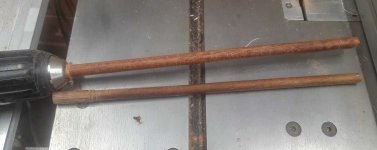
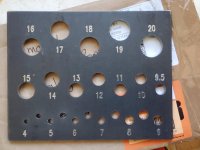
Doug
Old Oak
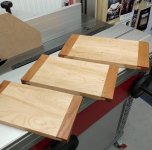
Stuart":31tbpxof said:I’ve got plenty of small off cuts so I’ll have a go at making my own. Only need 20mm lengths (for breadboard ends) so what can go wrong?
Funnily enough that’s exactly what I wanted small cherry dowels for on these small bread boards

Dr.Al
Old Oak
Another option is https://plugitwood.co.uk/collections/round-dowels
When I made the peg loom recently I needed about 8 metres of 10 mm sapele dowel and there was no way I was pushing that much through a dowel plate, so I bought some from plugitwood and it seemed very good quality (smooth finish). Lots of different woods and lots of different metric sizes.
When I made the peg loom recently I needed about 8 metres of 10 mm sapele dowel and there was no way I was pushing that much through a dowel plate, so I bought some from plugitwood and it seemed very good quality (smooth finish). Lots of different woods and lots of different metric sizes.

Pete Maddex
Old Oak
G&S timber do dowling
https://www.toolsandtimber.co.uk/hardwo ... den-dowels
I have used them my self and they are very good.
Pete
https://www.toolsandtimber.co.uk/hardwo ... den-dowels
I have used them my self and they are very good.
Pete
Commercial doweling is turned rather than riven and therefore takes no account of the grain running through it. This makes them very weak and rather fragile as most have oblique grain rather than longditudinal grain running through them. Making dowelling yourself allows you to make dowels and pegs much better suited to being used in construction of components by being significantly less liable to snap even once in-situ due to shear stesses.
@Peri, Did you make the jig on a CNC or by drilling and then stamping in the sizes. Just had an idea when I saw your plate that If on the CNC; you could first drill some 1/2 mm holes around the circumference before drilling out the main hole and get glue channels incorporated to the plate.
clogs
Sapling
look at Applebywood turnings they make all kinds...
also they sell all kinds of router n spindle moulder stuff......
they are happy to post and very helpful on the phone.....
nice people......
also they sell all kinds of router n spindle moulder stuff......
they are happy to post and very helpful on the phone.....
nice people......
Peri
Sapling
droogs":3n8q7jxs said:@Peri, Did you make the jig on a CNC or by drilling and then stamping in the sizes. Just had an idea when I saw your plate that If on the CNC; you could first drill some 1/2 mm holes around the circumference before drilling out the main hole and get glue channels incorporated to the plate.
CNC'd mate.
To be honest, I've never had the greatest of luck hammering bits of wood through them (others have though) - maybe my technique is a bit iffy, but thin dowels splinter and big dowels don't stay straight. I do mine with the 'drill' method, and that gives great results.
It's a good idea though, and wouldn't be that hard to do

EDIT: One problem - for best results I've found gradually reducing the dowel in size by making a few passes through consecutively smaller holes is the best method. If using glue channels you'd need to do the whole job in one pass, not sure how well that would go. Softwood maybe ok, hardwoods, maybe not.
Pete Maddex":3obnfxi2 said:G&S timber do dowling
https://www.toolsandtimber.co.uk/hardwo ... den-dowels
I have used them my self and they are very good.
Pete
There's an echo in here
Pete Maddex
Old Oak
Sorry I didn’t connect tools and timber with g&s timber.RogerS":3qd89e6z said:Pete Maddex":3qd89e6z said:G&S timber do dowling
https://www.toolsandtimber.co.uk/hardwo ... den-dowels
I have used them my self and they are very good.
Pete
There's an echo in here
Still two recommendations they must be good.
Pete

Woodbloke
Sequoia
Peri":25vjf5jz said:To be honest, I've never had the greatest of luck hammering bits of wood through them (others have though) - maybe my technique is a bit iffy, but thin dowels splinter and big dowels don't stay straight. I do mine with the 'drill' method, and that gives great results.
It's a good idea though, and wouldn't be that hard to do
EDIT: One problem - for best results I've found gradually reducing the dowel in size by making a few passes through consecutively smaller holes is the best method. If using glue channels you'd need to do the whole job in one pass, not sure how well that would go. Softwood maybe ok, hardwoods, maybe not.
Same here, it's a bit of an 'iffy' process and not one I do very often. The last time I had to do it in any quantity was to make a few 4mm shelf supports in very hard ebony, which seems to have a mind of it's own when going through a dowel plate. I started off with a blank of mild steel and drilled loads of holes decreasing in size by 0.1mm each time. Even so, I guess I lost half of them; bent, mangled or otherwise unusable. To prep the square blanks, I also planed the corners off in a simple jig to form a rough octagon - Rob
Pete Maddex":2be8esd0 said:Sorry I didn’t connect tools and timber with g&s timber.RogerS":2be8esd0 said:Pete Maddex":2be8esd0 said:G&S timber do dowling
https://www.toolsandtimber.co.uk/hardwo ... den-dowels
I have used them my self and they are very good.
Pete
There's an echo in here
Still two recommendations they must be good.
Pete
They certainly are and not that far away from me. Excellent selection of turning and carving tools.