• Hi all and welcome to TheWoodHaven2 brought into the 21st Century, kicking and screaming! We all have Alasdair to thank for the vast bulk of the heavy lifting to get us here, no more so than me because he's taken away a huge burden of responsibility from my shoulders and brought us to this new shiny home, with all your previous content (hopefully) still intact! Please peruse and feed back. There is still plenty to do, like changing the colour scheme, adding the banner graphic, tweaking the odd setting here and there so I have added a new thread in the 'Technical Issues, Bugs and Feature Requests' forum for you to add any issues you find, any missing settings or just anything you'd like to see added/removed from the feature set that Xenforo offers. We will get to everything over the coming weeks so please be patient, but add anything at all to the thread I mention above and we promise to get to them over the next few days/weeks/months. In the meantime, please enjoy!

Deeping / Resawing

Andy Kev.

Nordic Pine
Joined
Jan 4, 2021
Messages
716
Reaction score
58
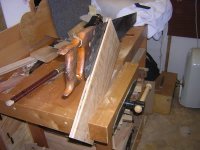
I've posted on this in the past as it is (for me at least) such a difficult thing to master. However, as ever practice helps. I'm slowly getting better, the measure of this being the amount of planing I have to do afterwards. I've just done a 2' x 6" piece of walnut and ended up with two pieces of just over 3/8" thick from an initial thickness of just under 1". They would have been thicker but I drifted a bit more at one end.

My current technique is to kick off with a normal backsaw, then, once I start hitting the brass back, switch to the Japanese thing which is rip on one side and cross cut on the other. If it goes wrong, it will be with the Jap saw. And now we come to the point: I've found that I seem to get better results with it if I use it double handed and held close-ish to the blade.

The reason for this post is to seek views on what folk think of this approach, particularly with ref to technique with the Jap saw. I'm obviously not doing too badly but is there anything I should be doing as a matter of course in order to improve results?
 
It was along time ago now and I started the cut on the table saw but I do wonder if a full sized old fashioned rip saw might be easier to keep straight than the more flexible jap saws.

Sorry about photo quality

38245684-77BA-465C-A657-2CDFAEED076C.jpeg
 
That's a very good point and I have thought about it but I have found that the close up grip on the Japanese thing to be helpful. Maybe a panel saw after starting with the back saw would work.
 
The thing with Japanese saws is they only cut with the blade in tension, which is on the pull stroke. There should be no flexing if you are pulling your arm straight back in line with the blade. I don't personally find that they wander off line, but I think some people use too much force or energy rather than just being relaxed and letting the saw do the work. It's such a different tooth pattern and position that comparisons are difficult, but personally I would not be switching between saws.

Not sure why you need to use two hands for re-sawing rip cuts - I would think that would make it awkward to get your hand, wrist and elbow to line up with the saw and the cut - like a pendulum. They cut so easily (if sharp) that you shouldn't need to apply much effort. I don't hold the handle near the blade. I just wrap my hand around the handle in a relaxed fashion.

Thinking about it I do use two hands for short cuts such as when making dovetails or tenons with a small Japanese saw as that doesn't require a long stroke, but usually I use a Western style Veritas saw for that.
 
AJB Temple":jmjtdn5n said:
.....Not sure why you need to use two hands for re-sawing rip cuts.....

Because one arm gets knackered. Re-sawing (or any ripping) is hard work.

Kerfing is the key to accurate re-sawing, I reckon.
 
Fair point. I am just used to using only my right arm as a I can't fully straighten the left one (accident when I was 20).

Of course, in my world unless the wood was too big, the bandsaw would be used.
 
Mike G":6gdt0wdf said:
Kerfing is the key to accurate re-sawing, I reckon.

I do very little hand resawing now due to a shoulder injury but I agree 100% with Mike on this.

My resawing was truly appalling until someone suggested kerfing all the way round the piece of timber. Absolutely transformed resawing for me.

Try it, - it works really well.
 
Thanks for the replies. Mike's idea of kerfing is a good one. Would that be done with a Fidgen style kerfing plane?

While having a look at Adrian's video recommendations, I stumbled on this chap:

https://www.youtube.com/watch?v=nPSOfa3wMiE

As it happens, he's showing how he does a tenon (including a bit of double-handedness). It's nice to see that there are no fundamental differences between western and oriental thought on that. FWIW I'm quite happy with western saws for joinery. It's deeping that demands the most of me.
 
Yes cut across the first corner and allowing the saw to follow that 45° cut slowly bring the saw handle down and cut for a few inches, do this on each corner and then Join up along the long face of the piece of wood but only to a shallow depth, then when you turn the wood over and cut along the top face the saw will follow the bottom cut (Line of least resistance) and bobs your uncle, I wouldn’t personally use the Japanese saw it’s easy enough with a sharp handsaw. Ian
Ps, well this is the way I’ve done it, might not be textbook
 
While I do appreciate that many people get satisfaction from working with hand tools, I dont understand the desire to use hand tools on mind numbing and tedious jobs. A bandsaw would cut that in about three minutes, leaving you an hour or more to do something more fulfilling. 8-)
 
sunnybob":hhxrrtmx said:
While I do appreciate that many people get satisfaction from working with hand tools, I dont understand the desire to use hand tools on mind numbing and tedious jobs. A bandsaw would cut that in about three minutes, leaving you an hour or more to do something more fulfilling. 8-)
I tend to agree here, but when I have of necessity had to deep saw handraulicly I used a sharp, big old Disston rip and cut from both edges, alternating every 100mm or so. Even a slight bit of 'wander' can be corrected cutting from each edge in turn.
However, as I can deep cut 250mm on my bandsaw, I no longer have to wield the Disston :D - Rob
 
sunnybob":2plv262o said:
While I do appreciate that many people get satisfaction from working with hand tools, I dont understand the desire to use hand tools on mind numbing and tedious jobs. A bandsaw would cut that in about three minutes, leaving you an hour or more to do something more fulfilling. 8-)

Agreed. However, the lessons learnt using handtools can help when using a bandsaw. When your bandsaw blade is not at its best, it has a tendency to wander, as we all know. If you need to re-saw a board, but don't want to chuck away that older blade just yet, you can put a kerf cut around your board first, by hand, and then take it to the bandsaw. The bandsaw blade follows the same rules as your handsaw, and will follow the kerf too, if you give it a chance.

I'm sure every bandsaw owner knows that moment when you turn your re-sawn boards over to look at the underside for the first time, and realise that it has drifted off course even though the top (visible) cut was straight enough. Well, kerfing reduces the chances of that happening.
 
When I am making veneer sheets, I find that using an adjustable kerfing plane all around the board edges gives a great guide to the saw once I start ripping off a sheet. My kerfing plane is an adapted wooden fillister with a fence and with a hacksaw blade inset along the length. This gives me a 1/4" deep kerf to guide my panel saw and I can set the thickness from 1mm up
 
Even when obviously past its best, a bandsaw blade will still do the job, it just needs to be given more time to do it. I taught myself bandsaw, from scratch (literally, I hadnt even seen a bandsaw in the flesh before I bought my first one :o ), and made a lot of firewood in the process. :eusa-doh: blade drift, wander, anything else you want to call it, is all about feed rate.
I can cut 200mm of bubinga with a well used 3/16" blade, as long as I am prepared to wait for five minutes, or even 10 :lol: :lol:
 
I'm far from an expert, but I agree on the kerfing thing. I made my own simple kerfing saw to help me started and then I use a humungous ryoba (much bigger than the normal one I use) for the actual sawing. The bigger ryoba has a thicker plate and coarser teeth and seems a lot easier (both in terms of speed and in terms of cutting straight) than the smaller one I have.

I'd love to have space for a bandsaw though: I hate resawing...
 
sunnybob":3tbopyrg said:
....is all about feed rate.
I can cut 200mm of bubinga with a well used 3/16" blade, as long as I am prepared to wait for five minutes, or even 10 :lol: :lol:
Agreed; I'm going to have to do something very similar shortly in Paduk and English Walnut - Rob
 
I use a lot of american black walnut, it cuts easily. I havent used english though.

Just checking.....you do know that Padauk dust is one the most allergy inducing, itchy, gets into more crevices than sand on a beach, type of wood?
I bought back a lump of it from yandles in february, havent got round to finding a use for this piece yet.
Use good extraction, a mask, and if youre allergy prone, brush off your clothing and wash all exposed skin properly as soon as possible after cutting it.
 
I used to have a band saw but it was a big thing and I had no space for it when I moved, so I sold it.

The positive thing about that is that I'm forced to develop my hand resawing skills. The negative aspect becomes apparent when I look at the two four foot lengths of elm which I have. I reckon that I'm going to be looking for another band saw before I touch them. However, for smaller pieces - say two foot or less - I'm happy to do it by hand.
 
sunnybob":38p7mfrt said:
Just checking.....you do know that Padauk dust is one the most allergy inducing, itchy, gets into more crevices than sand on a beach, type of wood?
I bought back a lump of it from yandles in february, havent got round to finding a use for this piece yet.
Use good extraction, a mask, and if youre allergy prone, brush off your clothing and wash all exposed skin properly as soon as possible after cutting it.

I didn't know that so thanks for the 'heads up'. I bought several big, thick, wide, boards from the same emporium (did you know that once stock is the the woodshed, they don't increase the price, so always pick your boards from the back of the stack). The timber that really irritates me is Iroko so it'll be interesting to see if Paduk is any worse - Rob
 
I am fine with Padauk and Iroko, but I don't work with it everyday.
I understand you can get sensitised to types of wood and never be able to work with it again.

Pete
 
Mike G":yxgeg95y said:
sunnybob":yxgeg95y said:
While I do appreciate that many people get satisfaction from working with hand tools, I dont understand the desire to use hand tools on mind numbing and tedious jobs. A bandsaw would cut that in about three minutes, leaving you an hour or more to do something more fulfilling. 8-)

Agreed. However, the lessons learnt using handtools can help when using a bandsaw. When your bandsaw blade is not at its best, it has a tendency to wander, as we all know. If you need to re-saw a board, but don't want to chuck away that older blade just yet, you can put a kerf cut around your board first, by hand, and then take it to the bandsaw. The bandsaw blade follows the same rules as your handsaw, and will follow the kerf too, if you give it a chance.

I'm sure every bandsaw owner knows that moment when you turn your re-sawn boards over to look at the underside for the first time, and realise that it has drifted off course even though the top (visible) cut was straight enough. Well, kerfing reduces the chances of that happening.

Absolutely, but why kerf by hand ? I run mine through the table saw with a thin (1.5mm) rip blade cutting quite deep, say 30mm, and then go to the bandsaw.
 
Woodbloke":190xq9kg said:
sunnybob":190xq9kg said:
Just checking.....you do know that Padauk dust is one the most allergy inducing, itchy, gets into more crevices than sand on a beach, type of wood?
I bought back a lump of it from yandles in february, havent got round to finding a use for this piece yet.
Use good extraction, a mask, and if youre allergy prone, brush off your clothing and wash all exposed skin properly as soon as possible after cutting it.

I didn't know that so thanks for the 'heads up'. I bought several big, thick, wide, boards from the same emporium (did you know that once stock is the the woodshed, they don't increase the price, so always pick your boards from the back of the stack). The timber that really irritates me is Iroko so it'll be interesting to see if Paduk is any worse - Rob

I only work with hardwoods, so I'm used to fine dust, but padauk is one of the worst I've worked with. Heres some more info on it https://www.wood-database.com/african-padauk/

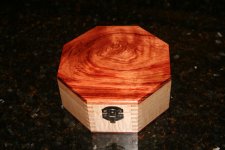
I got a 5ft x 8 x 2" piece, I picked it because it fitted my bandsaw cutting depth best for resawing. It was marked at 75, but they had a 15% sale on, so that was a result. But of course I had to get it back on the plane, as well as a 20kg mitre trimmer, so I had to cut it once to make the weight limit for each package. I was OK with that, but having had it back here since the middle of march, I've just checked and its split down the middle :eusa-doh: :eusa-doh: Must have been the pressure drop in the cargo hold. So now my padauk only has a usable width of about 3". Very bummed about that. I shall have to use it for box sides, rather than lids. If you have any with knotty grain, keep it for lids, this is one I made a few years ago with padauk.

IMG_1529.JPG
 
sunnybob":36txqs7c said:
I got a 5ft x 8 x 2" piece, I picked it because it fitted my bandsaw cutting depth best for resawing. It was marked at 75, but they had a 15% sale on, so that was a result. But of course I had to get it back on the plane, as well as a 20kg mitre trimmer, so I had to cut it once to make the weight limit for each package. I was OK with that, but having had it back here since the middle of march, I've just checked and its split down the middle :eusa-doh: :eusa-doh: Must have been the pressure drop in the cargo hold. So now my padauk only has a usable width of about 3". Very bummed about that. I shall have to use it for box sides, rather than lids. If you have any with knotty grain, keep it for lids, this is one I made a few years ago with padauk.

The stuff I got hold of was pretty ancient and had been there in the woodshed for some considerable time, right up against the back wall, missed and unloved by most of the punters. All of it was a beautiful colour, almost like rosewood and didn't appear to have darkened or gone 'brown'; it was all 75mm thick bar one plank that was 30mm and that's the one which will be turned into some veneers - Rob
 
chataigner":4xh91ygu said:
.....Absolutely, but why kerf by hand ? I run mine through the table saw......

:lol: :lol: Because I don't have a table saw.
 
Back
Top