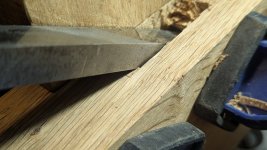
There'll be muntins: the majority will be straight but the top horizontal one will match the arc of the top rail. It's fairly gentle so although there'll be some short grain I was thinking of cutting the curve out of a straight piece rather than trying to bend a piece to the shape. Any strong opinions for either?
I've no experience of making straight muntins, let alone curved ones, but I've had a look in a few places that I thought might help. But first off, I wonder if you mean "muntins" - as far as I know that word is used for a vertical divider. Something of similar, structural size going horizontally could be a transom. They would divide up individual "lights" within a bigger window. Subdivisions within a light would all be called glazing bars. So, I assume we are discussing a horizontal glazing bar.
I was scratching my head wondering where I have even seen glazing bars that are not straight. The few books I have that cover windows or glazed doors with any sort of internal divisions all have straight bars, not curved ones. It's understandable, given the level of expensive complexity those curves bring, for the joiner and for the glazier.
Of the few modern books I have that show any curved work at all, only one has anything with curved glazing bars. That is "Carpentry and Joinery (Advanced)" by Alfred and Thomas Bridgwood, 1952. It shows how to make a door and frame, curved on plan, with a semicircular fanlight above.
Just to show that such work used to be done, here's a local example of something similar that I rather like.


It was built in Bristol as the Talbot Hotel in 1873 and later absorbed into the adjacent Courage Brewery as offices. Bombed in WW2, it lost its upper storeys but has since been impressively rebuilt. You can see that the pair of doors are curved on plan, with a semicircular window above. The current window is glazed with lead cames, but an older photo seems to show a window which tilted open for ventilation.
It's nice to see that the bricklayers rose to the challenge alongside their colleagues and made the transition from round to pointed so skilfully, but I digress...
Anyway, the Bridgwood book has 25 pages of dense description and geometric diagrams describing how to work out and cut the weird curves required and then join them all together. I won't reproduce them all here - I just like it as an example of how demanding such work really was and how it deserves our admiration.
The authors don't leave themselves much space to describe making the curved glazing bars. They do say that the "cot bar" (ie the little semicircle at the bottom of a fanlight) should be built up out of three thin strips, steamed and bent around a drum, then glued together and rebated and moulded afterwards. For the lesser curves on the radiating bars, they seem to imply that they would be cut from the solid.
Cassell's Carpentry and Joinery, 1907, edited by Paul Hasluck and available here -
https://archive.org/details/cassellscarpentr00hasl/page/n9/mode/2up - has something similar in the frontispiece and in the text:

and refers very briefly to making up the curved glazing bars from three strips laminated together.
Personally, I think one big piece of glass would be ideal and quite impressive enough, especially as I think it would have to be toughened glass these days.
Best of luck with it!