• Hi all and welcome to TheWoodHaven2 brought into the 21st Century, kicking and screaming! We all have Alasdair to thank for the vast bulk of the heavy lifting to get us here, no more so than me because he's taken away a huge burden of responsibility from my shoulders and brought us to this new shiny home, with all your previous content (hopefully) still intact! Please peruse and feed back. There is still plenty to do, like changing the colour scheme, adding the banner graphic, tweaking the odd setting here and there so I have added a new thread in the 'Technical Issues, Bugs and Feature Requests' forum for you to add any issues you find, any missing settings or just anything you'd like to see added/removed from the feature set that Xenforo offers. We will get to everything over the coming weeks so please be patient, but add anything at all to the thread I mention above and we promise to get to them over the next few days/weeks/months. In the meantime, please enjoy!

Dining room carver chairs - Take 2

Very nice indeed, shows we are all different, I would have set to with my Nr 4 to do those legs, and no doubt the concave sides would have been done with a spokeshave. Still, most impressive.
 
Cabinetman":1ejcc0zy said:
Very nice indeed, shows we are all different, I would have set to with my Nr 4 to do those legs, and no doubt the concave sides would have been done with a spokeshave. Still, most impressive.

Ian, I think that it would be impossible to use a #4 - or any hand plane for that matter, even a block plane (I did use one occasionally) - to plane these legs into a curved-tapered-oval-round shape. Straight legs are another matter, but not when there is a curve.

Regards from Perth

Derek
 
Thanks for sharing all this Derek. It's very nice work.

I'm going to have a similar exercise to do on my table project which has curved (heavily curved) and tapered legs which will be rounded over on the inside of the curve. Like you, I've sort of accepted that I'll work out how to do it when I get there! However, my basic plan is to facet the edges until I'm close to a curve and refine from there. I think this is how you would shape a guitar neck for example. I think I can work out, and mark, where the facet lines need to be at a given point on the leg (based on a cross-section of the leg) and can use a bendy steel rule to join the dots. My weapons of choice for removing wood will be spokeshaves, scrapers and perhaps round files/rasps.
 
I must admit that this is an unusual build for me. I literally do not know what I am doing ... insofar as I have to keep returning to parts to refine and refine them. That is what is so time consuming. I don't always score high on being sensible, but I do on perseverance and being bloody minded!

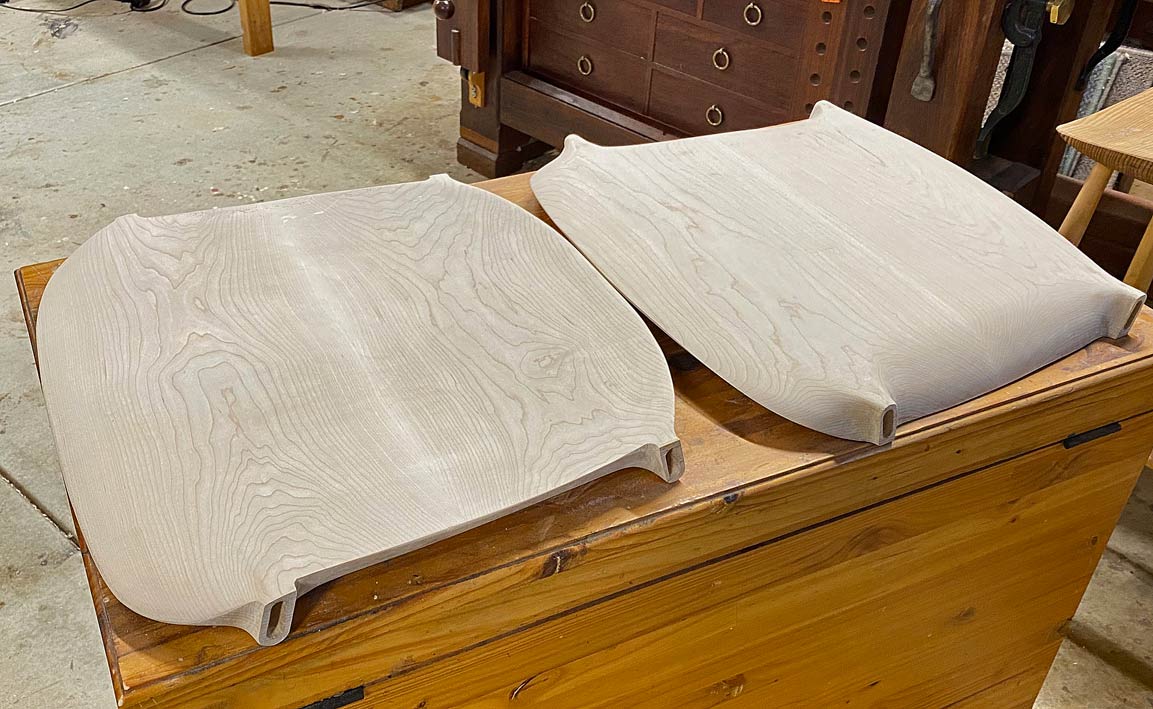
Today was not a work day, and I ear-marked completing the seats. The upper side was 99% done, but the underside needed fine-tuning. I have two photos to guide the shaping ...

Seats1.jpg


That one (above) is from the factory building the prototype. They screwed the legs to the seat, rather than use integrated tenons. This proved to be a great model in my case.

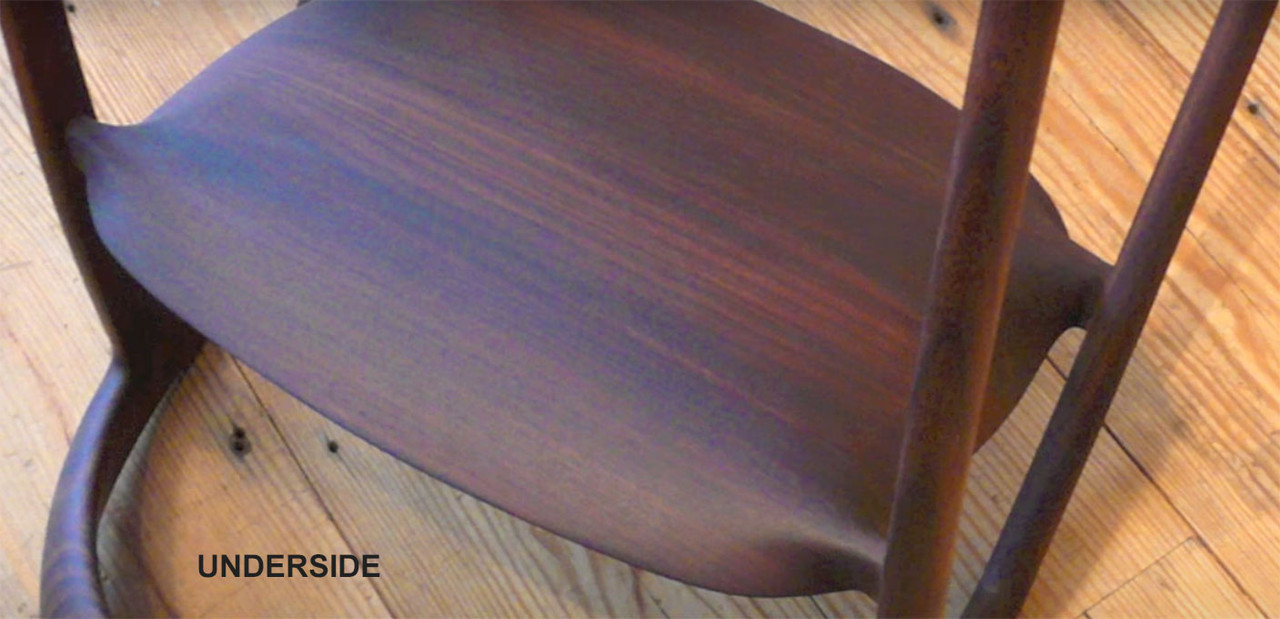
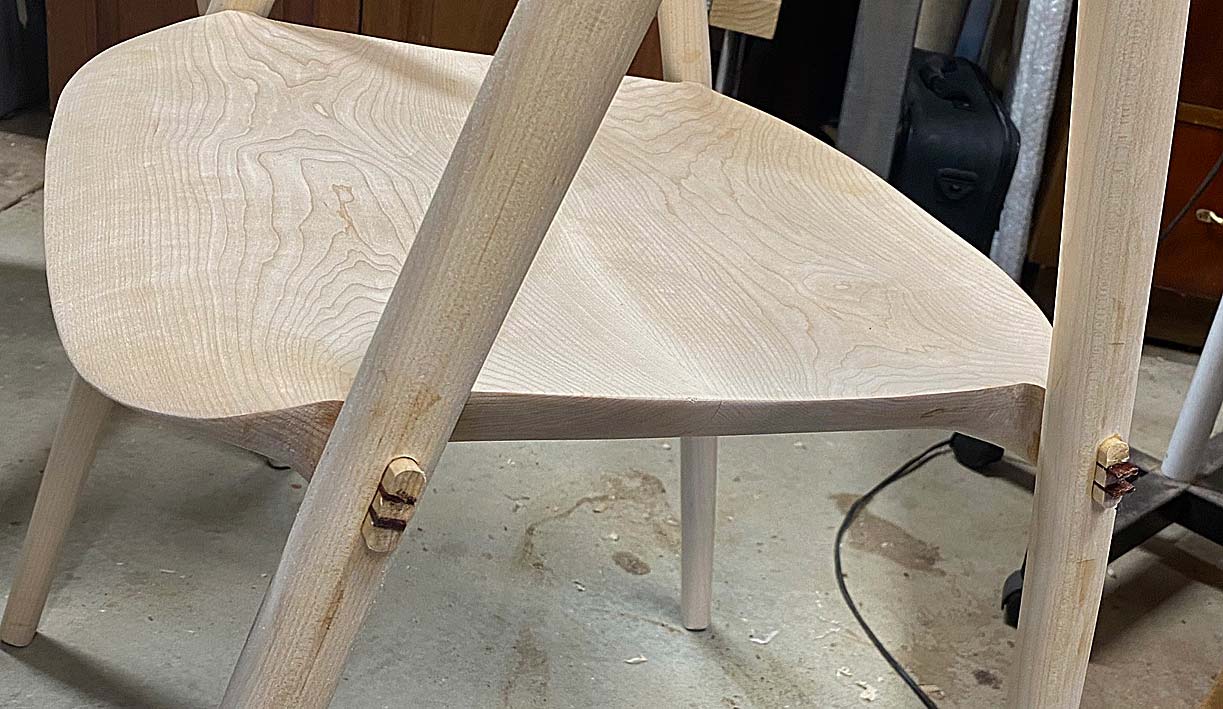
The second photo is a production chair seat taken from the underside. In particular, this shows the treatment of the smoothing of the tenons and their integration with the back ...

Seats2.jpg


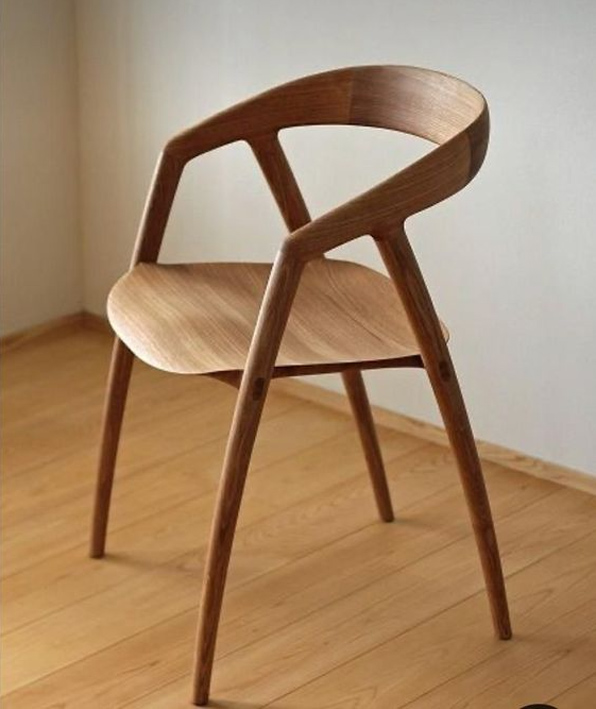
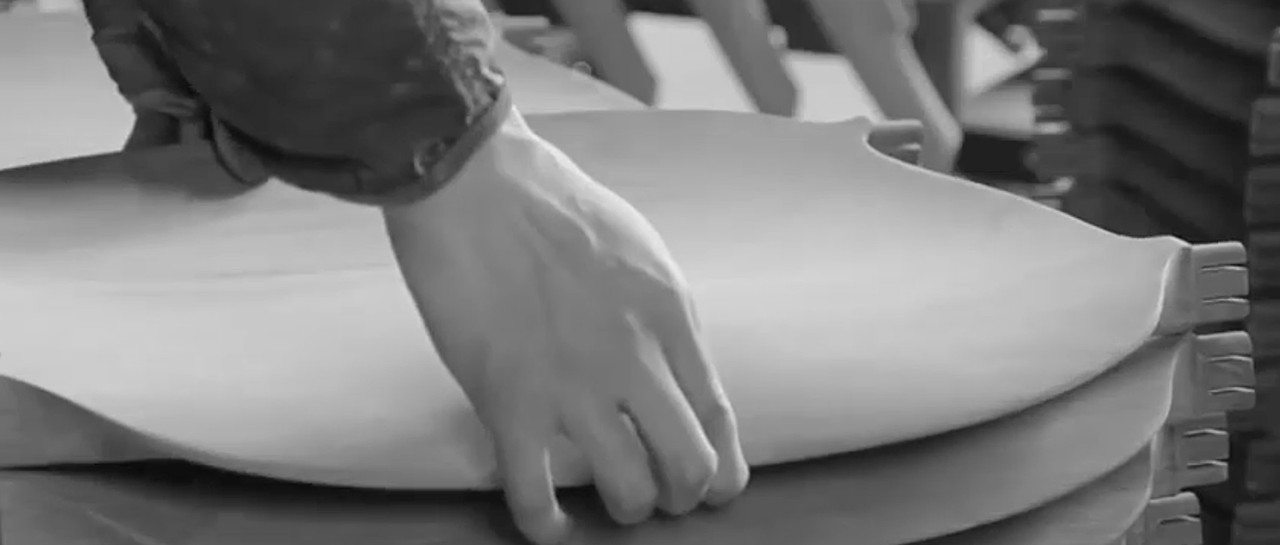
Lastly, I keep returning to this photo of the chair, which shows how thin the seat looks from the side. Keeping in mind that the seats started out at 50mm, and were 40mm after the plan was cut out, a great deal of tapering was necessary to achieve this look ...

Build40.jpg


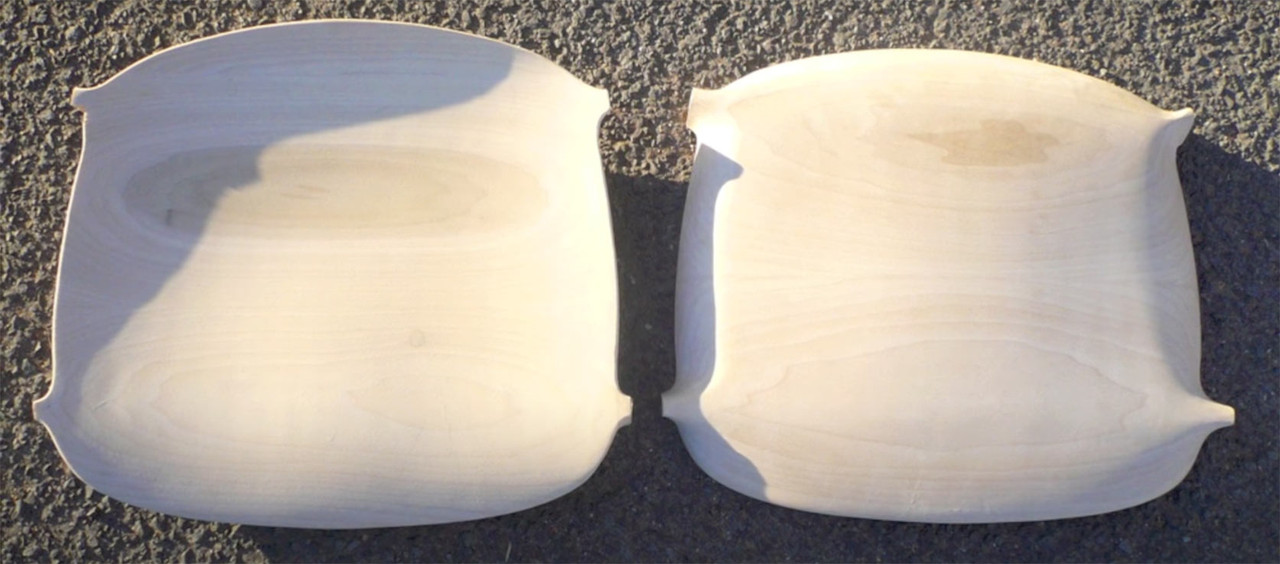
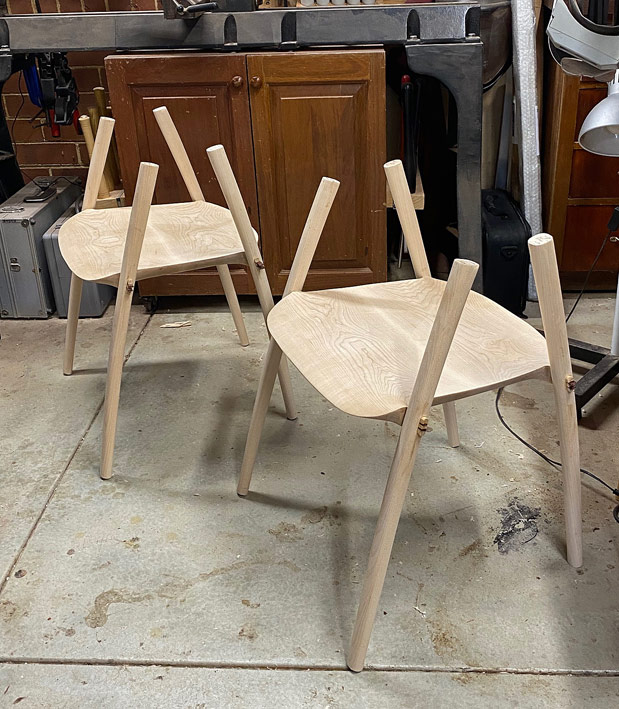
Here are the two completed seats. The seat on the left is face up, and the seat on the right is bottom up ...

Seat1.jpg


Regards from Perth

Derek
 
I'm impressed. Very clean tapering achieved there. Sculptural in fact.
 
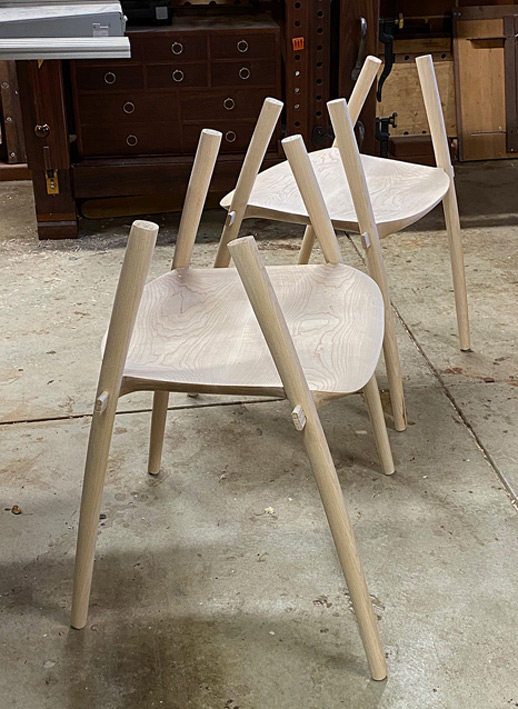
Today we reached the milestone I was patiently (okay, not so patiently) waiting for - glueing up the legs and seats. To get to this stage, however, required matching the mortices with the loose tenons, matching the loose tenons with the leg mortices, cutting slots for the wedges (into the tenons), and shaping the tenon mortise to fit the legs.

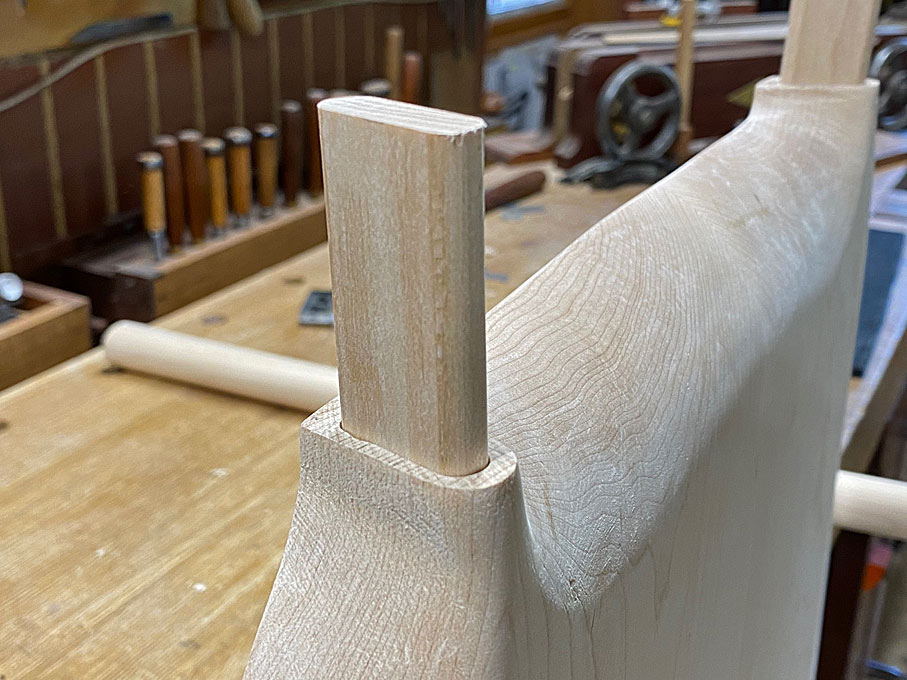
Let's start with the obvious. This is how the tenon and the tenon mortise will end up looking ...

T2a.jpg


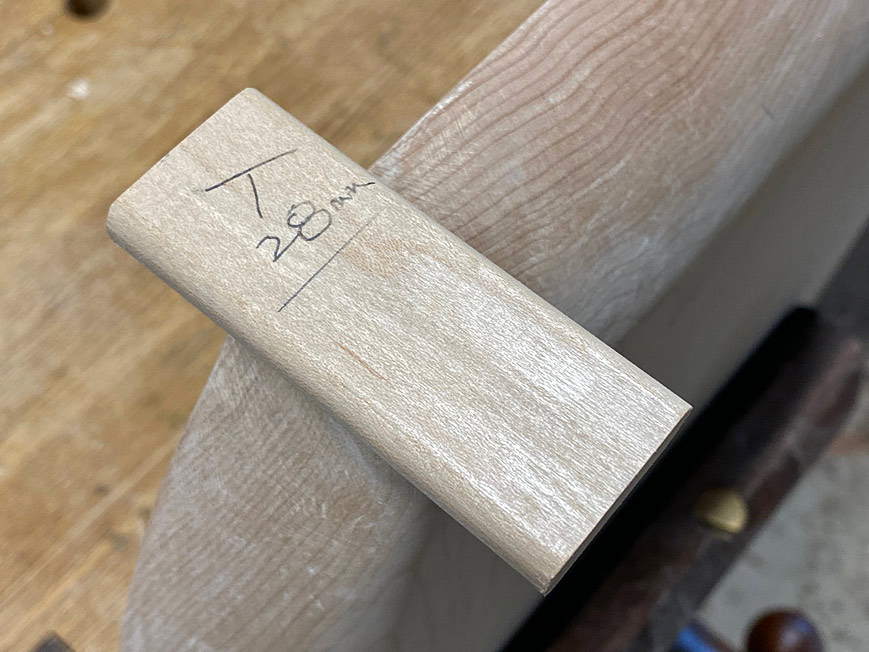
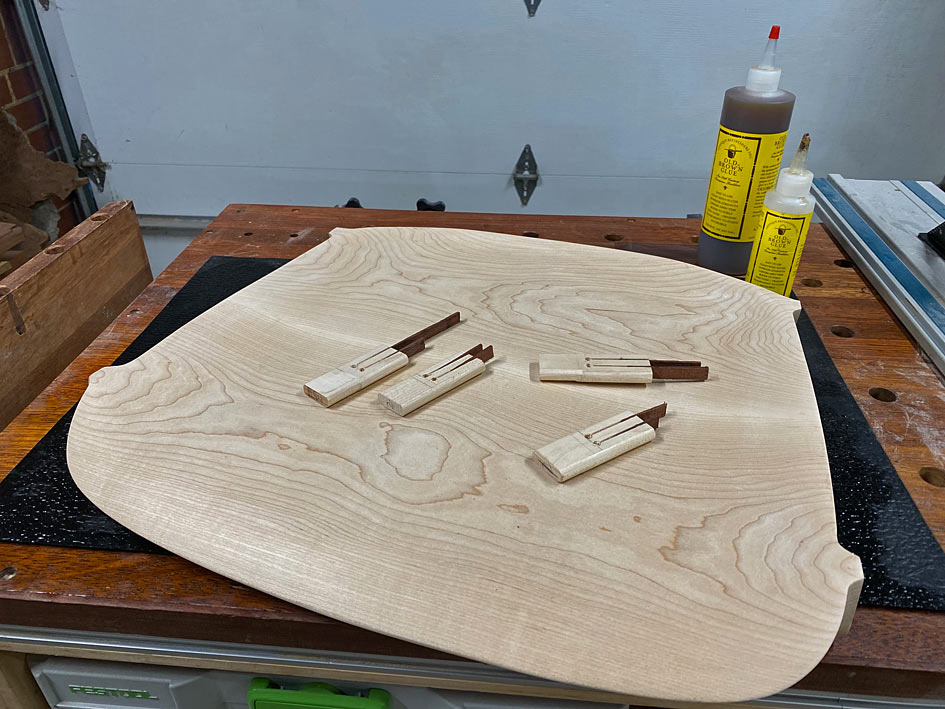
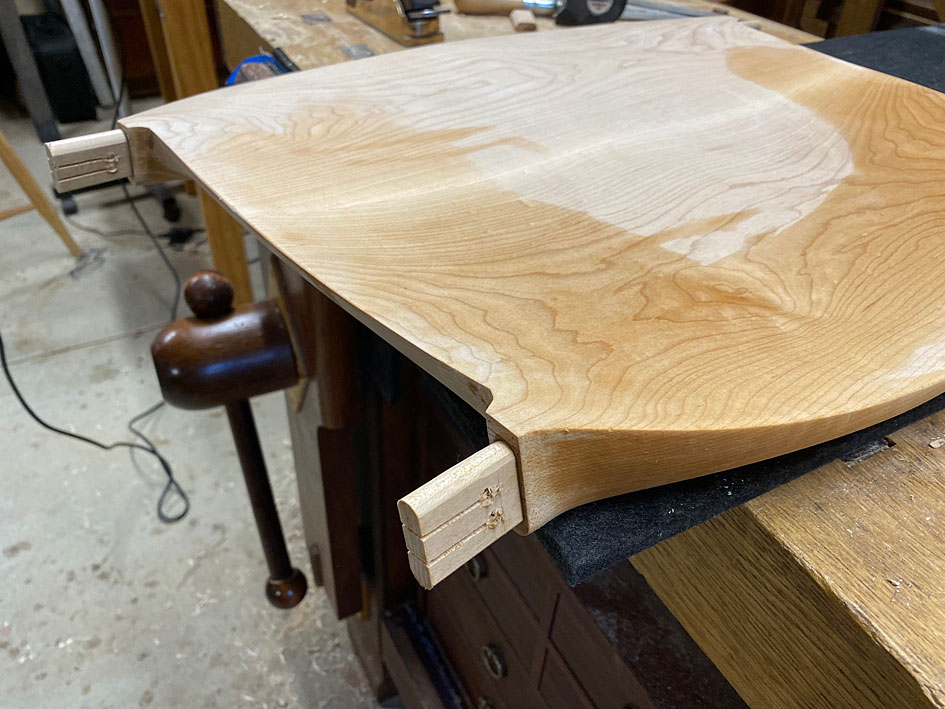
The loose tenon is 30mm wide and 10mm thick. It extends 28mm into the tenon mortise ...

T3a.jpg


This all looks rather neat, but it was the end result of further shaping to fit the legs with the seat. The issue was that the seat mortices were chunky ...

Seat1.jpg


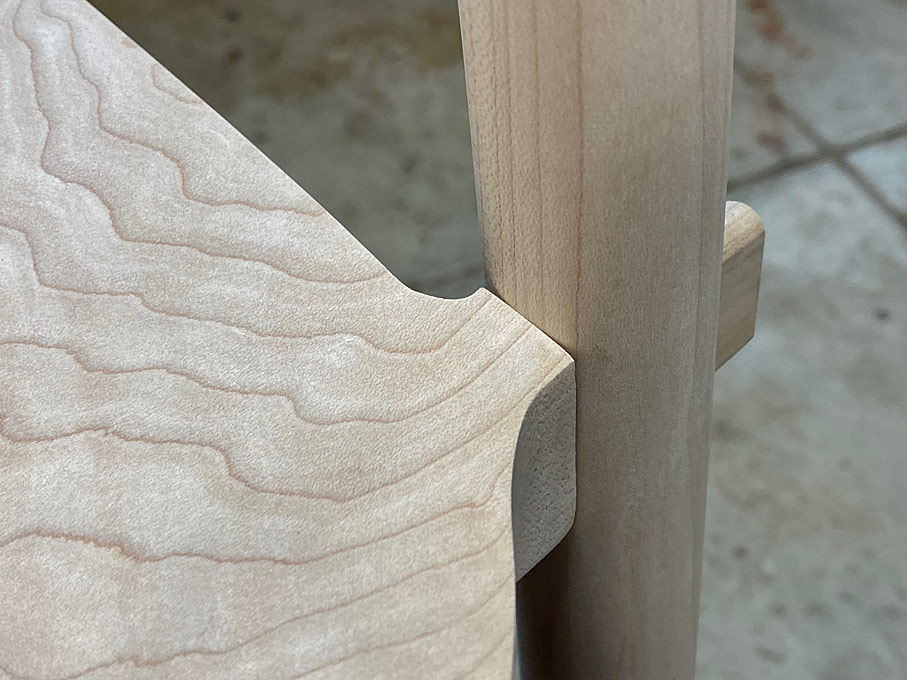
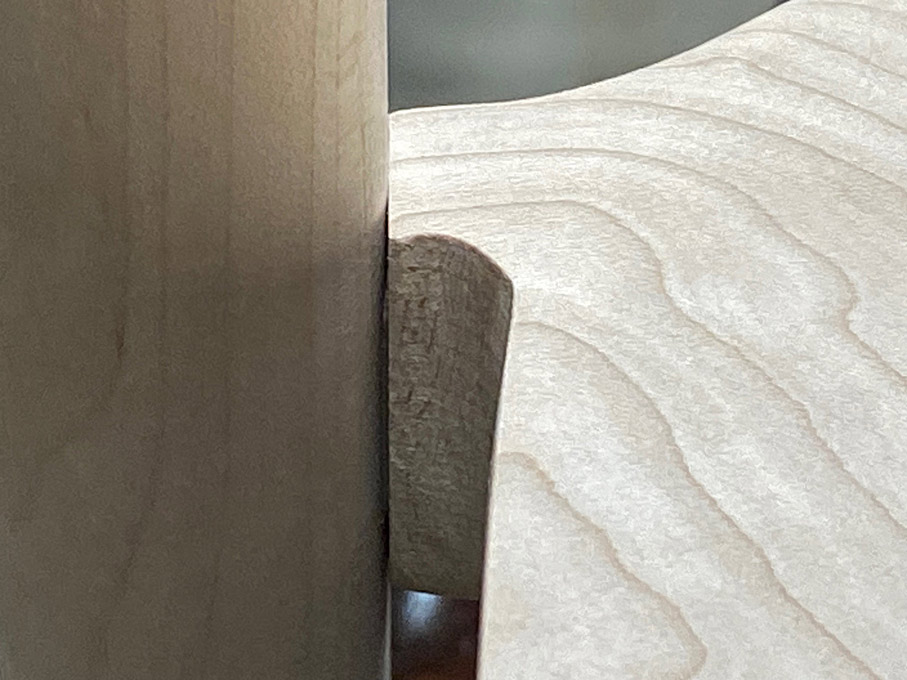
When joined, this was the fit ...

T4a.jpg


T5a.jpg


Two steps were involved. Firstly, the tenon mortise was reshaped to be thinner at the face (this involved removal of waste at the top edge and not the sides, which is needed support for the loose tenon) ...

T6a.jpg


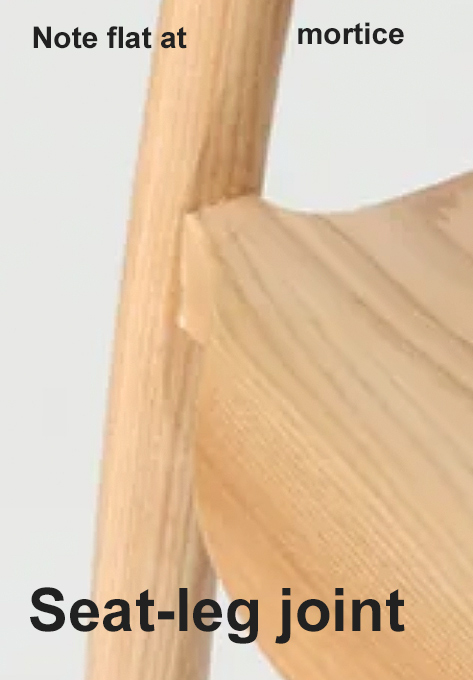
Secondly, the face of the leg mortise was planed flat to match the face of the seat mortise ...

T7a.jpg


This is how the original chair was fitted - photo I posted early on ...

Seats3.jpg


This is the result ...

T8a.jpg


T9a.jpg


All the parts fitted, but not yet glued up ...

T10a.jpg


Loose tenons slotted for wedges, along with the wedges. Glue of choice: Old Brown hide glue. Why? Because at some stage in the future, hopefully many years from now, it is likely that the joinery will need to be re-glued.

T11a.jpg


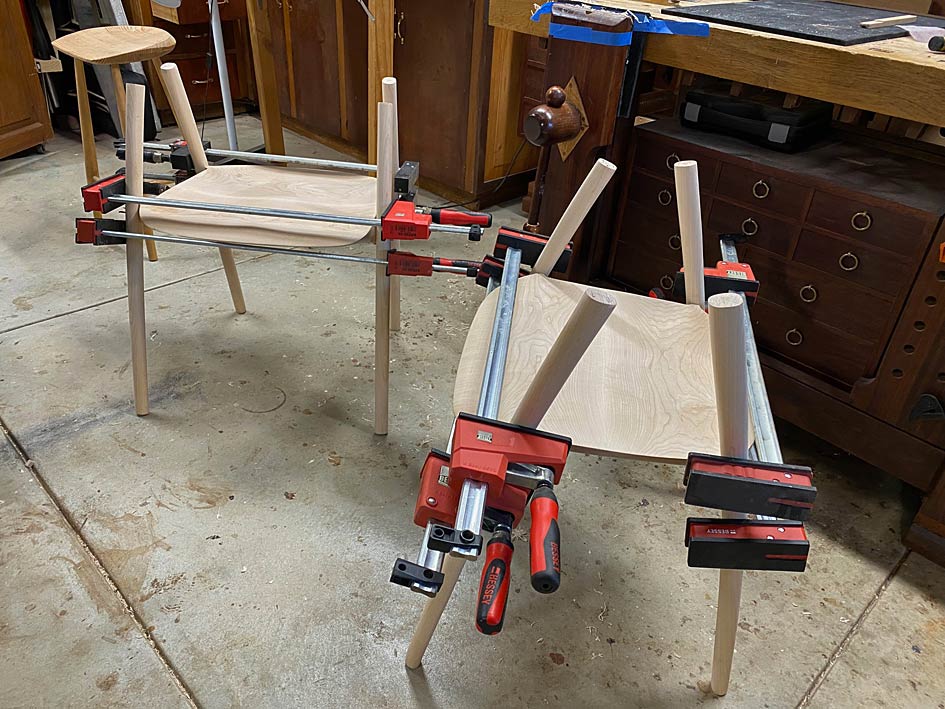
The seat tenons are glued first and the glue allowed to dry (they are a bit long here, and were cut shorter before the legs were attached) ...

T12.jpg


And a last photo of the final glue up. It will remain so for 24 hours.

T13.jpg


Starting to look like chairs! ;)

Regards from Perth

Derek
 
A note about wedges

This is a cross post from the Australian forum, where I was asked for more information about the wedged through tenons.


I am not sure if the photo provided must detail, but the wedges are tapers, but also long and skinny ...

T11a.jpg


They both fill the slot - which is full of glue - and create a wedging action, firmly pushing the tenon edges against the glued insides of the mortise. The mortises, both in the seat and legs was 30mm long. Most were exact, some of the legs were a little under a mm long. A little filing for all to create this tiny gap - it does not have to be more. The glue is enough and the wedges are security. Interestingly, this appears to be the same in the original chair, with the exception that they added a chamfer for the end of the wedge. I've never seen this before (but understand the reason) ..

Chair-seat5.jpg


In addition to the wedged legs (I am trusting that the small amount of taper inside the mortises will add an extra layer of solidness), the arm/back structure adds stiffness and resists the legs wracking/moving. It is akin to triangulation of the construction (not really triangles, of course).

I have removed the clamps and the structure is really stiff already - I will wait until Lynndy is out of the way to take some photos. She-Who-Must-Be-Obeyed is keeping a steely eye on my "taking it easy" today! [Explanation: I was in hospital yesterday for an op on my left torn patella]

Later:

I snuck into the workshop to unclamp the glue up. Lynndy caught me! But she then asked to sit on one of the chairs (sans the arms and back). She did so gently, and then with all her weight (55Kg). The seats did not even sigh, and nothing moved. She proclaimed the seat very comfortable. Yay!

Tenons and wedges yet to be cut and levelled ...

T15.jpg


T14.jpg


Regards from Perth

Derek
 
Excellent work. Hope you are OK after the op.

I was surprised to see the flat planed on the legs to achieve the mating surface. For some reason I expected you to file the seat joint face to fit the leg curvature. Was this to preserve faithfulness to the original design?

Did you use animal glue adhesive to facilitate future repairs in case someone like me, who does not weigh 55kg, sits down? Looks like hide glue bottles in the background? It's a serious question as chairs do seem to work loose over the years. A couple of years ago I made a facsimile of a fire damaged old chair from a historic building. When we took the original apart the dowels had clearly been repaired in the past by binding with thread (fine string or cotton of some sort) and driven back in with hide glue (which had loosened in the fire). I suppose the wedges would prevent disassembly.

A
 
I too was surprised with the flats, but seeing the joints together they look "right".
Dismantling in the future would still be doable by removing from the seat first and in the unlikely event of the leg part being loose it could be knocked back through/out I suppose.
I’ve never heated joints to dismantle, I imagine the tenon into the seat would need heat over quite a long period to get through the thickness of timber?
It’s so gratifying when your loved one approves and encourages your work, so success there Derek.
Ian
 
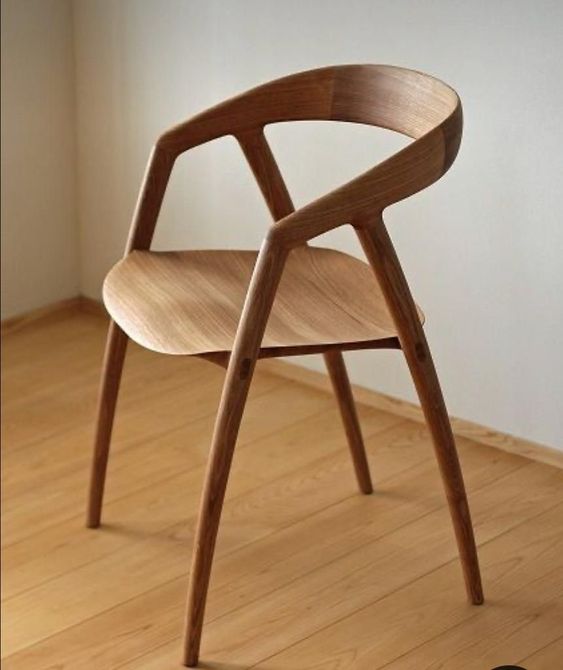
The legs and seats are done and it is time to move to the arms and backs. Once again, the chair to provide a context of where we are headed ...

Chair2.jpg


I was fortunate to find a few photos on the Web showing the development of the arms/back, which provided some insight into how to construct this ...

Seats4.jpg


The construction sequence that was really helpful was this (note these are from the underneath) ...

Arms1.jpg


While this makes it all appear accessible, my experience building a Hand Wegner chair prepared me for the large chunks that make up the two arms and the back ...

TheChairShapingArmsBackPart1_html_m11f0c459.jpg


Giant slabs and lots of carving (since, unlike the factory, I do not have a CNC machine) ...

TheChairShapingArmsBackPart1_html_m2b87da0c.jpg


But look at the first photo in that sequence - the back is angled into the arms. Wonderful - less to carve!

Arms2.jpg


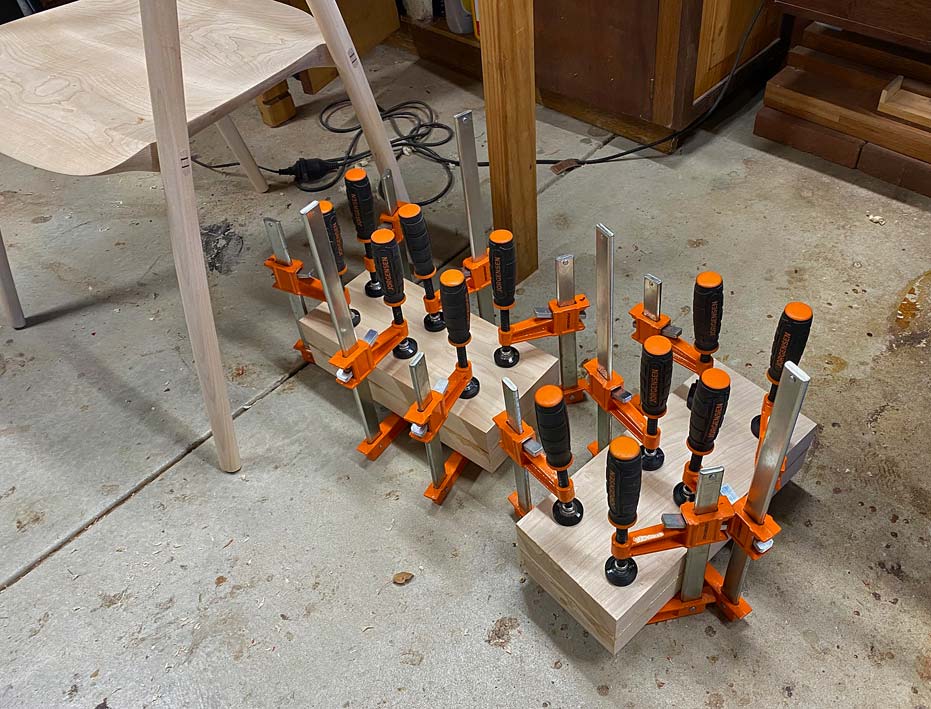
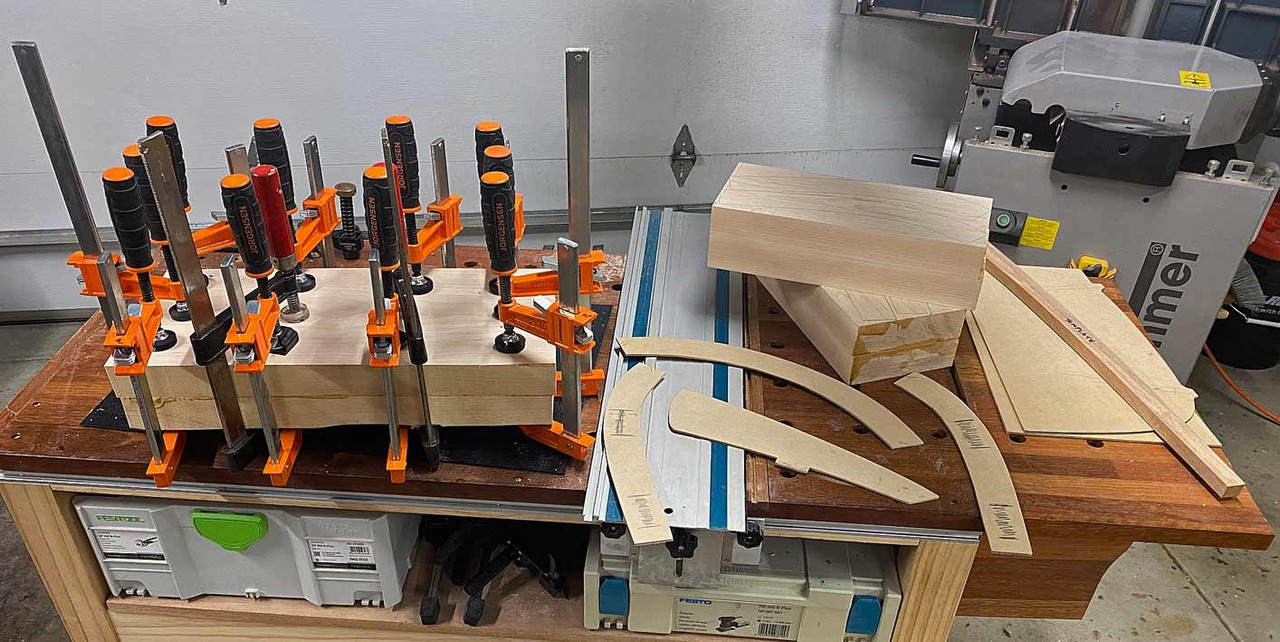
The arms need to be shaped from blocks 90mm high, so I got busy laminating ...

Arms7.jpg


And while this was drying, time was spent on getting the profile for the side of the arms ...

Arms3.jpg


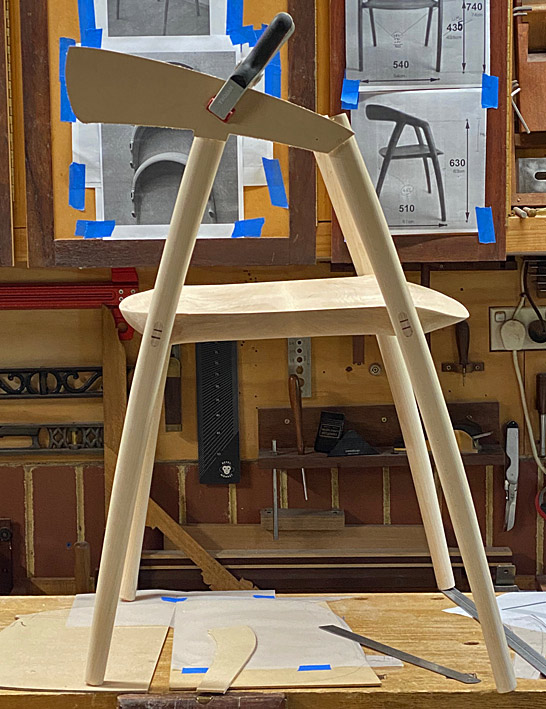
There's a photo on the wall behind against which to compare. Also, a first look at the completed through tenons.

That's the easy stuff. Time to design the arm and back profiles.

We start with a seat ...

Arms8.jpg


... to use to frame around ...

Arms9.jpg


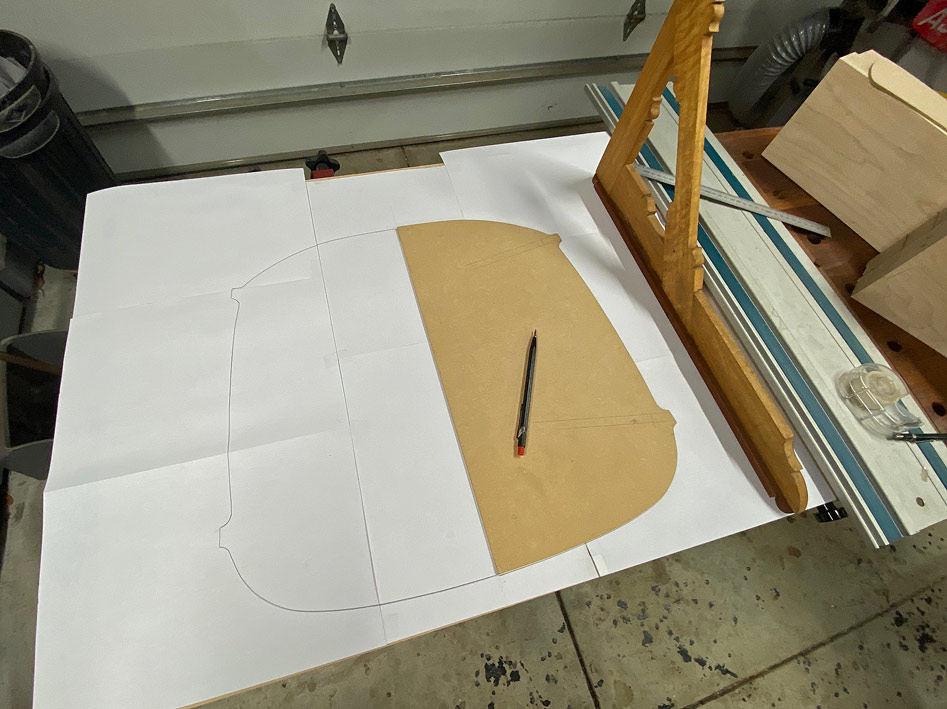
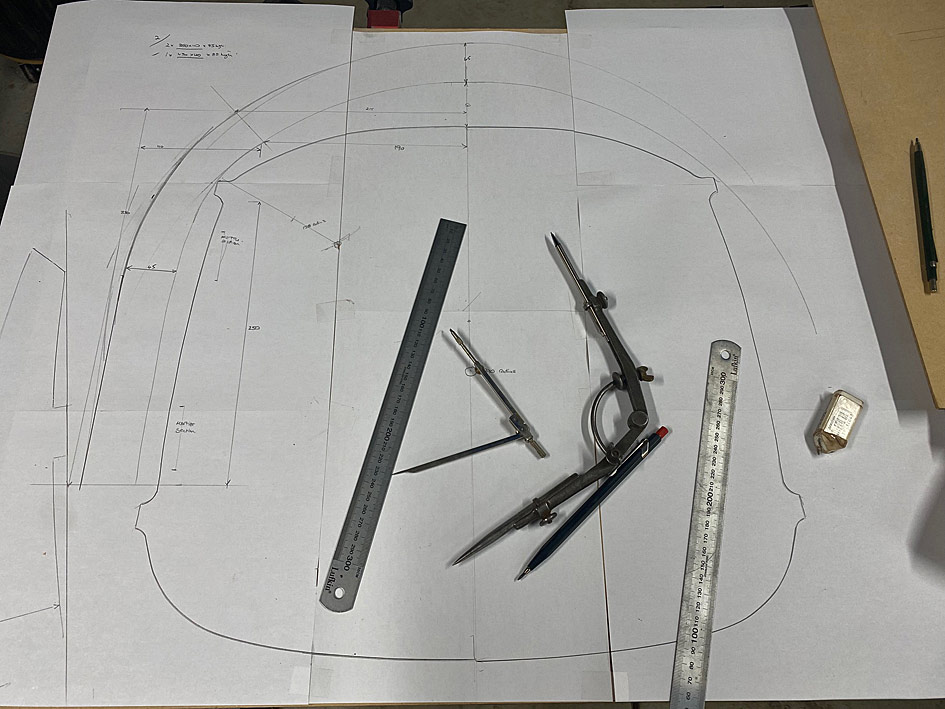
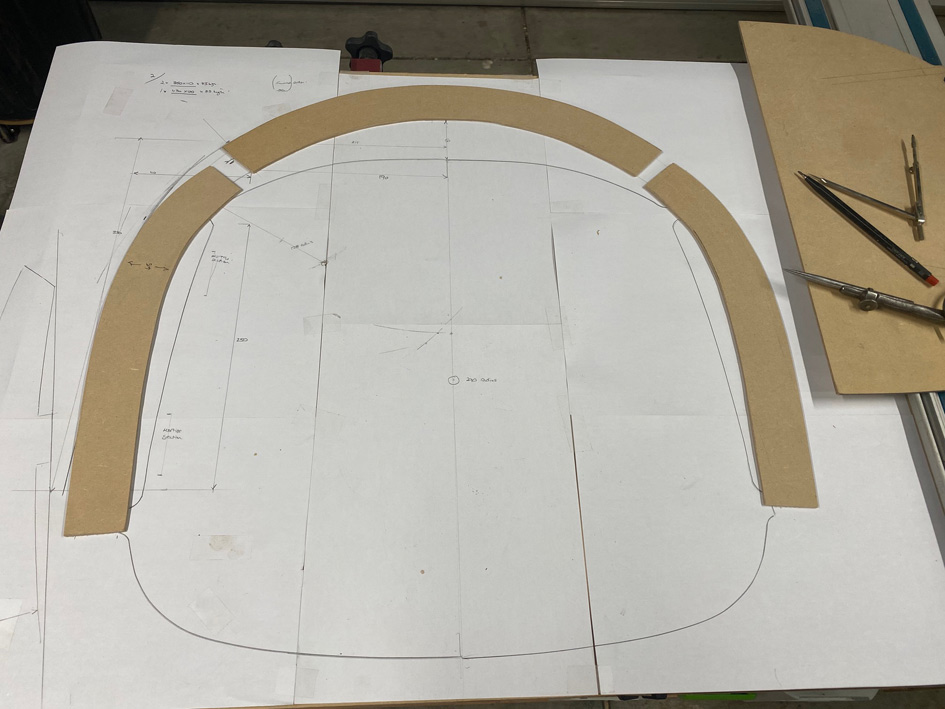
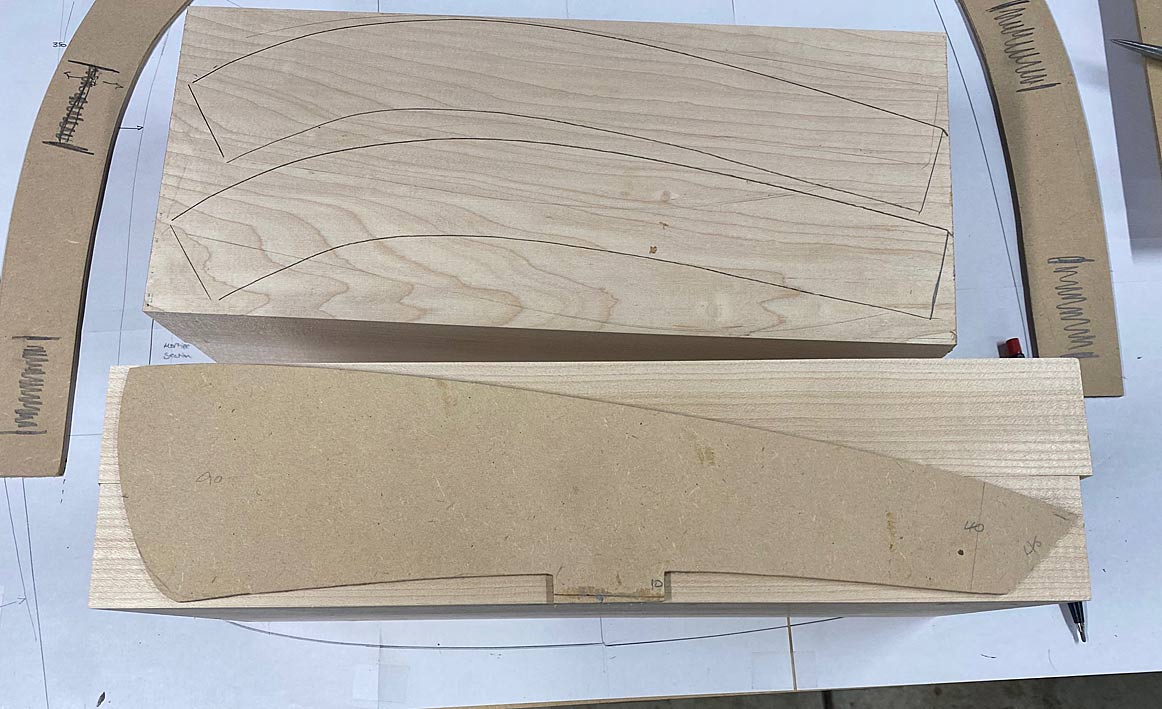
After much back-and-fro drawing, rubbing out, re-drawing, and transfering to MDF for templates ...

Arms10.jpg


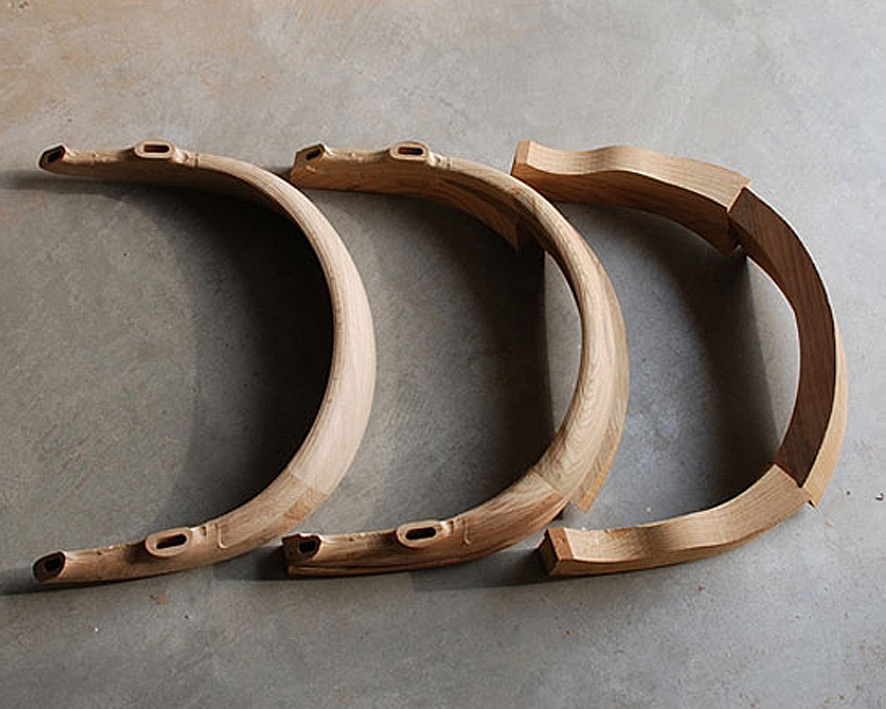
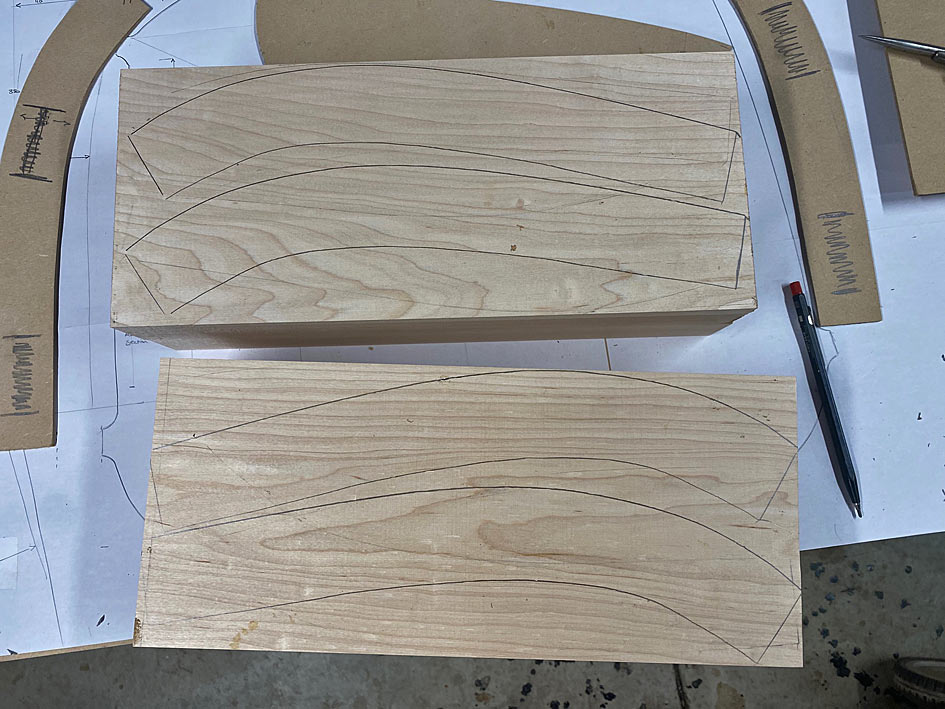
Each of the blocks (seen beng glued up earlier) create four arm blanks ...

Arms11.jpg


Here is the side elevation ...

Arms12.jpg


Wood for the backs came from sawing up this 3m long board ...

Arms13.jpg


And, for now, the backs are laminated and drying alongside the other blanks and templates ..

Arms14.jpg


Tomorrow I shall begin cutting it all up, and joining pieces together.

A question for all is how you might connect/join the arms with the legs? Note that the back will be joined angled to the sides, as per the photo.

Regards from Perth

Derek
 
Does your photo with the un-carved top resting on the legs show four pegs or dowels as the male end of the legs ready to fit into bored holes in the arms?

These chairs have been a huge amount of work.
 
Well yes, from your photo showing 3 arms at different stages it looks as though you will be using the same Dominoes as legs to seat?
I agree with Adrian, a mammoth task and I can see why they are made using a CNC machine normally.
 
Hi Ian

I plan to use 10mm Jarrah dowels rather than dominos. The dominos will be extremely difficult to mortise without reference sides. Dowels can use locators to position the holes.

Regards from Perth

Derek
 
Here is the work done today, which was preparing the arms before shaping. Critical work, and the day went well. This was mainly due to working methodically. Looking back it all seemed so logical and straightforward, but it didn't feel this way before hand.

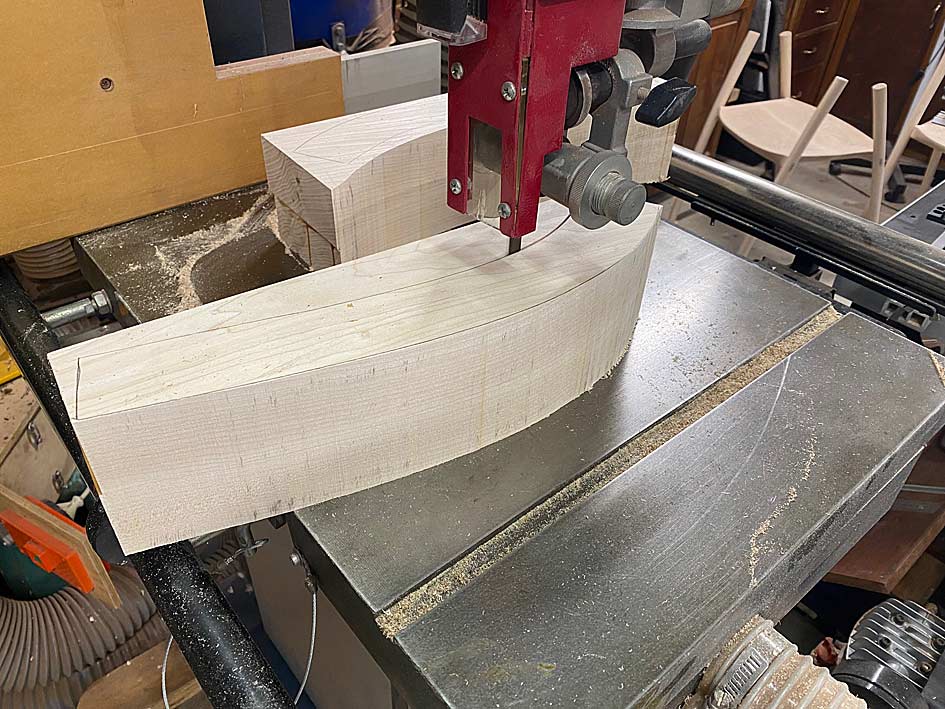
The first task was to bandsaw all the blocks of wood into shape, having outlined the parts with the templates.


Lining up the arm parts for two chairs, three for each ...


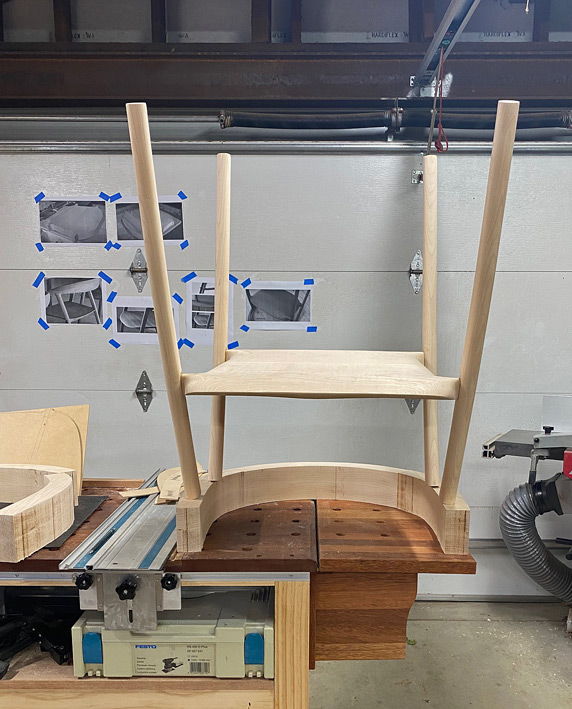
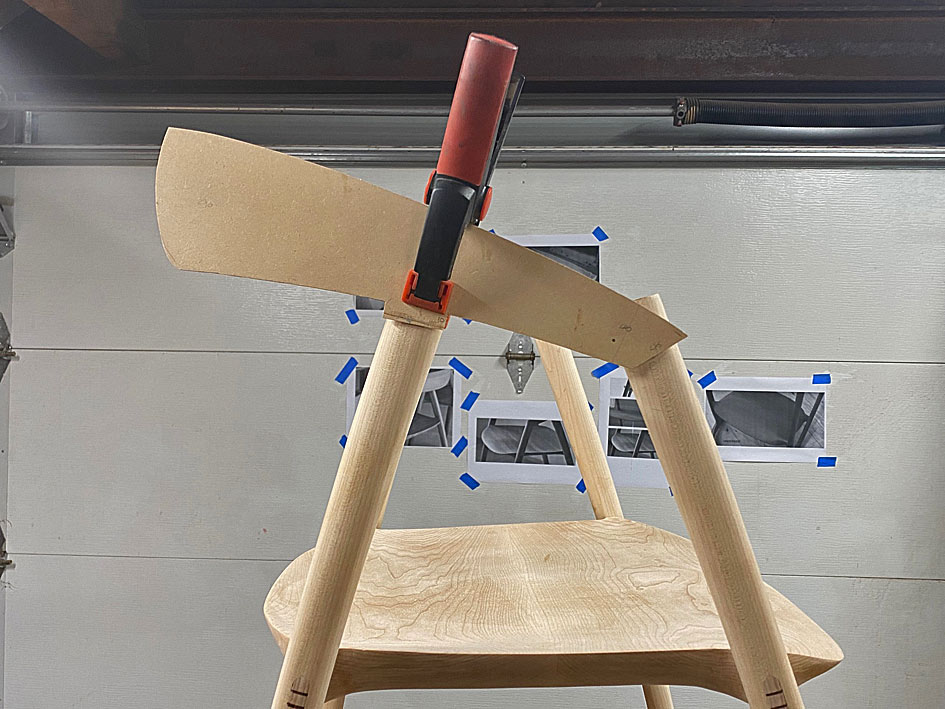
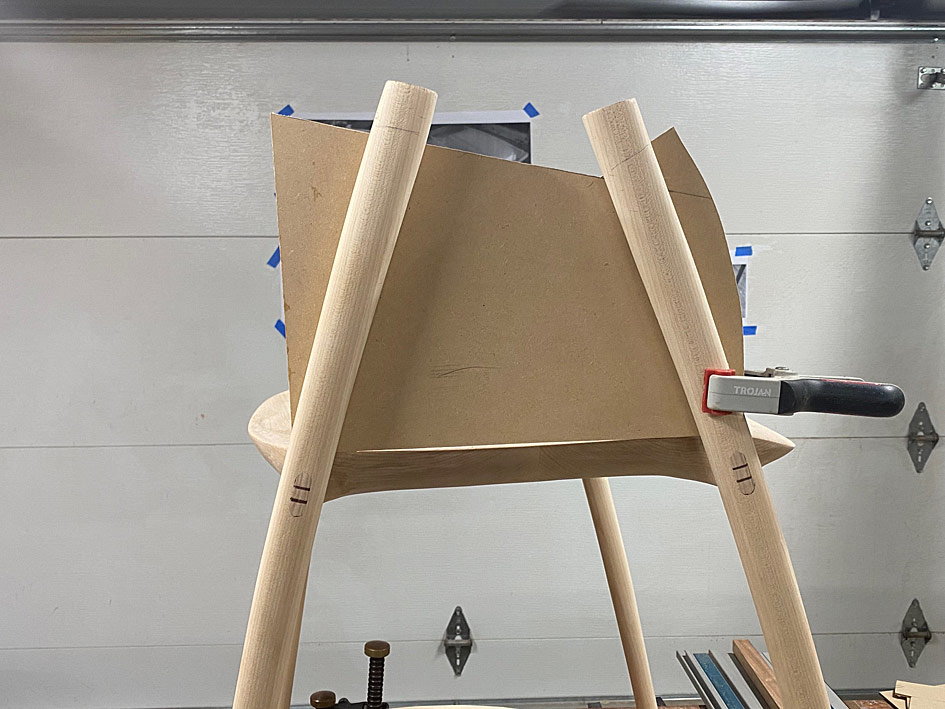
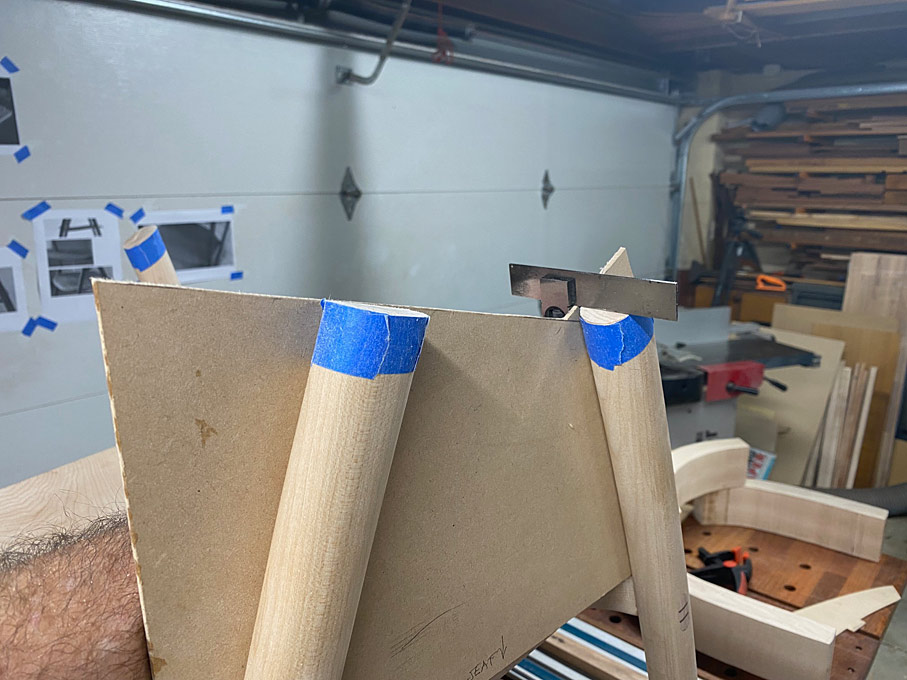
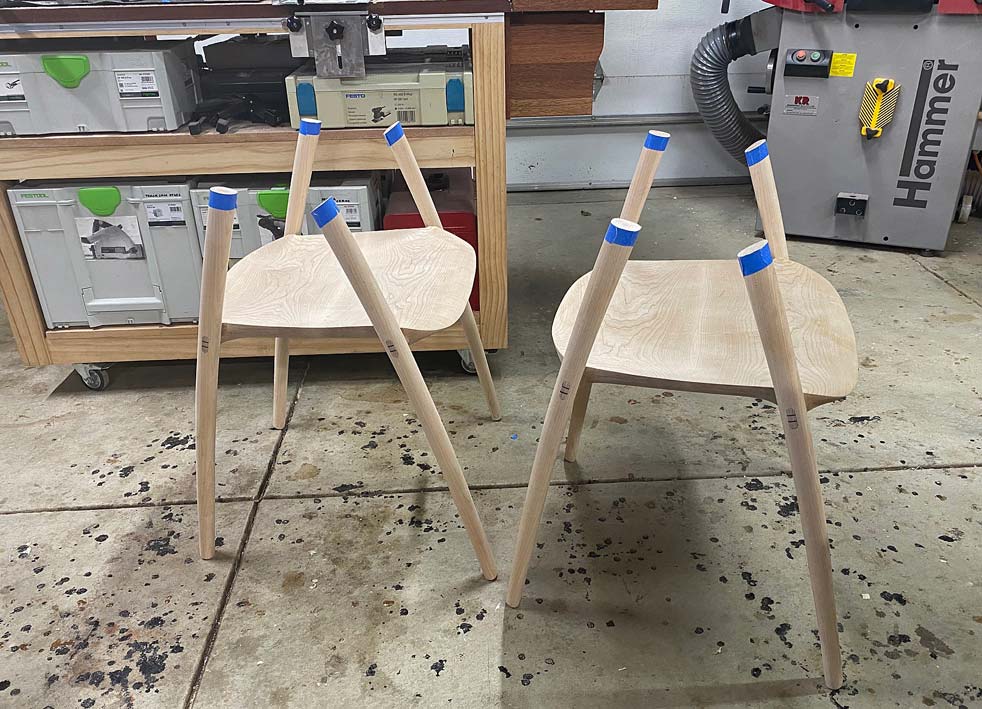
At first I thought I would clamp them together and balance the lot on top of each chair ... no, that would be silly! :) The chairs were turned upside down on the arms ...


This revealed that the spread of the arms was a little too wide. The arm supports need to be centred on the arm rests ...


Before adjusting this, the next stage needed to be to cut the arm supports to length. To do this, first the template for the arm elevation was positioned ...


... and then a template was made to position this ...


This allowed all the arms supports to be marked on both sides ..


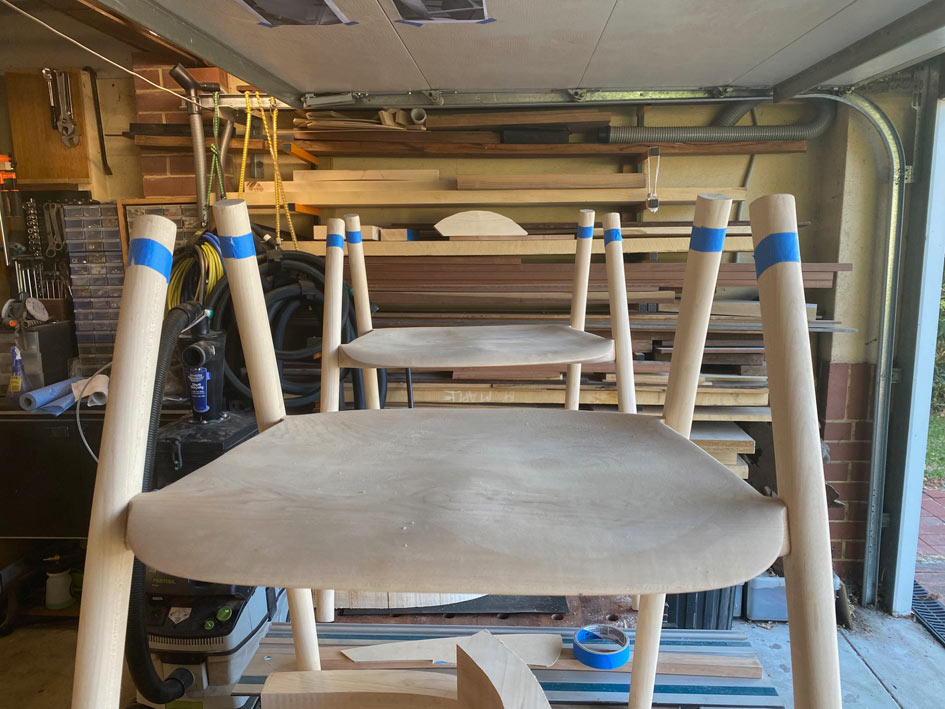
.. and marked with blue tape ...


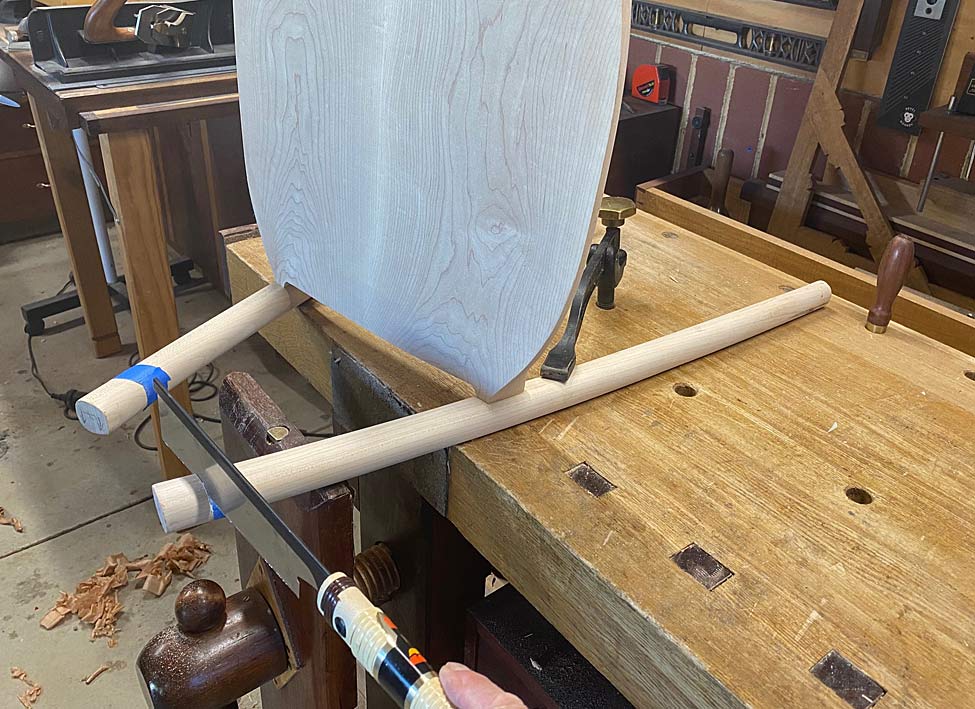
The excess is sawn away ...


The template also enables the accuracy of the saw cuts to be checked, and for square. This will need to be fine tuned later, but good for now ...


The underside of the arms are marked so the positions on each will be the same, and the overhang at the rear was roughly calculated. Again, this will be adjusted after the arms parts are joined.

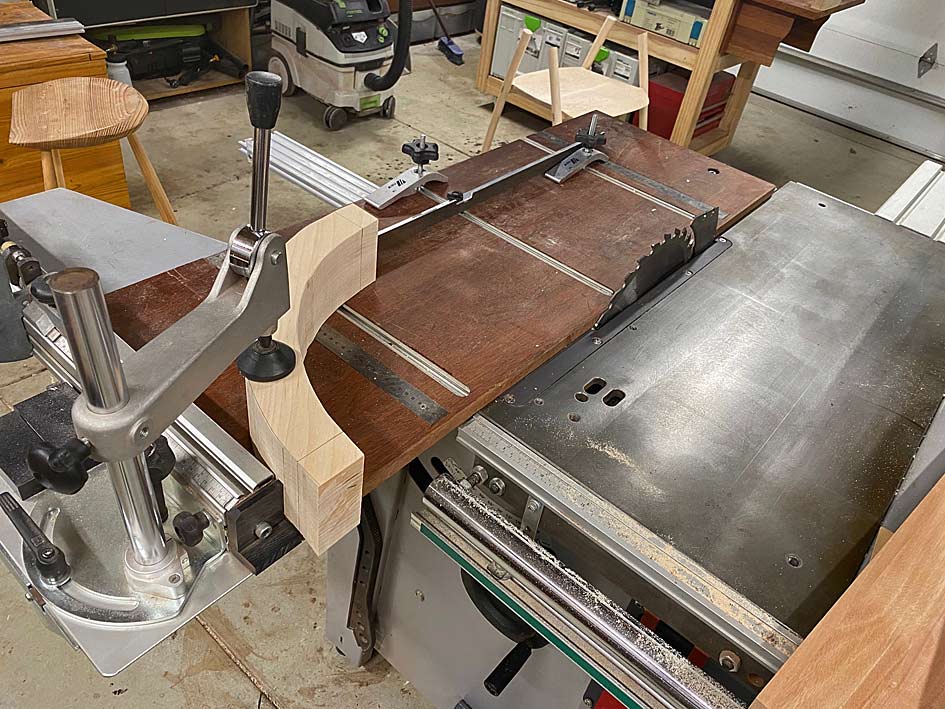
Now the top rail can be positioned for sizing ..


It is marked for sawing ...


Aligned on the slider ...


All the ends of the arms are squared this way, however the saw has a maximum cut height of 75mm and these parts are 90mm. This leaves 15mm to saw away with a hand saw, and then clean up with a block plane. This clean up is important as it is also jointing for the parts to fit together gap-free ...


The arm parts are ready to fit together ...


And all done for the day ...


Regards from Perth

Derek
 
derekcohen":2orxzhcj said:
Hi Ian

I plan to use 10mm Jarrah dowels rather than dominos. The dominos will be extremely difficult to mortise without reference sides. Dowels can use locators to position the holes.

Regards from Perth

Derek

By locators do you mean those little points that you place in one drilled hole and press the facing piece of timber on to it to mark the position for the facing hole?
 
Andyp":1d1okxqj said:
derekcohen":1d1okxqj said:
Hi Ian

I plan to use 10mm Jarrah dowels rather than dominos. The dominos will be extremely difficult to mortise without reference sides. Dowels can use locators to position the holes.

Regards from Perth

Derek

By locators do you mean those little points that you place in one drilled hole and press the facing piece of timber on to it to mark the position for the facing hole?

Andy ... yes.

I used one here (in a bed build)...


The locator will enable a row of dowels to be positioned, which is relevant as these need to be placed where the waste is not removed at the seat back. Tricky.

Regards from Perth

Derel
 
Arms - part 1

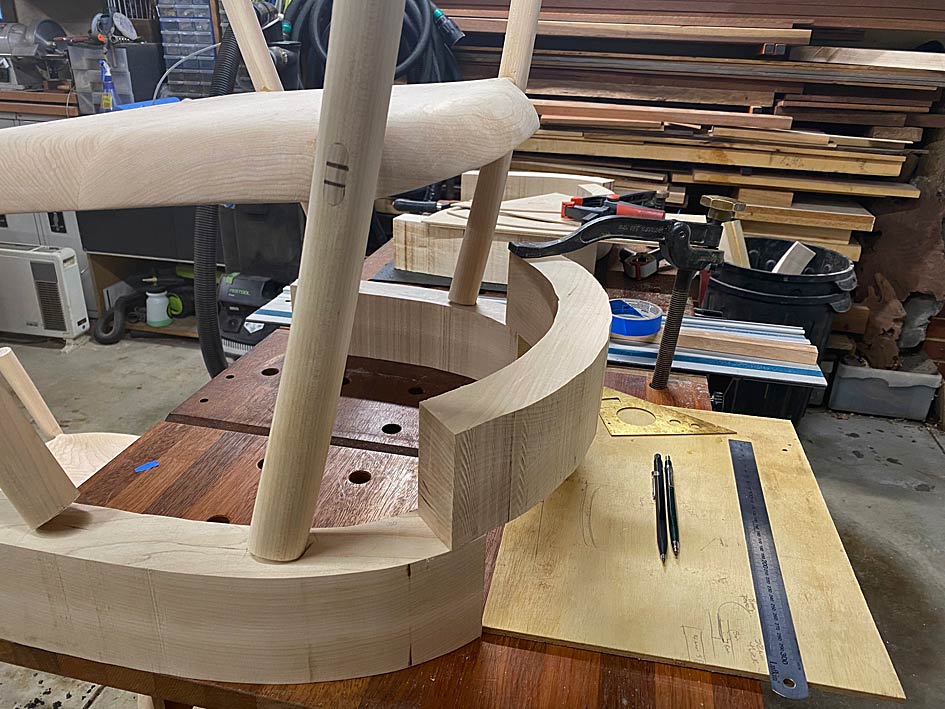
The key piece is the top rail, and the key element here is the rear curve. Here it is smoothed on the belt sander. It will be a reference side for marking curves ...


The angles I have had to guestimate have been the tilt, front and rear, of the top rail. This is what I came up with ...


The plan is to join the arms using dowels. The Rule of Thirds applies. 3 x 3/8" dowels (3/8" = 9.5mm, which is close to the 10mm tenons used previously). Why dowels? Because they are easier to position accurately without a reference edge.

Since a large amount of waste will be removed from the top rail and arms, through shaping, the dowels need to be positioned where they will not be cut into. The three marks on the ends of the top rail are the position for the dowels. The wooden block was a quick guide to drill vertical as it needed to be done freehand ..


The only complication was that I had 6mm dowel centre points. It would have been easier if they were 3/8". Nevertheless ...


Drilled for 3/8" dowels in Jarrah (I have a bucket of them), each close to 50mm (2") in length.


Everything is still a rectangle at this stage ...


The inside face of the top rail is shaped ...


It is at this point that I have a re-think about the curve of the rear - it is not a fair curve and enough curve when compared with the photos of the DC 09 chair. The re-drawn curve on the left looks correct to me now, and this is what we will go with ...


The parts are joined up as a loose fit (using undersized dowels)...


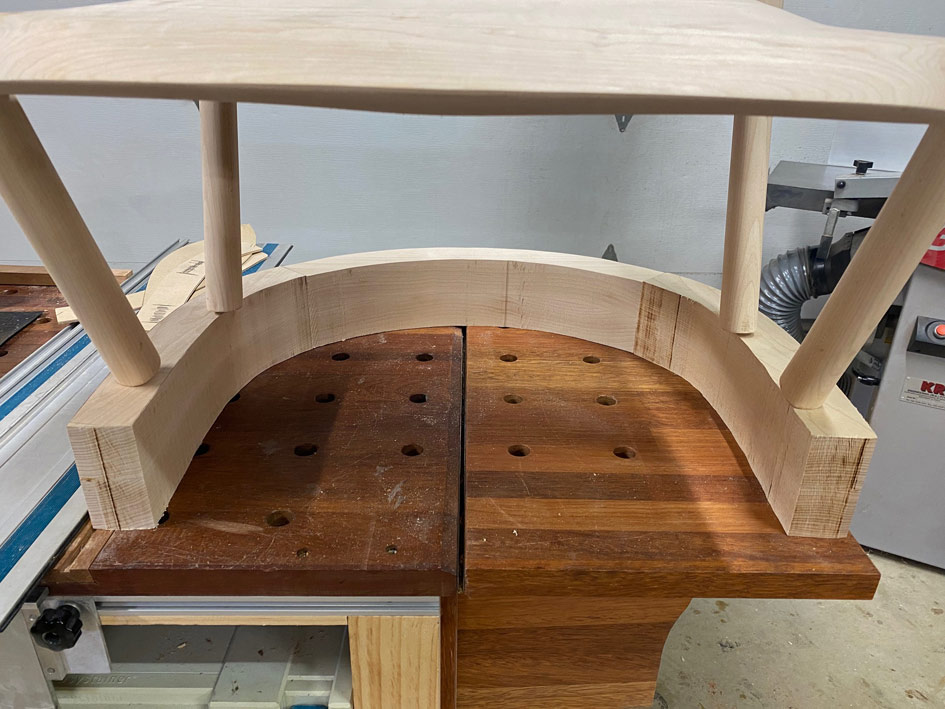
The arm/rail combination is now placed on the arm supports and adjusted to the front and rear to determine the rear overhang and position for the front joint ..


The template I made up earlier is used to trace out the side elevations. The shaping here is approximate. The main goal is to establish the length of the arms and from arm support joint ...


A little detail of interest: the height cut is slightly more than the front joint triangle would suggest as the final shaping requires a little extra meat to end in a curve ...


This is now sawn to shape, except for the underside of the arm, as the mortise/tenon area needs to be determined separately for each arm ...


Tomorrow will begin the final shaping and, hopefully, glue up of the arms.


Regards from Perth

Derek
 
A little more as it is getting closer.

The first step is to align all the arms and mortices ...


There was a lot of scribing, fitting, scribing and more fitting.

Finally the shaping of the underside of the arms was possible as it was now possible to determine the general position of the mortises.


The waste was removed with a bandsaw and coping saw ..


Now the specific position for the mortices was fixed with dowel pointers ...


Drilled and dowelled ..


And the arms fitted to check that all will fit at the end ...


Shaping to come.

Regards from Perth

Derek
 
This is a last post before I return from three weeks being dragged over New Zealand mountains by my wife and her family. I used the Easter Weekend to get as much done as possible, but I needed a few more days. So there is more to come, later.

It is helpful to remember what the aim is - as close a copy of the DC 09 chair as possible. All guidance from photos ...


We left off here ...


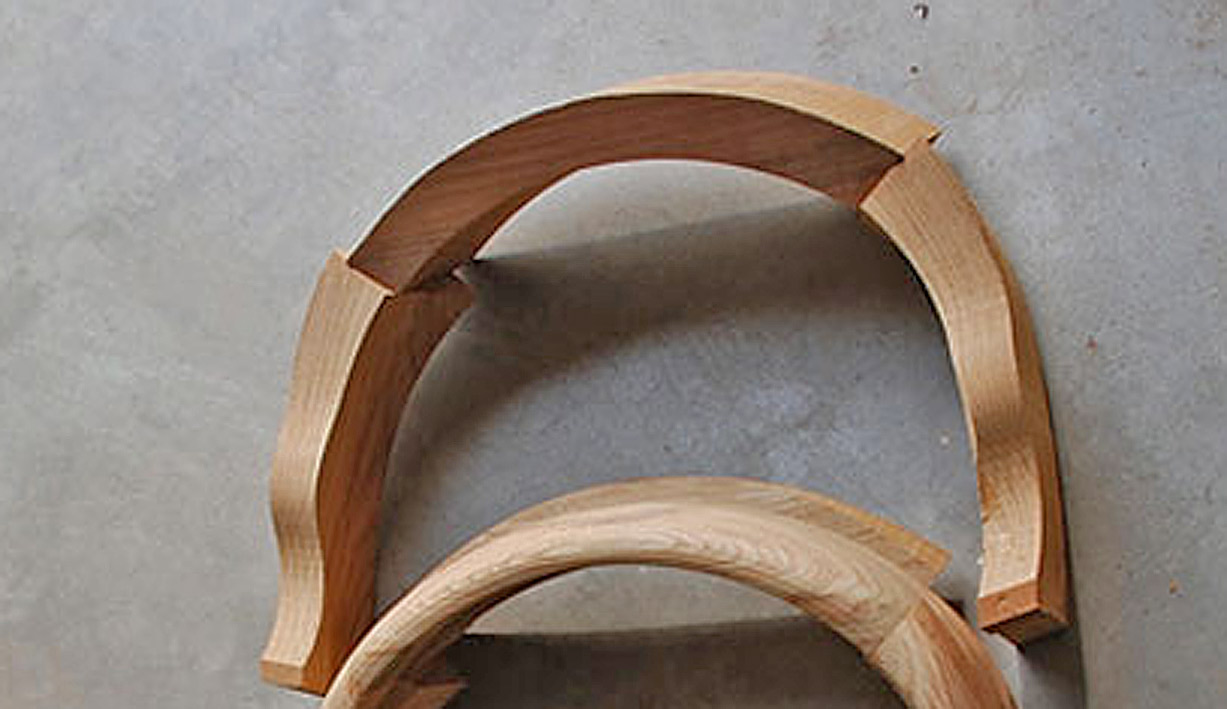
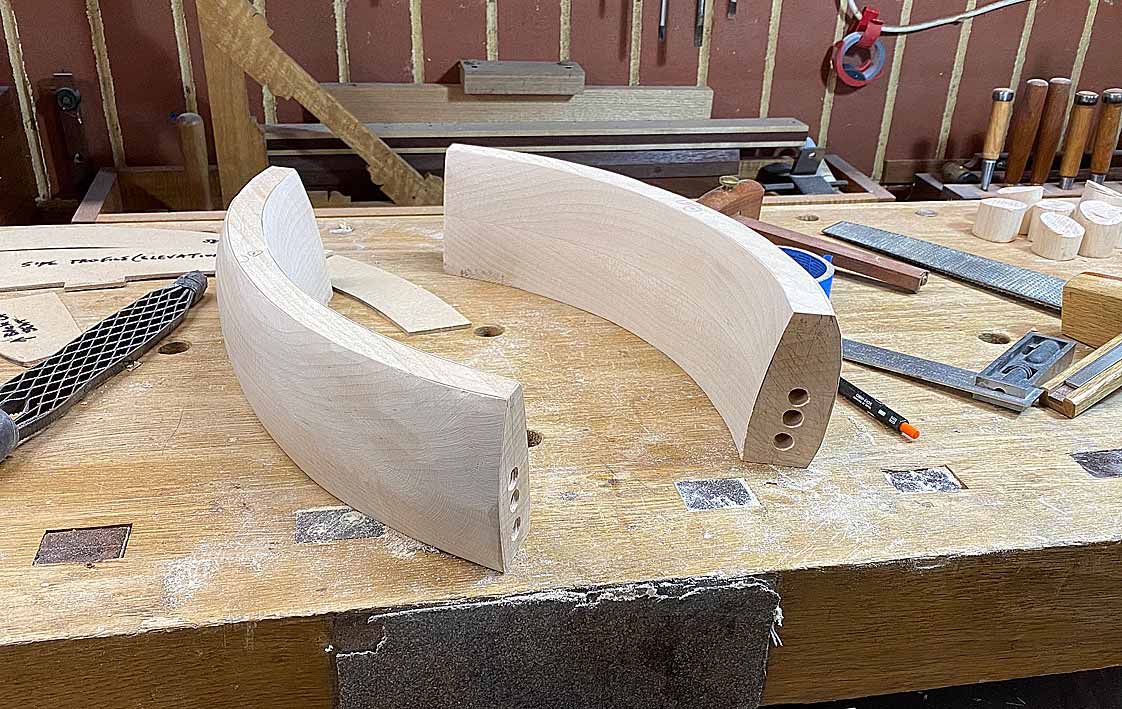
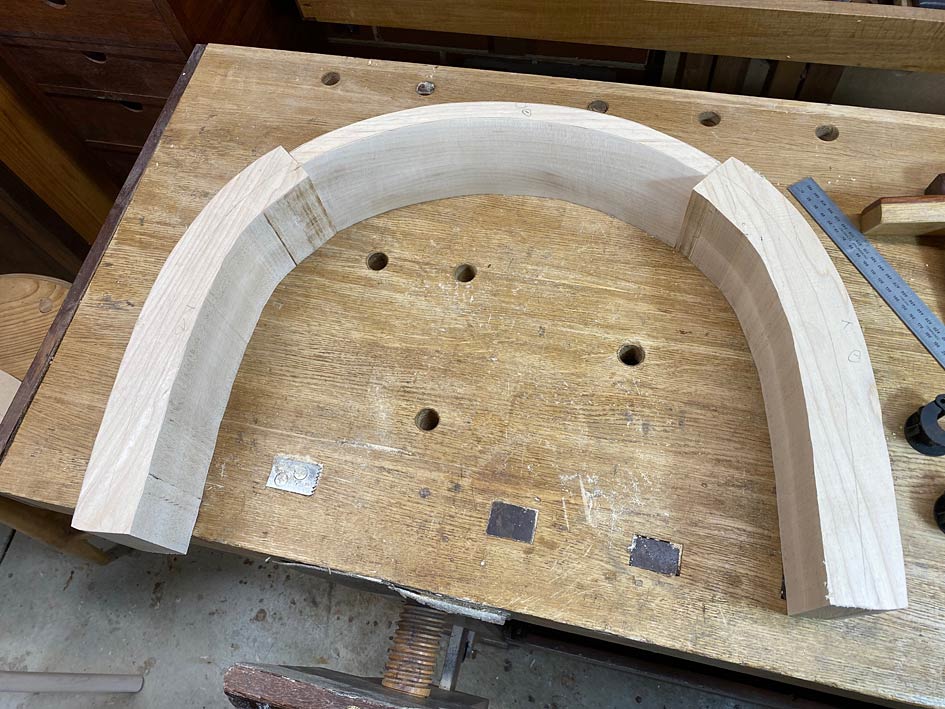
The three parts that make up the arms and top rail ..


The top rails were shaped ...


And shaping started on the arms ...


Today the arms were begun.

I find it easier to do one part as far as I can take it, then stop and repeat this with another part. When all four arms have progressed the same distance, I start with the first arm again and take it to the next stage. Then the other three to match. And so on.

Each stage completed must be checked, and this is done by putting the parts together, to check that they balance. The two sides must remain a mirror image, and the two chairs must be identical. There are no templates to mark the lines to work towards, only the rough layout lines that appear fair to the eye.

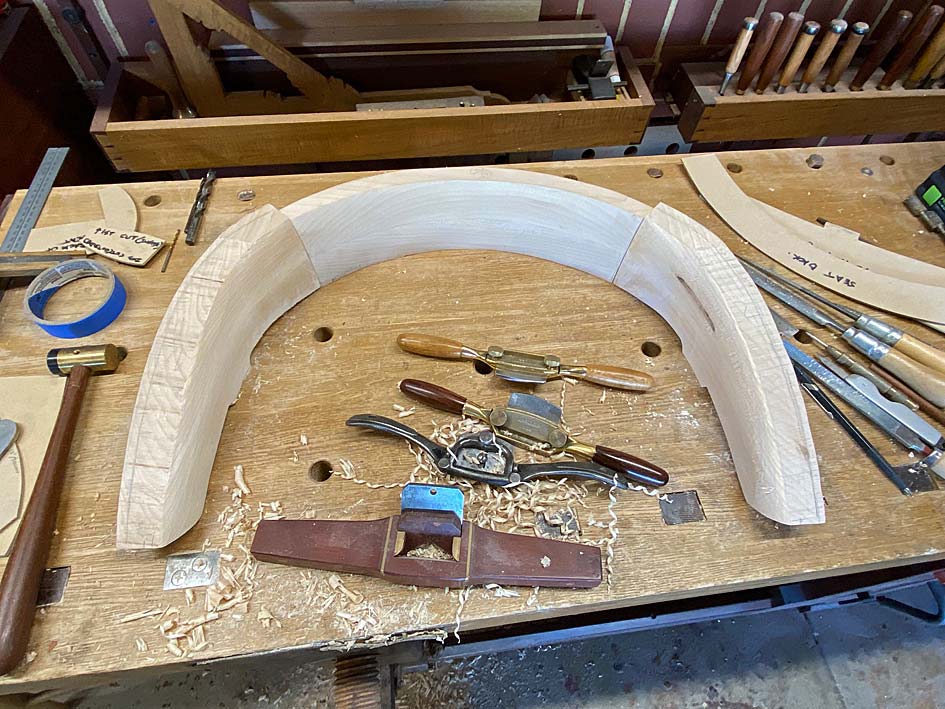
The arms are shaped with rasps and spokeshaves ... mainly coarse rasps - the Shinto and a 10 grain Auriou - followed with round- and flat bottom spokeshaves. Starting with the inside faces ...


Inside faces mostly done ...


Inside faces almost done, except for the undersides ...


Further along - top inside and outside faces mostly done ...


And that's it for now. More later. Thanks for keeping me company through this build.

Regards from Perth

Derek
 
Theses have been an incredible amount of work Derek, but certainly worth it, even if just from a learning and personal satisfaction point of view. But after saying that I’m not sure I would want to start your journey lol.
 
That's getting ever so close, Derek. I can feel your frustration in having to have a really lovely holiday just when you are on the home straight of this build, wanting to stay in the zone where it's all going so well.
 
Thanks Ian and Andy.

One value in taking a break is to be able to look over photos and make comparisons. For example, there is quite a bit of shaping still to do on the arms. At present, not only is the underside and mortices to be shaped, as well as ensuring all fits flush (which can only be done at the end), but the original chair has nice slim arms and top rail. Getting a little distance will help avoid anything impulsive.

Regards from Perth

Derek
 
Back on the job after 3 weeks hiking mountain trails in the South Islands of New Zealand, then returning home with Bronchitis (although I was wearing a mask on the plane, passengers preferred to sit with the crying babies than listen to me cough and wheeze!). A few more weeks to recover. First day in the workshop this weekend.

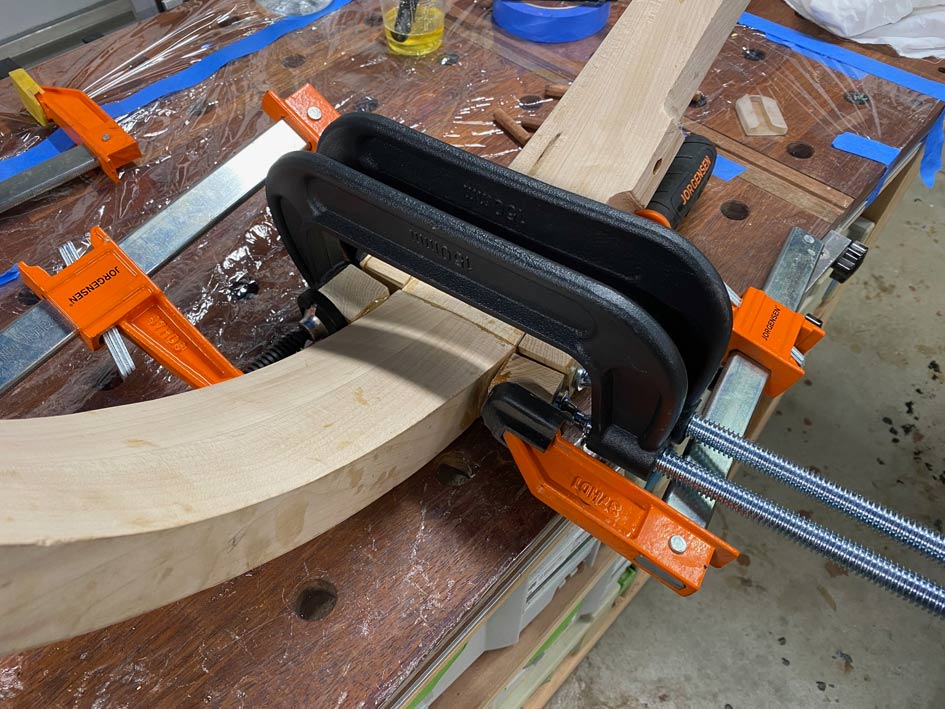
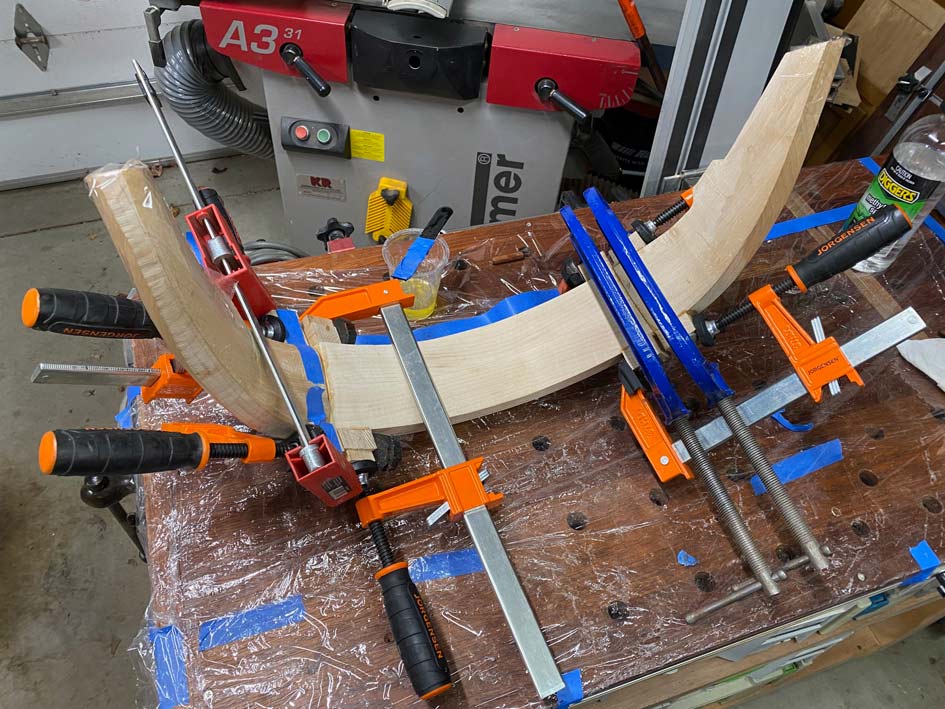
First task was to glue the arms sections together. You will recall that they are reinforced with dowels.


In a similar build, where the sections needed to be clamped together, it was possible to leave "ears" as the blanks were wider/thicker. I could not do that here, and so decided to epoxy these ears on ...


Well, it wasn't particularly successful, even allowing for 24 hours cure time. The ears broke off.

All I could do was clamp the ear on, and pray this would hold.


Later I realised that the problem was that the dowels I used were too tight, and the force needed to drive them home was unexpected. Lesson learned for all - if using epoxy, which is gap filling, the dowels has be a slip fit rather than a force fit. Of course, it would have been easier if I had known this beforehand!


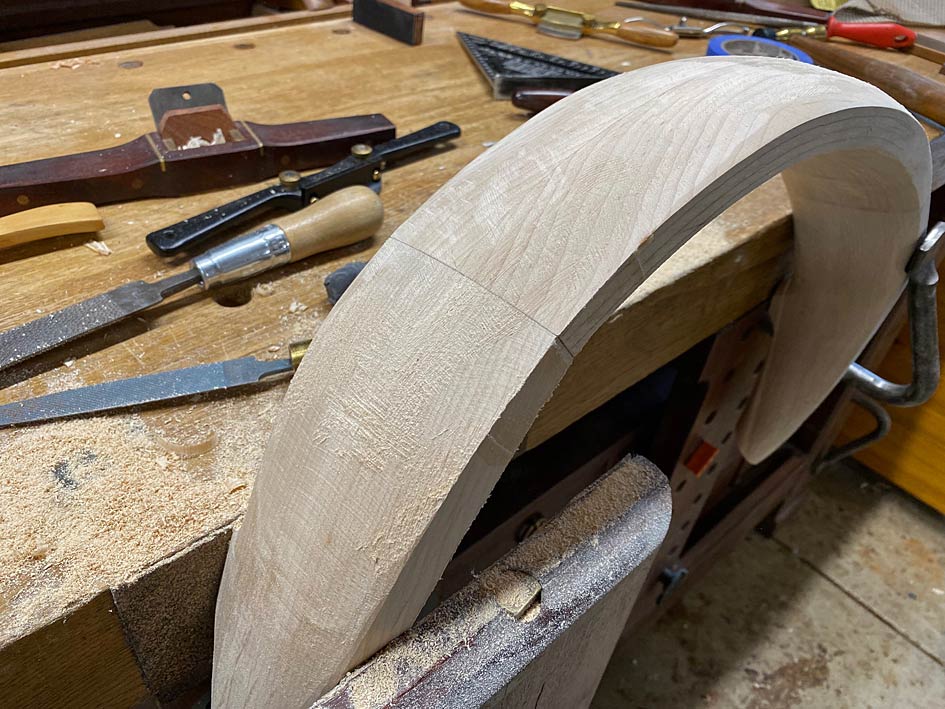
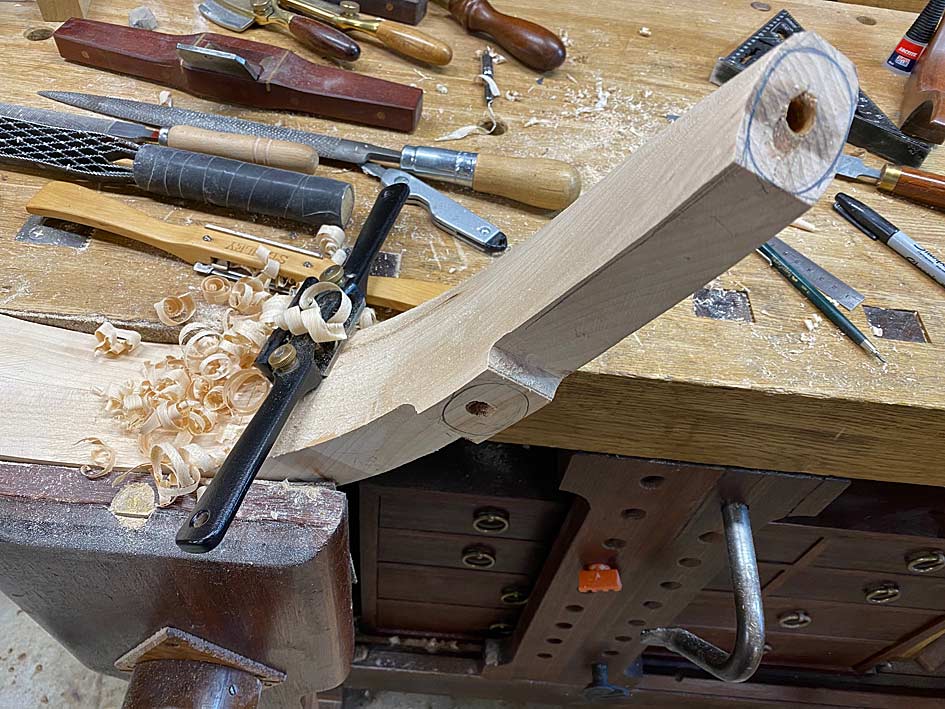
Once all was together, now in one piece (or two pieces if you count two chairs), the rasping and spokeshaving began ...


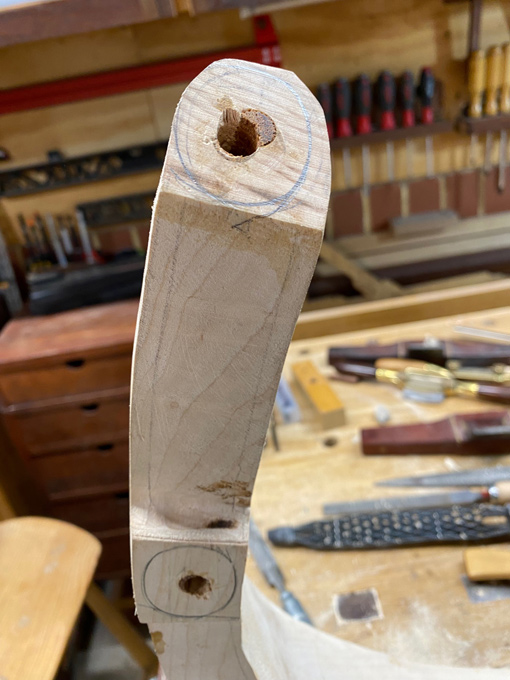
The aim now was to get the arms closer. This is all slow work, a bit here and a bit there, return to check the symmetry and shaping, and a bit more off. Work stopped to redrill the dowel holes that hold the arms to the legs. There had been a little movement while I was away, or I have measured inaccurately the at the start. It is important that the arms-legs join with as little stress to the joint as possible.


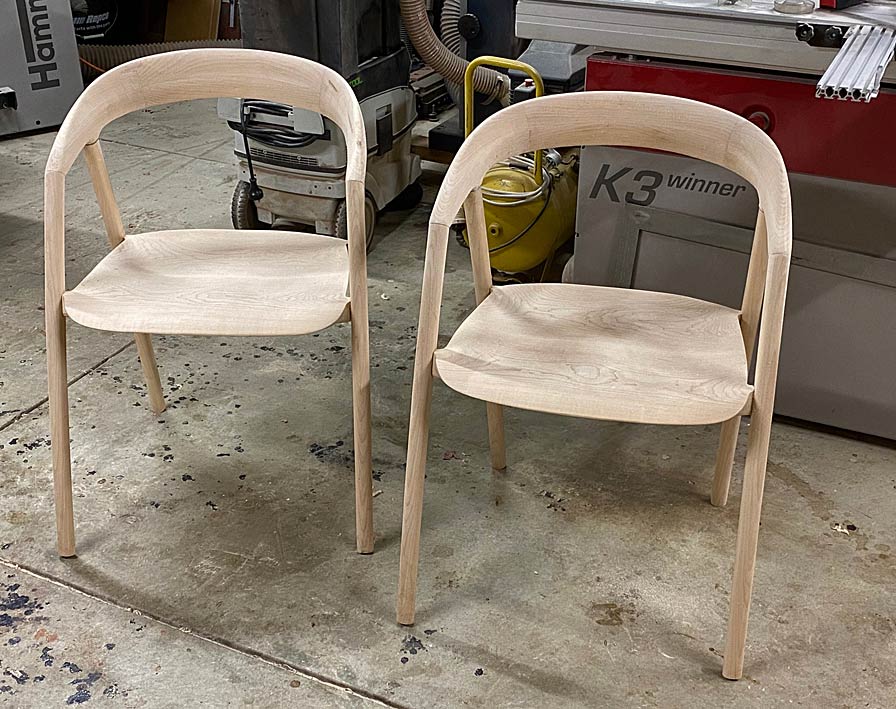
A couple of progress shots of shaping thus far - lots still to come, but its getting to look like the original chair now.


Regards from Perth

Derek
 
There is a lot of hand work going into making these chairs and it looks like quite an adventure.

Looking at the photos and taking a scale from the photo you put the seat at 430 high and the back of the chair at 740.

On my laptop screen the 430 measures 82mm so I divided 82 by 430 to obtain 0.19, I then I multiplied 0.19 by 740 which equals 141.12 but on my screen the actual measurement from the line to the back of the chair is 133 so less than 740. It may just be the angle of the photo, I hope you don't mind my commenting as you seem to be receptive to others comments?

Reading through this thread it seems to me that you have an enormous amount of woodwork skills and have enbarked on a real challenge making these chairs. I have only ever made one chair and it was quite a supprise to me just how many angles there are to work in. The chair you are making is at the next level and will be lovely to see when finished, I wish I had your patience. Mark
 
First class skills. Perhaps they will find their way into a competition soon.
 
I have found that the shaping of the chair arms and back to be a complicated process, with a step forward, then sideways, and then another step forwards. It is not plain sailing. There are many small corrections to make as I proceed, and I dare not attempt to leave these until a later date. I thought that some here will find the corrections ... repairs ... interesting, and hopefully useful if you find yourself in the same situation.

In the following photo, where the inside back is being shaped, you can see two joins where the arms and back connect ...


Outside example ..


These joins are clean and tight. In all there were 8 such joins, 2 chairs with each 2 inside and 2 outside joins. Of these 8 joins, 7 were perfect. One was a disaster!

What happened was, in clamping the two parts, there was movement and an outside section moved slightly. This left a gap. To make it worse - as bad as it could get - the corner of one piece was crushed by a clamp, and cracked! I pushed it back into position, secured it, but it must have moved a little. Try not to cry ...


Well, you just have to repair it. And not with filler or a wedge.

I decided to peen the wood and move it into the gap. I have used this technique for dovetails, which is edge grain, but never for end grain. In fact, I have not seen anyone do this before.

Using a couple of different size drift punches, I began tapping the wood into the gap ...
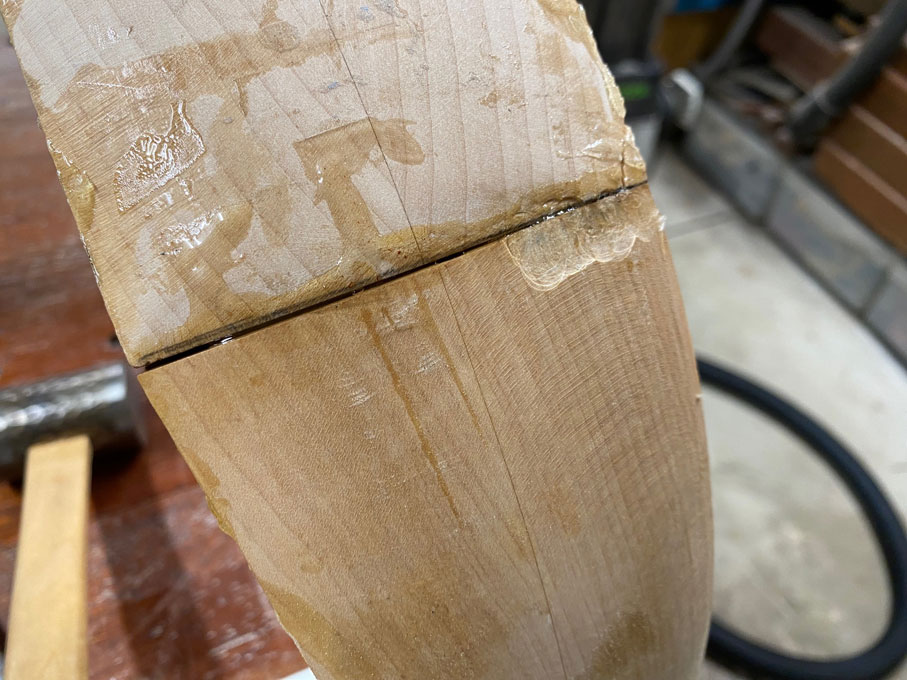


It looks like hell, but it did the job ...


I'll save the outcome for the end of the build. [wink]

In the following photo you can see areas marked in pencil. These are where waste is to be removed ...


A little is removed, and then the arms are returned to the base, where more is marked for removal ...


The shaping of the arms is completely by eye. There are no templates to guide the work done. The photos are my reference: "does it look right ... no ... take more off there ....".

I finally get to a point where I need to check whether the curve at the rear is fair. It needs to be symmetrical and fair, and the same for both chairs. Now I trace the curve of one half of the rear centre section ...
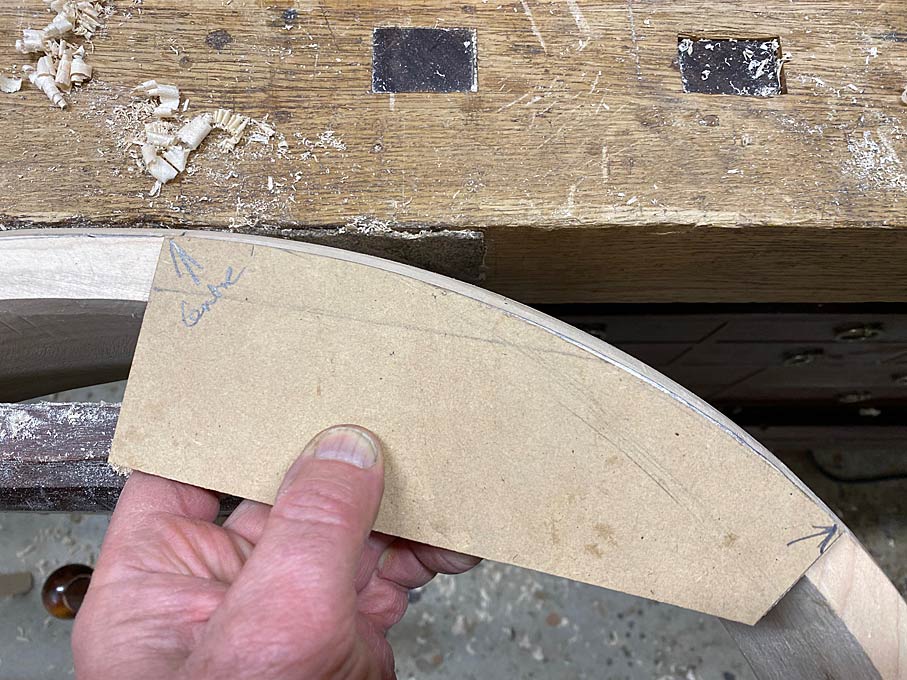


Flipping the template, this is taken to the other side of the back ..

It is just a smidgeon off ...


And the template is used on the other chair, and this proves to be identical o chair #1 ... just a smidgeon off the left side to spokeshave away ...
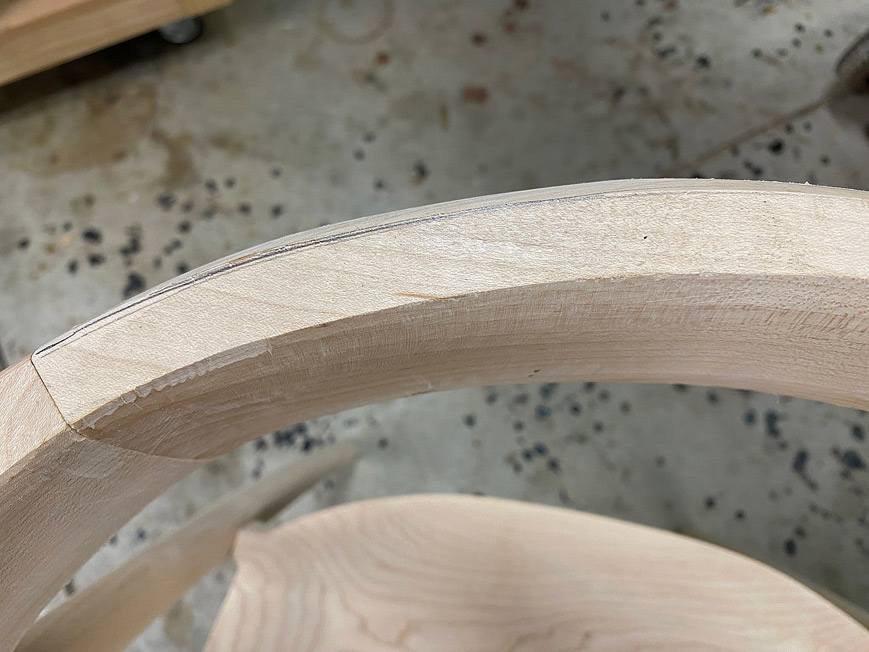


I am amazed that the shaping has remained within my tolerances all this time!

Lastly, I have been keeping an eye on the leg-arm joins. A couple were not meeting flush, and this needed to be corrected. For example, here you can see the gap. The blue tape marks where it keeps to be corrected ...


The top is covered in pencil to help see where the rasp is working, and the section that must not be touched ...


The result ...


The end of the day. A lot of work has been done over a period of 1 1/2 days in the workshop. This may go unnoticed by all but you and I ...


Lots more to do.

Regards from Perth

Derek
 
Nice.

I find using the 'shoe-shine' method of sanding helps create and maintain an arc. I've seen it used with 6" wide strips of 80 grit which removes significant amounts over a large arc in a fairly short time. I use narrower strips on my instrument necks.
 
This is, hopefully, the penultimate post on these chairs. I was unsure whether to post this one since the changes and progress sequence must appear so small to all, yet I am aware of how much work goes into shaving, shaving, shaving ... And there is still more to do, as well as more shaping to slim the arms further, and then sanding to a finished surface before adding shellac (for tone) and hard wax oil for protection. We are closing in. :)

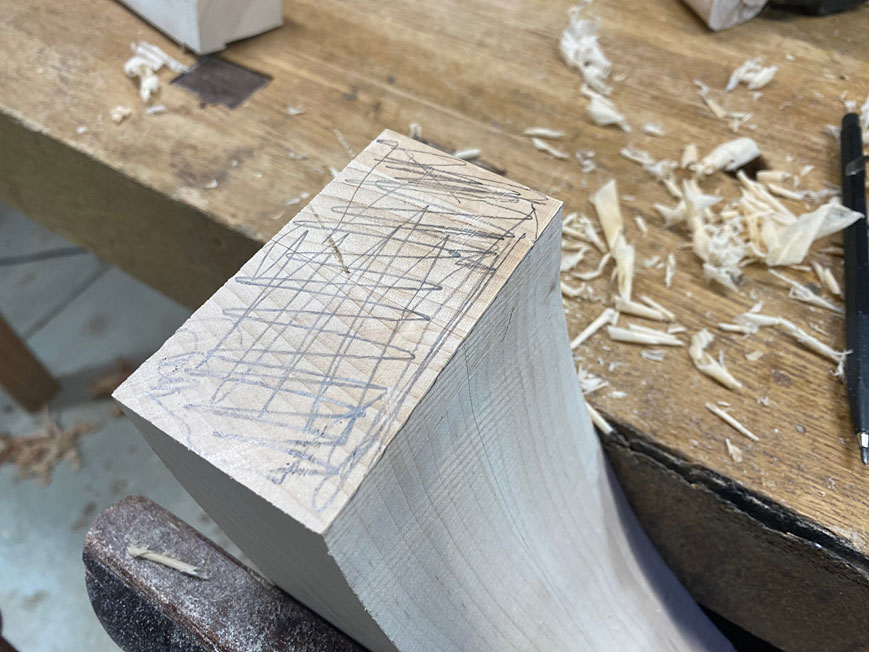
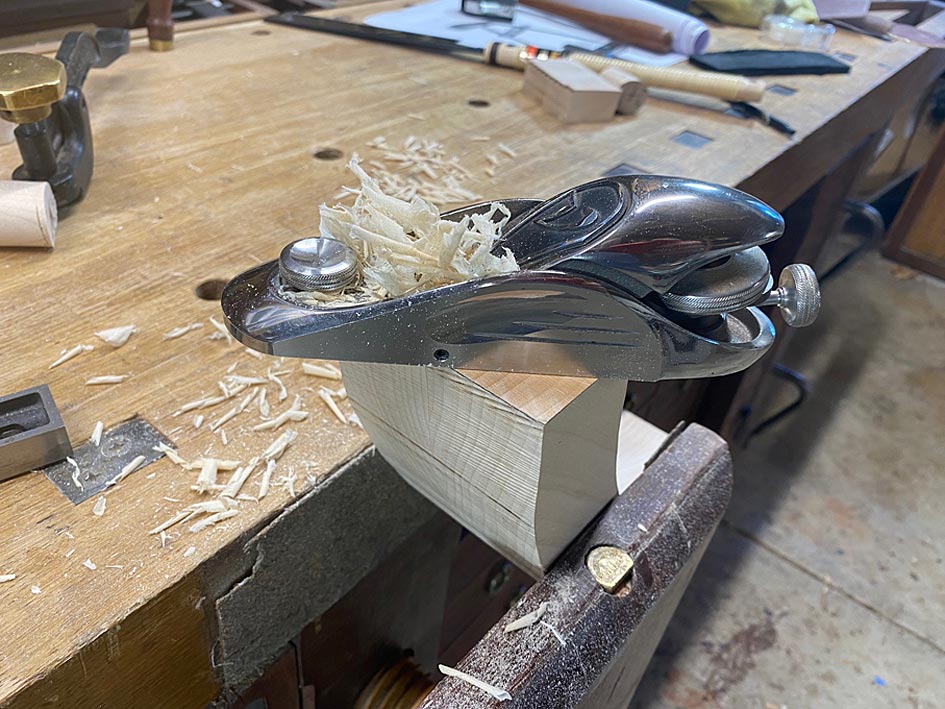
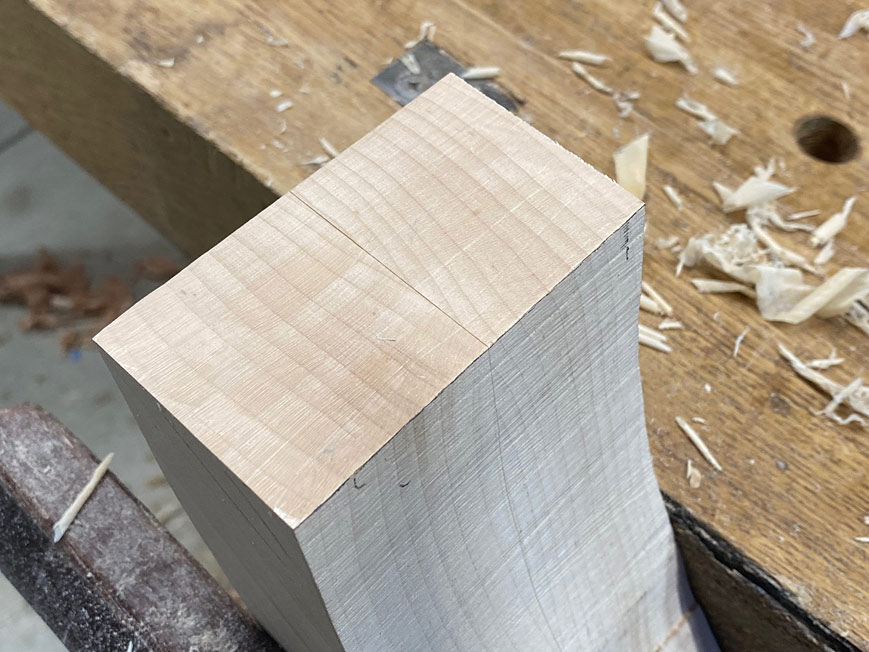
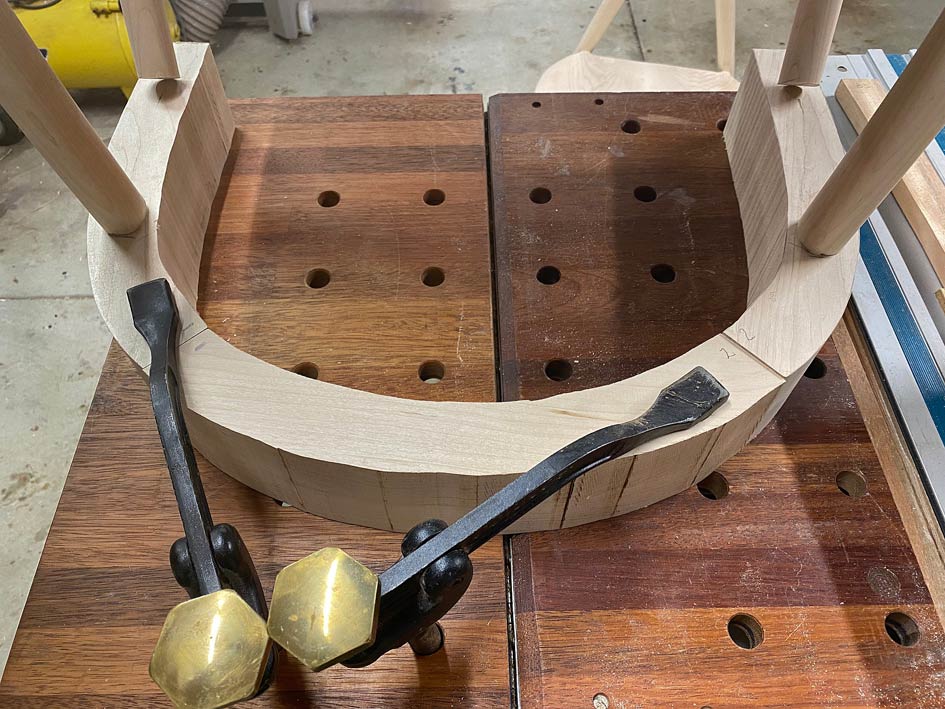
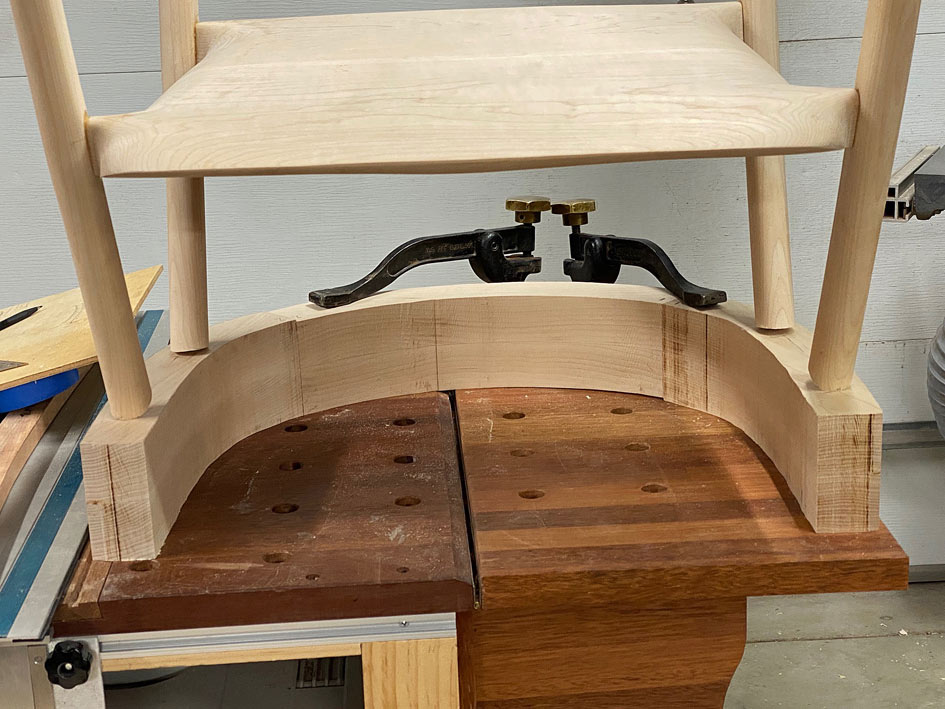
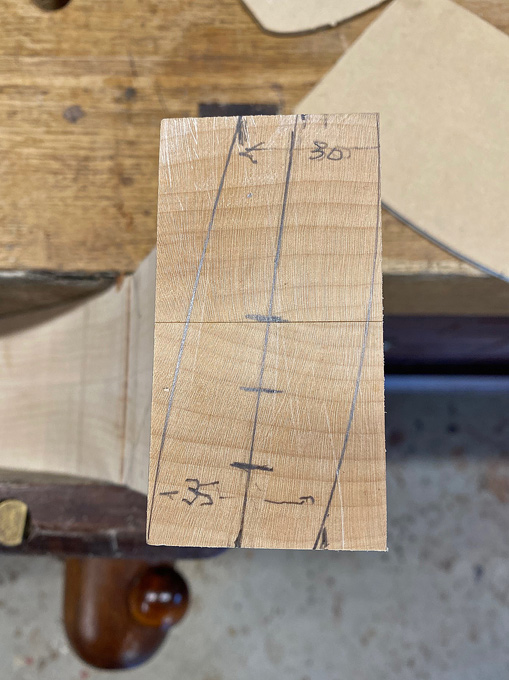
The toughest task in working on the arms is to hold them. I choose to work at a MFT bench as it has options for clamping. Here are some ...


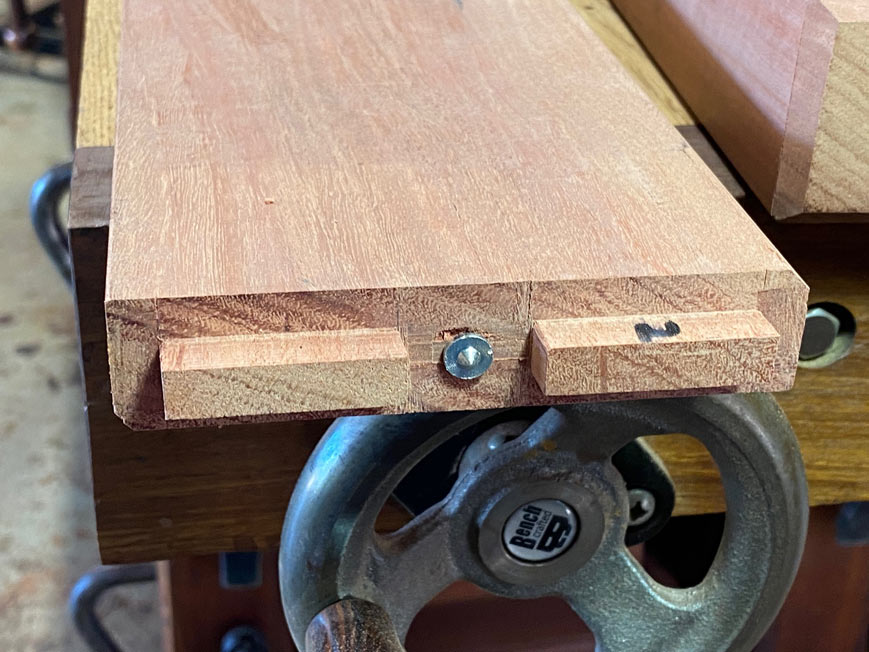
The end vise gets used in a number of ways ...


Hold downs secure the arms to work on the mortises ...


The arm-leg connection was worked on earlier and mated closely, but not enough. Final fitting is made by holding the two together and sawing though the join with a thin saw blade ...


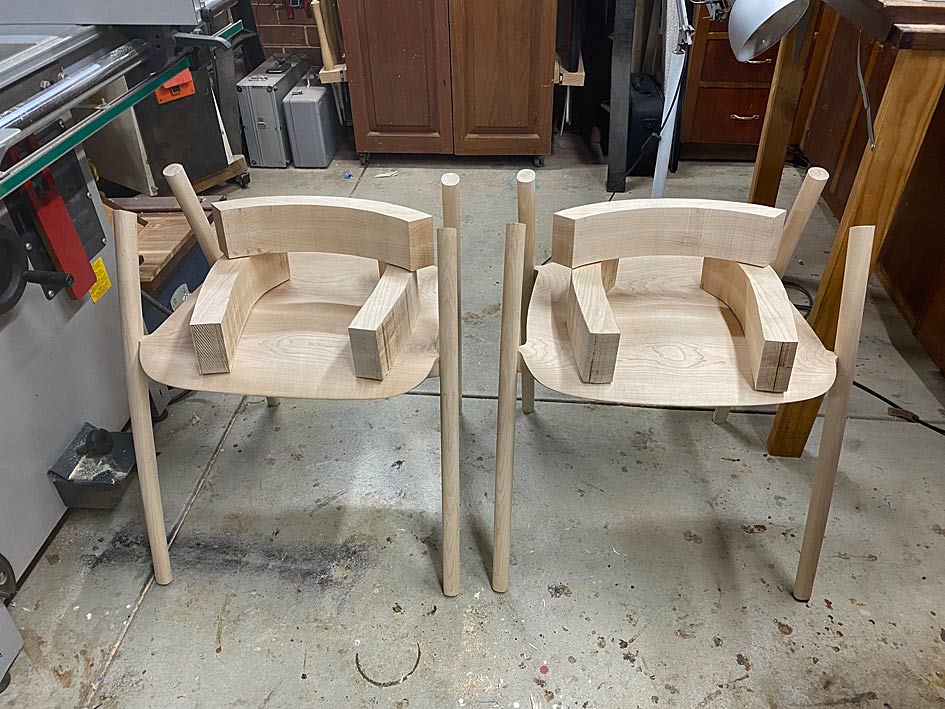
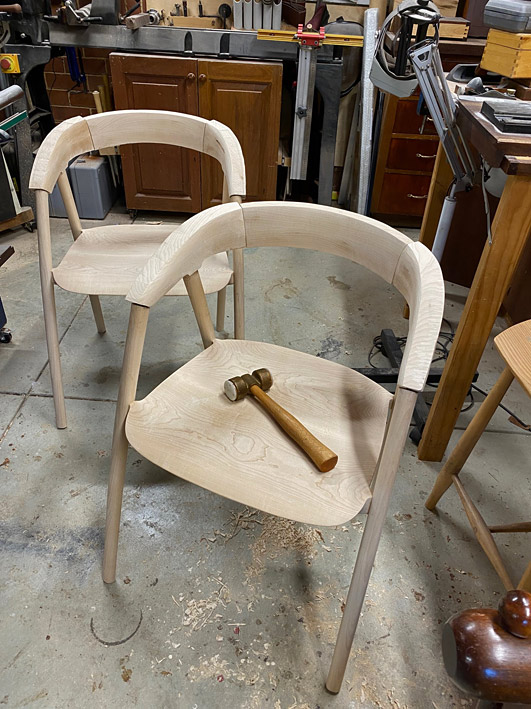
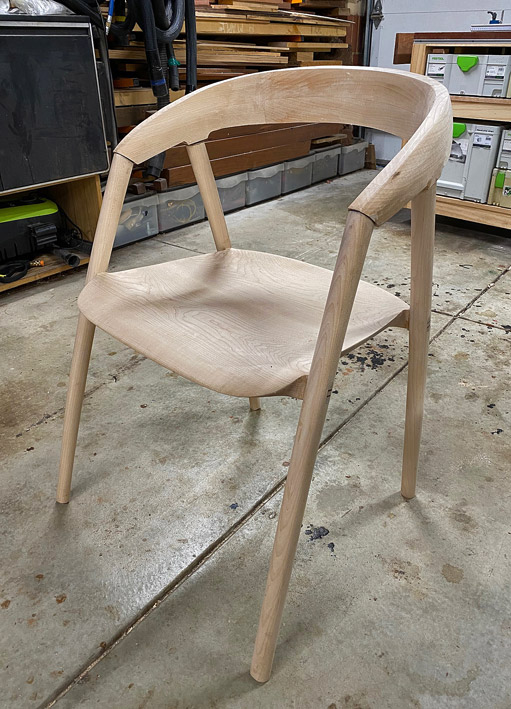
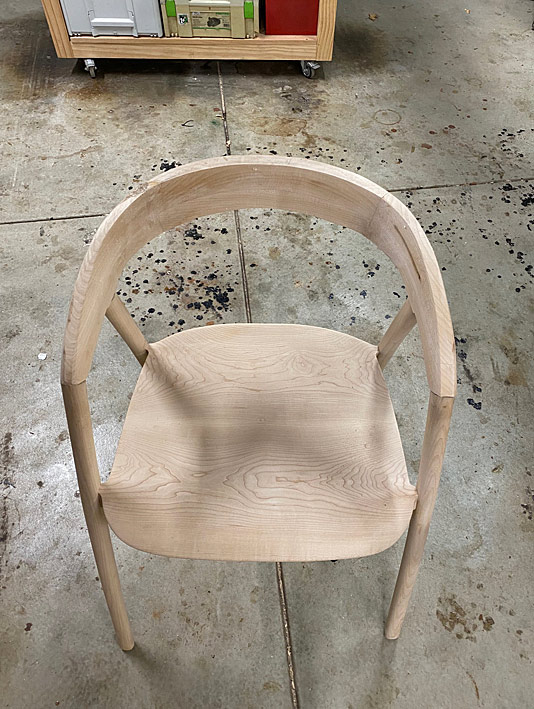
The current state of play ...


Regards from Perth

Derek
 
Back
Top