
-
Hi all and welcome to TheWoodHaven2 brought into the 21st Century, kicking and screaming! We all have Alasdair to thank for the vast bulk of the heavy lifting to get us here, no more so than me because he's taken away a huge burden of responsibility from my shoulders and brought us to this new shiny home, with all your previous content (hopefully) still intact! Please peruse and feed back. There is still plenty to do, like changing the colour scheme, adding the banner graphic, tweaking the odd setting here and there so I have added a new thread in the 'Technical Issues, Bugs and Feature Requests' forum for you to add any issues you find, any missing settings or just anything you'd like to see added/removed from the feature set that Xenforo offers. We will get to everything over the coming weeks so please be patient, but add anything at all to the thread I mention above and we promise to get to them over the next few days/weeks/months. In the meantime, please enjoy!
You are using an out of date browser. It may not display this or other websites correctly.
You should upgrade or use an alternative browser.
You should upgrade or use an alternative browser.
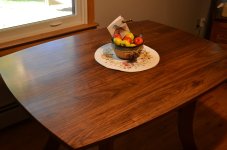
Dining table
- Thread starter fiveeyes
- Start date

Pete Maddex
Old Oak
Very nice.
Pete
Pete
Cabinetman
Sequoia
- Joined
- Oct 11, 2020
- Messages
- 5,837
- Reaction score
- 1,476
- Location
- Lincolnshire Wolds + Massachusetts
- Name
- Ian
Yes nice, great finish on the top, what did you use please?
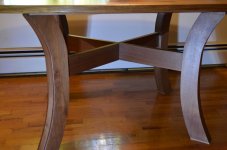
Difficult to see but it looks like you’ve fitted a thin subframe on top of the legs?
Difficult to see but it looks like you’ve fitted a thin subframe on top of the legs?
duke
Old Oak
As mentioned, very nice table.
fiveeyes
Nordic Pine
Thanks all. I had some comments written, must be in cyberspace.
Yes there is a frame attached to the legs, and then the top uses figure 8's.
The finish is oil base polyurethane, mixed 50-50, with naptha. Applied with a foam brush.
Was scheduled for 6 coats, but at 5, it looked really good, so stopped there.
I have photo's on my phone, but the plug in port failed, will have a go at getting them moved.
For you hand toolers, top is 35mm thick, beveled the underside edge, completely with a No 4, and a block plane.
Very satisfying.
I picked up a couple of side chairs, free, from a neighbor. The style of the legs, is close to the table.
I am going to make two chairs, using those for a pattern, loosely. This coming winter's project.
bil
Cabinetman
Sequoia
- Joined
- Oct 11, 2020
- Messages
- 5,837
- Reaction score
- 1,476
- Location
- Lincolnshire Wolds + Massachusetts
- Name
- Ian
Hi Bil I haven’t come across using Naptha as a thinner, looked it up and it would appear to have a few health risks, are they being over cautious do you think? I’m trying to put this into perspective compared to say French Polishing? I love the finish you got on the table and am a frequent user of water based polyurethane as a finish.
Ian
Ian

Steve Maskery
Old Oak
That looks very nice indeed 
What wood is thtat? You have created a beautiful colour.
I made a dining table and chairs a few years ago, and it really grieves me that it has been covered in kitchen junk for the last year, so I can't sit at it!
It was a mega-project, never again...
S
What wood is thtat? You have created a beautiful colour.
I made a dining table and chairs a few years ago, and it really grieves me that it has been covered in kitchen junk for the last year, so I can't sit at it!
It was a mega-project, never again...
S
fiveeyes
Nordic Pine
Steve...all wood is walnut.
Ian..I new that the fumes and smell, would not be well liked in my shop.
Therefore, it went to the garage. When the overhead door is up, ventilation is no problem.
The weather, at the time, was very good, 75-80 f. If you give it a go, you must work quickly.
The top is 132mm x 99mm, about 2/3's of way across,you cannot go back. Must keep a wet edge.
After the third coat, I had no more issues. Still looks great. Forgot...the first coat had an equal amount of BLO.
Let the oil dry for 3 days, before the 5 poly mix.
hope this helps
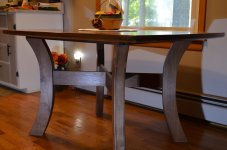
Yes, an attractive table with a lovely colour. However, my eye was drawn to two features of the legs:
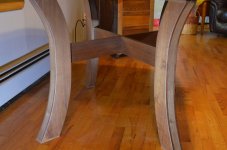
They appear to be laminated in the thickness with two outer layers sandwiching a differently coloured core. Am I seeing that right, or is there some other explanation?
The outer concave sweep of the legs is curious in that it's notchy. For example, there's a sweep at the top which has a sort of step change to a different sweep at a point somewhat above the level of the stretchers. I just wonder why you didn't incorporate a smooth imperceptible change to the sweep rather than an obvious notch? I can appreciate the reason for a straight part of the convex inner sweep to accommodate the stretcher to leg joinery, but that outer notchiness is somewhat discordantly eye catching. Slainte.
fiveeyes
Nordic Pine
Richard...yes, the sweeps are different. Upper one to increase the width, and length, to better support the top.
The lower sweep, to keep the footprint, at floor level, smaller. More room for my big feet.
Yes also, the legs are laminations. I have more photo's, on my phone, have to solve some hardware problems, first.
Working on that.
thanks
The lower sweep, to keep the footprint, at floor level, smaller. More room for my big feet.
Yes also, the legs are laminations. I have more photo's, on my phone, have to solve some hardware problems, first.
Working on that.
thanks
I think you could have achieved both those aims with a smooth transition from one curve or sweep to the other. As it is the eye is drawn to that somewhat discordant relatively sharp transition from one sweep to the other. Well, I find it a bit discordant, others may not. It's still a nice table though. Slainte.Richard...yes, the sweeps are different. Upper one to increase the width, and length, to better support the top.
The lower sweep, to keep the footprint, at floor level, smaller. More room for my big feet.