

Dr.Al
Old Oak
For those who aren't aware, Festool's main Domino patent expired a month or so ago. That probably means that there will be lots of Domino clones on the market in the near future (Kreg have announced one already).
At the moment, the idea of a Domino machine doesn't really appeal to me: I'd rather do some joinery with a chisel than listen to a machine screaming its way through a bit of wood. Nevertheless, I can imagine the odd situation where it could be handy for rough stuff where I just want to stick stuff together fairly quickly (but not so quickly that a screw would do the job ). That's definitely not enough of a justification to think about spending Festool money (or even Kreg money) on a machine.
However, it was enough of a justification to spend £9 on a 3D-model from JSK:
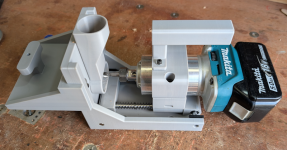
That's with the fixed fence fitted. I've also printed the adjustable angle one (for mitres and such-like). The plans also included some fixed bases (which you can see in the picture at the JSK link) so you could support small workpieces while using it, but I haven't printed them.
So, how does it work? Noisily! Well, it is a screaming monster after all
This is what it looks like in use:
I'll never be a youtuber. That was a bit jerky as I pushed the router in, but that was mostly me trying (and very nearly failing) not to trip over the camera tripod!
I had held a couple of bits of wood next to each other and drawn a couple of lines across both in arbitrary places. In each of the bits of wood, I lined the pencil marks up with the lines built-into the 3D-printed fence thing and attacked. The (Trend) dominos fit perfectly:
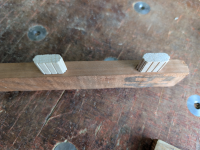
There is adjustability built into the jig (by tweaking the size of some simple spacers) but for me it worked with the default sizes.
Offering up the other part:
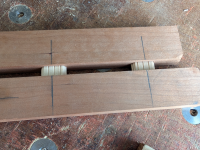
and closing the joint:
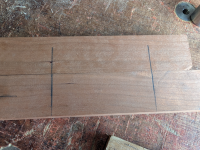
Quite impressive for a 3D-printed doodah.
I also tried doing an end-grain joint and that didn't line up as well. Given how well the dual domino face grain one worked I'd guess that was down to my inept technique rather than anything inherent in the tool. If it turns out to be the tool, then it should just be a case of tweaking the spacers.

Is this a way to get a Festool quality machine for free? No, of course not. I've never used a Festool Domino but I'm sure it's far, far more polished than this printed thing. However, for someone like me who would generally rather cut a traditional mortice and tenon, the number of situations in which a Domino would come out would never justify the cost.
Also, the printed thing isn't free. The 3D model costs about £9, then there's a shade over a kilogram of filament (so about the same cost again) for the bits I printed (i.e. excluding all the bases and stands) and finally some hardware to buy (linear bearings & rods, springs, screws etc). I had some spare linear bearings of conveniently the right size left over from my wood lathe duplicator and I've got a healthy collection of springs and screws so the only thing I had to buy was the 8 mm router cutter, but starting from scratch it would cost a bit more.
Was it worth it? Who knows whether I'll find a need for it, but it didn't cost me much and it's nice to have a variety of tools in the armoury.
At the moment, the idea of a Domino machine doesn't really appeal to me: I'd rather do some joinery with a chisel than listen to a machine screaming its way through a bit of wood. Nevertheless, I can imagine the odd situation where it could be handy for rough stuff where I just want to stick stuff together fairly quickly (but not so quickly that a screw would do the job
). That's definitely not enough of a justification to think about spending Festool money (or even Kreg money) on a machine.However, it was enough of a justification to spend £9 on a 3D-model from JSK:
That's with the fixed fence fitted. I've also printed the adjustable angle one (for mitres and such-like). The plans also included some fixed bases (which you can see in the picture at the JSK link) so you could support small workpieces while using it, but I haven't printed them.
So, how does it work? Noisily! Well, it is a screaming monster after all
This is what it looks like in use:
I'll never be a youtuber
. That was a bit jerky as I pushed the router in, but that was mostly me trying (and very nearly failing) not to trip over the camera tripod!I had held a couple of bits of wood next to each other and drawn a couple of lines across both in arbitrary places. In each of the bits of wood, I lined the pencil marks up with the lines built-into the 3D-printed fence thing and attacked. The (Trend) dominos fit perfectly:
There is adjustability built into the jig (by tweaking the size of some simple spacers) but for me it worked with the default sizes.
Offering up the other part:
and closing the joint:
Quite impressive for a 3D-printed doodah.
I also tried doing an end-grain joint and that didn't line up as well. Given how well the dual domino face grain one worked I'd guess that was down to my inept technique rather than anything inherent in the tool. If it turns out to be the tool, then it should just be a case of tweaking the spacers.
Is this a way to get a Festool quality machine for free? No, of course not. I've never used a Festool Domino but I'm sure it's far, far more polished than this printed thing. However, for someone like me who would generally rather cut a traditional mortice and tenon, the number of situations in which a Domino would come out would never justify the cost.
Also, the printed thing isn't free. The 3D model costs about £9, then there's a shade over a kilogram of filament (so about the same cost again) for the bits I printed (i.e. excluding all the bases and stands) and finally some hardware to buy (linear bearings & rods, springs, screws etc). I had some spare linear bearings of conveniently the right size left over from my wood lathe duplicator and I've got a healthy collection of springs and screws so the only thing I had to buy was the 8 mm router cutter, but starting from scratch it would cost a bit more.
Was it worth it? Who knows whether I'll find a need for it, but it didn't cost me much and it's nice to have a variety of tools in the armoury.
Last edited:

