• Hi all and welcome to TheWoodHaven2 brought into the 21st Century, kicking and screaming! We all have Alasdair to thank for the vast bulk of the heavy lifting to get us here, no more so than me because he's taken away a huge burden of responsibility from my shoulders and brought us to this new shiny home, with all your previous content (hopefully) still intact! Please peruse and feed back. There is still plenty to do, like changing the colour scheme, adding the banner graphic, tweaking the odd setting here and there so I have added a new thread in the 'Technical Issues, Bugs and Feature Requests' forum for you to add any issues you find, any missing settings or just anything you'd like to see added/removed from the feature set that Xenforo offers. We will get to everything over the coming weeks so please be patient, but add anything at all to the thread I mention above and we promise to get to them over the next few days/weeks/months. In the meantime, please enjoy!

Don't read if you are veganitarian

Country ham is the term used across the pond when referring to hams made from whole pork shoulder on the bone that go through a dry cure and cold smoking and are then air dried over a period of 10 to 18 months. The process and seasoning in the cure is based on Bavarian/Saxon cures from the 18th C and is very different to the process mostly used in England at the time which used a wet cure and hot smoke before being hung to dry. The way to thin about the final result is to see the country ham as having a Black Forrest/Iberico texture and the old English as breaded or Wiltshire ham.

As an aside most Americans these days when they make one use a product called cold smoke to inject into the meat to give the smokey flavour ~(as used in factory massed produced smokey bacon) It is basically the smoke from wood fires that has been captured in a big funnel and passed through condensing tubes to give a liquid at the end rather than making and using a proper cold smoker. Cold smoking cools the smoke to below 20c before it enters the smoking chamber and flavours the meat without cooking it in any way
 
:text-goodpost:

And also Americans make cheese by taking soft plastic and colouring it yellow.

I prefer the Bavarian / Iberico style if that is dark ham. I'm not aiming for a soft British type. No books haev arrived yet and anyway it's not raining so I am painting the dratted house. :|
 
AJB Temple":hyuozfz2 said:
And also Americans make cheese by taking soft plastic and colouring it yellow.
Some years ago there was a programme on the televisual where Stephen Fry toured the USA and at the end one of them he dryly commented to the camera..."bring your own cheese" :lol: - Rob
 
Cheese from all corners of the globe available at Wholefoods all across the states, bit like Waitrose.
So they are starting to return to civilisation :lol:
Just about the only supermarket where it’s safe to buy meat as well. Ian
 
While I generally agree regarding American cheese, we once had some cheddar, in a tin, from WA, that ranked with the finest cheddar I've ever tasted. I think they can make good cheese, but there's not a lot of demand for it.
 
I think that's a general pattern with American products, food and otherwise - there are small producers scattered around the country making things that are easily up there with the best in the world, but (as with many countries) the economy has been so distorted that the vast majority can't even think about affording them. Most of what's on the market, then, and what gets most associated with the country, is the stuff made to be as cheap and profitable as possible.
 
I agree. By far the best meat I have had was in Japan, then when I worked in Argentina (which was easily the best before I got hooked on Japan), and after that pitmasters in the US. The yanks do a lot of things really well. OK, it might be genetically modified, but taste is all.
 
And there are so many craft breweries it’s incredible, but they brew much stronger beers than I am used to.
This is the brew list from the local in Pennsylvania, the lowest ABV is 5% and the highest a massive 16.9% - it’s an old pub transported from Liverpool btw. Ian
 
wow. 16.9% is stronger than a lot of wine. I would be newty after one pint.
 
16.9 is ridiculous. Don't most yeasts die at around 14%?
I think the reason you find some stronger beers in the US is that in the UK, there's a higher tax above a certain strength.
 
I expect yeasts have been bred (hybridised) from sherry yeasts etc. which will go to about 17% iirc (or did a few decades ago, probably more now).

They alter the tax bands periodically. I remember in the late '70s we sold an apple wine by Merrydown which was 15% - the tax level was changed and it got so expensive no one kept it any more and it disappeared virtually overnight. (I remember someone drinking a half of a gallon of it (it came in 1/2 gallon bottles) one long lunchtime after eight bottle of Red Tuborg. He was a doctor.)

Years ago Watney's Starlight was so low in alcohol had it been 0.11% weaker it could have been sold to children.

I had a Licensed Victualler's Annual from 1900 (unfortunately I lent it and it was never returned) in which average percentage proof figures were given. They used what to me was the normal distinction (maybe not the technical one) between ales and beers - ales light, beers dark - and gave the average strength of beer as 5%+ and ale as 8%+. It was illegal to keep sugar on licensed premises as it could be added to beer to re ferment it.
 
I thought sherry was fortified.

I had a book about brewing and winemaking when I was about 11, so around 1964. I seem to remember it stated yeast generally died at about 13%. But I have no doubt that there are now super resilient strains in existence.
 
Andyp":2iv6tfs5 said:
I had a wee glass of this last weekend purely cos I liked the name. Very tasty


Quite apt for an English summer a winter ale :shock: :lol:
 
Back to curing.

The Keith Erlandson book arrived today. Lots of recommendations on-line. God knows why. The original was published in 1977 and mine is the 2003 update. You can read it cover to cover in 40 mins and learn practically nothing useful about curing meat for long term flavour development and storage. Very superficial to the point of being useless. Entire book is repetitive, but useful if you want to smoke or cure fresh fish.

Meat sourcing. It's recommended (elsewhere) to use a pair of hind legs from a smallish acorn fed or free range pig. Ideally not more than 2 days after slaughter and blood squeezed out from main artery. The popular local traditional butcher closest to me has no idea how old the carcass is when delivered to him. Yes, he could sell me a whole pig or half pig unbutchered. No, he still could not confirm when slaughtered. Same at the farm shop butcher who was unable to tell me where his pigs are reared and the family butcher in Tonbridge with a well known name locally said "ours come from the wholesaler and I couldn't tell you the breed".

Next week I will look around Tunbridge Wells and also visit the smokery about 10 miles away. I am determined to do this the Italian or Spanish way.

Just dug out my copy of Meat from Hugh FW and will see what he says.

PS. As an aside, one of my earliest childhood memories was of my grandfather (who lived next door on the farm) slaughtering a pig. He was a veteran of the Somme in WW1, a very good man with horses, and despite being as tough as old boots, very gentle and kind with me. There were pigs on the farm but also a few in the garden sty, next to the chicken shed.

Piggy was led to the pole. Clonked on the head with a lump hammer from behind so he (or she) never saw it coming and was hauled up the pole by a rope round its hind legs by my dad and grandad very quickly. Galvanised bucket placed beneath and throat cut. Blood collected carefully. Belly slit and innards removed and taken away. That's all I remember really. I was very young but I understood exactly what meat production involved. The local slaughterhouse was less than a mile away in the high street.
 
Been away on holiday - couple of recommendations for you for meat - we are fairly local. The first is the butchers in Marden, Ken Ballard. It is one of only a few butchers which has its own abattoir in the county or country I believe.

Second which we prefer for our pork is the open prison in East Sutton - it’s open Friday and Saturday and the meat is incredible and very well priced - a hidden jem. They send meat off weekly to slaughter and you may be able to speak to them and get it really fresh, not sure.

Reckon the first is more likely on the fresh front but the meat from the second is my favourite.
 
:text-goodpost: Thank you Matt. Hope you enjoyed your holiday. That is very helpful. I did not even know about the prison. (Women's open prison apparently). Or that butcher I think. I'm on it.

In the meantime I have perused "Meat". However, this is of no help sadly as HFW makes clear there that the curing recipes are not there, but in the River Cottage Cookbook. So' I forked out £3.17 just now to get one from Abe.

Truth to tell, there appears to be not much to it. Plastic box. Salt. Meat, Heavy weight. Drain daily and re-salt. Maybe add sugar.

Tricky bit is how long to salt, which seems critical, and finding good ham.
 
My grandfather was a slaughterman during WW2. He was a kind, gentle man. He used to kill and dress 200 chickens for his landlord over a weekend before Xmas, hanging them by the feet by the side of the river and chucking all the guts and feathers into it - hardly surprising it was full of rats. We played in it and I think we grew up immune to just about everything. The only thing he (and people he worked with) refused to kill were kids - they scream like children apparently. He ate tripe and all manner of things, but the one thing he would refuse to eat was a chicken sold without its giblets - he maintained that as the giblets were the first parts to show disease they were not included for a reason. This was in the days chicken was eaten three or four times a year, maybe.
We ate quite a lot of rabbit when I was a child, my grandmother made excellent pasties with rabbit and parsley. One of the first jobs my uncle had in the navy in the '50s was on Dartmoor clubbing rabbits with myxi. Apparently four or five hundred years ago Cornish peasants would eat rabbit if there was no choice in a really hard winter, and if the supply of rabbits dried up they had to eat lobster. :lol:
 
My grandfather was a slaughterman during WW2. He was a kind, gentle man. He used to kill and dress 200 chickens for his landlord over a weekend before Xmas, hanging them by the feet by the side of the river and chucking all the guts and feathers into it - hardly surprising it was full of rats. We played in it and I think we grew up immune to just about everything. The only thing he (and people he worked with) refused to kill were kids - they scream like children apparently. He ate tripe and all manner of things, but the one thing he would refuse to eat was a chicken sold without its giblets - he maintained that as the giblets were the first parts to show disease they were not included for a reason. This was in the days chicken was eaten three or four times a year, maybe.
We ate quite a lot of rabbit when I was a child, my grandmother made excellent pasties with rabbit and parsley. One of the first jobs my uncle had in the navy in the '50s was on Dartmoor clubbing rabbits with myxi. Apparently four or five hundred years ago Cornish peasants would eat rabbit if there was no choice in a really hard winter, and if the supply of rabbits dried up they had to eat lobster. :lol:
 
Well. it transpires Ken Ballard do indeed slaughter their own meat, so I can have two full hind legs of about 8kg on the say of slaughter if I give them a week's notice. It is not necessarily cheaper than buying the cheaper end of the Christmas market cured hams as the meat cost per ham will be about £50. But I think I will give it a go and do one on the bone and the other tunnel boned and done with a molasses cure.

The River Cottage cookbook arrived yesterday courtesy of Abe Books. I must admit Hugh FW does deal with meat, fish and game in a very practical way. I am still worried about the product being too salty and I will have to keep researching ways to deal with that. The HFW remark that made me concerned was sometimes the cured meat may be a little salty and this is negated by eating it with something sweet.

The serrano ham I have out on the rack now is firm and not salty. That was an Aldi ham. Can't remember now what the price was but it would have been under £50.
 
I made bacon the HFW way many years ago and it was inedibly salty. Others had the same experience. After many attempts, and triple-checking the recipe, we concluded that the salt was the wrong type. Ordinary, fine vacuum salt, which we used, is too effective.

I remember giving some to my boss at the time, and it gave him osmotic diarrhoea (‘a dose of salts’). This afforded some amusement :mrgreen:

The salt used by HFW must have been some sort of flaky ‘kosher’ salt or perhaps a more coarse-grained type. Also, without nitrites, the bacon goes brown on cooking which affects the flavour, and there is an increased risk of botulism.

By far the best way to dry cure bacon is to buy a cure mix from Weschenfelder, apply in precise amounts according to weight, and vac-pack for the recommended cure time. It stays pink, has a safe amount of nitrites in, and is never too salty.
 
If you are not using nitrate based curing salts then you must use large flake Kosher salt. This is just sea salt that has only been dried and tossed so is still in big snowflake size bits. The size prevents too much being absorb by the meat. Processed salt such as table are too small a size and melt and are absorbed too quickly and deeply into the meat. If you find a cure meat too salty soak in cold water for 8 - 12 hours before starting to use as this will draw a lot of the salt out.

hth
 
Thanks. Phil mentioned the salt issue above and as it happens I have a couple of sacks of food grade salt which has large flakes. Nothing like fine grained table salt (which I don't use anyway). These were bought for dosing Koi ponds, but I had far too much and 95% of it has not been touched.

I also have a kilo jar of saltpetre. Which presumably could be used. It is likely that I will rig up a cold smoking box and after initial salt cure in a box under heavy weights, I will cold smoke the hams before greasing, wrapping in muslin and hanging for a year.

I am not aiming to make bacon or soft, english style hams: the sole intention here is to see if it is worth the bother of making home cured serrano or iberico style ham on the bone.

I'm still thinking it over as the cost of whole hams is more than I expected (pushing the price close to or above a finished product from a wholesaler). I need to find out what it would cost to get a whole pig carcass from the slaughterhouse and butcher the whole thing myself for the freezer, spending a weekend doing that and making bacon, hams, sausages, salami etc. It might be worth it as an experience and experiment.
 
Both saltpeter, KNO3 (potassium nitrate) and curing salt, NaNO2 (sodium nitrite) are quite toxic, and I wouldn’t recommend you mix your own. There may also be problems with mixing and even penetration, given that particle size of each is different.

The ‘proper’ cure mix I use is a fine grained product, and doesn’t result in over-saltiness because the amount is controlled (between 25-40 g/kilo, or 2.5-4%), which is tiny, and then sealed off in the vac-pack. Even a large bag is very cheap, so you could use it as a whole-leg brine. Instructions/recipes are included so you don’t end up wasting good meat. I’d say trying to reinvent this might be a false economy.

For good home butchery guides, try Scott Rea on YT.
 
Thanks Ian. I am paying attention, and obviously reading up and learning.

Perfectly happy to buy a cure mix as that is not the costly bit. It does seem to be quite a faff and it is the devils own job to get a freshly slaughtered pig at a sensible price. I am happy to butcher a half pig sawn carcass myself, as I am very confident with knife work. I've put a few feelers out to producers and waiting to see what I am offered. I have a friend who is happy to raise a couple of weaners for me so that might be an option - if I can source weaners. We are, according to the media, in the midst of a pig glut but the weak link is slaughtering.

I can buy one of apparently good quality for £75: https://lunya.co.uk/product/rodriguez-r ... whole-leg/ plus £7 delivery. Finished weight of about 7kg (so after water loss). I don't think I can do it myself economically with that kind of offer.
 
Ouch. Must be Tunbridge Wells pricing.

The last (croft-reared) half pig we bought was £70. Keep looking!

(My name’s Andy, by the way :D )
 
Adrian, for what it is worth: the pages I posted for you earlier are from the original RCC, which is presumably what you have now. I’ve used HFW’s procedure for a quarter pork belly but I intended to (and did) use it as a salted cut rather than bacon, and soaked it before use. I used Maldon salt, but that would be cost prohibitive for anything major. I’ve made more rimmad fläsk, but that is a wet cure.

Never tried the air dried hams – the risk of spoilage always seemed too great.

Incidentally, (and this is connected) I make a lot more gravlax/rimmad lax than salted pork. An awful lot more. And my conclusions from that are: I do 1kg salmon (filleted), 5tbs sugar, 3tbs salt, some peppercorns. (Dill if you want). Many recipes have the reverse proportion of salt to sugar. Or even more salt. And it is normally the older recipes that have the higher salt content. I also do not cure for the time specified in the older recipes, 2 days rather than 3 or more.

My point is older recipes just seem to be much more salty. That is simply how they are. Which is why I have reservations about making my own hams. The time in the cure would appear to be the most critical thing. Trade-off between preservation and taste.

Pigs are a bit of a drug on the market just now, but not slaughtered ones. The home farm (nothing to do with me, thank god) has disposed of some excessively fat porkers for nothing. I don't think they made it into the food chain.
 
Thanks. I make gravlax and indeed smoked salmon and beetroot cured salmon too pretty often, but it's much less of a big deal than getting hold of suitable whole hind quarters and hanging them for a year.

Yes I eventually realised about the book, but I am glad I bought the River Cottage cookbook. I have a sneaky feeling I already had it somewhere: my cookery book collection has grown such that I sometimes can't remember what I already have (same applies to Japanese gardening books).

Having done some reading I see what you mean about salt quantities. It seems odd. I see there were media articles today suggesting a £6 a kg salt tax to get food producers to use less salt in manufactured foods. along with a hefty sugar tax. I can't see the appeal of factory made pre-cooked food really, but there is a huge market and if I don't cook my wife would mainly buy such things. She keeps things in the freezer that require zero prep in case I am ill or away and last night I oven cooked two Aldi fish cakes in breadcrumbs (normally I hate aldi foods). Quite honestly, whoever makes these should be ashamed: they were 90% mashed potato, hardly any fish and the smokey taste had that chemical injection tang to it. Vile.

Thanks for You Tube suggestion.
 
Doug":291s86q2 said:
Andyp":291s86q2 said:
I had a wee glass of this last weekend purely cos I liked the name. Very tasty


Quite apt for an English summer a winter ale :shock: :lol:

Who brewed Summer Ale as I can't recall. I remember it being very quaffable. My preference is for lighter 'session' beers 3.5 - 4%. Some of my larch planks are being bought by the owner of an excellent local brewery Muckle Brewing. We've agreed a price and I blagged a box of beer to be thrown in. :D
 
AJB Temple":b4pbs7dr said:
Thanks. I make gravlax and indeed smoked salmon and beetroot cured salmon too pretty often, but it's much less of a big deal than getting hold of suitable whole hind quarters and hanging them for a year.

Oh I agree, I was merely trying to illustrate my point, which was that older recipes tend to be much more salty than modern palates would tolerate.

This may amuse you. It’s a summary of the method for Parma ham from Elizabeth David’s ‘Italian Food’, p. 184-5 in my '89 reprint Penguin paperback, or p. 205-6 in my Folio Society edition. You undoubtedly will have your own copy.

Pigs killed September to March.
Kept in cold for 4 days. I.e. not freshly slaughtered.
1 to 1.5 kg salt depending on size which is stated as varying from 8 to 11 kg, 20g nitrate per 100kg salt (that’s what it says).
Laid in wooden trays 30 to 50 days, moved every 6-7 days.
Excess salt washed off, and hung in warm draught for 6 to 7 days.
Hung for 6 to 7 months, first month at 20c, second at 15c, and remainder at 10c.

What astonishes me is the time in the cure before the excess salt is washed off.

Her sources are: ‘Le Conserve di Carne’, Ghinelli, ed. Casanova, Parma, 1950. And ‘Gastronomia Parmense’, Ferutius, Parma, 1952.

Two works that I unaccountably have failed to acquire as yet…

Now, can we move on to salt cod?
 
:D
20g in 100kg must be a typo surely?

I do have, as you surmise, the book in question.
 
To tide me over I ordered one of these https://lunya.co.uk/product/rodriguez-r ... whole-leg/ with pre order for a second one in 3 months at same price and free postage if I like this one which is scheduled for delivery at end of June. Even if I make my own, it seems I can't realistically start until October as temp in hanging area needs to drop, so nothing will be ready for 15 months.
 
And...I contacted a few meat suppliers. Good quality farm in Gloucestershire does half pigs at £8.50 a kilo and further north much the same. Surprisingly expensive as the local slaughterhouse / butcher in Tonbridge, with locally reared pigs (7 miles from me) is £7 - £7.50 a kg just for the ham hock and less for whole have pig including head, brains, blood and offal. No butchery except splitting and clean out.
 
AJB Temple":xoywp7eu said:
To tide me over I ordered one of these https://lunya.co.uk/product/rodriguez-r ... whole-leg/ with pre order for a second one in 3 months at same price and free postage if I like this one which is scheduled for delivery at end of June. Even if I make my own, it seems I can't realistically start until October as temp in hanging area needs to drop, so nothing will be ready for 15 months.

You can rent the workshop...it's cold enough !
 
AJB Temple":18o6vpco said:
:D
20g in 100kg must be a typo surely?

I do have, as you surmise, the book in question.

Just so. Hence my parenthetical comment. It’s the same in both editions I have though. Never found old Liz D particularly accurate as to quantities tbh.

Do other bits of charcuterie fall within your sphere of interest? After a few wins, I have been politely asked not to enter again in the chicken liver pate category in the village show. All they want is a parfait, Hardly rocket salad…

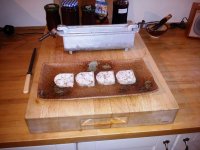
I do like doing faffy things like gallantines. Skin off, bone and restuff.

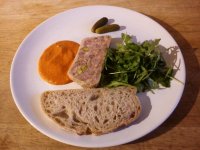
Chicken and tarragon (Simon Hopkinson recipe, but he got it from somewhere else).

Chicken tarragon terrine.jpg

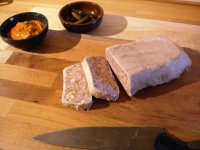
Gallantine de canard. Or as it is known in my household, duck brick.

Duck Brick 1.jpg

Duck Brick 2.jpg

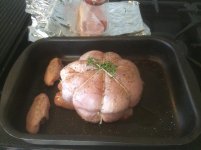
There is an italian one where I have boned the chicken (leaving it entire) and then stuffed it and baked/braised. But I don’t have a photo’.
 
Or this slightly less picturesque one, which was Christmas dinner this year gone:

Vv7ibjd.png

Having done it a few times before with chicken, I decided to do it to a goose because it'll be basically the same thing, right? Turns out while the motions are the same, the force required for some parts is an order of magnitude greater. It is much easier to carve at the table than a whole bird, though.

The closest I've got to proper charcuterie, though, was the duck rillettes as a starter for the same meal. I'd definitely do that again, but maybe not with a whole duck next time, and that duck brick is definitely tempting me.
 
Back
Top