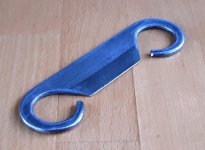
Thanks for all your comments. I thought you might like to see another shave I made. It is a reproduction of a tool found at Coppergate, York (No.2984), believed to date from the 9th to 11th centuries AD. I based it on a photo and information in a book: Anglo-Saxon Tools by Dennis Riley. It is effectively a small draw knife that could be carried in a pocket (in a leather pouch!). Mr. Riley has suggested the name “thumb shave" for it.

-
Hi all and welcome to TheWoodHaven2 brought into the 21st Century, kicking and screaming! We all have Alasdair to thank for the vast bulk of the heavy lifting to get us here, no more so than me because he's taken away a huge burden of responsibility from my shoulders and brought us to this new shiny home, with all your previous content (hopefully) still intact! Please peruse and feed back. There is still plenty to do, like changing the colour scheme, adding the banner graphic, tweaking the odd setting here and there so I have added a new thread in the 'Technical Issues, Bugs and Feature Requests' forum for you to add any issues you find, any missing settings or just anything you'd like to see added/removed from the feature set that Xenforo offers. We will get to everything over the coming weeks so please be patient, but add anything at all to the thread I mention above and we promise to get to them over the next few days/weeks/months. In the meantime, please enjoy!
You are using an out of date browser. It may not display this or other websites correctly.
You should upgrade or use an alternative browser.
You should upgrade or use an alternative browser.
Drawknife Making Project
- Thread starter rxh
- Start date
Cabinetman
Sequoia
- Joined
- Oct 11, 2020
- Messages
- 5,530
- Reaction score
- 1,232
- Location
- Lincolnshire Wolds + Massachusetts
- Name
- Ian
Yes, I can imagine that would be very handy, I have pulled spokeshaves towards me in the past which is virtually what this is doing. Very simple and I bet its effective. Ian
Not sure how you would stop it digging in though.
Not sure how you would stop it digging in though.

Mike G
Petrified Pine
Cabinetman":31qtat6q said:...... I have pulled spokeshaves towards me in the past.........
That's what I do 95% of the time.

Sheffield Tony
Nordic Pine
Cabinetman":2m61tjsv said:Not sure how you would stop it digging in though.
I'm imagining this is for quite light cuts. Not having had a play with one, I would guess you'd use it bevel down to be able to control the cut ? Much as you would with a full sized English drawknife (I say English as the French sorts are different, having a bevel of sorts on both sides and cranked handles, like the one MikeG was using)
That shape looks so Viking ! My friend does some forging of ram's head hooks and Viking style knives, and this definitely looks from the same school. I presume a Viking smith would have drawn out the handles before bending them round - to them it would be much more important to be economical with good steel than it is to us.
Sheffield Tony":lhnuhpge said:Cabinetman":lhnuhpge said:Not sure how you would stop it digging in though.
I'm imagining this is for quite light cuts. Not having had a play with one, I would guess you'd use it bevel down to be able to control the cut ? Much as you would with a full sized English drawknife (I say English as the French sorts are different, having a bevel of sorts on both sides and cranked handles, like the one MikeG was using)
That shape looks so Viking ! My friend does some forging of ram's head hooks and Viking style knives, and this definitely looks from the same school. I presume a Viking smith would have drawn out the handles before bending them round - to them it would be much more important to be economical with good steel than it is to us.
Tony, it does indeed seem to work better bevel down.
Yes, I'm sure a proper smith would forge the handles as you described. I just marked the shape of the tool on a piece of plate and cut it out with hacksaw and files.
I made a post about my thumb shave on a FB group earlier this year and it seemed to start a craze, much to my amusement. Various people in the USA started making and selling them

MattS
Nordic Pine
What a lovely looking tool! How is it to use?
I came across the APTGW a little while ago via spoon carving, I really enjoy working with green wood. There's a local group around here who meet regularly. Assume there are groups all over the country anyone interested might be worth checking their website. Thought it might be a way to learn more skills, but unfortunately, all the making sessions I've seen the local group advertise have been week days which is a shame for someone young enough to still have to work!
I came across the APTGW a little while ago via spoon carving, I really enjoy working with green wood. There's a local group around here who meet regularly. Assume there are groups all over the country anyone interested might be worth checking their website. Thought it might be a way to learn more skills, but unfortunately, all the making sessions I've seen the local group advertise have been week days which is a shame for someone young enough to still have to work!
Nico Adie
New Shoots
rxh":2z38czym said:The finished article.
That looks tremendous! Top work. Love the build process too.
Sheffield Tony
Nordic Pine
MattS":1lknprmy said:I came across the APTGW a little while ago via spoon carving, I really enjoy working with green wood. There's a local group around here who meet regularly. Assume there are groups all over the country anyone interested might be worth checking their website.
Local group list and contact details:
https://www.bodgers.org.uk/local-groups

Woodbloke
Sequoia
I've tried a little bit of green wood carving and I recently bought the Robin Wood carving axe and knives as well as a Mora 102 and Japanese whittling knife from WH. I't quite good fun, but I intend to make a few spoons from 'shop offcuts which are dry (Indian Rosewood, Cocobolo, English Walnut etc) where different techniques and tools are needed - RobSheffield Tony":2nbj94us said:MattS":2nbj94us said:I came across the APTGW a little while ago via spoon carving, I really enjoy working with green wood. There's a local group around here who meet regularly. Assume there are groups all over the country anyone interested might be worth checking their website.
Local group list and contact details:
https://www.bodgers.org.uk/local-groups
Sheffield Tony
Nordic Pine
I must have been a very good boy this year. Look what Santa brought for me:
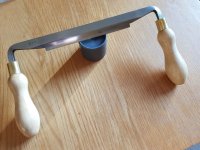
I really look forward to giving it a go. Might be a few weeks yet till my ankle is up to using the shave horse unfortunately. I like the rounded bevel, this usually seems to give good control when using bevel down.
As if that wasn't enough, it can accompanied by a rather nice and sturdy marking knife in the recognisable RXH livery:
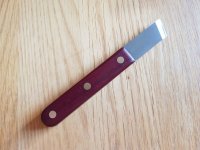
A big thanks to RXH for both. So much work invoved in them.
Merry Christmas to you all.
I really look forward to giving it a go. Might be a few weeks yet till my ankle is up to using the shave horse unfortunately. I like the rounded bevel, this usually seems to give good control when using bevel down.
As if that wasn't enough, it can accompanied by a rather nice and sturdy marking knife in the recognisable RXH livery:
A big thanks to RXH for both. So much work invoved in them.
Merry Christmas to you all.
Mike G
Petrified Pine
Very nice Tony. I've just had rather extensive use from my draw knife, roughing out some oak poles for hanging curtains. There is no tool like it for hacking off loads one minute, then just taking a whisker here and there the next.
Sheffield Tony
Nordic Pine
I was doing an unusual job at the weekend. Making a bat roost. No, not for a real bat, but for a copper one from Michael Kusz at the excellent Graculus sculptures.
Anyway, to get a branch of ash to that stripped, driftwood look I picked up RXH's drawknife. I've used it before, of course, but It occurred to me that I haven't reported back yet
I will admit I've made two slight adjustments. One is to reduce the bevel angle a little, the other, to bend the handles down slightly (viewed witb the bevel up) so that the angle of the handles bisects he bevel angle - this way the drawknife is held at the same angle when used bevel up (for light planing cuts) or bevel down. This was one of the adjustments Mike Abbot had Ray Iles make to his drawknife design. Tweaking a tool to suit your tastes was - should be - quite normal.
Anyway - it is very good in use. The heat treatment must have gone well, it takes - and keeps - a very fine edge. Really a pleasure to use. Thanks again Richard if you are still reading !
I must try to finish my scorp ...
Anyway, to get a branch of ash to that stripped, driftwood look I picked up RXH's drawknife. I've used it before, of course, but It occurred to me that I haven't reported back yet
I will admit I've made two slight adjustments. One is to reduce the bevel angle a little, the other, to bend the handles down slightly (viewed witb the bevel up) so that the angle of the handles bisects he bevel angle - this way the drawknife is held at the same angle when used bevel up (for light planing cuts) or bevel down. This was one of the adjustments Mike Abbot had Ray Iles make to his drawknife design. Tweaking a tool to suit your tastes was - should be - quite normal.
Anyway - it is very good in use. The heat treatment must have gone well, it takes - and keeps - a very fine edge. Really a pleasure to use. Thanks again Richard if you are still reading !
I must try to finish my scorp ...
Raymedullary
Sapling
- Joined
- Jan 20, 2020
- Messages
- 330
- Reaction score
- 93
I made my drawknife from a leaf spring off of a scrapped Ford transit mini bus with lati handles when I was teaching in West Africa. Ill try to post a pic later.
Tony, I'm glad you find it good to use. How did you bend the handles down? I may do the same to my one.Sheffield Tony":2t4zfi7r said:I was doing an unusual job at the weekend. Making a bat roost. No, not for a real bat, but for a copper one from Michael Kusz at the excellent Graculus sculptures.
Anyway, to get a branch of ash to that stripped, driftwood look I picked up RXH's drawknife. I've used it before, of course, but It occurred to me that I haven't reported back yet
I will admit I've made two slight adjustments. One is to reduce the bevel angle a little, the other, to bend the handles down slightly (viewed witb the bevel up) so that the angle of the handles bisects he bevel angle - this way the drawknife is held at the same angle when used bevel up (for light planing cuts) or bevel down. This was one of the adjustments Mike Abbot had Ray Iles make to his drawknife design. Tweaking a tool to suit your tastes was - should be - quite normal.
Anyway - it is very good in use. The heat treatment must have gone well, it takes - and keeps - a very fine edge. Really a pleasure to use. Thanks again Richard if you are still reading !
I must try to finish my scorp ...
Sheffield Tony
Nordic Pine
As it happens, I was using it quite a lot today at a green woodworkers gathering.
To adjust the handles, not knowing what the temper would be like away from the cutting edge, I confess I tapped off the handles. Then I heated it at the bend to a blue colour so I knew I could bend it without breaking anything. To be sure not to affect the temper of the cutting edge, I clamped a big G clamp between the bit I heated and the cutting edge as a heatsink. Then just a matter of slipping a tube over the tangs and tweaking them down by 10-15 degrees. I popped the handles back with a smear of epoxy for good measure.
The size is pretty ideal for most purposes. Today I was working willow, from which you can take really thick cuts. Quite a few knots which presented no problem. Testing the edge with a thumbnail after a day of use, no sign of chipping and still nicely sharp.
To adjust the handles, not knowing what the temper would be like away from the cutting edge, I confess I tapped off the handles. Then I heated it at the bend to a blue colour so I knew I could bend it without breaking anything. To be sure not to affect the temper of the cutting edge, I clamped a big G clamp between the bit I heated and the cutting edge as a heatsink. Then just a matter of slipping a tube over the tangs and tweaking them down by 10-15 degrees. I popped the handles back with a smear of epoxy for good measure.
The size is pretty ideal for most purposes. Today I was working willow, from which you can take really thick cuts. Quite a few knots which presented no problem. Testing the edge with a thumbnail after a day of use, no sign of chipping and still nicely sharp.
Thanks Tony - that seems a good way to do it.Sheffield Tony":19wx8pth said:As it happens, I was using it quite a lot today at a green woodworkers gathering.
To adjust the handles, not knowing what the temper would be like away from the cutting edge, I confess I tapped off the handles. Then I heated it at the bend to a blue colour so I knew I could bend it without breaking anything. To be sure not to affect the temper of the cutting edge, I clamped a big G clamp between the bit I heated and the cutting edge as a heatsink. Then just a matter of slipping a tube over the tangs and tweaking them down by 10-15 degrees. I popped the handles back with a smear of epoxy for good measure.
The size is pretty ideal for most purposes. Today I was working willow, from which you can take really thick cuts. Quite a few knots which presented no problem. Testing the edge with a thumbnail after a day of use, no sign of chipping and still nicely sharp.