• Hi all and welcome to TheWoodHaven2 brought into the 21st Century, kicking and screaming! We all have Alasdair to thank for the vast bulk of the heavy lifting to get us here, no more so than me because he's taken away a huge burden of responsibility from my shoulders and brought us to this new shiny home, with all your previous content (hopefully) still intact! Please peruse and feed back. There is still plenty to do, like changing the colour scheme, adding the banner graphic, tweaking the odd setting here and there so I have added a new thread in the 'Technical Issues, Bugs and Feature Requests' forum for you to add any issues you find, any missing settings or just anything you'd like to see added/removed from the feature set that Xenforo offers. We will get to everything over the coming weeks so please be patient, but add anything at all to the thread I mention above and we promise to get to them over the next few days/weeks/months. In the meantime, please enjoy!

Electrical installations domestic

AJB Temple

Sequoia
Joined
Apr 15, 2019
Messages
7,603
Reaction score
1,099
Just out of interest, are there any qualified electricians here?

Hitherto, I have done all of my own electrical installation work and had it signed off by a professional for Part P. As I am only working part time now, having taken a sabbatical for a year or so, I decided to do an electrical qualification so that should I want to I can sign off my own work. In order to do this it would appear that O may need to employ an electrical (by which I mean start another small business) so that I can be apprenticed to my employee in order to do the necessary practical experience.

I can easily generate enough work with projects (property developments and rentals) that my business partner and I plus her father (who has a lot of rentals) have, to make this wash its face. I've been doing quite a lot of on-line study and the technical aspects seem straightforward.

I know that there are electrical forums, but they are very judgemental and the whole concept of the apprentice being the business owner is beyond their ken. Just wondering if we have any current or retired sparks here that I could tap up for real world advice. This is purely for personal interest - zero interest in career as a sparks.

Adrian
 
I have experience with gas, but I believe the same procedures are in play.
You cant just "become" a gas safe registered fitter.
You have to be an "apprentice" for a company that has gas work as a significant part of its business, and work for them for 6 months minimum.
During that time you have to document your work with pictures and written details of work carried out.
After that period, and if the examining body think your work folder is sufficiently filled, you can then take the gas safety courses, and only if you pass the exam at the end of that course will you get a card allowing you to work on your own.
This is all designed specifically to stop people doing what you want to do, which is learn just enough to get you by without becoming an expert.

Possibly Electrical qualifications are simpler, but i doubt by much, as I have seen the work involved in the classrooms to get sparky's to pass their current "edition".
 
Check out Clarkson Evans in Gloucester who do a 2 week course to get your basic qualification

I did the same so I could do mine own retiring and had half a mind to head down the electrician route as a career change, but

The course gave me the theory and practical for installing new circuits and testing old, but what it doesn’t give you anything else, and by that I mean none of the tricks of the trade or more importantly experience of all of the old wiring practices and old equipment you’d find on site

So my advice would be do the course and perhaps a couple of additional , but also try and find an electrician who’ll let you work for them on reduced rates and get experience for 6 months at least. Unfortunately that may be difficult as in effect they’d be training a competitor

How that helps and best wishes


Sent from my iPhone using Tapatalk Pro
 
Thanks both. I have absolutely no intention of competing with anyone - I am not going to be going round to people's houses doing rectification work. I would just like to be able to sign off my own safety tests for Part P compliance on my own property. This is all brand new wiring to best spec and fully in compliance with 18th edition regs.

I know how to do the tests now, I have the equipment, and I do my own tests anyway before the certifying electrician comes along. Part of the reason is I used to use a really nice chap who did practically all of our electrical work including the commercial stuff. But he has emigrated. Since then I have had a couple of experiences with "qualified" electricians who were unimpressive.
 
AJB Temple":2ljsnbqc said:
Thanks both. I have absolutely no intention of competing with anyone - I am not going to be going round to people's houses doing rectification work. I would just like to be able to sign off my own safety tests for Part P compliance on my own property. This is all brand new wiring to best spec and fully in compliance with 18th edition regs.

I know how to do the tests now, I have the equipment, and I do my own tests anyway before the certifying electrician comes along. Part of the reason is I used to use a really nice chap who did practically all of our electrical work including the commercial stuff. But he has emigrated. Since then I have had a couple of experiences with "qualified" electricians who were unimpressive.

Hi Adrian,
As a retired electronic engineer, I understand the basics but do not have the detailed regulations imprinted in my head.
I have a small number of rental properties that now need EICR testing performed typically every 5 years. Given the cost of the test equipment and the annual calibration fee (unknown amount to me) I wonder if it is worth me getting up to speed to do my own EICR tests.
Currently I'm paying between £138 in a competitive area and £160 out in the sticks per property.
I could possibly arrange all the tests within a 12 month period once every 5 years to cut down on calibration costs.
What do you think?

Bob
 
youre correct, just because someone has the paper, doesnt mean they conduct themselves properly. I've come across many improper gas installations, several even so bad and dangerous as to have to call the gas board out to disconnect the premises until remedial work is done. One was so angry at me that he forced me out of his shop. I had to get the gas cut off in the road outside.
I even had to cause grief to a "qualified" electrician once (luckily, a lot less "iffy" spark's than gasmen about), who had signed off on a brand new shop that was a subway food store. I fitted a 3 phase turbo oven and found NO EARTH connection on his isolation socket.
I called the store manager and showed the problem. he called the project manager, who argued with me that he had the sign off papers in his hand. I suggested he come to the shop and see for himself what his sparky had signed off on. He did, and when I showed him the armoured 3 phase cable had not been connected to the metal box on the outer wire strands, he got very red faced and mumbly. I 'spect that sparky had a pay cut that week.
But thats what the "qualifications" are for, to weed out the careless and the unknowing, even if some do slip through the net.
 
For Part P purposes - to issue building regs completion for notifiable work - what matters is being a current member of a competent persons scheme; any paper qualifications only matter if the scheme you choose requires them.

The problem you're going to run into in making it economical is that those schemes are based on annual memberships with non-trivial fees, and that they require significant amounts of public liability and professional indemnity insurance. They'll also require a certain number of jobs per year to be inspected by them; if you're not doing that many on a consistent basis you'll have problems.

For non-notifiable work you can probably certify it yourself already if you've got the right equipment; you just need to be a skilled person in the BS7671 definition, which is a "person who possesses, as appropriate to the nature of the electrical work to be undertaken, adequate education, training and practical skills, and who is able to perceive risks and to avoid hazards which electricity can create." No exams or certificates needed there.

So far I've gone the building notice route to get the completion certificate; I write the EIC myself and let building control send whoever they want to check it over and issue the BR certificate. Obviously that's expensive for one-offs, but since the fee is per notice, if you're doing several things that require notification in a reasonably close time period, you can file one notice for all of them, do them all, then have them inspected all at once afterwards.

Of course, that doesn't help with EICRs. Those are something that can't be done by the book and need actual experience, as by definition you need to be able to recognise and evaluate installations that aren't compliant or were done to older practices or regulations. Especially if it's for rental purposes and will be your legal defence if something bad happens, I wouldn't recommend taking the chance.
 
You do not ned any qualifications to be an electrician in England or Wales, I am not sure about Scotland or NI.
As SPB has said for Part P self notification you need to register with a Scam, sorry Scheme. The available schemes have reduced in number over the last few years, you would need to look at their websites to see what qualifications they require for Part P notifications, they want you as a member. Also most of the schemes only require one competent person in the organisation who in theory inspects and sign off the work of others in the company. Search for the Emma Shaw inquest to see how well that works.

Also have a look at the type of work that needs to be registered under Part P, I think it is only new circuits and consumer units in England. It is surpriising how much work does not appear to need a new circuit as it already existed.

Very few people have been prosecuted for not complying with Part P, usually only when something goes wrong or they have done some dodgy gas work as well which is then the main part of the prosecution with Part P thrown in for good measure.

EICRS are a different issue. It is unusual to do an EICR on an installation that is installed to the current standard. BUT you are inspecting against the current standard. The inspector has therefore to make a decision on whether the installation, which may be 40 years old with modifications since, is safe for continued use, it does not need to be to the current standard to be safe. While there are various guides it is the inspectors name on the certificate if anything goes wrong. We are seeing any number of incompetent EICRS being performed by people who have no idea of what they are doing as a result of the the need for all rental properties to have an EICR and a lot of simple questions on forums that a half competent person should not need to ask. A lot of companies are using these to generate work and doing a cheap EICR to generate work. It used to take me about four hours to do an EICR on a one or two bed flat plus the time to write it up afterwards. I charged accordingly. I have recently seen an EICR which took 90 minutes and was obviously very wrong/incompetant just from seeing a photo of the consumer unit with the cover on.

I am happy to give you more advice and I have no issues with non time served electricians as I was one myself although I have been doing electrical installations since the 70's and have a variety of C&G qualifications to prove competence.

It is interesting that as I am no longer Part P registered there are things I should not do in domestic properties without paying Building Control a fee to inspect my work but I am deemed competent by qualification and experience to design, install and test industrial, agricultural and commercial single and three phase installations and am currently working on a Village Hall.
 
Same with gas. there are something like 23 different gas qualifications. :shock: I had a dozen or more of them.
Come the end of my working life I was deemed "safe" to work on 15,000 litre LPG bulk storage tanks, but not a domestic cooker or gas fire. :shock:
Its all about the money, and the liability when things go pear shaped.
 
Pretty much agree with HH & spd's comments, I am time served, industrial (C&G A,B & C) I used to be full NICEIC, then scaled back and went Part p only, for what it was/is worth, but gave it up 5 years ago, not enough domestic notifiable work to warrant it, I do it through BC if I need to now, but they are generally involved in my projects anyway.

I would suggest you would need at least to do the 18th regs course/exam and the 2391 inspection & testing exam, but I am not sure you need to be with any of the "Bodies" to do EICR/Landlords certs.
 
Thanks HH and HOJ.

Thanks all. I need to ponder this. Mainly I am educating myself. Below re TT will explain why.

This is the idiocy of inspection regimes. My brother was an engineer. In the latter stages of his career he designed gas and electric cookers (such as RangeMaster) for a US company that owned AGA etc. He had a team that made the prototypes of domestic and commercial appliances, and was a skilled fabricator himself. He was fully gas rated for the manufacture or commercial and domestic appliances. He had designed the damn things and supervised their manufacture, but he was not certified to install them in a domestic house. :? He knew more about these things than the installers and the test inspectors. Having designed them.

It is deeply frustrating in the electrical field. My partner (business not wife) has a few rental properties, and her dad has a lot of rental properties. We’ve been dealing with a bit of legal stuff lately and I’ve been reviewing compliance. When tenants change (between 1 to 3 years typically) an electrical inspection is done and a local sparks is employed to do this usually. Properties are in London, Bromley and Deal mainly, with a few others here and there. For landlords there is (predictably) a race to the bottom for people to do certification tests and you can get a bulk inspection certificate for 2 bed flats to 4 bed houses in the range £45 to £100 per property.

I was looking at a property in Deal that had been signed off by the electrician, who had installed a charging point for a Tesla. I am familiar with the 18th edition (thrilling read but I have done it cover to cover) and I am very familiar with Tesla installations as we have done three (all properly by my electrician who emigrated).

All of the ones we have done hitherto have been TT, with armoured feeding just the Tesla point and nothing else, and a dedicated TT for the high load charger unit. The one in Deal, where the Tesla charge point was in an outbuilding block or garages a fair way from the five flats, had been linked with the TN-C-S supply in the property. 3 core armoured had been installed above ground (only needed 2 cores), terminations unclear at first (not visible), but CPC seemed to me to be non-compliant. As indeed it transpired it was.

I ended up with a stand-off with the electrician as he claimed he knew best as he was certified. I felt he was wrong. He was super aggressive and threatening as he had already lodged his sign off. Building Control were paid to inspect anyway, and proved he was wrong and unsafe. Legal stuff (she’s a practicing solicitor) followed. Unpleasant.

The main reason for me wanting to do this is “spot the cowboy”. But I accept this may be unrealistic. It is not a money saving thing. I have been doing electrical work and electronics since I was 7. Includes making guitar valve amps and such like. The regs are straightforward. I’m interested in this stuff but I am realising that maybe getting a qualification that I will never really use to earn money is possibly a waste of time and I have zero interest in other people’s installations. Maybe we are better off buying the ”insurance” of a certified pro.

Adrian
 
This is the catch 22 of trades.
I have found over the years that I can do a better job than most of the tradespeople I know, mainly because I am doing it for myself and taking time to do it properly., whereas a "pro" is in a rush, bored, thinking about the weekend, etc etc.

BUT..... when push comes to shove, and one of your properties burns down and the enquiry finds that an unlicensed person (you) has touched the wiring, youre IT. Regardless of the number of other cowboys involved no one will take any responsibility after that point.

I taught many gas trainees, and the one sentence I used to scare them into working to the book was this; "at the inquest, its YOUR name on the ticket." :shock:
In fact it scared one fellow so much that he quit and changed professions :eusa-doh:
 
I used to work with a couple of Electricians sometimes at my last job. The was a regular lecky joke that if you asked 100 Electricians how to do a job, you’d get 101 different answers! :D
 
sunnybob":e1wikhlm said:
In fact it scared one fellow so much that he quit and changed professions

Good point, I did all the training for the 2391 exam, in order to be able to carry out EICR inspections, but chose not to take the exam, the main reason was that throughout the course the underlying suggestion was to find faults with the installation and therefore make money by identifying non compliant results against the current regulations in force at that time.

I have had quite a few calls from people in the past, asking me to quote for works to bring installations up-to current standards, on the back of reports from others, which in the majority of cases, from my own observations and knowledge, was for work that wasn't necessary.

This guy makes interesting points about testing (WARNING he's an acquired taste) but he reinforces my point at about 45 mins in:
https://www.youtube.com/watch?v=drRTv9yyArs

I fully support the reasoning for you to become familiar with working practices and the regs, more so as a landlord, and as such, as you have already proved, be in a position to evaluate work done and/or the content/value of the reports issued.

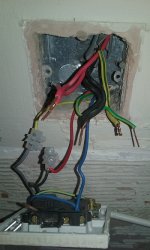
Mind you, in some cases inspections don't always pick things up as they are generally non invasive, here's just a couple of examples I've found recently:

electrical joint.jpg
electrical joints 2.jpg
 
Gosh..this takes me back to the early days of Part P. Then, Building Control were still feeling their way with it. I was probably one of the first 'customers' being in the middle of totally renovating an old cottage under Full Building Control. It came to the time for the first fix to be checked out.

"We'll send someone round" said BC. Lovely old guy turns up. Retired surveyor.
"I've come to look at your insulation" he said poking around the Kingspan.

"Um, no. Actually it's to check the first fix. Would you like me to run you through it?"

"Yes, please". So I did.

"You know more about this than I do" he said :eusa-doh:

Fast forward to the final electrical inspection. I rang up Building Control and asked when someone could come round.

"Tomorrow" was the reply.
"Crikey, that's amazing that you've got electricians on tap like that"
"Oh no, we don't send round an electrician. Would you like to speak to one of the BCO's?"
"We don't send round an electrician. We come round and have a look. If it looks OK then we sign it off"

Never did get thoroughly tested. :o
 
Compared with a few months ago - they took the building notice fee, then sent me the phone number of an electrician a few towns over and told me to give him a call and work everything out. Of course his calendar was busy enough that it took a month to get it inspected, but once he'd been around and tested everything the completion certificate arrived the next day. Didn't hear a peep from BC in between.
 
On Adrians second post:
Car chargers in an urban environment are a bit of a nightmare. Due to the car manufacturers not making their cars double insulated we have to jump through hoops to make the charger installation safe when there is a TNCS (PME) earth in order to protect the public from the car becoming live in the rare occurrence to the loss of supply neutral. The main hoop is to TT the charger circuit. The installation of an earth rod while ensuring sufficient electrical separation from metallic supplies of gas, water, and electricity which will probably be connected to the supply earth from bonding to earth in properties can be problematic when you do not know where the services run. It is surprising the number of very competent electricians who due to their location have never seen or installed a TT installation.

There are bits of equipment that claim to disconnect the supply in the event of a fault or loss of neutral removing the need to TT the charger but these do not so far meet the requirements of BS7671 so their installation is at your risk.

The use of three core instead of two core SWA is quite common as many wholesalers not stock two core and when they do it is about the same price or more expensive than three core.

Finding a decent electrician is difficult, but probably no more difficult than finding someone decent in any trade. I think you may be better spending your time trying to find a couple that know what they are doing and can be trusted and are prepared to discuss and justify any problems with you and giving them all your work. I find doing EICRS quite boring and sometimes quite challenging. I can send you a spec for them that was prepared by someone who is far more competent then me that I have found useful. You can use this to try and separate the wheat from the chaff. One problem with Landlords certs is the limited time you have to fix faults. The cowboys use this to railroad you into getting them to do the work. Another issue is the requirement for the installation to comply with a particular edition of the 18th Edition. This allows a lot of interpretation as to how close the installation actually has to be to the 18th edition as the 18th edition chapter on inspection and testing does not insist compliance with the 18th to be safe for continued use!

On the subject of incompetent EICRS, I did not do a lot of remedial work but I was asked to replace the aluminium cables in a church which, with some other minor work, was forcing the closure of the church until rectified. I found the aluminium cables were actually tinned copper, adequately sized, installed OK, perfectly serviceable and tested OK so I did not replace them and noted my observations why. The same inspector identified wooden patress switch mounts as a fire risk so I had to replace them as well.
 
HappyHacker":1tmytsda said:
There are bits of equipment that claim to disconnect the supply in the event of a fault or loss of neutral removing the need to TT the charger but these do not so far meet the requirements of BS7671 so their installation is at your risk.
Amendment 1 changes that - it adds provision for protective devices based on supply voltage changes specifically for EV chargers, as well as any other protective device which provides equivalent safety to one of the enumerated options. That makes the current generation of chargers with built-in protections against lost PEN compliant on a TN-C-S system with no extra work.
 
AJB, I looked at this myself a year or two back for the same reason – my rental properties (we are a bit more strict about the electrical checks up here, I think; certainly Scotland required them earlier: EIRCs since 2015 I think). I decided it wasn’t worthwhile. Partly the cost but mainly, as Sunnybob (what a little ray of sleet he is, to be sure – (no offence my dear, I’m agreeing with you)) pointed out, the issue of liability. Having got through two careers as an engineer and surveyor without any PI claims against me, I wouldn’t want to start now.

Doesn’t stop me getting a bit irked by electricians though. Still, knowing/having read the regs does allow you to ask pertinent questions – ‘is your comment about the number of outlets a recommendation or a requirement?’ And, of course, always allow a reasonable face-saving climb down for them.

Now, do you chaps have the mains linked smoke/heat detector regs we have up here? And another thing – what is the point of supplying an EPC on a Category A listed Georgian building? Who is going to pay any attention to that?

Whew. Started ranting there, but I think I’m over it.
 
18th Edition regs Section 10.2.2b requires heat / fire / smoke alarm systems to be interlinked, and is prescriptive as to locations. Interlinked is usually interpreted as mains wired with battery back up. Regs require permanently wired usually with own circuit to CU.


Not sure what a Category A building is. We only have listed buildings here, Grade1, 2* and 2, plus unofficial grade 3 but no one really cares about those.
 
AJB Temple":1o49a5df said:
Not sure what a Category A building is. We only have listed buildings here, Grade1, 2 and 2 but no one really cares.

It's your Grade 1. More or less. We just use different terminology... erm, because of some jolly good reasons.

And I do really care, otherwise I wouldn't have so many of them.
 
AJB Temple":1s2d7tuy said:
18th Edition regs Section 10.2.2b requires heat / fire / smoke alarm systems to be interlinked, and is prescriptive as to locations. Interlinked is usually interpreted as mains wired with battery back up. Regs require permanently wired usually with own circuit to CU.
....

Ooops...so my Nest fire alarms aren't any good. Hey ho...lucky it's not mandatory to have a smoke alarm in your own home. :D
 
By " no one really cares" I was not being facetious - just factual. From experience, planners and English Heritage get exceptionally worked up over Grade I, very worked up over Grade II*, but rather less so over Grade Iim and then there are the ones listed by local authorities, sometimes referred to unofficially as Grade III where there is no meaningful enforcement (hence the comment). It's an interesting area, as making buildings listed can have an adverse effect of discouraging people from taking them on. I've developed a couple of listed country houses, when I was briefly in that business, and probably would not do it again. I agree we should be preserving buildings of merit, but some of the dictats from planners are impractical or counterproductive.

I happen to live in a building that used to be listed. It was then developed (in the 80's) by some twerp, who did so much damage to the structural integrity of the oak frame, that listing was removed and he was fined. This is all local folklore and is long before my time. I think it was only ever listed because of age and a slightly unusual sloped face feature of this wealdland building, but in my view (I am very interested in ancient oak framing) it never had any special merit and certainly doesn't now.
 
Edit PS: the reg for wiring is 10.2.2 (C) (b). Own circuit for preference. You can use a lighting circuit if you can isolate the alarms without switching off the lighting.

These regs need to be changed in my view as they are way behind the times. Firstly, cabled switches for lighting may well disappear so the circuits will change as Kinetic switches take over, and secondly the regs are behind the technology. You an now buy all varieties of heat / fire / smoke alarm that have 10 year batteries, communicate wirelessly with each other up to 80 metres, have self test and anti-false alarm, will link to your smart phone (this is good idea - fires are not always conveniently timed) and will even give a pre-alarm that they are likely to do something if you don't take action.
 
spb":1uni5maa said:
HappyHacker":1uni5maa said:
There are bits of equipment that claim to disconnect the supply in the event of a fault or loss of neutral removing the need to TT the charger but these do not so far meet the requirements of BS7671 so their installation is at your risk.
Amendment 1 changes that - it adds provision for protective devices based on supply voltage changes specifically for EV chargers, as well as any other protective device which provides equivalent safety to one of the enumerated options. That makes the current generation of chargers with built-in protections against lost PEN compliant on a TN-C-S system with no extra work.

I have not looked recently but the issue was that the regs (722.531.3.101) require an RCD to BS EN 61008-1, 61009-1,60947-2 or 62423. I looked at one device and it did not have this certification and not having copies of each of the specifications I have no other way of knowing if they could comply, I have heard that there is some debate about whether many of these devices can comply. Adding an RCD to specification into the circuit would of course resolve this.

But is installing a device that is not to a BS standard a deviation from the regs which would need noting on the
EIC and for which the designer is taking responsibility.

I am glad that I am just about retired as I believe the regs are getting too complicated and are moving away from electrical safety into the areas of building control, buck passing and fire safety. In addition there are too many organisations looking for scapegoats when things go wrong. I look back with affection at my 14th edition which was an example of simplicity and conciseness, 224 pages of approx A5 compared with over 500 A4 pages, ignoring corrigendum, of cross referencing and ambiguity in the 18th. Don't get me started on metal consumer units and the proposal to introduce AFDDs.

Someone once pointed out to me that of the money and resources spent on Part P had been spent on inspecting and fixing stair carpets more lives would have been saved compared with Part P which despite the claims appears to have slowed down the year on year rate of decrease of deaths due to electrical causes.

I will get off my soap box, get my coat and go and fix a farmers pump :D
 
Happy Hacker - I would very much appreciate that checklist or guide you referred to written by a friend of yours. I will PM you.

Also meant to thank SPB for his input.

I think elements of the rules cause confusion because changes are not well explained. Metal CU's being one such example. The question comes up in forums sometimes as to whether a CU can be mounted on a wooden backer (say plywood cladding on a wall within a cupboard) or whether it must be mounted on intumescent material. I have not referred back to my recent 18th Ed copy but I think it is silent on the matter. You just need not to have potential causes of fire (like live bits poking out).

The Tesla example of earthing I gave above was when Tesla were ramping up their sales about 3 years ago. They provided a domestic charger unit with the car. This was confusing to a number of electricians as CPC arrangements were not super clear at first so an electrician had to look carefully. My friend the electrician went to far as to consult building control on our first one. There was no issue with TT rod at my rural house, but my partner lives in a built up street in London and goodness knows where metal gas and water pipes may be underground. The system was equally confusing to users, as the charge points arrived pre-set to the minimum charge rate (the "takes forever" setting). Anyway, I digress. Has proved to be a very helpful thread for me.
 
I've found it helpful too in that for my purposes with a few rentals to get checked, a professional test every five years is relatively cheap insurance provided I can actually get a sparky to give me an appointment. All seem to be silly busy atm.

Bob
 
Kevin

I note your comment on AFDDs. What is the reason for the comment may I ask? It's obviously outside of my expertise (though I know what they are) but we do have an arc protection device and surge protection on one of the sub consumer units. Everything is Hager now throughout this property.

The reason for fitting it was that we had to install a backup device in a remote location (ie my house) that connected with the financial markets (It is actually a CREST server) and the spec required AFDD among other things (cooling mainly). I hadn't given it a second thought until your post. The CREST server is now gone and the device is therefore redundant in that single purpose sub-CU but could be relocated.

Adrian
 
My gut feeling on AFDDs is that, like metal consumer units, as soon as a recommendation to use them outside of very specific situations comes in, there'll be a flood of chancers selling £80 EICRs and claiming the entire installation is non-compliant and therefore unsafe because it doesn't have arc fault detection, never mind that it's only two years old. The difference is that with the cost of AFDDs at the moment - not to mention that for some manufacturers they're still two-module devices that need a separate RCBO as well - just the material cost to fit them everywhere runs into the thousands for a normal house.

This isn't to say anything against AFDDs themselves - I have them on my garage/workshop socket circuits, because it was wired from scratch and the extra cost of two of them on top of all the cable, conduit and accessories wasn't too bad - but like many well-meaning regulation changes I'm quite sure it'll be abused for a quick buck.
 
Adrain, PM me your email and I will send you a copy, thanks for your PM.

My issue with AFDDs is do they actually work in real life situations? I looked at America where they have been using them for a number of years. They originally claimed there would be a massive reduction in fires caused by arcing faults a reason for introducing them. From the figures available I could not see any significant change in electrical fires that could not be explained by more new houses and updating of old wiring. Also a lot of the figures assume that an electrical fault/fire is always caused by an arcing fault without any further analysis. The lower voltage used in America results in higher currents and the different wiring practices with less installation testing and a greater reliance on constructing to the code make comparisons with our installations difficult.

AFDDs use a computer to analyse the waveform to determine if there is an arc occurring. As arcs occur when switches are operated and brushed motors start the software has to differentiate between faults and normal arcing. There are numerous videos on youtube showing people trying to get AFDDS to trip by generating arcs and generally not succeeding. Apparently using a carbon electrode is the best way of causing an arc that will trip an AFDD. I am told the computers are programmed to trip with the standard test waveform used by the testers which should be the same as a proper fault arc.

I have no problem with installing additional safety devices if they work but am yet to be convinced that AFDDS do provide an additional level of safety worth the cost. Are they just the result of good marketing/lobbying?

I can see a householder with a quote of >£2000 to replace their consumer unit with the full complement of AFDDS from a Part P electrician instead approaching Fred from the pub who will do the job for £600 using a £100 CU from one of the sheds with no AFDDs, no testing and no paperwork and it will only take him a couple of hours and as a favour he will put all the lights on one RCD/RCBO due to borrowed neutrals causing tripping otherwise. Or they will stay with the old rewireable fuse CU with no RCDs.

I have a very intelligent and very rich customer who I spent nearly 10 years trying to get to update his old Wylex rewireable CU to one including RCDs/RCBOs for improved safety for hm and his family. I failed and gave up a few years ago. I did get a callout to change a fuse wire for him before Christmas and I admired his new Porsche!

Please don't get me started on metal consumer units especially with TT installations of which I used to do quite a few.
 
Thanks Kevin. That does all make sense. Thank you for taking the time to explain. I suppose that my assumption was and maybe still is, that kit supplied by a reputable manufacturer such as Hager, properly installed, is likely to work. It is not clear to me why the arc protection was needed as really all that a CREST machine is, is a rack mounted computer that is remotely monitored for down time and operates in a temperature controlled and secure environment. There is nothing at all special about it and I could not see any aspect particularly justifying the specified protection.

PM on its way. I meant to send my email address earlier. Adrian
 
Back
Top