phill05
Seedling
A few years ago I built a manual dividing head for the milling machine and hoped that I could make similar for the lathe, In the middle of working on this I found an old cnc machine and rebuilt it to use to make parts then a year or two ago I designed and built an electronic indexing unit that could be moved between machines I found electronic parts online and started building the controller box to power a stepper motor, I needed 240v supply in and 12v - 24v - 68v out in one box that could be taken with the control box to where ever I needed to use it. So the power box was made.
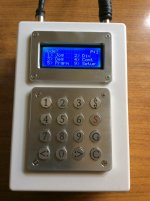
Then I started on the control box I found a board ( made by Steve Ward) that would give Jog: Divide: Degree: or Constant: working around that I used a plastic box to hold a Stepper driver, the card, a fan and a keyboard, one input 24v and 68v then a step down to 12v, on the opposite side power out to motor, I designed and cut the keys/pad with the cnc the window for the screen and the cut outs for the fan at the back of the box, I connected a motor all works as it should.
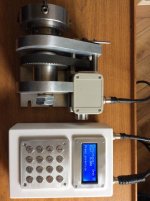
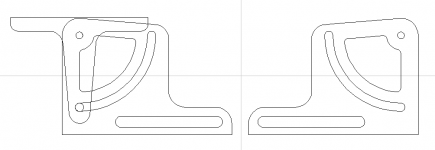
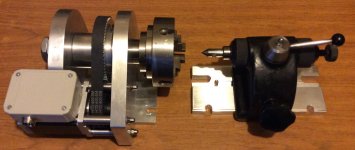
I then moved on to the indexer, plain aluminium frame to hold a ER32 collets plain bored shaft and the stepper motor with 3 to 1 reduction for holding position.
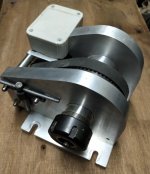
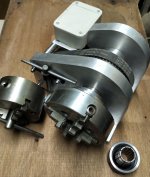
Once complete put power to box - box to stepper indexer in now working as it should be with a complete range of collets, then started thinking what if it had a 4 jaw chuck on it, so made two back plates to fit the nose thread of the ER32, one for a 125mm 4 jaw and one for a 80mm 3 jaw this now gives me many options.
Next I made a tailstock to suite.
I have used it in making/repairing old clock wheels and parts and in the future I want to use it to finish building a Turret clock that I started but could not take it any further at the time do to ill health.
A few months ago I came across a post on here by Dr Al that gave me the inspiration of another tool I was missing a slow rpm diamond grinding/honing plate, I had been looking online at different machines for doing it, but mostly based on a std grinder to me that was too fast, then Dr Al hit me, not in a bad way, I read his online website of the different tools he has made and I emailed him and out of the information I gleaned this was what I wanted to add to my indexer as I could have low speed.
So thanks to Dr Al this is where I started the honing plate, the disk is the same design as Al's (thank you Al) but fixed the disk to a 20mm back plate to fit in ER32 collet.
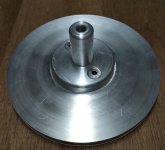
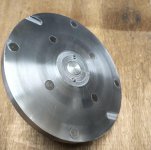
I was given two diamond disks 400 grit and a 2000 grit from a friend but both had different mounting holes, made a reversible centre plate that has different sized spigots this is now done and it works really well.
WIP:
I now have to decide how I want the table to be.
To be continued:
Phill
Then I started on the control box I found a board ( made by Steve Ward) that would give Jog: Divide: Degree: or Constant: working around that I used a plastic box to hold a Stepper driver, the card, a fan and a keyboard, one input 24v and 68v then a step down to 12v, on the opposite side power out to motor, I designed and cut the keys/pad with the cnc the window for the screen and the cut outs for the fan at the back of the box, I connected a motor all works as it should.
I then moved on to the indexer, plain aluminium frame to hold a ER32 collets plain bored shaft and the stepper motor with 3 to 1 reduction for holding position.
Once complete put power to box - box to stepper indexer in now working as it should be with a complete range of collets, then started thinking what if it had a 4 jaw chuck on it, so made two back plates to fit the nose thread of the ER32, one for a 125mm 4 jaw and one for a 80mm 3 jaw this now gives me many options.
Next I made a tailstock to suite.
I have used it in making/repairing old clock wheels and parts and in the future I want to use it to finish building a Turret clock that I started but could not take it any further at the time do to ill health.
A few months ago I came across a post on here by Dr Al that gave me the inspiration of another tool I was missing a slow rpm diamond grinding/honing plate, I had been looking online at different machines for doing it, but mostly based on a std grinder to me that was too fast, then Dr Al hit me, not in a bad way, I read his online website of the different tools he has made and I emailed him and out of the information I gleaned this was what I wanted to add to my indexer as I could have low speed.
So thanks to Dr Al this is where I started the honing plate, the disk is the same design as Al's (thank you Al) but fixed the disk to a 20mm back plate to fit in ER32 collet.
I was given two diamond disks 400 grit and a 2000 grit from a friend but both had different mounting holes, made a reversible centre plate that has different sized spigots this is now done and it works really well.
WIP:
I now have to decide how I want the table to be.
To be continued:
Phill