• Hi all and welcome to TheWoodHaven2 brought into the 21st Century, kicking and screaming! We all have Alasdair to thank for the vast bulk of the heavy lifting to get us here, no more so than me because he's taken away a huge burden of responsibility from my shoulders and brought us to this new shiny home, with all your previous content (hopefully) still intact! Please peruse and feed back. There is still plenty to do, like changing the colour scheme, adding the banner graphic, tweaking the odd setting here and there so I have added a new thread in the 'Technical Issues, Bugs and Feature Requests' forum for you to add any issues you find, any missing settings or just anything you'd like to see added/removed from the feature set that Xenforo offers. We will get to everything over the coming weeks so please be patient, but add anything at all to the thread I mention above and we promise to get to them over the next few days/weeks/months. In the meantime, please enjoy!

Exterior door threshold

Windows

Old Oak
Joined
Jan 25, 2022
Messages
1,420
Reaction score
415
Location
Cumbria & West Kent
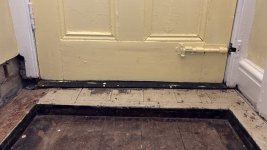
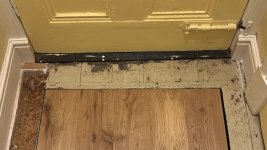
The cold weather has reminded me that a previous owner of our house thought an iron threshold to the front door would be a great idea. It’s certainly a hard wearing option, but it’s basically a heat sink for pulling warmth from the house and depositing it outside, so I’m going to replace it. If anyone has any advice about replacing thresholds on Edwardian properties - perhaps links to instructions from the period - I’d be grateful. Maybe iron thresholds were favoured by the Edwardians? It’s not an ideal option in the Cumbrian climate though.
 
I know what you mean. I altered the position of our front door ( moved it forward and fitted a new door).
For a step nosing I used a rounded edging slab and covered the joint between the slab and the concrete floor with a flat width of aluminium.
It looks and works well, but in the winter I have to wipe away condensation sitting on the aluminium most days.
With hindsight, I should have included a thermal break.
 
The condensation on everything is amazing. We had our first frost earlier this week. I don’t expect anything will be dry again until April.
 
If anyone has any advice about replacing thresholds on Edwardian properties - perhaps links to instructions from the period - I’d be grateful.

I don't have any experience to draw on - most houses I'm familiar with just have a flat step and a howling draught - but here are some details from Paul Hasluck's Carpentry and Joinery, from 1907.

It shows a wrought iron weather bar, set into a wooden threshold, butting against a rebate in the bottom of the door.

IMG_20251006_222714475~2.jpg
 
Thanks Andy. That’s interesting.

Underneath - from outside to inside - we’ve got a stone step, a gap, a concrete or stone support, a gap, and a wooden joist. Over the top, we’ve got a cast iron, ramp-on-both-sides, flat-top threshold that extends completely under the door from outside to inside, held up by the concrete/stone support and covering the gaps between the floorboards and the stone steps.

There’s weak and missing wood at the end of the floorboards under the iron threshold. It’s currently dry and I see no signs of active mould. Hard to know if it’s progressing, but I think not - the initial damage must have been done at least a decade ago, possibly many decades: there was a weird concrete patch with wine corks embedded in it filling a gap at the corner where a floorboard had rotted away that was covered by carpet. It’s not the kind of bodge that I’d expect either of the previous two owners to do. We’ve been here for 6 years now.

It’s possible the iron is still causing condensation to form that would cause rot if the floorboards were still in contact, but the decay may have solved the problem by causing the wood to retreat. Alternatively the rot was caused by a leak at the corner where the patch was - long since fixed.

I think I’m going to splice in some wood to fix the floorboards. They’re mostly very solid. Not quite sure how easy it’ll be to remove the iron threshold.
 
It's interesting to see the ideas different builders came up with. I'm pretty sure that in Scotland, for example, lots of details were different, presumably to cope with stronger winds and more snow. Cumbria has the same problems!

Catalogues of currently available threshold draught excluders show even more clever ideas and maybe do something about not conducting heat away.

I'm no expert on building regs, but Part P covers thresholds and even if the regs don't apply in your case it seems like a good idea to make your front door accessible to wheelchairs.

(And looking back at what I posted last night, the text makes it clear that the weather bar was fitted into a stone step, not wood. I ought to pay more attention!)
 
I live in a Victorian property and so that everything is in keeping I have tried to seal the bottom of the doors using traditional methods, despite my best efforts if it's raining heavily and the wind is in the wrong direction I can get a bit of water coming in.

Not the most traditional looking things but I don't think you can beat a Macclex threshold for the bottom of a wooden door, available in different colours, lengths and depths depending on the thickness of your door, also available with a thermal break to cut down on condensation.

 
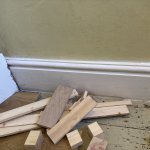
Still not sure exactly how or whether to remove the iron threshold, but I’ve pulled some rotten skirting off the wall. Not only the skirting was rotten, but also rotten were the wedges holding the nails that held the skirting to the wall - which made removal pretty easy. Half the grey plaster (?) behind the skirting also fell off the wall in powdery lumps.

IMG_3848.jpeg
IMG_3851.jpeg
 
Last edited:
Is there any point to plastering behind skirting on an internal wall? If I make the attachment points stable and hold the skirting at the correct distance, is there any point to plaster?
 
I don't really know, but like you I'd reason that there's no benefit. I've seen similar, and assumed it was a) for economy and b) to avoid picking up dirt from the floor onto the trowel. You could also argue that the point of the skirting board is to cover up the gap.
 
I would be looking into this whole area to establish to what extent the surrounding timbers are damaged due to possible water ingress from the front door threshold.
Got any more pictures of the current set up with door open and shut?
Cheers, Andy
 
You’re absolutely right — iron thresholds, while durable, can be problematic in colder climates like Cumbria. They tend to act as thermal bridges, drawing heat out of the interior and contributing to drafts and condensation issues around the doorway.

For Edwardian or period properties, a more authentic and practical replacement would be a hardwood threshold. Traditional oak or mahogany options offer great insulation, longevity, and maintain the period-appropriate look that suits older homes beautifully.
 
Last edited by a moderator:
hi search for a company called Door Deals then search for door thresholds makes such as storm guard or macclex will possibly suit at one time any good hardware store would have these in stock , storm guard is the easiest to fit remove the old bar may have to trim the door to fit
 
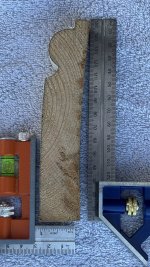
For the record, this is the torus skirting profile I’m removing from this area. I considered recreating it exactly, but I’m going to replace it with similar, but slightly slimmer off-the-shelf torus skirting. The current skirting is seriously chunky for such small rooms.
IMG_3875.jpeg
 
Pretty sure that’s the same profile as some mdf stuff, from Wickes, that I fitted in my son’s Victorian house, it was an exact match for the original.
Once painted who’s to know.

Edit: for the job above and a few years later, the whole of our current home I used frame fixings. They provide a quick and effective solution.
 
Last edited:
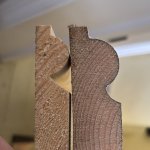
I haven’t got an exact match, but I got 3.6 m of redwood torus skirting - same height, but thinner - for £13 from Andersons in Carlisle.

Here’s the comparison image:

IMG_3876.jpeg
 
I guess that just shows that we're being a bit less profligate with timber than our forebears were.
 
After patching up the floor, I fitted the left hand skirting. Turns out the new skirting wasn’t the same height so I added a strip on the bottom. Got it to a height where I could go to town with the caulk rather than have to do some plastering. I attached it by nailing headless nails through to wedges that I’d put in where the originals were.

IMG_3878.jpeg

On the other side I’d removed a small piece of skirting to replace with the new stuff. That took more of the plaster with it when it went so I had to slap some undercoat plaster on to build it up again.

Plenty of tasks still left to do.
 
Looking a mess, but no holes. Filled the recess for the mat with a loose infill made of oak boards top-nailed to pieces of 2 x 2. It’s going to be covered with more of the same, so didn’t spend too much time on it. Still need to chamfer & sand the ends of the skirting.
IMG_3883.jpeg

There’s still a non-zero probability of pulling some of the skirting off the wall again in spring if I decide to yank out the threshold and fix up the door frame.
 
Last edited:
My understanding is that there SHOULD be a gap between the floor and the plasterwork, to avoid the wicking up of moisture, and one of the many benefits of traditional skirting, apart from looking good, is that it covers that gap.
The French don't have skirting boards, they have plinth, which is tiny and pretty useless, really. I've had to make my own.
S
 
Last edited:
I don’t know how common it is to be honest. I can’t remember the bolt situation in other houses I’ve lived in. I’m pretty sure this is the only house where I’ve used a bolt - I use it when we go on holiday - completely pointless really. The barrel bolt at the top doesn’t line up with the other side so if you want to use a bolt, it has to be the bottom one.

Another odd thing about this door is that there is nothing that keeps it closed when it’s unlocked. It used to stay closed with friction - but only in light winds - because the bottom of the door rubbed against the threshold on the left. But I cut the bottom off the door the other day to match the new floor level and now it swings wide open when unlocked. Another item on the long list of things to fix at some point. It’s probably just a broken spring.
 
Last edited:
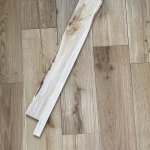
Decided to leave the iron threshold as it is and slap a wooden one over the top and glue it in place. Grabbed a board from a palette and rough cut to length.
IMG_3890.jpeg
Got some thicknessing and shaping to do on that. Machines available for thicknessing are: track saw, electric planer, and handheld router. Think I’ll make some skates for the router and do it that way.

It’d be quicker to eyeball it with the planer, but it’ll be exact if I use a jig and it’s easier to attach stuff to the router than the planer. I’m a big fan of electric planer jig videos, but they mostly use the Makita planer which seems easier to attach stuff to than mine. Router much more amenable to attachments.
 
I didn’t have the right screws to attach a sub base to a router base (needed M4, I’ve got a lot of machine screws and they’re all M6), so instead of thicknessing the threshold, I ordered some rail and linear bearings and some acrylic then turned my attention to the door latch.

I had believed that the door did not have a working latch and suspected that the spring in the mortice lock had broken. I was wrong. Instead, it turns out that the handles were stuck. Freeing the handles allowed the latch to appear. Now turning the handles anti clockwise retracts the latch and releasing the handles afterwards lets the latch spring out again. Turning the handles clockwise retracts the latch and releasing the handles does nothing: the latch remains concealed in the door.

I hope this is by design and not something still sticking because it’s a useful behaviour, but I’ve never seen a door with this behaviour before. What do you think? I guess it could take the mortice lock out of the door and look inside, but currently everything’s working OK so why mess with it?

Anyway, the reemergence of the latch on the door side was only one part of the solution. The mortice and plate on the frame also weren’t positioned to allow the latch to catch. A combination of painting, door movement, frame swelling or poor installation prevented it working. I had to chisel the mortice slightly and remove and reposition the plate to get things back in order which meant filling and redrilling the screw holes. But not before I spent ages almost getting it working with the existing screw holes.

So now I can close the door and leave it unlocked without it blowing open.

The mortice lock & door have a keyhole and space for a bolt and the frame and plate have the space to receive a bolt from the mortice lock. But there’s no bolt in the mortice lock.
 
Last edited:
Bolts were also a common way of overcoming a bit of twist in the door.
Not one of the doors fit properly in this house.
S
I also alluded to possible twist in the doorways of our place. Given the potential difficulty in getting assembled doors upstairs I’ve been wondering about taking the components upstairs, glueing up in situ and then using wedges all the way round the door and frame thus providing the necessary pressure to keep the joints closed while the glue went off and also to automatically adopt any skew or wind in the doorway.
 
Last edited:
Just remembered that I wanted to write down which tool I used for cutting out the existing skirting and floorboards here: it was the Gyokucho 293 compact atsuba kataba. This saw uses the S293 replacement blade that looks like this:

IMG_3898.jpeg

Dr Al pointed out this blade a while ago when I was asking about azebiki saws. The curved tip of this blade lets you start a cut in the middle of a board. It’s quite an effective and compact saw for a DIY toolbox and made short work of getting out the old wood without creating a lot of mess.
 
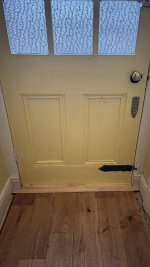
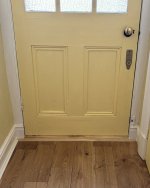
Current state of the front door. I had thicknessed the threshold using router skates so I removed the front door to chop the bottom off with the track saw. The track needed to go where the lower bolt was so I removed the lower bolt, filled the whole area (still using up that osmo ebony wood filler), then track sawed the bottom off the door. Wanted to see whether my line was accurate to the actual level of the threshold (slightly paranoid about cutting too much off the door), and it’s perfect. Need to take the door off again to give a little gap and extend the cut to include the weather bar which will mean some hand saw work.

I have a Trend swivel door lifter so can use my foot to get the door to the right height for reattaching the hinges solo. Finding that very useful.
IMG_4225.jpeg
 
Last edited:
These threads are a real testament to my slowness. Started thinking about this area late September. Started ripping things up late October. Here we are in March getting closer, but still not done. We’ve got visitors in May so it’ll be done by then.
 
These threads are a real testament to my slowness. Started thinking about this area late September. Started ripping things up late October. Here we are in March getting closer, but still not done. We’ve got visitors in May so it’ll be done by then.

Yebbut... You're making more positive progress than the millions of less handy homeowners who don't notice problems round the house or just ignore them.
 
My wife is surprisingly tolerant of partially completed projects, but she has recently decided on a new system for renovations: I’ll decide how and she’ll decide when. Seems like a good plan to me.
 
It may be that it was a shame to have trimmed some off the bottom of the door, the none fitting door sneck was probably because the hinges are worn and the whole door has dropped, at this age they were probably cast iron hinges, not so easy to find and steel ones need packing out, brass might have worked?
Ian
 
Yeah the door catch not aligning could have been a result of hinge-side changes over time. Not just the hinges are old, but the wood frame is not the strongest. Had to increase hinge screw size & length at the bottom. Hope to get another few years out of this door & frame before addressing them properly.

Cutting the bottom off the door had to happen because I raised the floor level and wanted a threshold to cover the ends of the new flooring. Doing this removed some rot & worm holes at the bottom, so happy to have got rid of that.
 
Back
Top