

Steve Maskery
Old Oak
Last year we had a new fireplace built. The old one was dangerous (flue installed upside down, chimney breast held up by a bit of 4x2, resting on a brick by just 20mm...). We had to sack the builder half way through the project, so it's taken a while to get it finished.
Just about every house we have been into has got a fireplace with a lintel over it. Sometimes it is stone, but more usually it is a massive oak beam. A friend gave me one such beam, saying it was oak. It was about 1.8m long and 200mm square. It took two of us to lift it. It didn't look very pretty - rot and woodworm:


My friend Jeff and I deep-ripped it on my bandsaw, but the coarsest blade I have is 3tpi, much too fine for this job. One cut took over an hour. Once cut I could see that it was not oak, but chestnut. No surprise, really, it grows plentifully here and, presumably, did so 200 years ago, too.
But a slice cut from the centre and cleaned up, it looked lovely.
I needed to work out how to attach it to the wall. My first thought was to insert some threaded rod into the wall, bolt on the lintel and then cover the holes with square iron studs. But then I had another idea.
I routed out a big cavity from the back. I can't remember whan I last used my router, I'd forgotten how to adjust it.
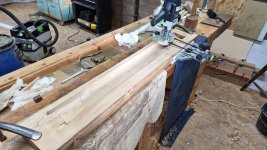
The ends were chopped out by hand
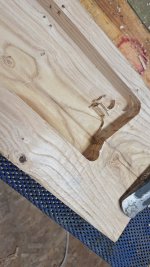

I then cut a pair of French cleats. For bevel cuts I move my fence to the left, so that nothing can get trapped. But that means I have no support for my SUVA guard, so I used my magnetic stand-alone one instead. Here are two views of the setup.


One piece was screwed into the cavity, the other to the wall.
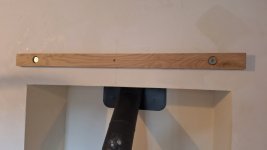
The oversized holes were so that I had some wiggle room for getting things level.
Then the lintel just dropped on and all was good.
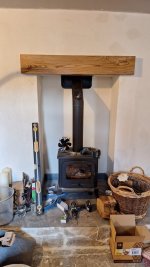
Chestnut is softer than oak, it was easily dinged by trapped sawdust or the like, but finished (I used BLO) it looks beautiful. I think I may have a new favourite timber.
Just about every house we have been into has got a fireplace with a lintel over it. Sometimes it is stone, but more usually it is a massive oak beam. A friend gave me one such beam, saying it was oak. It was about 1.8m long and 200mm square. It took two of us to lift it. It didn't look very pretty - rot and woodworm:
My friend Jeff and I deep-ripped it on my bandsaw, but the coarsest blade I have is 3tpi, much too fine for this job. One cut took over an hour. Once cut I could see that it was not oak, but chestnut. No surprise, really, it grows plentifully here and, presumably, did so 200 years ago, too.
But a slice cut from the centre and cleaned up, it looked lovely.
I needed to work out how to attach it to the wall. My first thought was to insert some threaded rod into the wall, bolt on the lintel and then cover the holes with square iron studs. But then I had another idea.
I routed out a big cavity from the back. I can't remember whan I last used my router, I'd forgotten how to adjust it.
The ends were chopped out by hand
I then cut a pair of French cleats. For bevel cuts I move my fence to the left, so that nothing can get trapped. But that means I have no support for my SUVA guard, so I used my magnetic stand-alone one instead. Here are two views of the setup.
One piece was screwed into the cavity, the other to the wall.
The oversized holes were so that I had some wiggle room for getting things level.
Then the lintel just dropped on and all was good.
Chestnut is softer than oak, it was easily dinged by trapped sawdust or the like, but finished (I used BLO) it looks beautiful. I think I may have a new favourite timber.
Last edited:


