• Hi all and welcome to TheWoodHaven2 brought into the 21st Century, kicking and screaming! We all have Alasdair to thank for the vast bulk of the heavy lifting to get us here, no more so than me because he's taken away a huge burden of responsibility from my shoulders and brought us to this new shiny home, with all your previous content (hopefully) still intact! Please peruse and feed back. There is still plenty to do, like changing the colour scheme, adding the banner graphic, tweaking the odd setting here and there so I have added a new thread in the 'Technical Issues, Bugs and Feature Requests' forum for you to add any issues you find, any missing settings or just anything you'd like to see added/removed from the feature set that Xenforo offers. We will get to everything over the coming weeks so please be patient, but add anything at all to the thread I mention above and we promise to get to them over the next few days/weeks/months. In the meantime, please enjoy!

Firmer chisels.

Mike G

Petrified Pine
Joined
Jul 30, 2014
Messages
12,481
Reaction score
3,033
Location
Suffolk
Name
Mike
What are they?

I mean, I know what they are, sort of, but is there a definition? I've seen bevel edge chisels described as firmers, which had me a little puzzled. I've seen butt chisels described as firmers....and I can see that this might be plausible.
 
Mike G":1poyh5ot said:
What are they?

I mean, I know what they are, sort of, but is there a definition? I've seen bevel edge chisels described as firmers, which had me a little puzzled. I've seen butt chisels described as firmers....and I can see that this might be plausible.
A proper 'firmer' chisel has a cross-section which is truly rectangular. Anything else is a 'bevel edge' where the sides may be very finely ground (LN or Veritas) or quite coarsely machined (plenty of examples) - Rob
 
As Rob said, they're basically just plain square/rectangular in cross-section chisels, with no bevels ground onto them. I would assume the name "firmer" comes from times gone by as back in the day beveled edge chisels were properly beveled edge (much like the premium stuff you can buy now) and quite delicate for heavy work, so "firmers" are a stronger chisel than a beveled edge. I think firmers were a much more preferred chisel for site work by a carpenter/joiner pre-plastic handles and thicker beveled edge chisels, especially the even more heavy-duty "Registered Firmer" chisels. The only thing I've noticed with old firmers is that they're much thinner than modern chisels such as the ones made by Stanley or Marples which are beveled edge.

AndyT, AndyT'N'T, Alf, or anyone else that's of a vintage hand tool persuasion would probably know more.
 
Is it not the case that a registered firmer chisel typically has a leather washer and the handle has a metal hoop so it doesn’t split when it’s clobbered?
 
Blackswanwood":2m2i1sw3 said:
Is it not the case that a registered firmer chisel typically has a leather washer and the handle has a metal hoop so it doesn’t split when it’s clobbered?

One of the nicest chisels I've ever used was like that......but had a fine, thin, bevelled 1-1/2" blade (blade? Is it a blade?). A firmer-type handle with a very fine steel thingamejig. And obviously, being an inch and a half, it wasn't designed for pushing around by hand.
 
I think there are two questions tangled up together here, each interesting in its own way.

One is "What forms of chisels have been made, over time and in different countries, exploiting the means of production available and serving the different needs of the trades where they were used?"

The second question is "How did the makers, sellers and users refer to the various sorts of chisels available in different times and places, so as to distinguish between them, and when they referred to a firmer chisel, what did they mean?"

As a brief response, I'll suggest that "firmer chisel" has generally meant the ordinary bench chisel of the carpenter and joiner, but at different periods the tools being referred to won't all be the same.

We could work together on a longer answer.
 
I think you are right Andy. From a bit of searching over the last hour it seems a firmer chisel was originally a reference to differentiate the way the chisel was made. If what I have read is correct “ordinary” chisels were made from iron with a steel laminate but firmer chisels were solid steel with square edges and hardwood handles designed for heavier duty use.
 
Blackswanwood":2zckcur3 said:
...firmer chisels were solid steel with square edges and hardwood handles designed for heavier duty use.

Just like these :D I know these are firmer chisels 'cos I bought the same brand new, boxwood handled Marples set in the 70's and they were sold as 'Firmer Chisels' - Rob
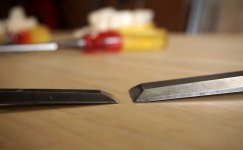
 
I'm rather confused now also!

I've got an old Marples catalogue from the 1930s that I bought donkeys years ago which I had a look through just to see what it says on the matter and it has "Firmer Chisels" and "Beveled Edge Firmer Chisels"

I feel like my whole understanding of woodworking has been turned on its head!
 
Trevanion":pn4r8j5t said:
I'm rather confused now also!

I've got an old Marples catalogue from the 1930s that I bought donkeys years ago which I had a look through just to see what it says on the matter and it has "Firmer Chisels" and "Beveled Edge Firmer Chisels"

I feel like my whole understanding of woodworking has been turned on its head!

Presumably thicker than a normal bevelled chisel?

9C700CF3-5D3F-44E9-9895-3C62D4726288.jpeg
 
Woodbloke":3cek0z6s said:
Just like these :D I know these are firmer chisels 'cos I bought the same brand new, boxwood handled Marples set in the 70's and they were sold as 'Firmer Chisels' - Rob

So at what point does a firmer chisel become a mortice chisel Rob?
 
Blackswanwood":ugf8is3y said:
So at what point does a firmer chisel become a mortice chisel Rob?

Well I would've thought once the chisel's thickness is greater than its width it becomes a mortice chisel but after these revelations today I wouldn't be surprised it's something completely different!
 
AndyT":1uoi3k74 said:
I think there are two questions tangled up together here, each interesting in its own way.

One is "What forms of chisels have been made, over time and in different countries, exploiting the means of production available and serving the different needs of the trades where they were used?"

The second question is "How did the makers, sellers and users refer to the various sorts of chisels available in different times and places, so as to distinguish between them, and when they referred to a firmer chisel, what did they mean?"

As a brief response, I'll suggest that "firmer chisel" has generally meant the ordinary bench chisel of the carpenter and joiner, but at different periods the tools being referred to won't all be the same.

We could work together on a longer answer.
All this. Except the last bit, because I'm not sure mass insanity should be encouraged... :lol:

Trevanion":1uoi3k74 said:
I'm rather confused now also!
Demonstrating your understanding of the problem.

I've long given up trying to make a definitive statement as to what makes a chisel an "X" or a "Y", because chances are there's another chisel that's the exception that proves the rule - and thus finds the rule wanting. At the very least you need a time frame in which you wish to place your definition, as Andy rightly says.
 
Blackswanwood":2wyzx5ga said:
So at what point does a firmer chisel become a mortice chisel Rob?
To my way of thinking, as I mentioned above, a 'firmer' chisel has a true, rectangular cross-sectioned, blade. When the blade is still rectangular in section, but maybe slightly chunkier and the handle has a leather washer and steel ferule on the end (aka Japanese style) it's a 'registered firmer' and is made for sustained, heavy duty chopping.

A mortice chisel still has a rectangular or square cross-section (depending on size), but in use it's turned through 90deg, the extreme example being the traditional 'pig sticker' type, where the cutting edge could be say, 6mm wide but the depth from front to back much deeper, say 10 or 12mm.

The variations between the different types/styles are obviously open to individual interpretation, but that's the way that I've always classified them - Rob
 
As has been said, to understand the different terms, think of it as an evolutionary/historical thing.
Firmer were general use chisels.... some chopping light morticin20211231_114300.jpgg perhaps. Alongside these were bevel edged. These were the pure bevel edge, usually quite thin on their edges. This allowed for fine work e.g. paring between dovetails. Then as things changed and people wanted a general purpose tool that could be hit but also nicer to use for paring. Thus the birth of the former bevel edge chisel.
 

Attachments

  • 20211231_114316.jpg
    20211231_114316.jpg
    333.9 KB · Views: 1,707
Back
Top