• Hi all and welcome to TheWoodHaven2 brought into the 21st Century, kicking and screaming! We all have Alasdair to thank for the vast bulk of the heavy lifting to get us here, no more so than me because he's taken away a huge burden of responsibility from my shoulders and brought us to this new shiny home, with all your previous content (hopefully) still intact! Please peruse and feed back. There is still plenty to do, like changing the colour scheme, adding the banner graphic, tweaking the odd setting here and there so I have added a new thread in the 'Technical Issues, Bugs and Feature Requests' forum for you to add any issues you find, any missing settings or just anything you'd like to see added/removed from the feature set that Xenforo offers. We will get to everything over the coming weeks so please be patient, but add anything at all to the thread I mention above and we promise to get to them over the next few days/weeks/months. In the meantime, please enjoy!

Fixing a Chipped Japanese Chisel Blade

Woodbloke

Sequoia
Joined
Jul 22, 2014
Messages
7,232
Reaction score
1,141
Location
Salisbury, UK
Not so much a sharpening thread as a 'fixing' one. Last week when chopping out the rear panel rebate corners, my 12mm Japanese chisel stopped behaving as a proper chisel and started cut weirdly. When I took it out of the cut, it soon became evident as to the reason:
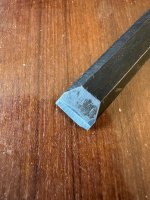
IMG_7809.jpeg

Being a 'silly billy' I'd forgotten that I needed to treat these things with a bit more decorum and civility than my Western 'Richter' ones. A Japanese chisel takes an incredible edge but it's so easy to chip it with the slightest lack of due care and attention. I decided this morning then, to do a 'fix', so stuffed it into the Veritas MkII Honing Guide with the chisel attachment:
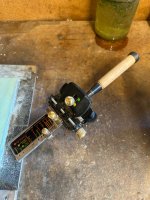
IMG_7813.jpeg

.... to hone a single bevel at 30deg on a 1000g water stone.

Half an hour later I was still at it with little sign of the chip retreating. Having purchased an Ax 'Ultimate Edge' I wondered if the Japanese chisel would fit into the plane/chisel jig, but surprisingly it did:
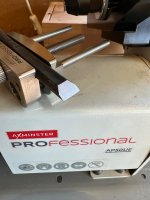
IMG_7810.jpeg

With a new 120g belt installed it was only a couple of light passes (with some cold water dunking inc) to remove the last of the chip. I thought I might have to do some work with the 'Kanaban' lapping plate and some coarse valve grinding paste (!!) to shift the 'ura' (the depression in the back) down a smidge but didn't really need to:
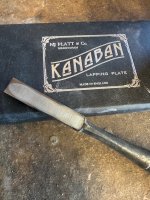
IMG_7811.jpeg

...as there was still about a mm between the edge and ura.

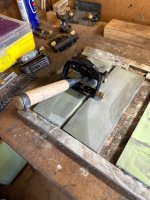
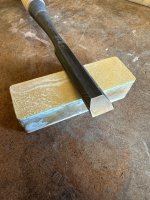
Then onto the waterstones and strop to remove the grinding marks and finish the single bevel at 30deg:
IMG_7814.jpeg

IMG_7815.jpeg

Japanese chisels can quite easily be 'fixed' (with care!) but I'd suggest that attempting the repair freehand is fraught with difficulty. Apologies also if the sight of waterstones and sharpening gear make you splutter on your coffee and cause the dunker to break off and disappear to the bottom of your mug:ROFLMAO: - Rob
 
Last edited:
Never had the need for a jap chisel but often wondered what happens when you sharpen back to the ura, do you have to reduce the thickness of the chisel to bottom depth of the ura?

I remember reading somewhere that the laminated construction means that you can (carefully) hit near the tip with a hammer & the softer backing metal will bend slightly and expose more of hardened cutting edge, so there's not as much work needed to flatten it (i.e. you don't have to flatten the entire back of the chisel again).

However that might just be plane blades or it might be me misremembering or misunderstanding: I've never really explored Japanese laminated blades.

I'm sure someone will be along shortly to explain why what I've written there is nonsense!
 
Never had the need for a jap chisel but often wondered what happens when you sharpen back to the ura, do you have to reduce the thickness of the chisel to bottom depth of the ura?
Nope, you just need to pass the back over a coarse/fine stone of some sort to 'shrink' it a bit; doesn't need to be very much, just enough to give some clearance between the depression and the edge. They're very good indeed when set up correctly (that takes some time!) but can be an 'acquired taste'...but they're capable of a sublime cutting edge - Rob

I remember reading somewhere that the laminated construction means that you can (carefully) hit near the tip with a hammer & the softer backing metal will bend slightly and expose more of hardened cutting edge, so there's not as much work needed to flatten it (i.e. you don't have to flatten the entire back of the chisel again).

However that might just be plane blades or it might be me misremembering or misunderstanding: I've never really explored Japanese laminated blades.

I'm sure someone will be along shortly to explain why what I've written there is nonsense!
You can do it that way Dr.Al, but I think you really have to know what you're doing; not something I've ever attempted - Rob
 
Good thread. I love my Japanese chisels and much prefer them over my LN and Blue Spruce for fine work. I've only every chipped one and to this day don't quite know what I did. I have the Sorby Grinder (Ax is better but I can't justify a swap) and find I can regrind with a home made jig and ice bath.
 
I have a couple of Japanese "Smoothcut" plane irons (for Nos. 5 and 5 1/2), which are brilliant.

All I usually do with them is scary sharp normally. They don't take excessively long to do, but they take a wicked edge and they last around 50% longer than the "stock" irons I have (Record 'crucible cast' and more recent Stanley ones). If I make the effort to strop/hone whenever I take a break, they last really well. Very much my first choice with difficult grain, too.

If I really make the effort with polishing, you can see the lamination on the bevel.

The frustrating thing is that I haven't been able to find them in the UK any more (both mine came from Axminster years ago).
 
I have a couple of Japanese "Smoothcut" plane irons (for Nos. 5 and 5 1/2), which are brilliant.

All I usually do with them is scary sharp normally. They don't take excessively long to do, but they take a wicked edge and they last around 50% longer than the "stock" irons I have (Record 'crucible cast' and more recent Stanley ones). If I make the effort to strop/hone whenever I take a break, they last really well. Very much my first choice with difficult grain, too.

If I really make the effort with polishing, you can see the lamination on the bevel.

The frustrating thing is that I haven't been able to find them in the UK any more (both mine came from Axminster years ago).
Workshop Heaven used to stock replacement 'blue steel' Japanese plane blades for Western planes and Classic Hand Tools have started to do the same but when you see the price, you need to take a very deep breath before you hit 'submit' - Rob

Edit - having just checked Workshop Heaven still stock them
 
£50 and worth it.
That's about what I paid for the second one - I think the original one was a bit cheaper on offer.

I'm inclined to agree that they're worth it - you can work for longer, and/or get a better finish with difficult woods.

That said, I have a couple of planes - an apron plane and a spokeshave - both of which use one of the modern steels for the irons (A2 or O1: they're the same but I can't remember which). Those also take and hold an excellent edge.

The great thing about having the Japanese irons is process: If I have a big planing task, I'll sharpen/hone all the irons I have in that size, and then swap them out as they go dull, having 'robbed' from my other planes. I can keep going for longer before needing to break rhythm completely, and the Japanese irons really help this.
 
Workshop Heaven used to stock replacement 'blue steel' Japanese plane blades for Western planes and Classic Hand Tools have started to do the same but when you see the price, you need to take a very deep breath before you hit 'submit' - Rob

Edit - having just checked Workshop Heaven still stock them
The ones I have look the same as the ones Workshop Heaven sell, apart from the brand name.
 
The great thing about having the Japanese irons is process: If I have a big planing task, I'll sharpen/hone all the irons I have in that size, and then swap them out as they go dull, having 'robbed' from my other planes. I can keep going for longer before needing to break rhythm completely, and the Japanese irons really help this.
This is what the late and very great Alan Peters used to do. Apparently he used a No.7 as a smoother(!!) and had a number of sharp blades to hand. As the one in use became blunt, it was immediately replaced by a new honed blade and so on until he'd used up all his sharp blades and was left with a pile of blunt ones for the 'young apprentice' to sharpen:ROFLMAO: - Rob
 
The great thing about having the Japanese irons is process: If I have a big planing task, I'll sharpen/hone all the irons I have in that size, and then swap them out as they go dull, having 'robbed' from my other planes. I can keep going for longer before needing to break rhythm completely, and the Japanese irons really help this.
I find this really interesting and it makes me think I need to work on my plane set-up technique. It generally takes me about a minute to do the actual sharpening of a plane blade (including putting it in a honing guide) but 2-3 minutes to get the blade out, put it back in and get it nicely adjusted. If I'm taking a blade out of a plane I generally feel I might as well sharpen it as that's the quick bit of the job. I guess that equation changes if you're more efficient at setting the plane up than I am.
 
Takes me ages to set a plane up as well Al. I'm fussy. I think the system above is more about not interrupting rhythm than speed. I quite like hand planing and sharpening, so time is not of the essence for me. Anyway, there is only one plane that I have more than one blade for.
 
Takes me ages to set a plane up as well Al. I'm fussy. I think the system above is more about not interrupting rhythm than speed. I quite like hand planing and sharpening, so time is not of the essence for me. Anyway, there is only one plane that I have more than one blade for.
Same here. I can take quite a long time to get the plane to take off the right thickness of shaving. I use the Charlesworthian trick of running a thin offcut against different parts of the blade to see if it's cutting evenly; it's surprising how long it takes to do with minute lateral and doc adjustments before you get it 'right' - Rob
 
Never had the need for a jap chisel but often wondered what happens when you sharpen back to the ura, do you have to reduce the thickness of the chisel to bottom depth of the ura?
During one of my course with David Charlesworth, I asked him the same question. Although he had every chisel LN made, I noticed he used the Japanese chisels more often. He held up one of Japanese chisels that still had a lot of flat area between the cutting edge and the hollow and said something like "I don't know. I've had this chisel for nearly 20 years and don't expect I'll live long enough to worry about it."
 
During one of my course with David Charlesworth, I asked him the same question. Although he had every chisel LN made, I noticed he used the Japanese chisels more often. He held up one of Japanese chisels that still had a lot of flat area between the cutting edge and the hollow and said something like "I don't know. I've had this chisel for nearly 20 years and don't expect I'll live long enough to worry about it."
Yep, that's what happens in the normal course of events. As you continually polish the back:

IMG_7831.jpeg

...the 'ura' starts to shrink back from the edge, as shown on one of my paring chisels (single bevel of 25deg) which I've had for about the same time as St.Dave. What's also a very good idea is to get hold of a Dremel and small grinding wheel so that you can grind a small flat just behind the polished back:

IMG_7832.jpeg

...which is very slightly lower, as shown above. The reason for this is that the black part of the blade starts to taper towards the handle, so that as you're polishing said back, it may make contact with the edge of your expensive waterstones, crunching into them with a very unhappy outcome! If you grind away a barely noticeable, flat depression, it won't happen and you can merrily polish away the whole back knowing that your waterstones aren't going to get munched. I've yet to do this on my new acquisitions but will get a round tuit when this bit of warm weather's passed; currently the 'shop is 'off limits' as it's about 29degC in there.

I think, but can't be sure, that it was one of St. David of Charlesworth's little tricks - Rob
 
I like my record staysharp blades very quick to sharpen, then drop the end bit and spend hours looking for it.

Pete
 
Back
Top