• Hi all and welcome to TheWoodHaven2 brought into the 21st Century, kicking and screaming! We all have Alasdair to thank for the vast bulk of the heavy lifting to get us here, no more so than me because he's taken away a huge burden of responsibility from my shoulders and brought us to this new shiny home, with all your previous content (hopefully) still intact! Please peruse and feed back. There is still plenty to do, like changing the colour scheme, adding the banner graphic, tweaking the odd setting here and there so I have added a new thread in the 'Technical Issues, Bugs and Feature Requests' forum for you to add any issues you find, any missing settings or just anything you'd like to see added/removed from the feature set that Xenforo offers. We will get to everything over the coming weeks so please be patient, but add anything at all to the thread I mention above and we promise to get to them over the next few days/weeks/months. In the meantime, please enjoy!

Flat tang bits.

Boringgeoff

Seedling
Joined
Nov 22, 2021
Messages
45
Reaction score
26
Hi All,
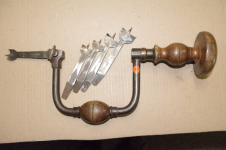
I have a handful of flat tang bits comprising centre bits and gimlets. flat tang2.pngflat tang4.png
They are used in this Gentlemens brace which can also accommodate common square tang bits.
The majority of my bits are German or Swedish, one may be British. According to an article I read in a TATHS publication, manufacture of the flat tanged bits in Britain finished in about 1810. I have two questions, when did these bits first come into production, and did manufacture of these bits continue after 1810 in other countries?

Cheers,
Geoff.
 

Attachments

  • flat tang16.png
    flat tang16.png
    1.9 MB · Views: 2,080
Hi Geoff, I've not yet managed to find any hard evidence but from discussions over the years I'm pretty sure that flat tang bits continued to be made in Germany, and possibly France, into the 20th century.

Hence the dual-standard chuck in your photo. I have a brace like that, which was still in a French catalogue in the 1930s. Of course, that could have been for backwards compatibility with the flat tangs after they had fallen out of production.
 
Interesting topic. I’ve seen square tang bits before but not seen the flat ones.
 
Thanks Andy, I should have mentioned that the brace has no identifying marks whatsoever. I've got perhaps four or five of these braces, all in various states of disrepair, this the only one with the dual bit chuck and it's not got the original thumbscrew.Flat Tang Centre Bits 002.png

Cheers,
Geoff.
 
Just for completeness, and because the other site no longer has my photos, here's a picture of the dual-standard brace that I have.

IMG_0592.JPG

It's marked "AMOBREQUIN" which was actually a special made-up name from Michelin (much like the product names that Ikea use). The idea was that you could place an unambiguous order by telegram, packing a lot of meaning into a single chargeable word. An Amobrequin was a wheel brace, but I reckon it was actually a perfectly ordinary carpenter's brace as commonly used in the early 20th century. For use as a wheel brace, Michelin supplied it with a box spanner attachment. (The box spanner on its own was called an "Amoki".)
It's also marked "L'UNIQUE BREVETE S.G.D.G" (ie The Only One, patented Sans Garantie Du Governement - without Government Guarantee.)

Here it is:

amobrequin.png

For the rest of the 1913 Michelin Guide to the British Isles, start here and scroll back or forwards.

https://archive.org/details/michelingui ... ew=theater
 
Good thinking on the part of Michelin, instead of making a dedicated wheel brace they got an existing brace and made a nut adaptor to suit. That's an interesting read, Andy, as a retired truck driver who's repaired hundreds of punctures, I'm thankful wheel and tyre technology has advanced a lot since that guide was published.

Cheers,
Geoff.
 
Back
Top