• Hi all and welcome to TheWoodHaven2 brought into the 21st Century, kicking and screaming! We all have Alasdair to thank for the vast bulk of the heavy lifting to get us here, no more so than me because he's taken away a huge burden of responsibility from my shoulders and brought us to this new shiny home, with all your previous content (hopefully) still intact! Please peruse and feed back. There is still plenty to do, like changing the colour scheme, adding the banner graphic, tweaking the odd setting here and there so I have added a new thread in the 'Technical Issues, Bugs and Feature Requests' forum for you to add any issues you find, any missing settings or just anything you'd like to see added/removed from the feature set that Xenforo offers. We will get to everything over the coming weeks so please be patient, but add anything at all to the thread I mention above and we promise to get to them over the next few days/weeks/months. In the meantime, please enjoy!

Foreign Electricity question

Rezi

New Shoots
Joined
Nov 28, 2018
Messages
240
Reaction score
0
Location
Somogyszentpál, Hungary
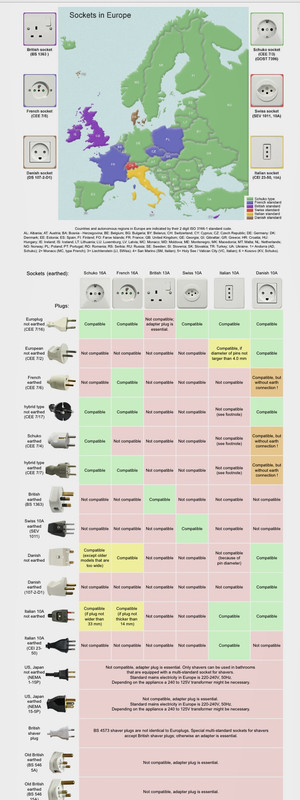
I live in Hungary and, like a lot of other non-UK countries, there are different rules and customs regarding electrical installations. In the UK, plugs and sockets are wired so that live always meets live and neutral always meets neutral whereas here (and I believe most or all mainland European countries are the same) the plug terminals are not marked and can also be flipped over meaning that live to neutral is as common a connection as live to live. I don't know how that works but it does and there doesn't seem to be any H&S issue either.
So, getting to my question, my wife, who is inclined to be a little dramatic :? , has some concern about seeing a blue spark when she pulls out the plug. I have checked all the connections and all seems good and there are no other issues so, is this caused by the unmatched connections?
 
no, it's because the thing is still live. you'd get the same sparks in the UK, but it's all hidden in the worlds greatest plug socket.

also, no earth.
 
novocaine":1nocpq1g said:
....the worlds greatest plug socket.

..

Unless it is from the now defunct (thankfully) Pure range from Knightsbridge and exclusively sold by TLC-Direct.

Whole house fitted out with this returned prac. Bad news.
 
OK, thanks.

You're incorrect about there being no earth. All the sockets are earthed and the plugs have an earth termination but not all of the devices have an earth wire.
 
Rezi":hwg9kbrn said:
OK, thanks.

You're incorrect about there being no earth. All the sockets are earthed and the plugs have an earth termination but not all of the devices have an earth wire.

But the earth pin is the same length as the main contact isn't it?
 
The German sockets have two earth spring clips at the top and bottom of the socket which correspond to the strips on the side of the plug - type F. The French plugs have a long earth potruding pin - type C. The plugs however fit both with them having strips for the spring clips and a hole for the pin. I'm sure older plugs were country specific but all modern appliances and spare plugs here are in this dual format.
 
my question still stands, without going and looking, doesn't the earth disconnect at the same time as the main pins?
UK plugs dont, the earth remains in contact till the power has been removed.
 
Not sure about Hungary but my wife's house in Germany has very similar schuko plug sockets and the CPC connectors definitely make contact before the supply makes contact and therefore remains in contact after the supply breaks circuit when plug is pulled out. There is no way you can touch a live pin as the socket shields it fully.

UK regs and I believe German regs don't refer to earth these days. CPC = earth = Circuit Protective Conductor though some sparky's call it continuous protective circuit. The way that is achieved various in the UK (TNS. TNCS. TT etc - sometimes a combination if vehicle chargers are involved) and may well do in Hungary and Germany too so it is as well to be aware of what yours is if you are doing electrical work. Many EU countries use shuttered child proof circuits (similar concept to the UK) but oddly enough not in Germany. I've worked in Budapest quite a bit but it was ages ago and can't remember what they use there. Would be interested to know.

PS schuko is a trade name I think. Might be called something else generically but that is the common word and is an abbreviation from a German word for shielded or shrouded. Presently having a mental blank on the actual German word.
 
Schuko plugs/sockets are a really good design.

The reason it matters here in the UK that live and neutral are not swapped over, is that fuse in the plug, up to 13 Amps. It needs to be in the live part of the circuit, so that if it blows it doesn't leave the appliance off but still live.

We wire 240V* systems differently to the way 220/230V systems are wired on the Continent: here there's a ring, usually rated up to 30 Amps, with lots of sockets strung along it. My understanding of Continental circuits is that there's a separate breaker for each outlet or small group of them. IIRC, additionally Schukos are rated at 10A too (not 13A).

Because we have lots of sockets together on one 'ring', the fuses in the plugs are there in part to prevent 30A being exceeded over the whole ring (or at least reduce the possibility of it happening). That tends to cause house fires.

So, because on the Continent there's no need for a fuse in the plug, they can be made to be plugged either way round. Additionally, when the earth is used, the Schuko design makes that connection first and disconnects it last (some variants have a pin, some have sliding contacts at the side of the plug. The Schuko design also means you can't actually touch the live pins at any time. In older versions of the UK ones, you can, just about get fingers round the back (children certainly could do this), so they are more dangerous.

Finally, Schukos with round pins theoretically make a better electrical connection than UK rectangular pin plugs do, although this is a matter of the design details of specific sockets.

*(I know "it's now 230V", except it shouldn't be - stick a voltmeter on your mains sometime...)

I forgot to say: the "ring main" system of wiring was introduced because there was a shortage of copper after World War 2 - it was intended to save resources, with a slight compromise in electrical safety. We also used aluminium cables, which are definitely a compromise in safety!
 
Regarding 220/230/240 V, my understanding of this is that the continent is on 220 V and we're on 240 V. When they were trying to come to a common standard, they settled on 230 V ±10% or something like that, which encompassed both voltages without anyone actually having to change anything.
 
Dr.Al":1sela8op said:
Regarding 220/230/240 V, my understanding of this is that the continent is on 220 V and we're on 240 V. When they were trying to come to a common standard, they settled on 230 V ±10% or something like that, which encompassed both voltages without anyone actually having to change anything.

We've always had a tolerance band for mains (both sides of the Channel), and you're right, the tolerance was tweaked so that there's a nominal 230V international standard, but in practice nothing has changed except that UK users now can't complain if they get 230V. In practice it's usually still very close to 240 V, since actually changing to 230V may cause issues with some motor designs, etc. (I was told fridge compressors, for example, but I defer to Bob on all things motorish). When I worked in Nepal briefly in the 1980s, many fridges had voltage stabilizers fitted, to prevent motor damage during the frequent brownouts, but that was a far bigger %ge change than 240 to 230V. It was explained to me at the time (shaded pole motors?) but I can't remember the details at this distance.

I didn't explain that bit too well. Sorry.
 
Here I Germany each room is its own radial circuit powering the sockets and lights. 16A. Each appliance also has its own radial. When wiring the normal is 1.5mm for the radials which is good to 3200w or 16A. I
Also cable run length has to be taken I to account for volt drop - something like 28 meters before splitting sockets and lights. Anyway it makes for bloody massive messy consumer units and tonnes of extra cable for wiring.
 
Ring circuits are out of favour in the UK too these days. I think they would be unusual on a well specified new build. Radials are easier and more logical and have less risk or no risk of accidental circumvention. Also much easier to test.
 
Still a lot of ring circuits in new builds in UK. Commercially maybe more radials. Trouble with a ring cct is that the ring can be broken due to crap wiring and then you end up with 2 radials being "protected" with a 32A device, you cant tell unless the wiring is being subjected to a fixed wiring test (which most people don't have done) so you are blissfully unaware of the problem - until the cables melt/ catch fire. At least with a radial if there is a break in the cct some of the sockets will stop working.

Not a big fan of ring ccts.
 
Rezi":g6jqs9bc said:
.....
So, getting to my question, my wife, who is inclined to be a little dramatic :? , has some concern about seeing a blue spark when she pulls out the plug. I have checked all the connections and all seems good and there are no other issues so, is this caused by the unmatched connections?
As novocain said this is perfectly normal as current is still flowing, if you could see the contacts of an on/off switch you would see the same.
As far as the electrons buzzing back and forth are concerned they don't care which wire is 'hot' and which is 'Cold' ie near or at ground potential. So which way round a two pin double insulated plug is inserted does not matter.
 
CHJ":9b9zosev said:
So which way round a two pin double insulated plug is inserted does not matter.
Provided neither conductor has a fuse or other protective device on it - ours do, so they're not reversible; the Euro ones don't so they are.
 
About 40 years ago, I had some equipment manufactured in Sweden. By good fortune I spotted that one had live and neutral swapped at random through various isolating switches and filter blocks. These thing had metal cases, and were supposed to be operated by the general public. I checked all twenty or so units out, and they were all fairly random. Telephoned the factory owner, who expressed no surprise, and told me it didn't matter. I said maybe it doesn't matter in Sweden, but over here the neutral and ground are usually at the same potential. We are so cheap over here. Ring mains to save copper, crappy earthing systems that can result in live EV bodywork or white goods exteriors during PEN faults...
 
We are so cheap over here. Ring mains to save copper, crappy earthing systems that can result in live EV bodywork or white goods exteriors during PEN faults...

That's a little unfair.

As I said above, the ring main system was introduced as copper was in such short supply after WW2.

And I don't think there is anything, except cost and complexity, to prevent you having protected spurs to each room in the continental style.

If Sir thinks we are cheap, can I introduce Sir to American wirenuts and aluminium cables? Note: 110V house electricity was originally decided on after lobbying from the copper smelters (so they could sell more product).
 
Eric the Viking":1g8qvhiz said:
We are so cheap over here. Ring mains to save copper, crappy earthing systems that can result in live EV bodywork or white goods exteriors during PEN faults...

That's a little unfair.

As I said above, the ring main system was introduced as copper was in such short supply after WW2.

And I don't think there is anything, except cost and complexity, to prevent you having protected spurs to each room in the continental style.

If Sir thinks we are cheap, can I introduce Sir to American wirenuts and aluminium cables? Note: 110V house electricity was originally decided on after lobbying from the copper smelters (so they could sell more product).
Fair comment. I take it all back...
 
Looking up wire nuts has brought back memories of Scruits, which IIRC, didn't have and conductive insert, but we're just used to insulate twisted together wires. I remember my dad had some. White ceramic things...
 
Many folks think there is a common standard in Europe … :lol:

FD3483-AD-C960-4251-946-A-591-D9-B592-A19.jpg
 
The power distribution in my Sons house in Bavaria leaves me ultra cautious

Local (older) power distribution between properties is daisy chained via 3 phase to poles mounted in the roof structures of the adjacent houses (100+-mtr spans in some cases).

3 phase is taken down the pole into a property distribution panel, (on the ground floor in my sons property).

Kitchen has fused 3phase supply for cooker to blue in-line socket.(no isolation switch), adjacent kitchen sockets are on spurs from wall mounted splitter boxes, not all sockets in the same room are from the same phase.

Plugging extension leads into various sockets around the house can result in two appliances/tools side by side being on different phases.

New wiring installations are fitted with RCB's etc. but power sockets for shavers/tooth brushes and illuminated mirrors adjacent to sinks in new bathrooms/shower rooms are not double isolated just RCB protected.
 
9fingers":2qlqdbj2 said:
Thank You,
What a mess! A while back there was some talk of a universal europlug but that seems to have disappeared.

Bob

can you imagine how many eu commitees and meetings that would have involved and for how long????
 
AJB Temple":d8xkaps4 said:
...I believe German regs don't refer to earth these days...

And then there are the Yanks who never referred to "Earth" but use "Ground" instead.

I've seen comments from North Americans - when they see the instruction 'earth machine' on a Wadkin saw they think it indicates the planet of origin ;) :lol:

Cheers, Vann.
 
Back
Top