• Hi all and welcome to TheWoodHaven2 brought into the 21st Century, kicking and screaming! We all have Alasdair to thank for the vast bulk of the heavy lifting to get us here, no more so than me because he's taken away a huge burden of responsibility from my shoulders and brought us to this new shiny home, with all your previous content (hopefully) still intact! Please peruse and feed back. There is still plenty to do, like changing the colour scheme, adding the banner graphic, tweaking the odd setting here and there so I have added a new thread in the 'Technical Issues, Bugs and Feature Requests' forum for you to add any issues you find, any missing settings or just anything you'd like to see added/removed from the feature set that Xenforo offers. We will get to everything over the coming weeks so please be patient, but add anything at all to the thread I mention above and we promise to get to them over the next few days/weeks/months. In the meantime, please enjoy!

Garden Arbour post fixings again.

AndyP

Moderator
Staff member
Joined
Jul 22, 2014
Messages
13,962
Reaction score
1,439
Location
14860 Normandy, France
I have not been allowed to erect a pergola on the soon to be completed terrace but I have been commissioned ;) to make an arbour/windbreak.
Something like this with a few construction modifications. Eg I will be adding fence panels at the back as a wind break.

woodwork-build-pergola-woodworking-plans-pdf_347359.jpg


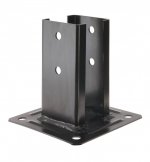
Total height about 2m total width 3.6m (in two 1.8m sections) depth about 50-60cm One end to be fixed to the house wall. The other posts to be fixed to the terrace. I want to keep the posts of the ground and the terrace is sloping by 4cm over that distance so I was think of using adjustable fixings like this:-

FOT_ART_U01_218102_%23SALL_%23AIN_%23V1.jpg


Has anyone used these type of fixings? Good idea or bad? Presumably the base is bolted to the ground, the top plate screwed to the post with a hole for the bolt then the post is screwed down to the level of the nut. How rigid will this be as the only thing stopping the posts from twisting will be the rigidity of the framework around them?

Or should I just use these but make the posts different heights to allow for the slope and raise them up of the bottom of the bracket when I fix them ?
pied-poteau-pp-visser.jpg
 
I've been looking for appropriate post anchors for the deck intersecting roof to my 'shop.

There will be difference in that my anchor's will be on top of the garden, so I will have make a concrete base for each anchor, possibly with cardboard tubes; but I think the principle is the same.

I've tried to look where the stresses will be: -

Gravity - downwards - so the concrete base will have to be sound in the ground.
Lift, wind getting under the roof - upwards, so the anchor will need to be.....anchored.
Torsional movement - twisting - so the anchor to post connection must resist twisting.
There may be others, but I'm not an engineer to know enough.

On a visit to Cherbourg earlier in the year and a quick visit to Bricot Depot I saw that anchor in your image at a very reasonable price compared to the UK. But I have ruled that one out due to it not being able to resist twisting with screws going into end grain at a vulnerable part of the post.

I am looking for an anchor that can be set into concrete, and has a foot on which the post will rest, and a vertical member in the middle with holes, so it can be inserted in a treated groove through the middle of the posted and fixed to the post with metal dowels going through post and vertical member. I've seen something like this in SS, but at £90 per anchor!!!!! Maybe I'll just have to do a couple of days consultancy and cough up!

So having gone through all that, I'd be a little anxious about the screws going in to the end grain of the foot of your posts and the potential for rot.

HTH.
 
Andyp":1y5fiiz6 said:
I see your point Malc. Thanks.

You are looking for something like this then?

https://www.tradecounteronline.co.uk/si ... post-base/


Yes, sort of. I think I definitely need a blade in the middle, with holes for dowels. But I think I need a rebar type post to be set in my concrete footing.

I think yours could benefit from a centre blade, but a flange foot would be OK on your concrete patio. There would be so much concrete around it that any torsional forces to the fixings wouldn't break the concrete.
 
I specify these things as a flat plate cast into the footings, and bolted into a slit in the post foot. I also always specify that half are turned 90 degree from the others, so that wind loads are shared. The trick in casting them is to fix them to a temporary piece of timber to hold them in place whilst the concrete is poured and sets. If the load is heavy, or the situation exposed to high winds, then having a 90 degree bend in the flat plate inside the concrete provides some extra strength.
 
I've just specified a whole lot of those for a treehouse.

For a decent base for a small shed, though, see here.
 
Mike G":yev3c3s1 said:
I specify these things as a flat plate cast into the footings, and bolted into a slit in the post foot. I also always specify that half are turned 90 degree from the others, so that wind loads are shared. The trick in casting them is to fix them to a temporary piece of timber to hold them in place whilst the concrete is poured and sets. If the load is heavy, or the situation exposed to high winds, then having a 90 degree bend in the flat plate inside the concrete provides some extra strength.

Thanks Mike.
Too late to concrete mine although if I am quick I can have them in place before the new tiles are laid.
 
Thanks for the reply Mike.

I'm thinking about a small shed for SWMBO to use as a pottery.

The ground it would stand on is 'made up' and the house has piled foundations. The one wall would be parallel to the boundary where the made up ground falls away so I was thinking of giving the foundation for that wall a bit more support. On reflection, having one wall supported differently to the other three might not be a good idea.

I'll have a look at building it elswhere, where the ground will be consistent all round.

Cheers

Dave
 
I am gonna build this arbour timber frame stylie. And as I have now posted about it I will have to do it. :)

Nothing too complicated :eusa-think: Not being a CAD user I only have back of an envelope sketch.

6 Posts ( two of which bolted to house wall ) about 2m high. Two rails about 4m long ( will have to scarf joint ) and 8 angled braces. Posts and rails 90x90mm, Braces 70x70mm. Simple trellis at far end and in the middle. Roof boards shaped to look pretty and slotted on top of rails.

I know not to place the scarf over the centre post but over the brace. Scarf will be simple not wedged.

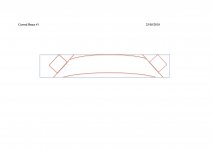
Must I make an angle mortice where the angled brace meets the vertical post? I have read that being as any gap on a 90 degree motice is OK as it is not on the load bearing side. But is there not a risk of the gap filling with water and rotting the tenon? As example here.
http://forestryforum.com/board/index.php?topic=69189.0

edit. to show drawing

Arbour.jpg
 
Do you plan this as a wind break or are you going to try and walk under it? It looks a bit the low side.
 
The M&Ts aren't angled. They're at 90 degrees. They can't actually work if they're angled, because assembly is impossible with multiple joints. I let my shoulders in so that no gap can ever appear, and if you are worried about water getting in, then drill a hole from the mortise downwards at an angle to allow any water that gets in to get out again (actually, it just gives a good place for insects to live!).

0GNylpv.png

XRQfA4B.png

DrN4VDR.png

tvtnx7a.png

Put a curve on those braces, won't you. They look loads better.

The thing is, all the timber is exposed to the same conditions, so they expand and contract together, and the joints don't open up particularly.....especially if you let the shoulders in as I showed.
 
Thanks Mike. I was looking for those images but couldn't find them last night. I agree curved would look better. Letting the shoulders in like that makes marking out so much more difficult, not sure if my skills can cope with that but I will sleep on it.
 
I highly recommend making a template from a scrap of hardboard/ ply/ mdf, then you don't have to think too much about marking out.
 
I was just thinking that in the car just now. Those braces will not be very long, only about 60cm. I could use a template to do most of the work on the router table.

Itching to get started now. But not much chance of that this weekend.
 
Yep........but make the tenon wider, to fill the full width of the board. This will help prevent twisting. In fact, it can be wider than the board by sacrificing a corner.
 
Deejay":1ko2kymm said:
Morning all

Apologies for the hijack but it might also be of use to Malcolm

Mike

Do you have experience of this kind of thing ... https://www.ukhelix.com/screw-pile-supplies/

I am thinking about support for a small shed.

Cheers

Dave

Impossible to screw in vertically. One small stone and you get thrown out of whack. One large stone and you go no further. DAMHIKT. Avoid like the plague.
 
Malc2098":30lib51c said:
.....

On a visit to Cherbourg earlier in the year and a quick visit to Bricot Depot I saw that anchor in your image at a very reasonable price compared to the UK. But I have ruled that one out due to it not being able to resist twisting with screws going into end grain at a vulnerable part of the post.

...

One way to use those - to my eyes - rather excellent feet and keep a good fixing into the end grain is to dowel like this

Untitled.png

The screws them go up and into the dowel for a secure fixing.
 
Morning Roger


Impossible to screw in vertically. One small stone and you get thrown out of whack. One large stone and you go no further. DAMHIKT. Avoid like the plague.

Thanks for the reply.

Most of the made up ground has lots of stone in it. Another reason to look at building on the other side of the plot which is level on both sides of the boundary.

Cheers

Dave
 
Thanks, Roger.

I think I might try that myself, if I can get a secure footing!

That means I'll have to pop across to Cherbourg for another cheeky weekend!
 
I’ve decided to go with these posts fixings, probably
DCA14993-6C08-4A79-8D86-24239D6AC47C.jpeg

Have seen 90x90mm posts I decided they were too large. So will use 70x70 instead. I could not find a 70x70 fixing with a fletch plate in the middle and the adjustable ones are over kill.

The above fixing, from Simpson Strong Tie, will both enable me to raise the post off the ground and allow for the slope on the terrace.(1.8cm between the two posts) I do not think that the slope will be enough to pull the posts out of vertical if it is a washer or too should suffice.

Happy to be told this is a bad idea.
 
I'd have gone to the local steel fabricator with a simple back-of-an-envelope sketch. They make these sort of things in their lunch break for cash, using materials from the scrap bin.

The downside of the one you are proposing to buy is that there will be a lip for water to sit on, at the top of the steel (unless your section if larger, and you cut the end down to fit the shoe).
 
Mike, Thanks. I can see your point. How much of a problem do you think that water sitting on top of the bracket will be?
I admit that I was more concerned with being able to raise the end of the post up off the ground which can be done easily and any water will drain out of those slots in the side.
I wll be using pressure treated timber, brown, not the awfull green, and also intended soaking the ends in cuprinol (spirit based) for a few days as well.
 
Back
Top