• Hi all and welcome to TheWoodHaven2 brought into the 21st Century, kicking and screaming! We all have Alasdair to thank for the vast bulk of the heavy lifting to get us here, no more so than me because he's taken away a huge burden of responsibility from my shoulders and brought us to this new shiny home, with all your previous content (hopefully) still intact! Please peruse and feed back. There is still plenty to do, like changing the colour scheme, adding the banner graphic, tweaking the odd setting here and there so I have added a new thread in the 'Technical Issues, Bugs and Feature Requests' forum for you to add any issues you find, any missing settings or just anything you'd like to see added/removed from the feature set that Xenforo offers. We will get to everything over the coming weeks so please be patient, but add anything at all to the thread I mention above and we promise to get to them over the next few days/weeks/months. In the meantime, please enjoy!

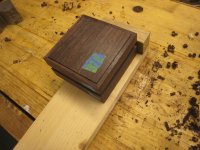
Glazed rosewood keepsake box

AndyT

Old Oak
Joined
Nov 23, 2020
Messages
3,665
Reaction score
1,461
Location
Bristol
Name
Andy
Apparently there's a shortage of wips around these parts, so I'm going to share my latest little project with you. Anyone who was around on another place back in early 2020 will find it a bit familiar, but that thread has no pictures any more, and we like pictures...

In making this, my aims are

- to make a nice little box
- to make it a bit neater than the other one
- to use a wide selection of tools of all ages, and
- to enjoy myself for as long as it takes.

Quite some time ago, an extremely generous woodworker (his forum name rhymes with Mustard ;) ) gave me a selection of what he claimed were offcuts. It was actually more like a carefully selected box of beautiful exotic and rare timbers, as a challenge to up my game and make more stuff. So rather than reach for something out of a skip, I started with this:
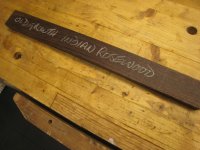
IMG_8893.JPG

IMG_8895.JPG

which is just the right amount of wood for the whole thing.

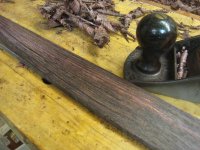
I've never used rosewood before. It's weird stuff, isn't it? I wouldn't have said it smelled of roses when cut, but the odour is distinctive. Maybe more like an expensive sort of China tea, smoky and aromatic. I ripped it in two on the bandsaw making one piece at about 3/8" and the other about 3/16" after planing.

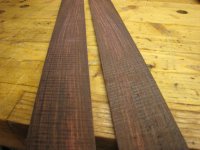
IMG_8899.JPG

IMG_8903.JPG

IMG_8904.JPG

It planes nicely but there's a lot of filthy dust in with the shavings. I had to keep washing my hands.

IMG_8905.JPG

The construction method I had chosen starts with two grooves and a rebate along the thicker piece. Here it's just pushed up against a bit of thin ply which is held with holdfasts. I'm using my Record 405. I've said it before, but I reckon these are really good, precise, controllable planes and there still seem to be plenty about at sensible prices.

IMG_8908.JPG

Although most of that groove worked really easily, there was a patch of reversing grain near the back which was less co-operative.

IMG_8909.JPG

IMG_8910.JPG

So I defined the edges with a chisel and used a little router to even it out, cutting in the opposite direction.

IMG_8911.JPG

I did another, very similar groove on the opposite face.

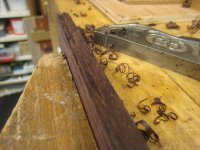
On one edge, I needed a little rebate - about 3/16" wide and 1/8" deep. On that sort of scale, I don't think it helps to use a big plane with fence and depth stop - there's not really room for it. I suppose I could have clamped another piece of something alongside, but instead I freehanded it, which is really not that hard.

You start by making a reasonably deep line with the marking gauge, then put one corner of a little plane into that line, holding the plane over at an angle like this, taking just a whisker of shaving off:
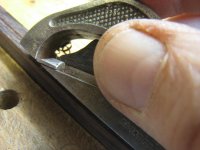
IMG_8913.JPG

Keep tilting and going deeper till it looks like this
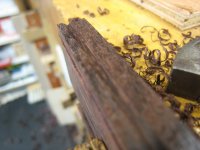
IMG_8917.JPG

IMG_8919.JPG

Then make the rebate deeper and squarer, maybe with a slightly larger plane, if you have one handy.

IMG_8920.JPG

IMG_8921.JPG

Before very long, you'll have a piece of wood that looks like this:

IMG_8923.JPG

And then you make that into a box. ;)
 
Brilliant and fascinating. I like that tip for making a rebate (and I've got the same "slightly larger" plane as that).

Watching with interest as ever.
 
Rosewood can be a pig to work with, looks like you have a very nice piece without too much silica in it!
 
Thanks for the appreciative comments. I can see flecks of shiny silica in this wood but my cutting edges seem to be standing up to the work so far. I guess 'old growth' wood has to be the better stuff.

To make what looks like some sort of miniature drawer side extrusion into a box, you just need to cut some mitres. True to form, for this job I chose my 1990s vintage mitre saw, the sort that the collectors will all be searching for now. :)

IMG_8924.JPG

I dare say it would be useless for 8" skirting boards, but for this sort of job it does all I need. There's a sacrificial strip of wood on the bottom and a simple home made clamp to keep things steady.

Also, I followed Rob's tip and used little coloured dots to mark which end follows which, to keep the grain running around the joints. It's well worth the required investment at your local stationers (£1.50 for a lifetime's supply) and is much quicker and more foolproof than pencilled numbers or bits of masking tape. Thanks Rob.

By measuring the first one and then matching later cuts to it, I soon had a set of parts. It really pays to be methodical on a job like this, especially if you have barely any spare wood and can't afford to cut a piece with the mitre the wrong way round. I soon had these, lined up like junior dominoes:

IMG_8925.JPG

For my benefit but mostly for yours, I checked the angles on the cut ends as they came off the saw. Two together make 90 degrees:

IMG_8927.JPG

and one on its own is 45:

IMG_8928.JPG

But even if the angles are ok, rough sawn ends won't do for this job. They need to be planed smooth and flat. I don't have one of those big old cast iron mitre trimmers that can cut off innocent body parts, so my tool of choice for this is a nice old mitre shooting block. I don't seem to have taken a general photo of it this time round, but here's an old one from another project:

bevelbox05.jpg

Oddly, it has a left hand thread on its clamping rod. I can't see any advantage in that, so maybe it was saved from something else and was hanging around in the workshop waiting to come in useful.

Here's one potential box side, clamped in place, just proud of the surface

IMG_8929.JPG

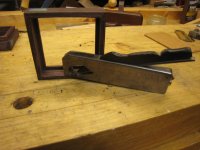
And here's an awkwardly posed shot showing that if you are lucky enough to have a dedicated mitre plane, this is definitely the time to use it.

IMG_8932.JPG

This is where using quality wood and quality tools pays off. This plane, with its sharp iron and delicate little mouth

IMG_8937.JPG

produced the finest shavings I have ever made

IMG_8931.JPG

left a delightfully smooth surface on the rosewood

IMG_8934.JPG

and a big grin across my face!

I know I should be focussing on the outcome, not the journey, but this tiny pile was all I had to shave off all eight ends. I'd have been even happier if I'd had to make more!

IMG_8942.JPG

With all the ends planed, and opposite sides checked against each other for length, it was time to glue the sides together. This was simple, using masking tape along the outside

IMG_8943.JPG

IMG_8944.JPG

painting the ends with glue and folding it up into a square. Modern masking tape has just enough stretch to hold everything together nicely. I used an engineer's vee block as a handy way to check that the corners were square enough,

IMG_8945.JPG

photographed the best corner

IMG_8946.JPG

and waited for the glue to dry.

More soon!
 
Nice Job Andy!...and you're right about the lack of WIP's (the one on my little cabinet will be resumed as soon as I've got the hinges). In the meantime, I share your comments about Indian Rosewood and agree it can be 'interesting' :eusa-whistle: to work. If you recollect, a couple of years ago I made a 'moon' jewellery box from the stuff which was well received by it's recipient, garnering some very favourable comments from her dad when he cast the Mk1 eyeball over it - Rob
 
Thanks all.

I was about to ask a question about finish on this rosewood. I've just bought some of Shane Skelton's Peacock oil and was thinking it could be a good choice. The instructions are quite detailed, suggesting lots of sanding, to a very fine grit, lots of coats and lots of waiting.

Now that you've mentioned your Moon box Rob, I looked back at it and saw that you used Peacock oil.

So that's a Yes to my first question, would it be a good choice.

But you also said it took 2 months to do the finishing!

So, any tips from you more experienced box finishers?

I've been preliminarily sanding to 400 (pics of this exciting stage coming soon) - do I really need to go finer?
Would it be sensible or daft to only oil the outside?

Any other thoughts?
 
I'm intrigued by the grooves on both sides of the some of the sides. I can't work out what the outer one is for.

As for finish.........I need a good reason these days not to use what seems have become known as 3M, or MMM.
 
AndyT":2yforldg said:
Thanks all.

I was about to ask a question about finish on this rosewood. I've just bought some of Shane Skelton's Peacock oil and was thinking it could be a good choice. The instructions are quite detailed, suggesting lots of sanding, to a very fine grit, lots of coats and lots of waiting.

Now that you've mentioned your Moon box Rob, I looked back at it and saw that you used Peacock oil.

So that's a Yes to my first question, would it be a good choice.

But you also said it took 2 months to do the finishing!

So, any tips from you more experienced box finishers?

I've been preliminarily sanding to 400 (pics of this exciting stage coming soon) - do I really need to go finer?
Would it be sensible or daft to only oil the outside?

Any other thoughts?
Shane's PO is really good stuff, but as you said, I couldn't get it go 'off' or harden on the rosewood, so I thought that I'd give him a shout on the dog n'bone and got straight through to the workshop. He's a really nice bloke and explained that rosewood is difficult as it's oily, but the really quick way to harden it off is to expose it to daylight! I gave the box surfaces four coats of oil and then left them in the greenhouse where they were sure to get plenty of illumination :lol: . Even a warm workshop won't harden it off very quickly...daylight is what you need.
That said, Shane's got some new stuff which I haven't tried which is supposed to harden much more quickly. I've got a bottle or three in the shop but haven't yet tried it on a project - Rob
 
Mike, the cunning design will be revealed in the next instalment...
Rob, thanks for the tip - a dark basement in the winter doesn't sound like the best option!
 
Mike G":24uhs3qx said:
As for finish.........I need a good reason these days not to use what seems have become known as 3M, or MMM.

:text-+1: Mike's Magic Mix on pretty much everything for me, including all the boxes I've ever made apart from one (on which I used Shellac as an experiment).
 
Very nice Andy, superfine shavings! That Rosewood looks really good quality. If it were me I would use French polish, and finish inside prior to gluing, so it will be interesting to see how your finish pans out as doing it in two goes is a pain.
My mitre planing jig works the other way to yours and in the vice but it’s at home so will post about it in a couple of months.
 
AndyT":2wifa499 said:
Thanks all.

I was about to ask a question about finish on this rosewood. I've just bought some of Shane Skelton's Peacock oil and was thinking it could be a good choice. The instructions are quite detailed, suggesting lots of sanding, to a very fine grit, lots of coats and lots of waiting.

Now that you've mentioned your Moon box Rob, I looked back at it and saw that you used Peacock oil.

So that's a Yes to my first question, would it be a good choice.

But you also said it took 2 months to do the finishing!

So, any tips from you more experienced box finishers?

I've been preliminarily sanding to 400 (pics of this exciting stage coming soon) - do I really need to go finer?
Would it be sensible or daft to only oil the outside?

Any other thoughts?

Andy - just to add to Rob’s comments above …

I use PO regularly and prior to application only sand to 400 but do use 600 wet and dry with the final application. If you’ve not got them already the instructions are available as a download on the Skelton Saws website.

The faster drying product is called Wick but I haven’t used it either.

Cheers

Robert
 
Nice WIP. Thank you Andy.

I agree with the others that Rosewood can be difficult. I bought several planks of it 30 years ago (when it was allowed and c heap to get get from India and Brazil) to make fingerboards and guitar backs and quickly found that the dust exacerbates my asthma. Back then I was not using a power mask - I just stopped using rosewood. Kept the planks though. Oddly, ebony does bot have this effect. It can be a right devil filling the end grain imperceptibly.

Excellent work and very clear WIP.
 
AJB Temple":3ua4vxl2 said:
I bought several planks of it 30 years ago (when it was allowed and c heap to get get from India and Brazil) to make fingerboards and guitar backs and quickly found that the dust exacerbates my asthma. Back then I was not using a power mask - I just stopped using rosewood. Kept the planks though. Oddly, ebony does bot have this effect.

Some timbers (Sensitiser Timbers) can cause quite severe asthmatic reactions in those that are vulnerable, and continued use without protection in those who aren't vulnerable to begin with will eventually develop asthma, other respiratory issues, eye problems, as well as skin issues.

You can see a pretty detailed list of sensitiser timbers here, might be a good reference for the future:

https://www.wood-database.com/wood-articles/wood-allergies-and-toxicity/#hp

All of the Rosewoods are severe sensitiser timbers, as well as some more common timbers you might find for sale here like Western Red Cedar and Yew. Interestingly there's a wood on there I've never heard of which is a severe sensitiser, "Sneezewood" which the name makes quite obvious what occurs when you work with it, I can see why you don't see it here.
 
Thanks for the reminder about reactions to the dust.
I was vaccuuming up the sanding dust frequently but will wear a mask as well from now on.
 
Thanks Dan. That's helpful and kind of you. I've had the triumvirate of asthma, eczema and hayfever from birth. Didn't realise about wood until I started woodworking as a teenager. I actually had allergen tests which identified a lot of issues, including allergy to wood tar, which is in paper and explained a lot. However, I'm firmly of the view that we need to find a way around these annoyances and not let them stop us. For many years, when doing woodwork I wore white cotton gloves from Boots that helped. When I was a kid I had these sown onto my sleeves of my pyjamas to stop me tearing the skin off my hands at night. Seriously. Handling fish in seawater was also a big deal. Bizarre I know.

Drugs improved and I have consumed a lot of 3M masks. Now I have very few symptoms, especially as for the past 15 years I wear air flow power masks for sanding, anything that will produce dust and even mowing the lawn. Virtually no carpets in the house. Dust mite sprays on bedding - the lot. But Rosewood gets through most things somehow. Walnuts are very dangerous for me, and even the timber dust from walnut can be challenging. I use oak a lot for a reason :lol:

What does help is the big Festool trade vac which is superb, and the big workshop pro vac that is piped to all work stations in my little shop.

I am at times guilty of making light of dust allergies etc, and that is daft actually.
 
Cabinetman":3sio2bi6 said:
...and finish inside prior to gluing...
I was thinking that too, but alas, the moment has passed! :lol:

Looking good, Andy - and that's just the drive-bys of all the toolz. ;)
 
Ok, just to show that I don't always take months over projects, here's the rest of the construction.

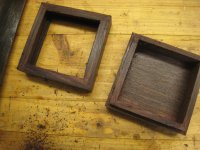
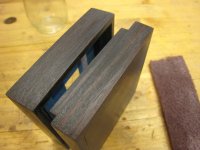
With the box held gently in the vice, it was time to separate what will be the lid from what will be the bottom tray. The two grooves then become a pair of rebates, allowing the top to sit over the bottom.

I used the side of the lower groove as a guide for the saw. For Alf's benefit (and everyone else's) I'll just add that this little saw is one of my favourites. It's from about 1900 and was made in Sheffield by Tyzack Sons & Turner. It also bears the name of Warlow - a Bristol ironmonger - on the blade which helps to date it. Nine inches long, 16 tpi, it cuts beautifully and fits my hand just right. I don't even mind that Mr Fyfield or somebody drilled a hole in the handle.

IMG_8959.JPG

The kerf is nice and thin

IMG_8961.JPG

and before long the two pieces were separated.

IMG_8962.JPG

I'd not risked making the two grooves meet - I didn't want the box to split in two ahead of time - so this cut leaves a little strip of wood to be removed from the lower edge of the lid.

I took most of it off with a knife

IMG_8964.JPG

If you are lucky enough to have a narrow but extra long bullnose shoulder plane, it's tempting to use it on the skew to try and level up the rest

IMG_8965.JPG

but that wasn't a total success so the plane went back on the shelf for another day. A friend had already mentioned that rosewood works best with files and abrasives so that's what I used next, and they worked better.

IMG_8966.JPG

That all took quite some time, as I needed to take wood away from the rim on the bottom of the box so that it would fit into the lid. I suppose I could have ploughed the grooves a bit deeper but I prefer to custom fit this sort of thing rather than trust measurements.

Here it is, nearly going together. The tape was to prevent any accidental sanding in the wrong places. (I was using various grades of paper stuck onto thin sticks.)

IMG_8969.JPG

But before I could call it finished I needed to fit the bottom. For this I used the thinner piece from the initial bandsawing. I cut two little pieces, planed them smoothish and similar and edge-glued them together, with tape as before.

IMG_8948.JPG

This time round I remembered that rosewood is an oily wood that's supposed to be difficult to glue, so I wiped along the edges first with some IPA. (The joints on the corners seem fine. Maybe it's more of a problem with PVA?)

To even up some slight discrepancies in the rebate that the bottom will fit into, I used a nice old router. These old wooden routers have some advantages over the Stanley/Record ones. The high angle gives a nice scraping cut. It will work almost all the way into a corner like this. And they still don't cost much. :)

IMG_8951.JPG

Here you can see me taking a few more shavings off to get the bottom to fit. The patch of tape was to get it the right way round, not one of the seven wrong ways.

IMG_8955.JPG

IMG_8956.JPG

Later on, when I did some more sanding before actually gluing the bottom in, I realised some indelible marks were better:

IMG_8982.JPG

There was a lot of sanding to do. I used this simple sanding board. It's just a piece of MFC with some strips of hardwood screwed into transverse dowels. This side has 120 and 240 grades, the other has 320 and 400. It's not my design, but I saw it online somewhere and copied it. If you shared it originally, thank you.

IMG_8977.JPG

To glue the bottom in, I used the minimum amount of glue, so as to avoid cleaning up excess

IMG_8983.JPG

and put my heavy weight on top - it's a box containing some bits of scrap lead water pipe from our loft. (I did the dovetails that way round just to amuse Sheffield Tony.)

IMG_8984.JPG


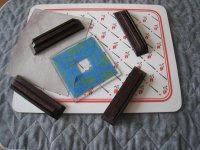
To hold the glass in the lid, I cut some tiny little strips from the thin piece, planed them, sanded them, then mitred the ends. Not so much to get in the way this time.

IMG_8974.JPG

But of course the ends needed a bit of trim to get them properly smooth and at 45 degrees. And what more excuse do I need for owning a nice brass mitre template as well as one or two wooden ones? ;)

IMG_8975.JPG

Here's the dry fit.

IMG_8976.JPG

The glass is there in that picture, I think. I don't have any photos of my poor glass cutting skills, so I'll just say, it's a lot quicker if you don't need to grind down the edges of the glass to the right size. :oops:

And so, after some more glue-setting and some more sanding, here's the bare box so far.

IMG_8987.JPG

I could claim it was all part of my design that the strips holding the glass would meet the top of the rim at the same time as the outside edges join without a gap, but actually it's more luck than judgement that they do. I'd added up the dimensions on my original sketch but was pleased that they were that close without more adjustment.

The bottom is flat but I hope some of that ugly gap will disappear when some more sanding dust and finish go into it later.

IMG_8988.JPG

Over the next few days, I'll experiment with finishes on some of the scraps I have left. That will take a little while, especially if I need to build a greenhouse to get the oil to go off! :)
 
Very nice work indeed Andy.

I'm always a bit windy about cutting glass. Lovely accurate work.
 
That's marvellous™. I really like the idea of the groove-rebate thing for joining box & lid. I might have to steal that idea.
 
I like it.

I also have a tendency to cut glass too large and then have a hard time fine tuning it. I guess it's from working with wood where it's easy to take a shaving or two to get something to fit 'just so'. If only someone would make a tool that can plane glass...
 
NickM":1zmdivy3 said:
I like it.

I also have a tendency to cut glass too large and then have a hard time fine tuning it. I guess it's from working with wood where it's easy to take a shaving or two to get something to fit 'just so'. If only someone would make a tool that can plane glass...

Exactly so. I think it's become easier nowadays, with modern abrasive papers or coarse diamond plates.

Back when we only had glasspaper, it must have been much harder!
 
I expect you are all wondering what happened next.

Well, this is my experience.

I wanted to seal the inside with something reliable, so brushed on a coat of shellac. This dried instantly, leaving a pleasant satin finish on the open grained wood.

IMG_8998.JPG

For the outside, I tried the fancy new Peacock Oil. I'd just bought it, and Rob had good results with it, even if it did take him quite some time. As I had done with the shellac, I painted the oil on generously with a soft, fine brush, waited a while and wiped off the excess. It stayed sticky for rather a long time, so I wiped again a bit harder. Next day it seemed ok so I repeated the procedure. This went on for some time. I can't remember now how many coats I tried - somewhere between 6 and 10.

I seemed to be in a loop where I was wiping off as much as I had put on, without getting any build up of thickness or filling in of the grain.

I was doing this upstairs, in a good light, not down in my cold basement. And so it was that I tested the integrity of the construction by dropping the lid from the table to the hard wooden floor... "Oh bother" I said. "Drat." :evil:

I didn't think to photograph the bits as they lay on the floor but here they are a few minutes later.

IMG_8992.JPG

I'd put the blue masking tape on the glass so that I didn't paint oil over the edges; maybe it helped keep it in one piece. The corner joints all separated very neatly - I only needed to lightly sand the ends to even out the remaining glue.

I taped the bits together and re-glued it.

IMG_8993.JPG

Of course, it didn't go together as perfectly square as it had the first time, so some extra sanding was needed to make the lid fit on the base and line up ok.

After all this fiddling about, I was still disappointed with the finish. Having sanded it back quite a lot, I decided to give the Rustins Finishing Oil a chance, having spoken to a friend who said he'd used it happily on rosewood.

This was no better!

After I forget how many coats, this is how it looked. Nasty streaks where the oil had soaked in and dried, or not soaked in and barely dried at all.

IMG_8994.JPG

It was hard to photograph, but this shows how uneven and streaky it was looking on the bottom

IMG_8997.JPG

So I sanded it all back again and turned to the shellac that I should have used in the first place, when you were all looking at that picture of the inside and saying that it looked ok.

Before:

IMG_9000.JPG

And after three coats:

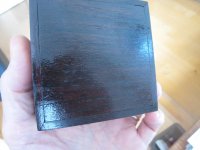
IMG_9011.JPG

IMG_9012.JPG

It's hard to photograph a shiny finish without getting swamped in reflections but this is good enough for me and is the sort of look that I had in mind.

Ian, I don't think my simple approach to brushing or wiping on some shellac really counts as French Polishing, but some time back you said
Cabinetman":2n1h2p57 said:
If it were me I would use French polish, and finish inside prior to gluing, so it will be interesting to see how your finish pans out as doing it in two goes is a pain.

I didn't do what you said and I got my dose of pain! :)

And shellac really is amazingly good, versatile stuff.
 
Nice result Andy. I think I mentioned somewhere that Indian Rosewood is oily and therefore not ideal to accept Peacock Oil and dry hard; at least that was my experience. However I then picked up the dog n'bone and spoke directly to Shane Skelton in Scarborough who said that you need natural daylight to harden it quickly, so I used the greenhouse.

Have you got your's built yet and if not we expect a WIP when it happens :lol: - Rob
 
Rob, I should have said that I was doing all the oiling upstairs so that it was in as much light as I could find (in winter, with the sun moving round the room) and it still wouldn't go off. I'll try it again on something else.
 
AndyT":3r60z2kq said:
Rob, I should have said that I was doing all the oiling upstairs so that it was in as much light as I could find (in winter, with the sun moving round the room) and it still wouldn't go off. I'll try it again on something else.
I follow Shane on Instagram and he uses it on all of his luuuverly saw handles (bubinga, beech, walnut etc) but I haven't seen him use the stuff on Indian Rosewood or any other oily wood - Rob
 
AndyT":fzk8ns0a said:
For the outside, I tried the fancy new Peacock Oil. I'd just bought it, and Rob had good results with it, even if it did take him quite some time. As I had done with the shellac, I painted the oil on generously with a soft, fine brush, waited a while and wiped off the excess.

Don’t know if it will help next time you use your Peacock oil Andy but I watched Shane demonstrate oiling & to say he is sparing with it is an understatement as he was with the amount of clothe he used, not much bigger than a postage stamp.
One drop on the clothe seemed enough to give a handle a coat, he certainly made it go a long way & if I remember correctly he recommended quite a few very thin coats.

That said I know oilly timbers can be difficult to get a good finish on with oil.
 
Thanks Doug. I was brushing it on thinly but not spreading it with a cloth while it was wet.

I wonder if, another time, it would be worth applying a thin layer of shellac first, to seal the surface then layers if oil to build up a lustre?
 
NickM":1xqhs30d said:
........If only someone would make a tool that can plane glass...

Diamond plates do the job beautifully.
 
Glad to be of service with the Friench Polish, sorry you’ve had a bit of a game, what I would do now is a very light rub with fine wire wool and then wax it, it will remove some of the gloss and make it look more natural. But it’s looking very good indeed.
Ian
 
Cabinetman":9i7zh0f5 said:
Glad to be of service with the Friench Polish, sorry you’ve had a bit of a game, what I would do now is a very light rub with fine wire wool and then wax it, it will remove some of the gloss and make it look more natural. But it’s looking very good indeed.
Ian


Thanks Ian, I've now done exactly that, but I haven't managed to photograph it in equivalent conditions as the daylight has faded too much. It's a subtle change but a nice one. Nicer on the fingertips too.
 
Good work Andy. I'm impressed you stayed the course. You faced some headwinds and got through it.
Can't beat a bit of shellac!
Nice to see the wooden router in play. You rightly highlighted its advantages. If you have a full set of plough irons, which I suspect you do, it has the added bonus of lots of cutter widths.

Sent from my Pixel 4a using Tapatalk
 
Back
Top