

Here's a plane which belonged to my father in law. It's an ordinary sort of number 4, in rather scruffy condition, but I thought I'd tidy it up a bit.

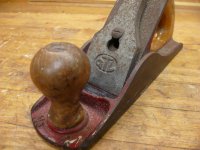
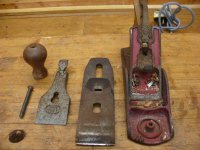
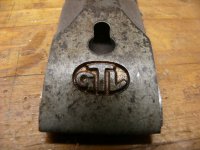
The name on the lever cap is GTL. This was "Guaranteed Tools Limited." They sold tools, made for them by established Sheffield firms, gathered into attractive kits and advertised in magazines in the 1920s and 30s. They were available on easy "hire purchase" terms.
This advert ran in "John Bull" in the late 30s, alongside ads for cigarettes, body building courses, rheumatism cures and boot polish: (image from Grace's Guide at https://www.gracesguide.co.uk/Guaranteed_Tools)
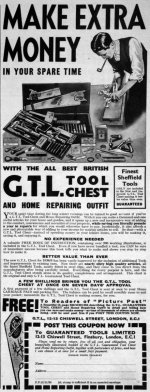
Anyone who has looked at ebay listings or similar places for old planes will probably have seen pictures of an eye-catching No 4 sized brass-bodied smoother that they sold, which had a Norris-type depth adjuster, but is always described as disappointing by people who have bought one. That's the plane that the pipe-smoking gent in the ad is using, with a round adjusting knob protruding above the top of the iron. Interestingly, the ad also shows another plane, which looks like a more conventional Stanley type. That's what we have here.
They are not rare, or valuable. I found several on eBay now, all looking like this one. The distinctive feature that makes them easy to spot is of course the red paint. I know that Marples and Rapier (Anglo-Scottish Tool Company) used to paint their planes red, but there was also the Acorn brand with red paint. And this GTL-badged plane was made by JA Chapman Ltd of Sheffield, who used the Acorn brand. For corroboration, have a search on eBay for Acorn planes and you'll see plenty, identical except for the lever cap. Or look in Goodman's British Planemakers which confirms the connection and says that Chapmans also made planes sold by Spear & Jackson and Talco.
Chapmans made a wider range of tools besides planes, especially various models of braces. According to Geoffrey Tweedale they were bought up by Norman Neill in the mid 30s and then sold to Stanley Tools in 1938, enabling them to start manufacturing in the UK. Stanley kept the Chapman and Acorn names and you'll see planes on eBay with original packaging or stickers on the rear handle showing the Chapman and Stanley names together.
But before we look at the details, this is all I did to clean it up.
Obviously, I wiped off all the dirt and crud that had built up over several decades on a garage shelf. I removed the rust - which was all pretty superficial - mostly with Garryflex blocks, which are a lump of rubber with grit embedded in it, sold in several grades. Think of them as erasers for rust.
The little spot of rust on the sole and the corner of the iron got scraped, as the rust was making a noticeable bump.

Another distinctive feature of these planes is that the beech handles are varnished but not stained - there's no attempt to imitate premium rosewood and I think the colour scheme looks rather 30s modern. Naturally the varnish didn't stop this one from splitting in the usual place
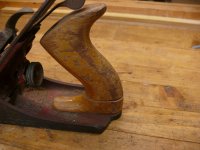
so I applied some wood glue and wedged it up. Those of you without a tool well must be wondering what else you could do in a tricky spot like this!
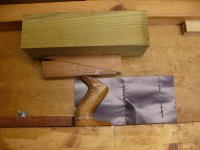
I then scraped and sanded all the old, failed varnish. My aim was to get this plane in working order, not to put it back in original condition, so I didn't replace the old varnish; instead I wiped on a few coats of thinned linseed oil, which I prefer for this and is less bother.
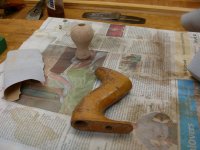
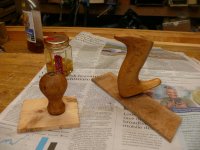
I used the same oil for the painted parts. It's an easy way to perk up an old finish and prevent rust on bare steel.

I just painted it on with a small brush and wiped any surplus off with some paper after 15 minutes or so.
The grey hammer finish on the lever cap was pretty rough. I sanded the surface smooth and oiled what was left. It's not pretty, but it's functional. I think there's a trace of gold paint behind the lettering.
One fiddly aspect was that, as the plane had clearly been used with the handle broken and wobbly, the hole underneath was a very loose fit on the locating pin (cast on the bed of the plane). Also, the hole was off-centre by a couple of millimetres:
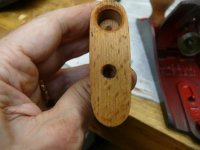
I whittled the end of a dowel until it could be glued in the hole
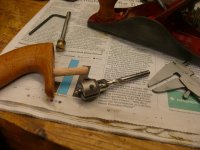
cut it off flush and marked the proper centre

and drilled a new hole in the right place
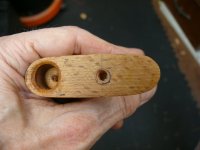
After a bit of careful tweaking, and a washer on the fixing rod to make sure it could tighten up without bottoming out, I had a firmly fixed handle.
All the screws were de-rusted and where possible cleaned up with a die.
[Incidentally, although this plane is a Stanley copy, the threads are standard sizes, not backwards compatible oddities. In case anyone is ever restoring one of these and searching for the thread sizes on Chapman Acorn planes, the sizes used are these:
Rear handle and frog screws: 1/4" BSW 20 tpi
Front knob: 5/16" BSW 18 tpi
Lever cap retaining screw: 9/32" BSF 26 tpi
Depth of cut adjuster screw: 9/32" 24 tpi left hand thread. (Ok, that's the odd one. It's not BSF or even British Standard Brass, which are both 26 tpi. Apparently it was a Whitworth Admiralty Fine size and is the same as Stanley used. I expect following Stanley for this bit made it easier to buy in the brass adjuster wheel, or take them from the same parts bin if this plane was made after the Stanley takeover. )]
That's about it for the remedial work - little more than a good clean. I tickled the edge of the iron and reassembled everything. So here is the action shot, showing a pile of shavings from a bit of dry old oak.

Naturally, it works!
So should you rush out and start pushing up the prices of old Acorn planes beyond the £10-20 mark they seem to be at the moment? Not really, not unless you are very hard up and don't already have a proper Stanley or Record. It's ok but not superior, in my estimation.
Remember that these were aimed at amateurs, with some features left out or simplified. For example, there's no screw under the frog to move it back or forwards:
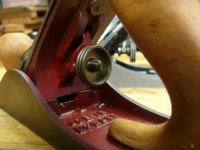
Hands up if you can remember when you last used the frog adjusting screw on your no 4!
That adjuster knob is smaller than you'd find on most Stanleys.
The lateral adjuster is just one piece of steel, bent round to make a tab with the other end bent up to engage in the slot in the iron (see below). Does that matter? Probably not, it seems to work and the Stanley three piece design doesn't perform any better as far as I can tell.
Compared to earlier Stanley models, the frog casting only touches at the edges - but that's the same on this 1960s Stanley:

The casting seems to be quite well made, though it lacks the central ridge and the sides are not at a perfect right angle to the sole, and in this case there is some perceptible wear to the sole, which shows up as gaps of a thou or two. I haven't flattened it; it would be perfectly ok for ordinary dimensioning of softwood, which is what it would have been bought for.
The casting is about 3/8" shorter than the Stanley - but I don't think I would have noticed that if I hadn't put them side by side:
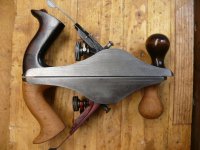
But really, the point of the exercise wasn't about getting another plane - which I hope will go to another member of the family - it was just to put an old, much-used tool back in working order and remind the world that old and dirty tools are not necessarily just scrap.
Oh and if anyone has one of those chests of tools, I'd love to see some pictures, especially if you have the included book on how to make money with them, with no experience needed!
The name on the lever cap is GTL. This was "Guaranteed Tools Limited." They sold tools, made for them by established Sheffield firms, gathered into attractive kits and advertised in magazines in the 1920s and 30s. They were available on easy "hire purchase" terms.
This advert ran in "John Bull" in the late 30s, alongside ads for cigarettes, body building courses, rheumatism cures and boot polish: (image from Grace's Guide at https://www.gracesguide.co.uk/Guaranteed_Tools)
Anyone who has looked at ebay listings or similar places for old planes will probably have seen pictures of an eye-catching No 4 sized brass-bodied smoother that they sold, which had a Norris-type depth adjuster, but is always described as disappointing by people who have bought one. That's the plane that the pipe-smoking gent in the ad is using, with a round adjusting knob protruding above the top of the iron. Interestingly, the ad also shows another plane, which looks like a more conventional Stanley type. That's what we have here.
They are not rare, or valuable. I found several on eBay now, all looking like this one. The distinctive feature that makes them easy to spot is of course the red paint. I know that Marples and Rapier (Anglo-Scottish Tool Company) used to paint their planes red, but there was also the Acorn brand with red paint. And this GTL-badged plane was made by JA Chapman Ltd of Sheffield, who used the Acorn brand. For corroboration, have a search on eBay for Acorn planes and you'll see plenty, identical except for the lever cap. Or look in Goodman's British Planemakers which confirms the connection and says that Chapmans also made planes sold by Spear & Jackson and Talco.
Chapmans made a wider range of tools besides planes, especially various models of braces. According to Geoffrey Tweedale they were bought up by Norman Neill in the mid 30s and then sold to Stanley Tools in 1938, enabling them to start manufacturing in the UK. Stanley kept the Chapman and Acorn names and you'll see planes on eBay with original packaging or stickers on the rear handle showing the Chapman and Stanley names together.
But before we look at the details, this is all I did to clean it up.
Obviously, I wiped off all the dirt and crud that had built up over several decades on a garage shelf. I removed the rust - which was all pretty superficial - mostly with Garryflex blocks, which are a lump of rubber with grit embedded in it, sold in several grades. Think of them as erasers for rust.
The little spot of rust on the sole and the corner of the iron got scraped, as the rust was making a noticeable bump.
Another distinctive feature of these planes is that the beech handles are varnished but not stained - there's no attempt to imitate premium rosewood and I think the colour scheme looks rather 30s modern. Naturally the varnish didn't stop this one from splitting in the usual place
so I applied some wood glue and wedged it up. Those of you without a tool well must be wondering what else you could do in a tricky spot like this!
I then scraped and sanded all the old, failed varnish. My aim was to get this plane in working order, not to put it back in original condition, so I didn't replace the old varnish; instead I wiped on a few coats of thinned linseed oil, which I prefer for this and is less bother.
I used the same oil for the painted parts. It's an easy way to perk up an old finish and prevent rust on bare steel.
I just painted it on with a small brush and wiped any surplus off with some paper after 15 minutes or so.
The grey hammer finish on the lever cap was pretty rough. I sanded the surface smooth and oiled what was left. It's not pretty, but it's functional. I think there's a trace of gold paint behind the lettering.
One fiddly aspect was that, as the plane had clearly been used with the handle broken and wobbly, the hole underneath was a very loose fit on the locating pin (cast on the bed of the plane). Also, the hole was off-centre by a couple of millimetres:
I whittled the end of a dowel until it could be glued in the hole
cut it off flush and marked the proper centre
and drilled a new hole in the right place
After a bit of careful tweaking, and a washer on the fixing rod to make sure it could tighten up without bottoming out, I had a firmly fixed handle.
All the screws were de-rusted and where possible cleaned up with a die.
[Incidentally, although this plane is a Stanley copy, the threads are standard sizes, not backwards compatible oddities. In case anyone is ever restoring one of these and searching for the thread sizes on Chapman Acorn planes, the sizes used are these:
Rear handle and frog screws: 1/4" BSW 20 tpi
Front knob: 5/16" BSW 18 tpi
Lever cap retaining screw: 9/32" BSF 26 tpi
Depth of cut adjuster screw: 9/32" 24 tpi left hand thread. (Ok, that's the odd one. It's not BSF or even British Standard Brass, which are both 26 tpi. Apparently it was a Whitworth Admiralty Fine size and is the same as Stanley used. I expect following Stanley for this bit made it easier to buy in the brass adjuster wheel, or take them from the same parts bin if this plane was made after the Stanley takeover. )]
That's about it for the remedial work - little more than a good clean. I tickled the edge of the iron and reassembled everything. So here is the action shot, showing a pile of shavings from a bit of dry old oak.
Naturally, it works!
So should you rush out and start pushing up the prices of old Acorn planes beyond the £10-20 mark they seem to be at the moment? Not really, not unless you are very hard up and don't already have a proper Stanley or Record. It's ok but not superior, in my estimation.
Remember that these were aimed at amateurs, with some features left out or simplified. For example, there's no screw under the frog to move it back or forwards:
Hands up if you can remember when you last used the frog adjusting screw on your no 4!
That adjuster knob is smaller than you'd find on most Stanleys.
The lateral adjuster is just one piece of steel, bent round to make a tab with the other end bent up to engage in the slot in the iron (see below). Does that matter? Probably not, it seems to work and the Stanley three piece design doesn't perform any better as far as I can tell.
Compared to earlier Stanley models, the frog casting only touches at the edges - but that's the same on this 1960s Stanley:
The casting seems to be quite well made, though it lacks the central ridge and the sides are not at a perfect right angle to the sole, and in this case there is some perceptible wear to the sole, which shows up as gaps of a thou or two. I haven't flattened it; it would be perfectly ok for ordinary dimensioning of softwood, which is what it would have been bought for.
The casting is about 3/8" shorter than the Stanley - but I don't think I would have noticed that if I hadn't put them side by side:
But really, the point of the exercise wasn't about getting another plane - which I hope will go to another member of the family - it was just to put an old, much-used tool back in working order and remind the world that old and dirty tools are not necessarily just scrap.
Oh and if anyone has one of those chests of tools, I'd love to see some pictures, especially if you have the included book on how to make money with them, with no experience needed!


