

Lons
Old Oak
Sorry, not much woodwork or a work in progress, during the Covid after effects I just couldn’t be bothered but hopefully some might find it of interest and I’ll post up the results good or bad when I eventually try it out.
I mentioned a while ago that I wanted to knock up some kind of copy carver mostly to duplicate a stock or two for my air rifle. I could do the whole stock by hand but as there could be more, a mate has dropped hints and another mentioned copying some guitar bodies, I considered this worth a try especially if I used materials I already had and if not I can reuse all the metal for something else.
So after the first few days of Covid between Christmas and New Year, weary of daytime TV I started, a few hours here and there and I’m fairly confident it should work although it might be a while before I try it out as the only sizeable hardwood I have is the mahogany in the last photo. I’ll probably try it first on softwood or laminated ply but I might eventually try to find a nice piece of walnut or a burr if everything works.
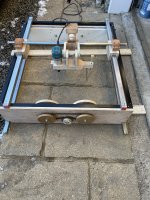
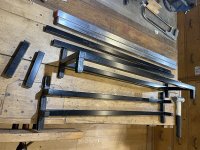
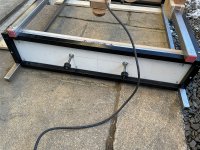
Main slider rails from 30mm sqare tube and the frame from 25mm tube with commercial corner joints rivetted for stability. The cros slide is 13.5mm thick walled tube which is all I had.
“bearings” for main sliders are 18mm birch ply lined with some scrap 3mm polypropylene as I had no ptfe. The alternative would have been to buy proper rail and linear bearings or a number of ball races. Bearing for the cross slide was a lump of mahogany with a hole drilled and carefully filed to a tight sliding fit for the round tube, I also drilled the back of that, theaded the holes to 6mm cut a couple of leather pads inside the holes with small springs then 6mm cap screws, intended to take up slack if the hole wears.
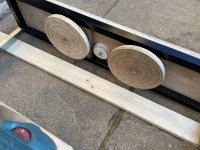
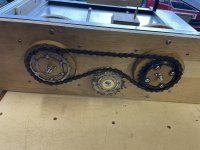
The drive end is ply screwed to the frame with extra mahogany blocks, wood faceplates secured to long carriage bolts, as these were partly threaded I had to use a 10mm die to cut threads the full length, I also used some brass tube as sleeves through the timber. These faceplates need to turn exactly the same amount in use so I repurposed some cycle cogs and a cut down chain on the other side, wasn’t happy initially so turned them around. I may need to find a way to lock these in position but probably not.
For the opposite end I made up a separate framewith two lengths of 25 tube with hardwood blocks sandwiched between 18mm MDF. The points are threaded rod adjustable for length. This is screwed to the end which is suitable for the gunstock length but I can move that to suit smaller objects.
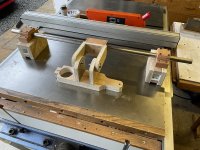
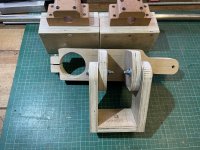
The router holder and guide assembly is similar to a design cribbed off the internet, made from 18mm birch ply to accommodte my Makita trim router with the guide point again threaded rod. I’ve turned 3 ends and threaded those to screw on the end but can easily make others to suit the width and profile of router cutter used. The assembly has a counterweight at the back which is just a box and 4 old sash window weights. It wouldn’t be difficult to make a new holder part if I wanted to use a different or larger router.
Everything slides well with a smear of wax on the rails and bearings so promising.








I mentioned a while ago that I wanted to knock up some kind of copy carver mostly to duplicate a stock or two for my air rifle. I could do the whole stock by hand but as there could be more, a mate has dropped hints and another mentioned copying some guitar bodies, I considered this worth a try especially if I used materials I already had and if not I can reuse all the metal for something else.
So after the first few days of Covid between Christmas and New Year, weary of daytime TV I started, a few hours here and there and I’m fairly confident it should work although it might be a while before I try it out as the only sizeable hardwood I have is the mahogany in the last photo. I’ll probably try it first on softwood or laminated ply but I might eventually try to find a nice piece of walnut or a burr if everything works.
Main slider rails from 30mm sqare tube and the frame from 25mm tube with commercial corner joints rivetted for stability. The cros slide is 13.5mm thick walled tube which is all I had.
“bearings” for main sliders are 18mm birch ply lined with some scrap 3mm polypropylene as I had no ptfe. The alternative would have been to buy proper rail and linear bearings or a number of ball races. Bearing for the cross slide was a lump of mahogany with a hole drilled and carefully filed to a tight sliding fit for the round tube, I also drilled the back of that, theaded the holes to 6mm cut a couple of leather pads inside the holes with small springs then 6mm cap screws, intended to take up slack if the hole wears.
The drive end is ply screwed to the frame with extra mahogany blocks, wood faceplates secured to long carriage bolts, as these were partly threaded I had to use a 10mm die to cut threads the full length, I also used some brass tube as sleeves through the timber. These faceplates need to turn exactly the same amount in use so I repurposed some cycle cogs and a cut down chain on the other side, wasn’t happy initially so turned them around. I may need to find a way to lock these in position but probably not.
For the opposite end I made up a separate framewith two lengths of 25 tube with hardwood blocks sandwiched between 18mm MDF. The points are threaded rod adjustable for length. This is screwed to the end which is suitable for the gunstock length but I can move that to suit smaller objects.
The router holder and guide assembly is similar to a design cribbed off the internet, made from 18mm birch ply to accommodte my Makita trim router with the guide point again threaded rod. I’ve turned 3 ends and threaded those to screw on the end but can easily make others to suit the width and profile of router cutter used. The assembly has a counterweight at the back which is just a box and 4 old sash window weights. It wouldn’t be difficult to make a new holder part if I wanted to use a different or larger router.
Everything slides well with a smear of wax on the rails and bearings so promising.


 TBH whether it works or not I got a lot of satisfaction just working out how to best use the materials on hand and it kind of evolved so just a lot of faffing about.