• Hi all and welcome to TheWoodHaven2 brought into the 21st Century, kicking and screaming! We all have Alasdair to thank for the vast bulk of the heavy lifting to get us here, no more so than me because he's taken away a huge burden of responsibility from my shoulders and brought us to this new shiny home, with all your previous content (hopefully) still intact! Please peruse and feed back. There is still plenty to do, like changing the colour scheme, adding the banner graphic, tweaking the odd setting here and there so I have added a new thread in the 'Technical Issues, Bugs and Feature Requests' forum for you to add any issues you find, any missing settings or just anything you'd like to see added/removed from the feature set that Xenforo offers. We will get to everything over the coming weeks so please be patient, but add anything at all to the thread I mention above and we promise to get to them over the next few days/weeks/months. In the meantime, please enjoy!

Help please, I need to visualise Celtic knot diameters

AndyP

Moderator
Staff member
Joined
Jul 22, 2014
Messages
14,175
Reaction score
1,715
Location
14860 Normandy, France
You folks have seen how 4 veneers precisely angled into a square blank can create a Celtic knot design in a pen
I have only ever done this on a ¾” square pen blank.

Supposing I started with a 2.5” square blank with the 4 angled inserts at 45 ° at what diameter will the complete knot appear? Can this be calculated ?
 
Wouldn't it just be in the same ratio of starting square size to final round diameter?

So (say) 25:16 ratio for a pen in mm would be 63/25 x 16 = 34mm dia..
 
You folks have seen how 4 veneers precisely angled into a square blank can create a Celtic knot design in a pen
I have only ever done this on a ¾” square pen blank.
I still haven't used the one you made for me Andy; will probably buy a decent kit for from somewhere like Beaufort lnk, who now are stocked by Yandles - Rob
 
Wouldn't it just be in the same ratio of starting square size to final round diameter?

So (say) 25:16 ratio for a pen in mm would be 63/25 x 16 = 34mm dia..
I don’t thick so Robert, the complete knot on the pen appears before the final diameter is reached. I think the only way I can satisfy myself is make a test piece which is a pain as it’s a 4 day job, although if I use just two inserts opposite each other it may do.
A surprise event has just been brought to my attention and I now need to make a suitable gift before the end of April.
 
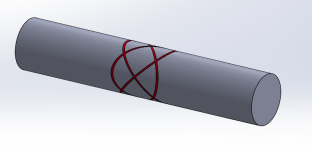
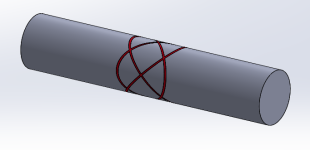
I don't think it matters. Having read the question, I had no idea, so I decided to cheat and let Solidworks do the work.

This is a 19 mm blank, with 0.6 mm veneers, turned down to 19 mm final diameter:

1742062567935.png

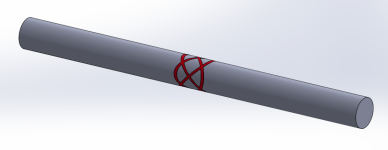
This is the same blank turned down to 8 mm diameter:

1742062584987.png

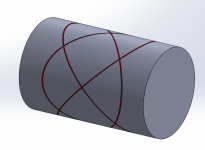
If we start with a 63.5 mm blank (ah, the joys of parametric CAD!) and turn it down to a 63.5 mm diameter (still sticking with 0.6 mm veneers), it looks like this:

1742062651573.png

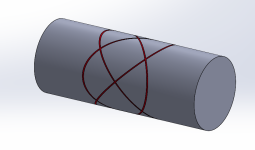
40 mm final size:

1742062671544.png

20 mm final size:

1742062692397.png

I'll save the CAD model, so if you want me to stick any other numbers in for blank size, veneer thickness and final diameter, then let me know.
 
Brilliant Al, thank you so much my fears are allayed. I’ve no idea what parametric CAD is but your use of it has earned you a virtual beer or two.
I want to incorporate the knots in a couple of pepper & salt grinders and having never turned a knot in anything with a diameter greater than an 1” I just could not visualise how they would come out.
I’ll not be getting my kits until 5th April when daughter returns for easter break and I need to have the mills made by the 18th so I will not have much time to practice.
 
No problem: it didn't take long.

Parametric CAD is how most professional 3D CAD programmes work (but not things like SketchUp, Tinkercad et al). It means you can drive the design by dimensions & can, if you want, even have a spreadsheet controlling the design so you stick a new row in the spreadsheet and a new part magically appears.

Imagine you were modelling an M6, 1mm pitch, 20mm screw. With parametric CAD, you'd set the diameter, pitch, length and hex socket size as parameters as you drew that one screw. Then you could point it at a spreadsheet & produce CAD models of every screw from M0.5 up to M64, every pitch & every length, without having to do any drawing work.
 
Back
Top