• Hi all and welcome to TheWoodHaven2 brought into the 21st Century, kicking and screaming! We all have Alasdair to thank for the vast bulk of the heavy lifting to get us here, no more so than me because he's taken away a huge burden of responsibility from my shoulders and brought us to this new shiny home, with all your previous content (hopefully) still intact! Please peruse and feed back. There is still plenty to do, like changing the colour scheme, adding the banner graphic, tweaking the odd setting here and there so I have added a new thread in the 'Technical Issues, Bugs and Feature Requests' forum for you to add any issues you find, any missing settings or just anything you'd like to see added/removed from the feature set that Xenforo offers. We will get to everything over the coming weeks so please be patient, but add anything at all to the thread I mention above and we promise to get to them over the next few days/weeks/months. In the meantime, please enjoy!

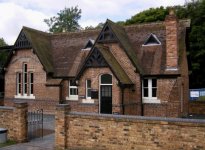
Heritage Home Moved To Allow A Condo Development

duke

Old Oak
Joined
Dec 18, 2020
Messages
3,032
Reaction score
1,756
Location
Field, Ontario, Canada
Name
Scott
1887, rare example of an Ontario cottage style dwelling with Victorian embellishments.
This caught my eye as I remember it not being in it's present location. Having lived in Toronto for eight years I admired this house which at that time was a law office.
 
How did they move it? Brick buildings aren't the easiest to shift.
 
I have no idea Mike, I need to look into this.
The two story buildings to the right at some time will be demolished for condos.
Everything has changed in the area, green spaces gone for housing, well that's the way it goes.
 
Bad enough putting a lintle into a brick building but picking it up and moving must be a nightmare, I’m imagining cracks everywhere,
Where it’s living now reminds me of that old Church surrounded by skyscrapers in the centre of NewYork, always wanted a pic but I usually drive.
 
Plenty of ancient buildings are carefully deconstructed,catalogued and then rebuilt in a safer place such as Blists Hill.
 
Plenty of ancient buildings are carefully deconstructed,catalogued and then rebuilt in a safer place such as Blists Hill.
Yes, but not typically brick-built buildings. It's realtively easy with oak framed buildings, and American timber framed buildings. Ashlar stone buildings can be done too, but bricks are hard to take apart and clean up ready for re-laying, usually.
 
It would be interesting to know what percentage of those bricks made it from the original building, compared with new ones.
 
Not sure about everything pictured, but the chemist shown on the right of that picture was built in 1984. I’d guess the others shown are also new.

“Some of the buildings you can visit, for example the Candle Factory, Butcher shop and school, are historic buildings that have been deconstructed and rebuilt here brick by brick. Others are copies of historic buildings or feature original period interiors.”

“The recent BBC television series about a Victorian pharmacy features the Bates and Hunt Chemist's shop at Blists Hill, a recreated Victorian town at Ironbridge Gorge. The shop was built in 1984, but is modelled on a pharmacy that stood in nearby Wellington. The contents, however, came mainly from a pharmacy in Bournemouth.”

Which is not to say that there aren’t transported & rebuilt Victorian brick buildings there, only that the picture may not show them.
 
The school at Blists Hill originally opened in 1881, closed 1972/1973, torn down 1989, rebuilt 1993 apparently looks like this:

IMG_3923.jpeg

Looking at the picture, it seems likely that the on show woodwork did not make it intact from the 1880s, so I’d assume that the wood was all new in the 1990s. But if anyone has links to more detail on the rebuild, I’d be interested to read about it.
 
Last edited:
I remember seeing a US series where they loaded whole wooden buildings ( even some rather ordinary ones) onto lowloaders and movd them hundreds of miles to a new site.
In one instance the only damage was one broken window pane from a passing tree branch
 
There’s a description of numbering the bricks and marking the mortar joints for rebuilding the Long Port Farmhouse at the Weald & Downland on this page:

Here’s an extract from one of the PDFs for ease of reading:

Brickwork

It was clear almost from the first time we saw the building in September 1992 that the external brick walls would have to be re-built exactly as found, whatever decisions were taken about the interpretation and display of the older historic features inside, and this meant numbering every facing brick and stone - approximately 8,700 altogether.

This was the third time we had dismantled a building and numbered the bricks, the first being the dismantling of the Newdigate Bakehouse, but Longport House jumped the queue and became the first to be re-built, so we were anxious to see if our systems would work.

The original walls had to be recorded, of course, with drawings on which the numbering could be applied. At Longport we were fortunate in having the use of superb rectified photographs taken by the Canterbury Archaeological Trust - a parallel with the plane of the wall, and with horizontal and vertical scale makers.

Tracings were made from these photographs at a scale of 1:10, and these were used for recording the brick numbering.

In each course the bricks were numbered on their top surface, and a tile batten was marked with the position of each brick from end to end. When it came to rebuilding, the same batten was used as a guide to position the bricks. This simple system did away with any need for measurements, except for the overall dimensions of the wall and openings for setting out the work. On the whole the system worked well, but we found that as well as the batten it was necessary to have large size colour photographs of the wall for the bricklayer to follow the subtle variations in position and angle of the bricks.

One aspect that we had not predicted was the importance of the job of cleaning and sorting the bricks. The mortar had been knocked off during dismantling, but the outside surfaces of the bricks had become impregnated with demolition dust, which proved very troublesome to remove. Eventually every brick was given a short bath in brick cleaner, which removed the white dust but left the weathering colouration intact. The main part of the front wall of the building had also been very crudely repointed at some recent date, and the bricks were badly disfigured with cement mortar stains. This was removed in the same way. After cleaning and sorting, the bricks were laid out on racks, ready for the bricklayer.

Some bricks had broken and were repaired by being glued together. A few others had crumbled beyond repair, and they were replaced by bricks reclaimed from the inner skin of the wall, which were not numbered. These replacement bricks lack the dark weathering of the originals, but otherwise match in very well. In general, we were surprised at the ease with which even quite small fragments of brick could be re-used in their correct positions, and overall the walls are a faithful re-creation of the walls as we found them.

The walls were 1½ bricks thick up to first-floor level, and 1 brick thick above.
 
Last edited:
Mike, look up "Folk and Transport Museum, Cultra".

They are/were experts in numbering, dismantling, rebuilding, masonry structures. A stone (setts) cottage my father knew well was moved 60 miles to the museum, and when he visited its new site, he was struck by the faithful re-erection; even vertical and horizontal irregularties in the walls were faithfully restored.
This preservation technique -as detailed above - isn't new and has provenance as a preservation method for future generations to marvel at.
 
Anyone got examples of rebuilding mid-20th Century or later brick buildings? With hard mortar, it’s going to be a lot less fun than taking apart buildings with the soft stuff between the bricks. We’re already 75 years out from 1950 - are mid-century homes heritage yet?

On the subject of the difference between wooden and brick buildings, it was a not uncommon sight in Seattle to see wooden homes moved a short distance… vertically. You could see houses pushed a storey up on jacks so that they could add a whole new ground floor below the existing house. Not a technique used all that much on brick buildings I suppose.
 
Thank you for posting that. I’d never heard of that happening in Hereford. I can’t imagine them doing it today for all sorts of reasons

i checked this morning to see if it had managed to escape again but its still there.IMG_20251203_102924112_HDR.jpg
 
Back
Top