• Hi all and welcome to TheWoodHaven2 brought into the 21st Century, kicking and screaming! We all have Alasdair to thank for the vast bulk of the heavy lifting to get us here, no more so than me because he's taken away a huge burden of responsibility from my shoulders and brought us to this new shiny home, with all your previous content (hopefully) still intact! Please peruse and feed back. There is still plenty to do, like changing the colour scheme, adding the banner graphic, tweaking the odd setting here and there so I have added a new thread in the 'Technical Issues, Bugs and Feature Requests' forum for you to add any issues you find, any missing settings or just anything you'd like to see added/removed from the feature set that Xenforo offers. We will get to everything over the coming weeks so please be patient, but add anything at all to the thread I mention above and we promise to get to them over the next few days/weeks/months. In the meantime, please enjoy!

How do you light you fire?

Always wood shavings from the shop and bark as kindling or other off cuts from the shop.
My job to start fire before I go to work.
 
This drives me nuts, I just can’t get my head around why people including our wonderful @TrimTheKing think this is a good way to do it.
Flames go upwards! — simple, so Newsprint half scrunched then kindling in a mesh type layout then coal or logs on the top, light the paper at the bottom and the flames go upwards setting fire to the next layer above. Never had a failure in probably 55 years. ( Yes I know, sorry)
 
My house in Virginia had a catalytic woodstove insert in the fireplace. I had the best results if I got the flue warmed up prior to loading the woodstove with wood. I crumpled up the sheets from Sunday Washington Post and spent about ten minutes feeding the stove until the paper was gone. Then I loaded the stove as Ian described. As soon as the catalytic element in the stove was hot enough, I closed the damper and enjoyed the heat.
 
A pile of shavings, then an open stack of kindling, with something very slightly bigger on the top. Take a match......
 
This drives me nuts, I just can’t get my head around why people including our wonderful @TrimTheKing think this is a good way to do it.
Flames go upwards! — simple, so Newsprint half scrunched then kindling in a mesh type layout then coal or logs on the top, light the paper at the bottom and the flames go upwards setting fire to the next layer above. Never had a failure in probably 55 years. ( Yes I know, sorry)
I did it the 'traditional' way up until about 2 years ago when I got into pizza oven cooking and discovered the 'top down' fire method. I can't say either works better generally to be honest, but what I have definitely found is that in our lounge stove a top down fire 100% gets up to speed quicker than bottom up, which is why I now do it that way.

And that's made my day right there, I haven't been called 'wonderful' in any capacity for a looooong time, if indeed ever!! :love:
 
I must admit that I do it in what I would regard as the conventional way. The most combustible stuff at the bottom, then kindling then logs. Incidentally lavatory roll inners stuffed with wood shaving are very good for the lower layer (and are essentially free). And birch bark works well too.

However the top down version is accepted in Scandiwegia. I read about it in Lars Mytting’s Norwegian Wood. Although it never occurred to me to ask my neighbours how they lit their fires.

This is getting close to a sharpening conversation.

Oh and we can get onto chimney draw, back boilers, and all the rest. But I digress...
 
As per Mark....The log burner guys who sell and install new ones (ours for eg) say top down approach is MUCH better. It gets some heat into the flue rapidly and improves draw. Ours has a heavy steel baffle / reburner thing as well to improve efficiency once the fire has caught hold, and it really works. It is streets better than our old log burner.

We were told in no uncertain terms don't use newspaper to start them as it leaves dirty residues on the flue and creates a lot of ash. So we don't do that anymore.

Getting more wood next week. Kiln dried - 6 big bags from regular supplier. This is for next year and we pre-bought it ages ago.
 
My method for my Dik Guerts Ivar stove (Dutch, and excellent) - leave a layer of ash about 2 inches deep, make a channel in it front to back, place a wax/wood wool firelighter in it (Flamers from Amazon), a stick of kindling side to side, 3 sticks on top front to back, then 2 logs side to side. It roars away within about 5 minutes.
 
As per mark and adrian.

From bottom up, Logs on bottom, last nights charcoal, newspaper, shavings, kindling, then an A frame of thinnish logs which will then burn and fall on top of fire. Once lit, with matches, no need to open door for at least an hour or more. Been doing that ever since we moved here, 17 years now.
 
Check out Rockefeller there, rich enough to be burning plywood!!!
Way off, mate! Plywood? Plywood ? That's for cheapskates. What you see there is finest French oak floorboards...too few to do owt with...besides I've got nowt to do with at the moment.


Doesn't burn very well BTW
 
For fire lighters we save our tea bags, dry them out and fill a small screw top jar with as many as will fit and pour a little bit of kerosene in. Shove one in under the kindling, light it with a match, job done.
 
This is how I lay the fire. Start with small pieces then used tissue and shavings , bark then kindling. Light it leave door open a crack then shut it when going.
 
This is the reference to the top down version of firing I was thinking about earlier. As I said this is from a Scandinavian based book. There are some qualifications. It should be readable if you zoom in.

IMG_20241027_141932361_BURST000_COVER_TOP[1].jpg

But, of course, what works will always be dependent on the set up. I don’t use the same method in Edinburgh (one open fire and one stove) where we have flue lengths of maybe 50ft and wildly variable winds because of the way the New Town is laid out (you need to get a good column of warm air up the chimney as quickly as possible) as I would in the Borders (two stoves and 4 open fires)– about half the flue length, always a good breeze.
 
I do know that open fires are more difficult to light than an air tight wood stove. Gran had an open fire, what a pain it was.
 
The book above is a bit scant on detail of laying the fire for top down; so the "kindling" is on top of the logs - but what kindling, sticks but what to get them going. I tried a few times in my small Stovax, and the problem to avoid seemed to be the top burning away without setting fire to the bigger stuff below it, leaving a burnt out mess of logs under paper ash that was easiest to resolve by reaching for the blowtorch (that always works).

I decided that top down was not for me (or something less polite). Paper, shavings, sticks, a couple of small logs, always with plenty of surface area, not in the round. Light the paper, and if within a couple of minutes I don't have a firebox full of enough flame to burn off any volatiles, something has gone horribly wrong.
 
One thing I don't understand about the top-down method is what happens when the kindling has all burnt and the wood on the lower layer is well on its way to being burnt. If you put a couple more logs on then they're going to be on the top which is the opposite to top down.
 
I don't know the technical answer. However, on modern log burners with the Eco credentials and the reburner baffle the top down method works brilliantly. What might be a factor is the air supply? On ours, the air is sucked in from outside (rather than wasting warm air in the room). The door is always shut so there is no spillage at all.

We wanted the external air supply set up because I can't see any sense in taking freshly warmed air from the room and sending it up the chimney. It is ever such a lot better than our old log burner, and far cleaner. Still miss the large inglenook open fires from previous house though. Can't beat the sound and atmosphere.
 
The top down vs bottom up discussion is interesting, but just to present a third option: what I was taught to do in Scouts many years ago was to light sideways.

Place a large log, then put the tinder next to it and lean the kindling against the log above said tinder. Once it's caught, then you can start adding logs on the other side so that there's a V shape with the fire in the centre - this part works better for a camp fire than in a cramped log burner, so in a burner I generally just lean the next log against the first in a similar manner to the kindling.

Having learnt this at an impressionable age I didn't think to investigate whether it was established practice or just what one person did and liked to teach. Has anyone else heard of this approach?
 
Kind of. Our old log burner had the air drawn in (from the room) on the left side through some vent system that we never properly understood (we inherited the thing). Suggests that the fire might best be lit nearest the air intake.
 
Interesting thoughts about air supply. All our windows have trickle vents. The wood burner air intake is internal and needs a supply of air so fresh air is being drawn into the room the whole time. I see this as a good thing as air is constantly being replaced .
 
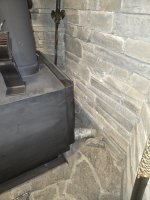
Our fresh air supply for combustion. Pipe comes up from the crawl space below to bottom of stove.
 

Attachments

  • 1000003491.jpg
    1000003491.jpg
    197.7 KB · Views: 3
Interesting thoughts about air supply. All our windows have trickle vents. The wood burner air intake is internal and needs a supply of air so fresh air is being drawn into the room the whole time. I see this as a good thing as air is constantly being replaced .
Yeeeees......but the fire it is taking air from the room, turning some into radiated heat and putting the rest up the chimney. You are always drawing cold air from outside into the room, to replace the air that the fire consumes. It obviously impairs efficiency (I suggest) compared with drawing air into the stove directly from outside. This is why you need so many logs :ROFLMAO:
 
I guess this depends on the house. My colleague upgraded his house insulation to passivhaus standards (close to a rebuild), and an external air supply would be needed to keep a woodburner, but it was not sensible really as lighting it would have made the house into an oven !

Our house is 1930's, solid brick walled. A combination of heat and ventilation is needed if you don't want black mould. A stove with air supply from the room is ideal IMHO. When it is going and closed down, it seems a fairly gentle air flow, not like it creates a hurricane.
 
Our old ancient log burner took air from the room and after it had been on for a while we always started to feel sleepy. We either had oxygen deprivation or smoke was shutting us down :rolleyes: House is a barn so was not even close to air tight where the log burner used to be. Since rectified that.
 
Oxygen depletion seems unlikely to me, unless the stove is leaking into the room (in which case you havd a much more serious problem !). If it draws air from the room, then uses the oxygen for combustion, it is surely not selectively drawing in oxygen ?
 
Oxygen depletion seems unlikely to me, unless the stove is leaking into the room (in which case you havd a much more serious problem !). If it draws air from the room, then uses the oxygen for combustion, it is surely not selectively drawing in oxygen ?
Well we didn't do a scientific test! We got rid of the thing a couple of years ago and put a new modern log burner in a different spot with a new chimney. Don't think I said anything about "selectively" drawing in oxygen. It just used the oxygen in the room and we eventually felt drowsy. It looked quite nice but mainly heated up the chimney breast (kind of small inglenook) rather than the actual room.
 
Umm, did you have CO monitors? I’ll have to ask my partner, but low levels of CO can cause lethargy. High levels, of course, cause death. We have CO monitors in all the rooms in which we have fires. Never heard a peep out of any of them. But then again, my properties are so old that they are essentially open to the elements. Trickle vents -pah, we just have rubbish windows.

On the other hand, sitting in front of a nice log fire, with a glass of something, and a book, can induce drowsiness. I’m told. I’ve never been woken up from contemplation by my partner at 4am with the question ‘are you coming to bed?’. Never. Still, better than my clubbing days. At least I’m at home.
 
Don't think I said anything about "selectively" drawing in oxygen. It just used the oxygen in the room and we eventually felt drowsy.
Well, if it doesn't selectively draw in oxygen, and isn't leaking back into the room, it must be drawing in all the components of air, which would cause fresh air to be drawn in from somewhere to replace it, so not depleting the oxygen. The more likely explanation is that it was allowing some carbon monoxide into the room, or the heat / ambience was creating a sleepy atmosphere. I've fallen asleep in front of my stove a few times, as I eventually woke up, I assume it was the more benign latter explanation ! I do also have a fire / CO detector in the room - is it a part J requirement for new installs now ? The sweep always checks it.
 
Well I do know that it’s a regulation that a room with a woodburner must have a carbon monoxide detector, it’s one of the more sensible regs imo.
If and when I have a woodburner installed in the future I would definitely have the air supply coming from outside, the cold air coming across the room from under the door to the fire was noticeable in my last house.
If I recollect correctly the vent needs to be 2” dia.
 
Back
Top