• Hi all and welcome to TheWoodHaven2 brought into the 21st Century, kicking and screaming! We all have Alasdair to thank for the vast bulk of the heavy lifting to get us here, no more so than me because he's taken away a huge burden of responsibility from my shoulders and brought us to this new shiny home, with all your previous content (hopefully) still intact! Please peruse and feed back. There is still plenty to do, like changing the colour scheme, adding the banner graphic, tweaking the odd setting here and there so I have added a new thread in the 'Technical Issues, Bugs and Feature Requests' forum for you to add any issues you find, any missing settings or just anything you'd like to see added/removed from the feature set that Xenforo offers. We will get to everything over the coming weeks so please be patient, but add anything at all to the thread I mention above and we promise to get to them over the next few days/weeks/months. In the meantime, please enjoy!

How The Spindle Moulder Gained Its Notoriety

i have dabbled. Guided by Dan, who is the expert here. Scary tools and I use a remote control starter. I think routers are also potentially dangerous and so I have a lot of respect for all high speed spinning tools.
 
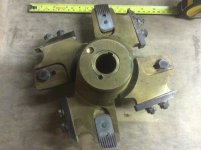
Some of those cutter blocks look really barbaric and I can see why the router table became more popular for home use than a spindle moulder.

Some are more fun than others.
Screenshot_20260324_082141_Gallery.jpg20240408_181215.jpg

And sometimes the sheer size of thr heads is amusing (8"x2.5" rebate blocks & 254mm scribe head)
20250210_204653.jpg
20250212_130819.jpg
 
Some of those almost look like a slice from a P/T cutter block and use that same screw arrangement to wedge the blades in so if it comes loose that blade will be ejected outwards harder than kickback on a table saw. It looks like the newer blocks actually retain the blades which is much safer.
 
I think it is worth getting a fully guarded SM. I had a couple of false starts (sold on at no loss luckily) and ended up with a Sedgewick SM4 Model II. I find it a great deal safer (feeling - so may be imaginary) than using a router table to do similar things. It came with quite a lot of useful cutters, from an eBay dealer. I mainly use it to do t&g for oak flooring, overlap MDF, strip for panel mouldings, and some skirting. I've done a few hundred maybe even thousand metres of mouldings for acquaintances, which has pretty much covered the cost of the machine. It has a pretty basic power feed and a remote starter (rigged up by me). As I am super careful with changing cutters, and it has a cover head thing, I am generally well away from the firing line. I actually feel safer with it than my old router table (only any use for small amounts). Will probably move it on though soonish as I suspect this is our last house renovation.
 
Some of those almost look like a slice from a P/T cutter block and use that same screw arrangement to wedge the blades in so if it comes loose that blade will be ejected outwards harder than kickback on a table saw. It looks like the newer blocks actually retain the blades which is much safer.
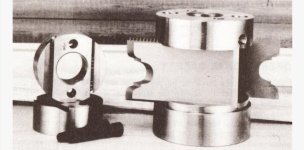
The wedge gib is an older design (but still available new over here). The current style corrugated heads are pocket gibs with grub screws.

Modern pocket gib head
Screenshot_20260324_220249_Gallery.jpg

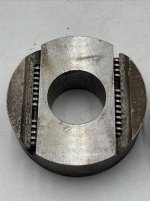
Smooth back vs corrugated (the corrugated is an original from my 1950s 4 sider)
20260323_194102.jpg

If you look at a cutterhead from a P/T the knife pockets are smaller as are the gibs and gib bolts. Though the same concept.

Screenshot_20260324_220718_Gallery.jpg
 
We used to have a big old Wadkin 5 head planer/moulder that had square blocks, sometimes if just a small amount of moulding was needed we would use one of the blocks in the spindle moulder, this seemed perfectly normal at the time but I wouldn't be doing it these days!

The Wadkin had a maximum capacity of 4"x3" which became a bit limiting so we got a Dominion which could machine up to 7" wide which was great for skirtings etc.

We still kept the Wadkin and it was left set up for making dado rail, this was in the 80's and we sold 1000's of feet of the stuff. I remember we sold it for 25p per foot and couldn't make enough of it at the time.

For some reason talking square cutter blocks got me feeling all nostalgic 🥹
 
I don’t have a lot to do with tenoning heads, these are the biggest I’ve had dealings with.

IMG_20221230_154314604.jpeg

A mate bought them but they were for a 2” shaft so wanted a sleeve to fit them to his machine so he sent over the shaft off his tenoner & the blocks & we machined him a shaft up.
I saw them in action a couple of years ago & they certainly removed some material in a single pass, not for the faint hearted.
 
I use these on the Wadkin BRA, not spindle moulder, but they work very nicely for trenching and tenoning. In fact, I used them last week to notch out some uprights for a shed. They were initially too big, for a Wadkin CC I think, but a certain Mr @Trevanion guided me through modifying them on the lathe a few years ago. The ribbed ‘nickers’ are set just out from the blades:
IMG_0879.jpeg
 
I wouldn't mind having a set of those wadkin tenon heads.
They are handy things and are not as scary as they look, I use a set on my CK Radial arm saw. You'd think they would try and walk through the work but they dont.
 
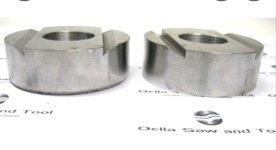
Did lockedge (considered the safety improvement) or bevel edge collars see any use over there? They were widely used here.

Not to be confused with the square profile slotted collar which was not widespread on this side of the Atlantic.

Lockedge
Screenshot_20260930_212709_Chrome.jpg
Screenshot_20260930_213514_Chrome.jpg


Bevel edge
Screenshot_20260930_212849_Chrome.jpg
 
Did lockedge (considered the safety improvement) or bevel edge collars see any use over there? They were widely used here.

You could get bevelled edge collars though I don't believe they were very popular here, as they're very rare compared to the plain square slot versions. Lockedge never made it over here, I suspect mainly because the American stuff was rarely imported after the Second World War, and it would've been very expensive compared to domestic offerings.
 
You could get bevelled edge collars though I don't believe they were very popular here, as they're very rare compared to the plain square slot versions. Lockedge never made it over here, I suspect mainly because the American stuff was rarely imported after the Second World War, and it would've been very expensive compared to domestic offerings.

That makes sense, the wadkin style safety block was not really used here, but the bevel edge collars (straight and lock) were used extensively up until corrugated back knives became common.

All the inventions described by Rohr to keep non matched knives from slipping out of collars would seem to indicate thrown knives were more common than not.
 
All the inventions described by Rohr to keep non matched knives from slipping out of collars would seem to indicate thrown knives were more common than not.

A big issue with the slotted collars is that the slots themselves would wear in time nearer the front edge of the slot from being clamped up, meaning the cutter was only really gripped at the back edge. This was also a similar issue with slotted/french spindles, where the clamping surface at the base of the slot would become convex and not grip effectively.
 
seeing these blocks an cutters bring back bad memories as an apprentice i refused to use the spindle moulder as it was almost unguarded didnt help that the old guy i worked with would tell stories of the accidents that he had seen in other workshops . the one bit of advice that stuck with me was never stand in front of the machine when you turn it on he then proceeded to tell me of the day he had set the spindle up moved to the side and turned it on for the clamp to fail and a cutter shot forty feet across the shop and went through 20 sheets of 3/4 blockboard found it in the 21st . when i went on to study for my advanced cert in college they had a rogues gallery of cutters and bolts from square blocks there was one bolt that had stretched twice its length cutters bent 90 degrees horror stories !
 
seeing these blocks an cutters bring back bad memories as an apprentice i refused to use the spindle moulder as it was almost unguarded didnt help that the old guy i worked with would tell stories of the accidents that he had seen in other workshops . the one bit of advice that stuck with me was never stand in front of the machine when you turn it on he then proceeded to tell me of the day he had set the spindle up moved to the side and turned it on for the clamp to fail and a cutter shot forty feet across the shop and went through 20 sheets of 3/4 blockboard found it in the 21st . when i went on to study for my advanced cert in college they had a rogues gallery of cutters and bolts from square blocks there was one bolt that had stretched twice its length cutters bent 90 degrees horror stories !

I'm always a bit cynical of "workshop horror" stories like that after hearing so many that are so ludicrous that they can't possibly be feasible, like a cutter punching a hole through a solid concrete block wall and embedding in a vehicle outside... Obviously, if a cutter is let loose, particularly the larger square block cutters they have a significant amount of mass and the speed they are moving could cause serious damage, but I do think stories are significantly overplayed to scare young workers. I've yet to hear a genuine first-hand account with evidence; it's almost always a secondhand or thirdhand account of an accident that had happened decades ago, and there's no photographs or case studies in the case of stories of fatalities. I once heard of a cutter striking the spindle moulder operator in the head and killing him instantly on the spot, I have no idea how one would get struck in the head because the cone area of the cutter coming loose would be horizontal from the shaft, not diagonal towards the head.

Generally, you will want to spin a square block at around 4800RPM or less. With a 3” square block (105mm corner to corner) with cutters that have a 40mm projection as I had set up in the video in a previous post, you have a total cut diameter of around 165mm, at 4800RPM the rim speed at the edge of the cutters is around 93MPH. That is fast, and if the cutters did come loose it would cause some serious damage to the machine if it ejects inside the hood, or if you're unfortunate enough that it ejects in the narrow window in the fence plates it could be catastrophic if it hits the operator. However, even if you're using a cutter that's on the heavier side, with the average cutter being about 300g or so, say you're using one that's 500g, the kinetic energy of the cutter would be in the region of 400 joules. A full metal jacket 9mm bullet has a kinetic energy of around 500 joules, and even with the extreme concentration of the bullet it will not break through a concrete block, nor will it pierce many sheets of plywood, with examples online of it only piercing 6 sheets. The sheer size of the cutter and the fact that it would probably be tumbling through the air rather than in a straight path like a bullet makes me believe that it would simply bounce off anything remotely hard, obviously with quite the bang, and with it tumbling through the air it would lose significant momentum after forty feet, if it could fly that far.

I would like to get a cheap scrap spindle moulder or make a DIY version one day and set up an experiment to see if a cutter would indeed fly that far if let loose, and if it would pierce through 2" of timber clamped around the table. The heavier cutters probably will cause some serious damage but you also hear stories of the much smaller and lighter Whitehill cutters breaking through walls too; I have doubts whether they would even pierce a single sheet of 12mm plywood.

It's the same as the stories you have of metal lathe chucks launching chuck keys across a workshop and embedding in a wall, most lathe and chuck combinations with a key installed will not complete a full revolution without the key smashing into the ways. Obviously, there are exceptions like if you're using a particularly small chuck on a larger lathe where the key could clear the ways, or if you're using a gap-bed lathe, but most of the time it will smash into the ways. So if that's the case, unless you're using your key at the rear of the machine for some strange reason, it will only have about less than half a revolution from top dead centre, which is where most people use the key, to the ways. I just can't see a key gaining enough momentum in half a turn to launch it the ridiculous distances people quote and end up embedded in the ceiling or walls, or even going straight through walls. Especially as most lathes are used under 1000RPM. Say on my own lathe, which has a 6" chuck fitted usually, running at around 1000RPM, which I rarely use, the key extends about 6" out of the chuck, the very outer edge of the key would be spinning around 52MPH and the chuck itself turning 17MPH. I'm not sure at what speed it would be thrown out of the chuck at but even if it was 52MPH, I don't see it having enough momentum to travel across an entire workshop and embed in a wall, especially on wind-up.

This video is a good example, it even shows that someone can throw it by hand further than the lathe could.

 
Back
Top