Making a moxon vise for the travel tool chest, the threaded rod i have is 1/2” thick zinc plated steel. The big 3” wingnuts are cast iron. I do have a welder, but haven’t had luck wellding cast iron, and I would need to remove the zinc coating before welding the steel rod. So trying to come up with alternatives. Not sure if Loctite would be strong enough. Maybe JB Weld? Some other method? Or a combo of an adhesive and like mechanical way (is it called peening when you hammer a punch into the corner of a nut and bolt to kind of “ruin” the threads?)

-
Hi all and welcome to TheWoodHaven2 brought into the 21st Century, kicking and screaming! We all have Alasdair to thank for the vast bulk of the heavy lifting to get us here, no more so than me because he's taken away a huge burden of responsibility from my shoulders and brought us to this new shiny home, with all your previous content (hopefully) still intact! Please peruse and feed back. There is still plenty to do, like changing the colour scheme, adding the banner graphic, tweaking the odd setting here and there so I have added a new thread in the 'Technical Issues, Bugs and Feature Requests' forum for you to add any issues you find, any missing settings or just anything you'd like to see added/removed from the feature set that Xenforo offers. We will get to everything over the coming weeks so please be patient, but add anything at all to the thread I mention above and we promise to get to them over the next few days/weeks/months. In the meantime, please enjoy!
You are using an out of date browser. It may not display this or other websites correctly.
You should upgrade or use an alternative browser.
You should upgrade or use an alternative browser.
How to attach cast iron thumbscrew to zinc steel threaded rod for light duty moxon vise?
- Thread starter SteveMP
- Start date
fuse
Nordic Pine
- Joined
- Sep 4, 2025
- Messages
- 517
- Reaction score
- 395
- Location
- Herefordshire UK
- Name
- Martin
- LOCATION
- Uk
Drill hole and tap in a roll pin?

Dr.Al
Old Oak
I agree with Martin, the simplest way is probably a roll pin. Alternatively, you could drill and tap a cross-hole and use a grub screw. That has the advantage of being removable.
The challenge with both those options is that it can sometimes be difficult to get the drill into the right place (depending on the length of the handwheel centre piece) - here's a photo from when I did something similar for the three vice screws on my portable workbench - you can see I had to use a reduced size chuck:
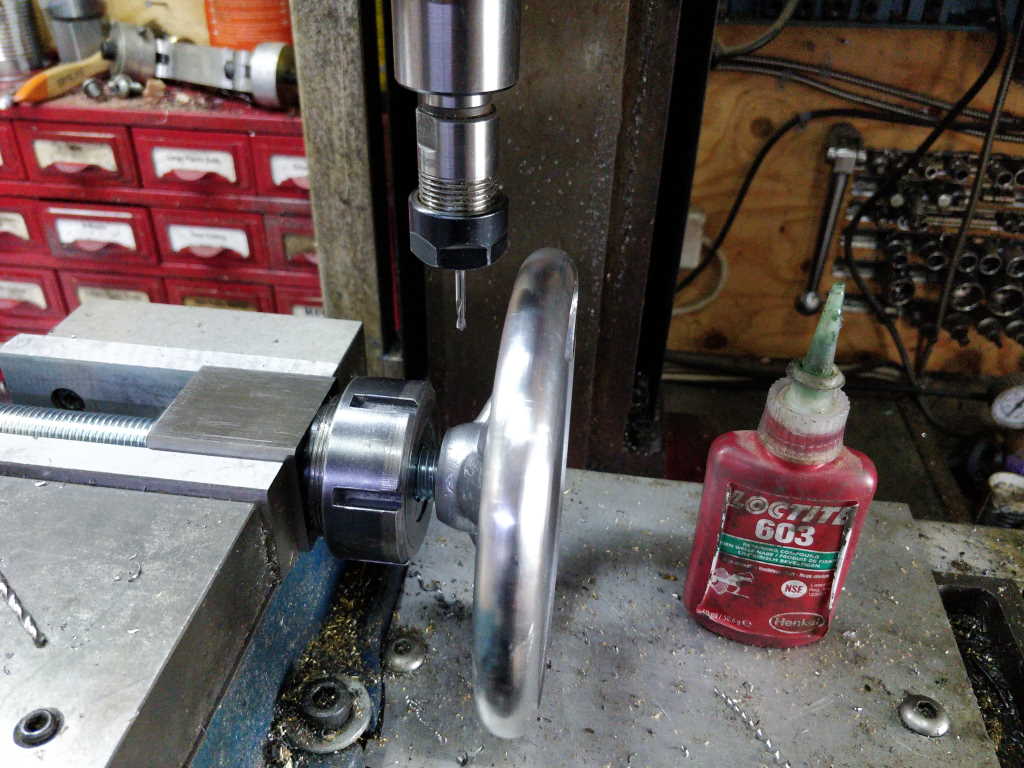
You might be able to get round that by drilling at an angle.
Another approach is to drill in from the end. For short-ish screws this is quite straightforward on a pillar drill; for longer ones you'd need to do it by hand which is a little more challenging.
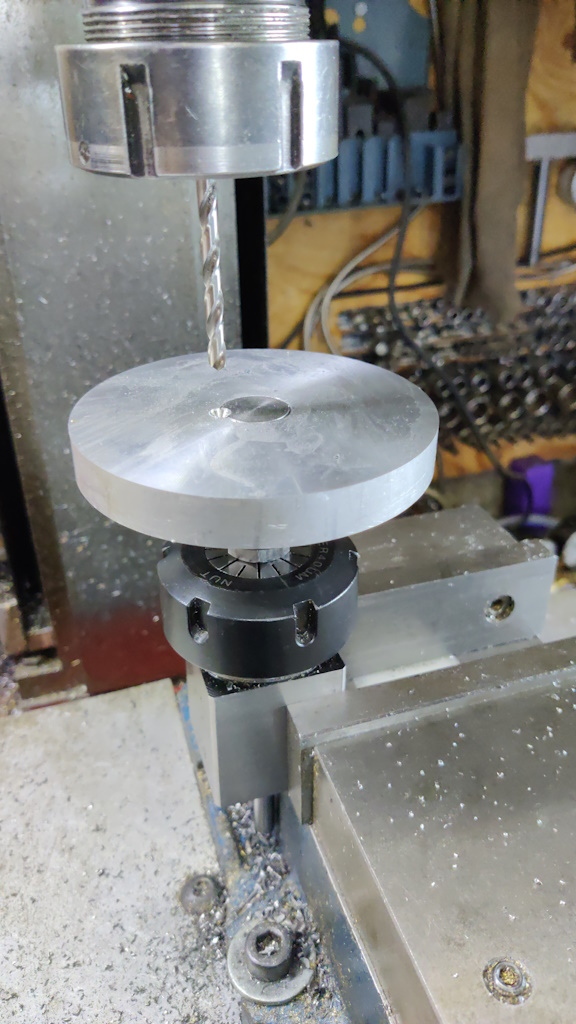
That hole can then be tapped for a grub screw:
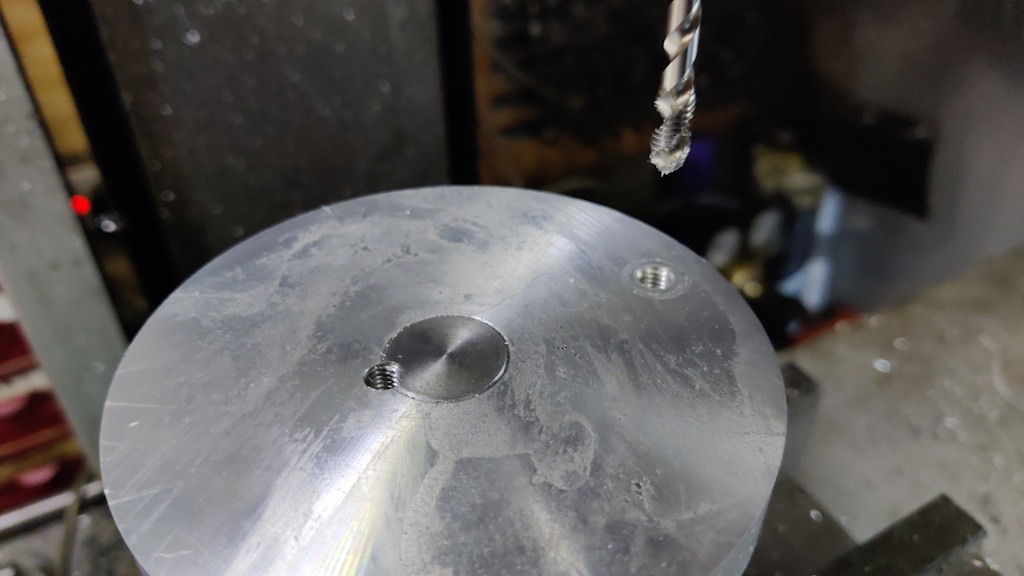 2
2
Alternatively, just buy some Loctite 603 and stick them together - assuming the threaded bar is a good fit in corresponding hole in the hand wheel, it'll be plenty strong enough. Peening could work, especially if the hand wheel is threaded to match the screw so the peening is just there to prevent rotation and and the screw does the rest of the work. If it's a plain shaft in a smooth hole it'll be a lot more difficult to get it right I think.
The challenge with both those options is that it can sometimes be difficult to get the drill into the right place (depending on the length of the handwheel centre piece) - here's a photo from when I did something similar for the three vice screws on my portable workbench - you can see I had to use a reduced size chuck:
You might be able to get round that by drilling at an angle.
Another approach is to drill in from the end. For short-ish screws this is quite straightforward on a pillar drill; for longer ones you'd need to do it by hand which is a little more challenging.
That hole can then be tapped for a grub screw:
Alternatively, just buy some Loctite 603 and stick them together - assuming the threaded bar is a good fit in corresponding hole in the hand wheel, it'll be plenty strong enough. Peening could work, especially if the hand wheel is threaded to match the screw so the peening is just there to prevent rotation and and the screw does the rest of the work. If it's a plain shaft in a smooth hole it'll be a lot more difficult to get it right I think.

Lons
Old Oak
Great advice given already and the way I'd do it but if you can't then another possbility is just screw a nut on to the threaded rod each side of the handle. Not as neat but effective enough if you have the space. Locknuts would be best.
It is 1/2-13 threaded rod and the wingnut is 1/2-13 threads as well, so it is a good fit. I just wasn’t sure if Loctite would have enough torque for twisting like that for a vise. TBH, i have only used loctite more for keeping screws from backing out due to vibration etc. you know the screws that already have some blue loctite on the threads that come as part of some kit. But i’ll take your word and look for that number (didn’t realize there was so many numbers of it)I agree with Martin, the simplest way is probably a roll pin. Alternatively, you could drill and tap a cross-hole and use a grub screw. That has the advantage of being removable.
The challenge with both those options is that it can sometimes be difficult to get the drill into the right place (depending on the length of the handwheel centre piece) - here's a photo from when I did something similar for the three vice screws on my portable workbench - you can see I had to use a reduced size chuck:
You might be able to get round that by drilling at an angle.
Another approach is to drill in from the end. For short-ish screws this is quite straightforward on a pillar drill; for longer ones you'd need to do it by hand which is a little more challenging.
That hole can then be tapped for a grub screw:
2
Alternatively, just buy some Loctite 603 and stick them together - assuming the threaded bar is a good fit in corresponding hole in the hand wheel, it'll be plenty strong enough. Peening could work, especially if the hand wheel is threaded to match the screw so the peening is just there to prevent rotation and and the screw does the rest of the work. If it's a plain shaft in a smooth hole it'll be a lot more difficult to get it right I think.
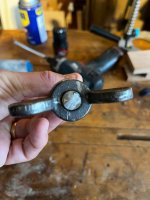
I’ll post some pics of the setup as it doesn’t look i could drill very easily due to awkward shapes and curves.
Not sure if i could drill into this, kind of awkward size and shapeDrill hole and tap in a roll pin?


Dr.Al
Old Oak
Loctite 603 is incredible stuff (completely different to threadlock - it's intended for a permanent seal and can fill gaps a bit better than normal superglue). You can break the seal with a blowtorch (much like superglue) if you can get enough heat into it to get it all north of 200°C but beyond that I'd be surprised if you could break the joint if there's enough contact surface area.
A typical vice hand-wheel is likely to see 10 to 20 Nm of torque, perhaps up to 50 Nm if you try really hard (which seems unlikely on a travel tool chest). If you can get 20 mm of thread engagement (length through the hand wheel) then it'll easily withstand 80 Nm before the glue gives way and in practice it'll be a lot more than that. Having now seen the wing nut (after writing most of the above), 20 mm looks about right for that photo but I'd be surprised if you got above 15 Nm in applied torque, let alone 50 Nm.
I think it'd be quite straightforward to cross-drill for a roll-pin if you can beg/borrow/steal a pillar drill: clamp the screw in a vice on the pillar drill with the wings of the nut horizontal (and perhaps glued into place), grip a steel rule between the drill's tip and the wing nut and make sure the steel rule is horizontal (this makes sure you're drilling centrally) and then drill straight through. Insert roll pin.
Without a pillar drill, glue it together with Loctite 603 and if it ever comes apart find a pillar drill!
A typical vice hand-wheel is likely to see 10 to 20 Nm of torque, perhaps up to 50 Nm if you try really hard (which seems unlikely on a travel tool chest). If you can get 20 mm of thread engagement (length through the hand wheel) then it'll easily withstand 80 Nm before the glue gives way and in practice it'll be a lot more than that. Having now seen the wing nut (after writing most of the above), 20 mm looks about right for that photo but I'd be surprised if you got above 15 Nm in applied torque, let alone 50 Nm.
I think it'd be quite straightforward to cross-drill for a roll-pin if you can beg/borrow/steal a pillar drill: clamp the screw in a vice on the pillar drill with the wings of the nut horizontal (and perhaps glued into place), grip a steel rule between the drill's tip and the wing nut and make sure the steel rule is horizontal (this makes sure you're drilling centrally) and then drill straight through. Insert roll pin.
Without a pillar drill, glue it together with Loctite 603 and if it ever comes apart find a pillar drill!
Lons
Old Oak
Hey Steve
I agree completely with Al but you could drill that easily with a hand drill.
Scoop out a small recess in a bit of scrap wood to sit the wing nut into with the threaded rod screwed in place and I'm sure if still nervous you could devise a simple way of clamping it down, especially the rod to stop it turning. File a small flat where you want to drill and punch a start where you want the hole then drill nice and steady right through with only a little pressure you'll be surprised how easy it is. Be careful as it breaks through the bottom, you can hear and feel when that's about to happen so just ease back on the pressure.
You can use a soft round nail if you don't have a roll pin, cut it off and peen both sides over.
I agree completely with Al but you could drill that easily with a hand drill.
Scoop out a small recess in a bit of scrap wood to sit the wing nut into with the threaded rod screwed in place and I'm sure if still nervous you could devise a simple way of clamping it down, especially the rod to stop it turning. File a small flat where you want to drill and punch a start where you want the hole then drill nice and steady right through with only a little pressure you'll be surprised how easy it is. Be careful as it breaks through the bottom, you can hear and feel when that's about to happen so just ease back on the pressure.
You can use a soft round nail if you don't have a roll pin, cut it off and peen both sides over.
Interesting stuff. I did some reading on the different loctites and asked A.I. about it and said something about "pre-loading" after applying and threading the thumbscrew on to put pressure on the threads as that it will increase the torque it can handle. Its also interesting that it is different for different sized bolts. But sounds like this should work for my needs, like you said its a travel chest, and I can only get so much torque with my fingers on these things. If i line the jaws with crubber or suede should be plenty for stuff I will use it for.,Loctite 603 is incredible stuff (completely different to threadlock - it's intended for a permanent seal and can fill gaps a bit better than normal superglue). You can break the seal with a blowtorch (much like superglue) if you can get enough heat into it to get it all north of 200°C but beyond that I'd be surprised if you could break the joint if there's enough contact surface area.
A typical vice hand-wheel is likely to see 10 to 20 Nm of torque, perhaps up to 50 Nm if you try really hard (which seems unlikely on a travel tool chest). If you can get 20 mm of thread engagement (length through the hand wheel) then it'll easily withstand 80 Nm before the glue gives way and in practice it'll be a lot more than that. Having now seen the wing nut (after writing most of the above), 20 mm looks about right for that photo but I'd be surprised if you got above 15 Nm in applied torque, let alone 50 Nm.
I think it'd be quite straightforward to cross-drill for a roll-pin if you can beg/borrow/steal a pillar drill: clamp the screw in a vice on the pillar drill with the wings of the nut horizontal (and perhaps glued into place), grip a steel rule between the drill's tip and the wing nut and make sure the steel rule is horizontal (this makes sure you're drilling centrally) and then drill straight through. Insert roll pin.
Without a pillar drill, glue it together with Loctite 603 and if it ever comes apart find a pillar drill!
I may attempt it but we shall see. These things are cheap but I had to order them and it took almost 2 weeks to get in stock.Hey Steve
I agree completely with Al but you could drill that easily with a hand drill.
Scoop out a small recess in a bit of scrap wood to sit the wing nut into with the threaded rod screwed in place and I'm sure if still nervous you could devise a simple way of clamping it down, especially the rod to stop it turning. File a small flat where you want to drill and punch a start where you want the hole then drill nice and steady right through with only a little pressure you'll be surprised how easy it is. Be careful as it breaks through the bottom, you can hear and feel when that's about to happen so just ease back on the pressure.
You can use a soft round nail if you don't have a roll pin, cut it off and peen both sides over.
Dr.Al
Old Oak
One thing I forgot to mention: make sure you clean the threads thoroughly (acetone is good) before gluing them together.
Ok yeah i read that they recommended a loctite primer. Good to know acetone works as i can use my wife’s nail polish removerOne thing I forgot to mention: make sure you clean the threads thoroughly (acetone is good) before gluing them together.
fuse
Nordic Pine
- Joined
- Sep 4, 2025
- Messages
- 517
- Reaction score
- 395
- Location
- Herefordshire UK
- Name
- Martin
- LOCATION
- Uk
From experiece ,leaving grubby thumb prints on the bottle is a bad mistake.
Drilling is a bit easier if you grind a little flat spot and cerntepunch it to get the drill started.
Drilling is a bit easier if you grind a little flat spot and cerntepunch it to get the drill started.
Last edited:
fuse
Nordic Pine
- Joined
- Sep 4, 2025
- Messages
- 517
- Reaction score
- 395
- Location
- Herefordshire UK
- Name
- Martin
- LOCATION
- Uk
Nail polish remover is watered down - get a little bottle of full strength stuff off ebay
B T W , neat acetone and sewing machine oil mix runs rings around wd40 et al
B T W , neat acetone and sewing machine oil mix runs rings around wd40 et al
Last edited:
Lons
Old Oak
When I said hand drill I meant the pwered type btw.I may attempt it but we shall see. These things are cheap but I had to order them and it took almost 2 weeks to get in stock.

Got it. I usually use a 12v Bosch with Milwaukee titanium drill bits for most things. Seems to work well for most things except hardened steel.When I said hand drill I meant the pwered type btw.