• Hi all and welcome to TheWoodHaven2 brought into the 21st Century, kicking and screaming! We all have Alasdair to thank for the vast bulk of the heavy lifting to get us here, no more so than me because he's taken away a huge burden of responsibility from my shoulders and brought us to this new shiny home, with all your previous content (hopefully) still intact! Please peruse and feed back. There is still plenty to do, like changing the colour scheme, adding the banner graphic, tweaking the odd setting here and there so I have added a new thread in the 'Technical Issues, Bugs and Feature Requests' forum for you to add any issues you find, any missing settings or just anything you'd like to see added/removed from the feature set that Xenforo offers. We will get to everything over the coming weeks so please be patient, but add anything at all to the thread I mention above and we promise to get to them over the next few days/weeks/months. In the meantime, please enjoy!

How would you make this?

AJB Temple

Sequoia
Joined
Apr 15, 2019
Messages
7,556
Reaction score
1,068
s-l1600.jpeg
The question is about forming the hollows smoothly and evenly without it taking forever. I need to make a few. (The carving aspect is not a problem). The hollows I have in mind are about half a cricket ball each. In solid oak.
 
Depending on the diameter required I would first use a hole saw then hog out the material using a forstner bit and go deeper with the hole saw if needed. If you need round sides than a hooked carving knife to get the radius that you need.
 
Put a router on a pivot? You’d need the pivot to be close to the level of the bit and to the surface of the material if you want something close to a full hemisphere, but maybe there’s a compromise on the exact shape of the hollow.
 
I’ve seen something like this done on the lathe. I can’t remember what chuck was used and how it was held. I feel sure one of the better turners would know how.
 
If you’ve got a cricket ball sized circular saw, you could also create these by rotating the wood around the center of the hollow and making repeated cuts with the circular saw (then sanding), but it seems a little unlikely you’d have a saw that small.
 
the oldschool way would be to carve out the dishes with a gauge and leave it rough, then also hand carve the lettering with a v gauge and chisels, that's how I'd do it. In the photos the salt and pepper txt isn't even central and it really bugs me, attention to detail is important.
 
Last edited:
I used to have a raised panel cutter that would be large enough (or nearly so). I can't remember if it had a bearing or not. It would need jigging up, not hand held.
You could rig up something like Windows' idea using an angle grinder.
But I think ttm's idea is the most appealling, if you can carve (I can't).
 
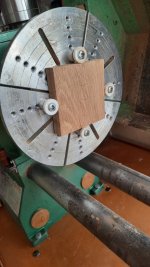
Having put on my thinking cap a faceplate could be used. You would have to either plane away the screw holes afterwards or cover the base with felt or cork.
 
That's possibly one of the trickiest operations to do by machine once you start going above 50mm diameter, the obvious thing you want is something along the lines of a giant cove/core box router bit but these are hard to find and would be extremely expensive not to mention that you would need a powerful machine to be able to drive the bit into the workpiece, you would need something along the lines of a geared pillar drill.

A way it could be done to create a perfect semi-circular hollow would be in a milling machine with the head canted at 45-degrees, using a fly cutter set to the correct diameter and the workpiece rotating on a rotary table, steadily raising the workpiece up into the fly cutter until the dish is made. Although, finding someone willing to get their milling machine plastered in timber dust will be very difficult.

It could also be done on a lathe as @AndyP suggested but it would have to be done with the workpiece spinning relatively slowly because of the imbalance of off-setting the work, or you could add a counterweight.

As @Malc2098 said, the easiest, fastest, safest, and probably cheapest way to do it in this day and age would be to get them done on a CNC.
 
Thanks all.
The point is for me to make them, not send them out. I am aware I can have them made for £25 each including lettering and the oak. I agree with Tyreman the lettering looks machined and badly aligned - this photo was taken off the bay where some wood shop is selling them. I'm quite experienced with letter carving now so that is the easy bit.

The small circular saw idea would work if I had a saw that small.

Sippose I could turn it if I was doing the dishes separately as cubes but I would be very wary of sticking an out of balance rectangle on my lathe and cutting a hollow. I'm not an experienced turner and can only do straightforward stuff. Needs to be a rectangle for the planned carving to work.
 
Apologies to the last three posters. My reply was typed before them but got stuck.
 
All or any of the above, or....

........make a template of MDF. Slice the bottom off your piece of oak and set aside. Scroll saw or jig saw to cut out the bulk of the waste. Hot glue the template into position. Rout as deep as (top) bearing-guided straight cutter will allow. Flip over, and use a bottom-bearing cutter referencing the bit you've already finished, if necessary. Glue the bottom back on. Follow around the top edge with a bearing-guided 45 degree cutter. Plane, sand, whatever, then carve.
 
I vaguely remember Roger talking about a carving tool that might rough this lot out. I thing I have a rotary rasp amongst my myriad of stuff I never use. If I followed the early advice and mainly hogged it out with forstners under the Fobco, the rasp may get me close to a profile.

Not sure, but think I don't have a curved tool that would carve this, like a curved knife, but will have a hunt on line. The oak will be rock hard as it is from my old stock. I also have a bit of beech that might be easier to carve. It does not need to be super smooth - carving marks are ok in the dishes. But it must be smooth enough to clean and also look professional.

I want to make 5. 15 carved letters on each.
 
Mike. We crossed. That's a good idea but do you think if I did that the oak would look like one piece?

Doesn't have to be oak.
 
Yes, it would be indistinguishable, particularly if your grain was straight. It might be more of an issue in something gnarly. I made the side of a bookcase "cut-'n-shut" like that, and even though I know it's there, I can't see the join myself. If you need to convince yourself, it's an easy experiment with an off-cut.
 
I've thought of a way of turning that would not create too much of an imbalance but it wastes a lot of wood.
I hope I can explain.
Start with a long length of wood and make the first hollow in the middle. Then reduce the length of the wood so that the second hollow can be made in the middle. Then reduce the length again so that both hollows are equidistant from each end.
I have never tried his of course and can accept that this is perhaps harebrained .
 
I've thought of a way of turning that would not create too much of an imbalance but it wastes a lot of wood.
I hope I can explain.
Start with a long length of wood and make the first hollow in the middle. Then reduce the length of the wood so that the second hollow can be made in the middle. Then reduce the length again so that both hollows are equidistant from each end.
I have never tried his of course and can accept that this is perhaps harebrained .
Blimey, how big is your lathe? Or does the head swing? Anyway, great idea, albeit a bit wasteful of wood.
 
Hmm. I will give that a try Mike. I have enough wood to choose from and if I slice it on the bandsaw and then leave those two faces alone, they might glue back as if nothing happened. I'm fussy though these days - too many past bodges.

andy - you no doubt have a better lathe than me. Mine is a record with two big bars. There is not enough clearance between chuck centre and bars for your (good I think) idea to work.
 
Yep - Mike thought same as me. The head on mine is fixed I believe. It's quite a basic lathe. I don't mind wasting some wood as I have more than I can use in my lifetime.

The project MUST be cheap / free. It's just a fancy, not an essential. Plus I like carving - which is Mike's fault actually. Waste of time :D .
 
Assuming the lathe had enough swing clearance,
I’ve seen something like this done on the lathe. I can’t remember what chuck was used and how it was held. I feel sure one of the better turners would know how.

Offset mounting the rectangular blank on a set of Cole Jaws would be the easiest, and leave no mounting details to worry about.

sq2.jpg
 
Last edited:
Thank you CHJ. You are a lathe expert. I've never heard of cole jaws before. The cost of buying them would make the project unviable sadly. I shall have to think on.
 
Having put on my thinking cap a faceplate could be used. You would have to either plane away the screw holes afterwards or cover the base with felt or cork.
No, mount a scrap disc first and hot melt glue the oak to it with one hollow on centre, turn it then take it off and hot melt it with the other on centre - no holes. Safer than cole jaws, and cheaper.
 
It seems a lot of work even on the lathe. Might be a silly question but why not buy some cheap shallow glass dishes (I've seen them around so can't be uncommon) and use an expansive bit to drill square sided holes. more hygienic I'd have thought as well as far easier and quicker.

I'd have thought salt would damage the oak or finish.
 
I vaguely remember Roger talking about a carving tool that might rough this lot out. I thing I have a rotary rasp amongst my myriad of stuff I never use. If I followed the early advice and mainly hogged it out with forstners under the Fobco, the rasp may get me close to a profile.

Not sure, but think I don't have a curved tool that would carve this, like a curved knife, but will have a hunt on line. The oak will be rock hard as it is from my old stock. I also have a bit of beech that might be easier to carve. It does not need to be super smooth - carving marks are ok in the dishes. But it must be smooth enough to clean and also look professional.

I want to make 5. 15 carved letters on each.
I'm sorry Adrian but the name escapes me at the moment. Will have another go tomowwor.
 
Another way to accomplish this would be to drill square sided holes with a large Forstner bit and turn up some little bowls ( a bit like @Lons said) which drop in, easier to clean, you could turn them out of something hard, contrasting and fine grained like Boxwood.
Ian
 
Thanks all. I want to make the thing pictured, not something else. My lathe skills are rusty and rudimentary anyway. I will bang one out next week using a carving gouge as Pete suggests. If I can get it done reasonably fast then I will make some more, otherwise it will just be the one. The holes don't need to be hemispherical, just a hollow. It's only a pinch pot after all. Presumably the commercial ones are done by CNC these days, but that is not a route for me.
 
I made a holder for our salt and pepper grinders exactly in the way Mike suggested. It'll work perfectly, and the join between the layers will be imperceptible, especially when the carving is done.
 
All or any of the above, or....

........make a template of MDF. Slice the bottom off your piece of oak and set aside. Scroll saw or jig saw to cut out the bulk of the waste. Hot glue the template into position. Rout as deep as (top) bearing-guided straight cutter will allow. Flip over, and use a bottom-bearing cutter referencing the bit you've already finished, if necessary. Glue the bottom back on. Follow around the top edge with a bearing-guided 45 degree cutter. Plane, sand, whatever, then carve.
That's the way I would do it as well. Simple, easy and quick. Once the base has been glued back on it would be almost invisible. I'd add that the blank would need to be a fraction bigger when the base is cut off to allow for final planing to size after it's re-glued - Rob
 
That's the way I would do it as well. Simple, easy and quick. Once the base has been glued back on it would be almost invisible. I'd add that the blank would need to be a fraction bigger when the base is cut off to allow for final planing to size after it's re-glued - Rob

All good ideas.

The lathe being the right tool, but not that size.

Adrian, what about glass bowls inserts? Easier to clean and replenish, especially the salt which draws moisture and gets gungy.
 
I want it to look similar the one pictured Phil. Otherwise we would just use dishes - as we do now.
 
What about a router with a large diameter bowl & tray bit with a bearing and a template of the desired diameter? You'd have a flat bottom, but if that's not a problem, then it would be by far the fastest approach, I think.
 
A 2" core box bit, if you can find/fit a big enough guide bush for it, would give you just under an inch of flat spot on the bottom, which may or may not be close enough for your purposes. Of course it also doesn't really fit 'free' since most people don't have one of those lying around, but it's probably one of the simplest ways to get close.
 
You could try free hand with a small angle grinder with coarse sanding discs then hand sand after.

Screenshot 2025-01-04 132923.png


Screenshot 2025-01-04 133254.png


Screenshot 2025-01-04 133500.png
 
Well! How dim am I? Thanks HdV and SPB. I had never heard of a "bowl and tray bit" or a "core box bit" (appears to be the same thing) but I do have one as part of one of those Trend 1/2" sets with lots of bits you never use. Might not be the ideal size but it will be proof of concept at least for hogging out the majority of waste.

I shall have a play. Thanks too meccaroll. I try to avoid PRC stuff (not always successfully).
 
Back
Top