• Hi all and welcome to TheWoodHaven2 brought into the 21st Century, kicking and screaming! We all have Alasdair to thank for the vast bulk of the heavy lifting to get us here, no more so than me because he's taken away a huge burden of responsibility from my shoulders and brought us to this new shiny home, with all your previous content (hopefully) still intact! Please peruse and feed back. There is still plenty to do, like changing the colour scheme, adding the banner graphic, tweaking the odd setting here and there so I have added a new thread in the 'Technical Issues, Bugs and Feature Requests' forum for you to add any issues you find, any missing settings or just anything you'd like to see added/removed from the feature set that Xenforo offers. We will get to everything over the coming weeks so please be patient, but add anything at all to the thread I mention above and we promise to get to them over the next few days/weeks/months. In the meantime, please enjoy!

I hate my band saw.

Andy Kev.

Nordic Pine
Joined
Jan 4, 2021
Messages
701
Reaction score
46
Good Afternoon.

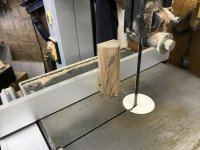
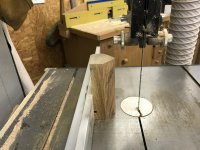
I've just planed up a piece of rippled maple which I wanted to rip into two pieces. The prospect of rip sawing doesn't exactly give me a thrill so I turned to my Record Power band saw. The fence was in the horizontal position and the size of the piece meant that I'd be best served having it vertical. So I positioned and adjusted as best I could.

The blade ended up wandering off course. As far as I can tell, I've got the fence fairly well adjusted, so is this a matter of tightening up the blade or something?

I think that the root of my problem is a psychological one: I'm actually not interested in machines although I do of course appreciate the convenience they offer for the more tedious jobs. The upshot is that I end up begrudging every minute that I have to spend fiddling with a machine. It feels like being a machine operator and not a woodworker. However, that is by the by, what I'm after is some sort of suggestion as to what might be going wrong. Also does anybody know of a source of information e.g. a DVD which would help me to get the thing working the way I would like it to work i.e. with precision?
 
Theres a farsand fings it could be, but the biggest cause of wandering is pushing too hard.
Even a blunt blade will cut straight if its given enough time (ok, it will burn a bit at the same time).
When you watch those utoob videos whizzing through stuff, theyre running the film at 10 times normal speed.
 
Yes it is the one that came with the machine, although I'm not sure if that means much as I tend to use the machine only for ripping. That said, I suppose the the usage adds up if you're thinking that the blade might have become a bit blunt.

As for speed of feed: I suppose I could go a bit slower and see if it helps.
 
Mark beat me to it!
53726576819eabc7a28933ace8697bb7.jpg
 
If you've ever cut curves with that blade that can bugger the set on the teeth and cause it to wander too. No fix for that other than a new blade, but I would definitely recommend Steve's DVD, and if you don't want to spend out on that then there's loads of bandsaw setup videos on Youtube. You need to spend a bit of time getting the blade sitting right on the tyres and getting the guides aligned. They're the basic essentials, then you can go into a lot more if you want.

That's the one Dave, I was just about to go to my bookshelf to get a pic of my copy.
 
Thanks for the tips. It looks like Mr M's DVD might be the way ahead!
 
Andy Kev.":2dj4nk92 said:
Yes it is the one that came with the machine, although I'm not sure if that means much as I tend to use the machine only for ripping. That said, I suppose the the usage adds up if you're thinking that the blade might have become a bit blunt.

As for speed of feed: I suppose I could go a bit slower and see if it helps.

I think it's generally accepted that the blade that comes with most bandsaws is pants and worth replacing from the get go. The difference between a pants, dull blade and a new, sharp blade is night and day, I would highly suggest trying a new blade first before you try any other remidial action trying to compensate for it as a sharp blade will solve 95% of most bandsaw problems.

You'll usually get recommended to have a chat with Ian over at Tuffsaws but he isn't taking any orders on at the moment as he has a huge backlog. Even then, I think he stopped taking phone calls a while ago because it was eating up too much of his day answering the same questions all the time so I think he prefers email communication now where he can copy and paste an answer.

The Axminster Ground blades are pretty well-regarded and so are Beverstock Saws.

https://www.tuffsaws.co.uk/
https://www.axminstertools.com/accessor ... saw-blades
http://beverstocksaws.com/index.php?route=common/home
 
Trevanion":2c3rv7hn said:
I think it's generally accepted that the blade that comes with most bandsaws is pants and worth replacing from the get go. The difference between a pants, dull blade and a new, sharp blade is night and day, I would highly suggest trying a new blade first before you try any other remidial action trying to compensate for it as a sharp blade will solve 95% of most bandsaw problems.

You'll usually get recommended to have a chat with Ian over at Tuffsaws but he isn't taking any orders on at the moment as he has a huge backlog. Even then, I think he stopped taking phone calls a while ago because it was eating up too much of his day answering the same questions all the time so I think he prefers email communication now where he can copy and paste an answer.

The Axminster Ground blades are pretty well-regarded and so are Beverstock Saws.

https://www.tuffsaws.co.uk/
https://www.axminstertools.com/accessor ... saw-blades
http://beverstocksaws.com/index.php?route=common/home

Nice to see the Ax bandsaw blades get a mention in the same post as Tuffsaw offerings :eusa-whistle: They're both equally as good and there's nowt to choose between them.

Bandsaw set up is crucial, but it's not difficult and doesn't take long. I use the 'Snodgrass' method (clips on UToob) which is pretty much fool proof. I set maximum tension on my 12mm, 3tpi Ax gound tooth blade and proceed with the cut at a snail's pace; even a smidge too quick and it'll start to wander.

Slooooooooow is the name of the game and as SB mentioned above, even a 'bertie-blunters' :D blade will cut well, provided the feed rate is slow. I've just been cutting (with a quite blunt blade) some 120mm wide, qs London Plane back panels for a forthcoming cabinet, around a metre long and it took say, 10mins to do each one. Also, the fence must be set parallel to the blade and the Ax 'Bandsaw Buddy' is my 'go to' implement for that job. As others have said, the supplied blade is pretty rubbish, so bin it and install a decent one; the difference is 'night n'day' and you won't believe how well the machine works afterwards - Rob
Edit - with the blade correctly aligned and tensioned, it shouldn't touch the guides and provided you go very slowly, they're not actually needed very much.
 
try one of theseIMG_0046.jpeg draw a line on the timber and you can then steer the wandering blade .but a new blade will make a world of difference
 

Attachments

  • IMG_0048.jpeg
    IMG_0048.jpeg
    345.1 KB · Views: 6,270
TrimTheKing":1fj0b8q5 said:
Steve Maskery, a member here, did a very good DVD on bandsaw tuning and might have some left...


:text-+1:
 
Woodbloke":xxg9shvp said:
Edit - with the blade correctly aligned and tensioned, it shouldn't touch the guides and provided you go very slowly, they're not actually needed very much.

I had a heated argument about this point with someone at the other place that at advocating spending over £200 on those daft Carter Guides as an improvement over the existing guides on a Felder Bandsaw as the disc type was "old-fashioned", depite not being able to provide any actual proof that the Carter-style guides did indeed improve blade life or cut quality other than "I'm an engineer (a structural engineer!) and I know what I'm talking about".

If the blade is sharp, the guides are practically not needed.
 
Trevanion":37u58sr2 said:
If the blade is sharp, the guides are practically not needed.
Yep and even with a moderately blunt blade they're still (mostly) not needed, provided the feed rate is slow - Rob
 
The trick, in my ever so not vast experience, is recognising the blade is past it’s best before you bûgger the prized piece of wood.
 
Its all about speed.
I have ripped 7" high bubinga planks, with a 1/4" blade (purists can gasp now :shock: ), purely because i could not be arsed to change it.
Even if it did take me a half hour. :lol: :lol:
 
I always hated the disc guides on my Record Power bandsaw and I’m not alone.

https://youtu.be/DQZY0bFDiw8

Some later Record Power models dropped the disc idea and use bearing guides similar to the Carter aftermarket guides. Axminster also use the same system on some of their machines.

https://www.axminstertools.com/axminste ... set-102273

We had a fairly large Startrite machine at my last job for ripsawing and that had the same bearing setup.
 
Very pleased to see that some venerable gentlemen still recommend my DVDs, after all these years, especially in the face of everything that is on YT. Thank you all. I am still proud of it all, actually.
No DVDs left, but still available via download, PM me if you are interested.
 
Ninety plus percent of all bandsaw issues are solved by the insertion of a new blade (says Mike, whose current blade is past its best, and who hasn't any replacements lined up yet). Fit the appropriate new blade, then try again. Feed speed, tension, guides, drift are no more than subtleties compared with having sharp well set teeth.
 
Hi Mike, don’t try and fight it, use it as it is. I don’t have a fixed fence on my bandsaw, I built a very high L shaped one out of 2 bits of kitchen worktop, imagine a try square stood up, if I want to rip something at three eights thick I draw a line on a piece of plywood at three eighths and then put it through the bandsaw and the angle that I have to push it at is the angle that I put the fence to. In effect I cut the plywood halfway along, keep it still and turn the machine off then move the fence up to the plywood at whatever angle it is at, cramp it down and off you go it works every time for me. Ian
Ps I know exactly what you mean about hating being turned into a machinist, now I have retired I shall be back on the handtools much more. Job satisfaction is everything.
 
Thanks for all the replies and advice. I've pm'd Steve Maskery ref the download of his DVD.

I had to rip another piece of maple yesterday. I double and treble checked the alignment of the fence and then put the wood through very slooooowly. What an improvement! And why don't they put that sort of advice in the instructions??!!???

Therefore it looks like I don't need a new blade in the short term but I'll probably order one before spring.

If there's one thing I want to do with the bandsaw (now that I can get halfway decent results with it), it is to rig something up so that I can attach it to my Festool hoover (sorry: dust extractor) because I'm not to crazy about my current dust set up for it which is too loud for my taste in any event. But that's a back burner thing.
 
:eusa-clap: :eusa-clap: :eusa-clap:
Learning the bandsaw was a hard process for me, and I've worked with all sorts of metal and machinery all my life. :o

You tube has to take most of the blame, cutting is boring to watch so they run the film at high speed, but very rarely mention that.
Also, different woods take different times to cut. Use some construction soft wood and it will slide through in seconds. Use 6" thick bubinga and you could read a book in the time it takes. :lol:

Try practicing with an offcut of hardwood; draw a line down the centre of it, DO NOT use the fence, and feed the wood through watching the blade. Vary the speed and You can see immediately when the pressure gets too much because the blade curves away. At that stage, the grain of the wood takes over and the blade follows the line of least resistance, so even with the same wood a whirly grain will take longer to cut straight than a long straight grain piece.
Then you have to be alert for the opposite problem. If you linger too long the friction of the blade sliding across the wood will start to burn the wood. Its not an exact science. :eusa-naughty: 8-)
 
Andy Kev.":2ee3k28c said:
If there's one thing I want to do with the bandsaw (now that I can get halfway decent results with it), it is to rig something up so that I can attach it to my Festool hoover (sorry: dust extractor)

Well it just so happens...

[youtube]sAEr8oZfJYA[/youtube]
 
sunnybob":ifhlsg84 said:
Its all about speed.
I have ripped 7" high bubinga planks, with a 1/4" blade (purists can gasp now :shock: ), purely because i could not be * to change it.
Even if it did take me a half hour. :lol: :lol:

I fitted my 1/4" blade and have never changed it because a) I'm too lazy and b) I nearly severed an artery trying to do that folding them up thing.

I genuinely don't know how different the 1/2" blade would be.
 
billw":j3mho3rz said:
I genuinely don't know how different the 1/2" blade would be.

The only real advantage with a thicker (back to front, blade gauge thickness is another matter) blade is beam strength, the wider the blade the less likely it's going to flex in the cut, bear heavily on the guides and wear out prematurely then break. If you're feeding slow enough a 1/4" blade is just as good as a 1/2" for ripping, but once you start pushing it the blade will falter eventually.

Imagine a 2" x 1" stick on edge on top of two concrete blocks that are four feet apart, stand on it and more than likely it will break unless it's a particularly stiff and resiliant piece of wood (think regular carbon steel vs M42 HSS), now imagine a 4" x 1" on it's edge on the concrete blocks, more than likely you could stand on it all day and it wouldn't break.

Steve Maskery":j3mho3rz said:
Tseasy: video

I hate bending down, I tend to grab opposite ends of the blade, twist one hand clockwise and the other anticlockwise whilst bringing them together and the blade folds into three neatly, all without having to go near the floor 8-)
 
Trevanion":3gzkxlpp said:
I hate bending down, I tend to grab opposite ends of the blade, twist one hand clockwise and the other anticlockwise whilst bringing them together and the blade folds into three neatly, all without having to go near the floor 8-)

Ah yes, I know someone who does it that way. I've seen him do it several times, but I still don't see exactly what he does. I think you really need to make a YT video! :)
 
When I had the big Basato, when unleashing the blades, I'd take them coiled out to the lawn, undo the fixing and then hurl it as far away from me as I could. Wearing safety glasses obviously, just in case a mole threw it back at me like an unexploded grenade.
 
Trevanion":6y5bvi7q said:
I hate bending down, I tend to grab opposite ends of the blade, twist one hand clockwise and the other anticlockwise whilst bringing them together and the blade folds into three neatly, all without having to go near the floor 8-)

How long are your arms???
 
Steve Maskery":xtgzb9en said:
Ah yes, I know someone who does it that way. I've seen him do it several times, but I still don't see exactly what he does. I think you really need to make a YT video! :)

I don't need to! This personable fella has already made a video with the exact techniques I was taught for coiling and uncoiling blades:

[youtube]Bis5p9TcWqU[/youtube]

Although, I rarely coil a blade up anymore as they tend to explode before they get to that point :lol:


RogerS":xtgzb9en said:
When I had the big Basato, when unleashing the blades, I'd take them coiled out to the lawn, undo the fixing and then hurl it as far away from me as I could. Wearing safety glasses obviously, just in case a mole threw it back at me like an unexploded grenade.

I've never liked the idea of throwing a bandsaw blade to uncoil them, can't be good for the teeth if they land tooth down!

Once you've got the hang of uncoiling the way that's shown in the video it's very predictable and not as terrifying as it may seem, you can even do it ungloved without too much risk. Uncoiling and coiling a thick gauge 16' x 2.5" resaw blade is a different kettle of fish though, I prefer to wire these into a heart shape for when they go off for sharpening.

MlIh77K.png

TrimTheKing":xtgzb9en said:
How long are your arms???

You don't need long arms! But if you must know they're a hair under 1.8m tip to tip :lol:
 
A wide blade makes ripping easier, without a doubt. Far less likely to drift. If I spent most of my bandsaw time ripping long planks or veneers, I would fit one. I do have a couple of 1/2" blades, they have gone dark brown rusty from disuse. :shock:

But I cut a hell of a lot more curves than straights, so my 1/4" and less blades are nice and shiny, even if they are almost blunt. :lol: 8-)

I have perfected the folding up of blades without any bloodletting, but unfolding is a risky business so I just throw them away from me and let the floor sort it out 8-) 8-)
 
sunnybob":2b9fdc3i said:
A wide blade makes ripping easier, without a doubt. Far less likely to drift. If I spent most of my bandsaw time ripping long planks or veneers, I would fit one. I do have a couple of 1/2" blades, they have gone dark brown rusty from disuse. :shock:
It may make it a bit easier, but it's not essential. Provided the machine is set up correctly and the (sharp) blade is really well tensioned to max, a 1/2" blade is perfectly adequate. I can quite easily produce veneers 200mm+ wide - Rob
 
Woodbloke" Provided the machine is set up correctly and the (sharp) blade is [b:7n428xc4 said:
really[/b] well tensioned to max, a 1/2" blade is perfectly adequate.

Absolutely, and on a small hobby machine 1/2" might be the max you can properly tension. There is no reason why you cannot rip with an even narrower blade, provided it has rip teeth. Greater width helps, yes, ALL OTHER THINGS BEING EQUAL, but tooth geometry and setup are way more important.
 
Yes, change the blade ! And, while you're at it fit a coarser one (ie fewer tpi), unless you hope to make fine finishing cut with it (no chance), or cut small radius curves, you are generally better off with a big coarse tpi blade.

You can cut small stuff with a big blade, but it's damn hard to cut big stuff with a small blade. :twisted:
 
Back
Top