• Hi all and welcome to TheWoodHaven2 brought into the 21st Century, kicking and screaming! We all have Alasdair to thank for the vast bulk of the heavy lifting to get us here, no more so than me because he's taken away a huge burden of responsibility from my shoulders and brought us to this new shiny home, with all your previous content (hopefully) still intact! Please peruse and feed back. There is still plenty to do, like changing the colour scheme, adding the banner graphic, tweaking the odd setting here and there so I have added a new thread in the 'Technical Issues, Bugs and Feature Requests' forum for you to add any issues you find, any missing settings or just anything you'd like to see added/removed from the feature set that Xenforo offers. We will get to everything over the coming weeks so please be patient, but add anything at all to the thread I mention above and we promise to get to them over the next few days/weeks/months. In the meantime, please enjoy!

Ian’s new workshop. The Wonky Donkey. Starting to fit the lintels.

58 60 years ago the screws and methods of putting them in where very different to today.
I don’t want to imagine trying to screw a floor down with slot head screws unless you use a London screwdriver.
Good point! I suppose it would have been time for a Yankie, were Philips screws out then? Tried one with slotted screws and it most often slipped off and chewed up the wood.
 
The guy that taught me was an old school coffin maker, be hated the modern yankey screwdriver, I understood why when it slipped off whilst hanging a mahogany door with polished brass hinges.
I remember when Philips and Pozi screws where first available to us, went out and bought a 7.2 volt makita, saved so much time!
 
So back to the us and back to work, minus 6c but I was well wrapped up, I had realised that the vertical blocks I had added to the end (very wonky) wall would be difficult to hit with the 7” screws through all the insulation so I have had to sacrifice an inch and a half off the workshop length and add horizontal 2x4’s.

View attachment 37958

Forgot to mention in the what tools I got for Xmas that son Ben bought me a small level, just like a dozen others but with the added bonus of coloured lights to tell you when it’s level. Now I did think that it was just a gimmick but for a job like this it was very handy indeed, not super accurate about 3mm over 6feet, so you wouldn’t want to be doing anything critical but for a job like this it was ideal with a driver in one hand and levelling up the 2x4 and squinting at the bubble or not in this case! Lift the wood till the level turns green and screw it down.

View attachment 37959

Then it was on with the Kingspan type insulation, you may remember I was finding it difficult to cut? Well out came a very useful tool, long wavy edged cutters that fit onto a multi tool. Noisy yes but so quick and easy, even better than a hot knife through butter!

View attachment 37960
In reference to the insulation cutters above I’m sorry to report that they are totally unfit for purpose and sincere apologies to anyone who followed my recommendation and bought one.
They cut very well with very little dust or mess but the weld gives up after very little use and the blade drops off the Multitool fitment, I was hoping it was just that blade but trying the second I bought it lasted less than a minute!
Again apologies Ian
 
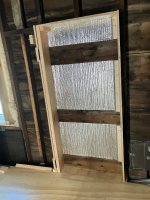
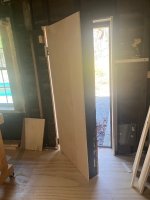
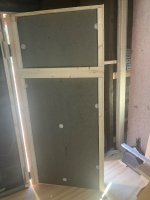
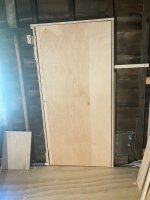
The wall insulation has been going really well, I only have a bit to do on the last wall and that’s that phase finished. It’s the wall that has two windows and a door to the garden, the door won’t be used much but better we keep it than board it up. So I decided to insulate it This involved adding a box to the inside of the door 6” deep for the insulation and moving the hinges to the room side of the box.
IMG_4379.jpeg

This job has taken me far far longer than I anticipated as my first attempt wasn’t very good at all, the reinforced ply edge where the hinges were flexed far too much and coupled with the door being twisted I was forced to scrap it and start again.
This time I used a it of 1 1/2” pine for the hinge side and it was a huge improvement. The door was an old barn door with three horizontal ledges, no brace, but well made with clenched over nails and no sag.

IMG_4395.jpegIMG_4396.jpeg
I added some of that thin shiny stuff (Radiant barrier?) between the ledges and covered it over with two layers of rigid foam then a lid of 1/2” ply, all I had was two long thin bits and it needed fastening together, this went much better than I’d feared.

IMG_4394.jpegIMG_4397.jpegT

The piece of wood going across the door is to fasten a locking bar to. Will be doing this next, it involves a BIG nut and bolt.
 
Just an update, the insulation has gone well, just two sheets to do but they are around the windows and side door so nothing like as quick as the bish bash full sheets around the rest of the room.
Here’s a pic to show the cutouts around the first window.
After that the Furring strips go on then it’s the big heavy headers Coach screwed to the Barns 2x4’s followed by the joist hangers and joists, then lots of insulation on top and the thing is almost done! I really can’t wait!!!

IMG_4443.jpeg
 
No it’s going to be drywall, and the ceiling.
Despite what I said previously it would seem that square edge ie without the scalloped edge, isn’t available very easily so I shall be taping and mudding. Be a first for me!
 
Oh yes I remember now , I guess my wife is right in that I am getting forgetful.
A 4'x8' sheet of drywall will have a tapered edge on the long sides and square edge on the ends. When taping pull the butt joints to twice the width as the tapered edges and you will be fine.
 
Ian when I built my shed I lined the internals with white faced melamine, just put a small v on the joints to stop the sharp edge. It give a nice bright finish and harder than drywall
 
Here is an example. Butt joints top and sides, tapered joints in the middle. This was the finish coat I did today. View attachment 54314
Now you see Scott, that just proves that I don’t know what I’m doing lol.
I was going to have the 8’ length horizontal with 2 boards resting on the top of each other, so that there was only one line of mud around the room. It would have meant that the square ends were butted up against each other and I was wondering what to do about that!
Ian
 
It's coming on well Ian.

I don't fancy doing the drywall and 'mudding' thing so wish you well in doing it.

I used 1.5mm~2mm (forget which) white plastic wall sheeting. They came as 8'x4'... stuck to the OSB lining fixed to the concrete block walls. Bit of a wobble when cutting to height as my place isn't 8ft high - same when I had to reduce for the widths around doors/windows... I was going to butt joint but they do a joint strip so used that. Saves me having to paint the walls. T&g soffit boards for the ceiling.
 
It's coming on well Ian.

I don't fancy doing the drywall and 'mudding' thing so wish you well in doing it.

I used 1.5mm~2mm (forget which) white plastic wall sheeting. They came as 8'x4'... stuck to the OSB lining fixed to the concrete block walls. Bit of a wobble when cutting to height as my place isn't 8ft high - same when I had to reduce for the widths around doors/windows... I was going to butt joint but they do a joint strip so used that. Saves me having to paint the walls. T&g soffit boards for the ceiling.
Oh yes I know the stuff, I’ve used it as a backing in built in wardrobes in the past, that’s not a bad idea Frank, I shall see if
Ian it’s cost effective over here, I hate dealing with plasterboard so that might be a good alternative!
 
Just did a check for prices here Ian... gone up quite a bit since I got mine.

May still be worth considering though as once up there's no maintenance, just a wipe over or put the hoover (or point a blower) on/at it to remove dust. Doesn't get damaged like plasterboard would if you bang a piece of wood (or metal?) in to it.

Additional *bonus*: makes for a good "whiteboard" for notes etc. 😎
 
I’ve been relatively busy building the Wonky Donkey, all the wall insulation is up!
My temporary bench has been reassembled and the first shavings in the new workshop have been produced. Well over a year since I’ve done any proper woodworking and it was sending me a bit cranky.
IMG_4437.jpegIMG_4436.jpeg
The vice almost in the middle of the bench was an experiment when I built it, still not sure about it tbh, jfyi I’m right handed.
 
That's one thing I don't have *fitted* to a bench/worktop in mine anymore Ian - a vice. I used to have one in the old fixed bench, right hand end on the long side - I'm also right handed. Seemed the right place to have one... Now, with the *modern* way (?) with MFTs 'bench dog' and the Gripper dovetail top type clamp systems...

I'll admit that it's something I do miss but none of the mobile units would work with one.
 
Nice to see wood shavings! I played with my vice location by using the clamp on vice in different positions on my assemble table. What worked for me was having it very close to the left end , being right handed. This way it made more sense to me for sawing stock and better for working with a draw knife.
 
That's one thing I don't have *fitted* to a bench/worktop in mine anymore Ian - a vice. I used to have one in the old fixed bench, right hand end on the long side - I'm also right handed. Seemed the right place to have one... Now, with the *modern* way (?) with MFTs 'bench dog' and the Gripper dovetail top type clamp systems...

I'll admit that it's something I do miss but none of the mobile units would work with one.
Not sure I could do much without a vice really, how about mounting one on a chunk of wood with dowels protruding that drop into the MFT holes? Never even seen an mft in the flesh tbh lol.
 
Nice to see wood shavings! I played with my vice location by using the clamp on vice in different positions on my assemble table. What worked for me was having it very close to the left end , being right handed. This way it made more sense to me for sawing stock and better for working with a draw knife.
Yes that’s more normal, I was finding that it was getting in the way when planing, perhaps I should have put the vice to the LH end and the planing stop to the right of the vice?
I would like to get started on the type of woodwork that needs a drawknife, Windsor chairs are calling my name!
 
Not sure I could do much without a vice really, how about mounting one on a chunk of wood with dowels protruding that drop into the MFT holes? Never even seen an mft in the flesh tbh lol.
I'd not thought of that Ian, good idea. I've 3 types of vice - one was my father's engineering type. Another is a small bench fitted one while the third is a small one with a thread clamp at the base for clamping to a worktop.

I've yet to get to do an 'MFT' type top on the 'worktop' side of the units... presently a machine is on one 'top' and the other is just flat. Trying to decide if to do dovetail (Gripper type) slots/grooves or MFT dog type... The depth of hole/dog fitting is bothering me - with the tops being 2 surfaces attached to a central 'spacer' where the rotation happens. Not sure if you'll remember the posts and photos I put up? If I'd just a 'normal' single thickness top it wouldn't be a problem.

I'd not seen any except in YouTube videos. Thought about doing one but the jig and other required tools wouldn't warrant the expense for my small area. Instead, I bought a pre-cut replacement one to use as a jig/marker for placement of the holes. Still a WIP while I get sidetracked on other stuff.
 
The Windsor chairs will look great in your new old home.
First thing is a double seat, I really am looking forward to devising the jig for the arched back that then turns through 90° at each end to form the arms.
Steam bent of course, it’s a few years since I last did any Windsor chair work so it should be interesting.
Ian
 
Next stage! Fitting the ceiling which is made from 2x8’s dropped into hangers attached to headers on each long side of the workshop.
The Headers are Coach/ lag screwed to the studs and top plate, true to form the Wonky Donkey isn’t the same height along its length so at one end I have had to notch out around the rafters? The Coach screws should be in a zigzag pattern too but that hasn’t been possible at one end. Despite all that I’m pleased with the way the headers have gone on, certainly not going to fall down.


IMG_4541.jpegEven where the studs meet the top plate things aren’t level so blocks of wood are pinned in place to level things up, all different thicknesses of course!

IMG_4542.jpegThat’s the first bit of Header in place, notched out.

IMG_4550.jpeg

The wiring had to be undone from its clips, I found this to be really awkward as they were really tough and I risked damaging the wiring.
This side of the workshop was the worst, the other side being fairly straightforward in comparison.
IMG_4552.jpegThis shows the back of the other wall, plenty to screw into but how to establish just where to screw? Simply solved with holes drilled alongside the studs and nails pushed through, I was really lucky that none of the hangers on this side of the roof coincided with where the Coach screws needed to be.
IMG_4553.jpeg
Hangers on 16” centres. When this stage is done ( with help from a couple of strong young men to drop in the joists) I can put 3 layers of insulation- 4 1/2” on top and then fill in between the joists at the ends to match what’s on the walls.
I have a plan in mind to make a measuring gizmo for the joist lengths, only allowed an eight of an inch discrepancy in the length.
 
Last edited:
Headers!! You've gone native, Ian. They're lintels. :)
 
Last edited:
I was going to just use the proper nails, do you have a preference? Local rules allow the screws.
Ps, if you think I’m doing any of this important stuff wrong please say something.
Ian
The screws make for a faster install but be careful to not over torque them as they will what I call strip out.
Nails are fine but you may end up with a tender elbow from hammering them in.
 
Google AI gives this information when using 'lintel and header' as the search text... even going as far as to suggest it will help give 'best building practices' depending on what you're building 😎🤔

C&P (copy & paste):
AI Overview


Lintel construction – Southwest New Brunswick Service Commission
Both lintels and headers serve the exact same primary purpose: acting as horizontal support beams over openings (like doors and windows) to safely transfer the weight of the structure above to the vertical supports on either side. However, they differ significantly in their material and typical construction application. [1, 2, 3]

1. Construction Style
  • Lintels: Primarily used in masonry and brick construction. They sit across the opening in a brick or block wall to carry the weight of the bricks above. [1, 2, 3]
  • Headers: Exclusively built into timber-frame or light-gauge steel wall construction. They frame out the rough opening for a door or window and distribute the vertical loads to the surrounding studs. [1, 2, 3]

2. Materials
  • Lintels: Generally crafted from heavy-duty, rigid materials like precast concrete, cast stone, or structural steel.
  • Headers: Usually made of doubled-up timber framing lumber (e.g., two 2x8s or 2x12s sandwiched together) or engineered wood, often concealed by drywall. [1, 2, 3]

3. Visibility and Aesthetics
  • Lintels: Because they support exterior brickwork, lintels are frequently visible and sometimes designed to be ornamental.
  • Headers: Because they function inside interior or exterior timber stud walls, headers are typically hidden behind siding, drywall, or other finish materials. [1, 2, 3]

Summary Resources
While the terms are often used interchangeably by laymen, understanding the difference comes down to the building method. To explore the engineering distinctions and building terminology in more detail, refer to resources like the Lintels vs. Headers Guide on Extech Building Materials or the Design+Encyclopedia Lintel Vs Header page. [1, 2]

If you are working on a specific building project, let me know:
  • Is the wall made of timber (wood) frame or brick/masonry?
  • What is the width of the opening you are trying to support?
I can help you narrow down the best building practices or standard sizes needed for your build!
 
The screws make for a faster install but be careful to not over torque them as they will what I call strip out.
Nails are fine but you may end up with a tender elbow from hammering them in.
I’ve read similar comments elsewhere, they are thick rough nails so probably. Might use a mixture as you suggested as from memory there are 10 nails each and there are 30 hangers.
Ian
 
Google AI gives this information when using 'lintel and header' as the search text... even going as far as to suggest it will help give 'best building practices' depending on what you're building 😎🤔

C&P (copy & paste):
AI Overview


View attachment 55202
Both lintels and headers serve the exact same primary purpose: acting as horizontal support beams over openings (like doors and windows) to safely transfer the weight of the structure above to the vertical supports on either side. However, they differ significantly in their material and typical construction application. [1, 2, 3]

1. Construction Style
  • Lintels: Primarily used in masonry and brick construction. They sit across the opening in a brick or block wall to carry the weight of the bricks above. [1, 2, 3]
  • Headers: Exclusively built into timber-frame or light-gauge steel wall construction. They frame out the rough opening for a door or window and distribute the vertical loads to the surrounding studs. [1, 2, 3]

2. Materials
  • Lintels: Generally crafted from heavy-duty, rigid materials like precast concrete, cast stone, or structural steel.
  • Headers: Usually made of doubled-up timber framing lumber (e.g., two 2x8s or 2x12s sandwiched together) or engineered wood, often concealed by drywall. [1, 2, 3]

3. Visibility and Aesthetics
  • Lintels: Because they support exterior brickwork, lintels are frequently visible and sometimes designed to be ornamental.
  • Headers: Because they function inside interior or exterior timber stud walls, headers are typically hidden behind siding, drywall, or other finish materials. [1, 2, 3]

Summary Resources
While the terms are often used interchangeably by laymen, understanding the difference comes down to the building method. To explore the engineering distinctions and building terminology in more detail, refer to resources like the Lintels vs. Headers Guide on Extech Building Materials or the Design+Encyclopedia Lintel Vs Header page. [1, 2]

If you are working on a specific building project, let me know:
  • Is the wall made of timber (wood) frame or brick/masonry?
  • What is the width of the opening you are trying to support?
I can help you narrow down the best building practices or standard sizes needed for your build!
And there was me just thinking it was semantics and location. Thanks for that.
Ian
 
Back
Top