• Hi all and welcome to TheWoodHaven2 brought into the 21st Century, kicking and screaming! We all have Alasdair to thank for the vast bulk of the heavy lifting to get us here, no more so than me because he's taken away a huge burden of responsibility from my shoulders and brought us to this new shiny home, with all your previous content (hopefully) still intact! Please peruse and feed back. There is still plenty to do, like changing the colour scheme, adding the banner graphic, tweaking the odd setting here and there so I have added a new thread in the 'Technical Issues, Bugs and Feature Requests' forum for you to add any issues you find, any missing settings or just anything you'd like to see added/removed from the feature set that Xenforo offers. We will get to everything over the coming weeks so please be patient, but add anything at all to the thread I mention above and we promise to get to them over the next few days/weeks/months. In the meantime, please enjoy!

Jacobean style oak dining table & chairs.

When this is made properly, it will be upholstered with a woven tapestry fabric using brass upholstery nails...not like this:

RT1kJHT.png

bZhfx6h.png

It's actually really comfy, and there are no major geometry adjustments to be made. I've cut an inch off the height, and removed the tapered front feet to replace them with rounded pillow shapes:

4T3tZBb.png

They'll obviously be turned with the rest of the leg when this is made properly, rather than tenoned in separately.

We're just going to sit on this for a while and see what minor tweaks might be necessary. The only concern I have is that the front-to-back measurement of the seat might be an inch long, perhaps. The height of the back is going to come down a tad, but that's just an aesthetic choice.
 
Scrub my remarks about the shape of the central panel, I'd thought that all the wood was going to be visible. Now it looks like the central pad sits on top of a strong frame.

 
AndyT":3691vedn said:
Scrub my remarks about the shape of the central panel, I'd thought that all the wood was going to be visible. Now it looks like the central pad sits on top of a strong frame.

:text-+1:
Beat me to it Andy. The eye is now drawn to the fabric stting in a concentric constant width frame. The proportions are just fine.

Bob
 
The panel on the back is on show, though, so the same argument applies.

I've had a little practise of the barley twist. I've got the geometry sorted now:

wlQyJkJ.png

I can't see any way of speeding the process up, though. There's at least an hour and a half of work there, and I've got 10 to do. All will have to be finished to a higher standard than this.
 
Are you using the hand rotate and rasp method?

I've never seen a quick way of doing it without specialist machinery. Of course, if you wanted to show off you could do a hollow twist somewhere unstressed. Quite fun to make but fiddly.
 
Yes, it's just shaped by hand. I won't be doing hollow ones, though. Too much work, and not authentic on a chair. One day when I'm very very bored.........

 
Mike G":3l5esjxg said:
Yes, it's just shaped by hand. I won't be doing hollow ones, though. Too much work, and not authentic on a chair. One day when I'm very very bored.........

I do have a Trend router lathe in the shed, it is able to cut barley twists.
I have never cut one but you could use it to hog out and then finish with the rasp by hand?
 
Thanks Dave, but I'll plod on by hand. Hopefully I'm going to be sitting on these for a few years, and if I ever see the barley twists I'd like to think I made them myself. I've actually come up with a little idea which might speed things up a bit, too.
 
Mine's nowhere near ready, but a CNC router with a a 4th Axis should be able to make repeat twists.
 
For those following along on the barley twist sage, here's a thingy I made to speed up the process. The waste of these things is entirely removed by hand with rasps etc, and is a long and tiring process. I've got to make 10. So, I came up with this:

xvF2Nwr.png

IUj7StO.png

Jw8LJVa.png

The last one isn't very clear, but shows the profile of the edge, which fits rather neatly into the recess in the helix of the barley twist.

PsWaZpR.png

You have to find the correct angle to offer the work. I'll either get used to it quickly, or I'll make some sort of guide. This is 60 grit paper so it is for clearing wood away quickly rather than polishing to a fine finish. It works a treat:

K9H67iM.png

That may well save an hour for each piece, at a guess.
 
I like that. No shopping required!
Presumably it's more agressive than your axial sanding drum, because of the high speed out on the rim of the disc.
 
AndyT":uzap8miy said:
I like that. No shopping required!

Is such a thing available to buy?

Presumably it's more agressive than your axial sanding drum, because of the high speed out on the rim of the disc.

They're both capable of shifting a fair amount of material fairly quickly, but the drum sander has a lot more momentum because of its weight, and so is less prone to stopping when excess pressure is applied. This disc is very lightweight.
 
Mike G":28upzma4 said:
AndyT":28upzma4 said:
I like that. No shopping required!

Is such a thing available to buy?


I don't know. I just meant that it's more interesting to see a diy approach, rather than just buying a commercial tool.
 
Lovely looking chair, I know nothing about Jacobean chairs by tastes are more modern!

The barley twist front stretcher looks a bit weighty - I know it's just a prototype in my mind barley twists are usually a bit thinner. Your photos of later samples look like you could be thinning it up a bit anyway, and I'll refer back to my first comment, I know nothing about Jacobean design!
 
You're dead right about the barley twist, Matt. I had no idea what I was doing when I made it, and used it as an exercise for working out the geometry. Afterwards, I rang a friend for a photo and some dimensions from an old chair of his, then did a couple more test pieces, and now know how to make them properly. This is somewhat unfinished, but gives the approximate look of the final piece:

wlQyJkJ.png

Interestingly, there is quite a difference between barley twists from the 16th and 17th centuries (the ones I am trying to replicate), and those made by the Victorians in the 19th century. The latter are slimmer and deeper than the former. Books: there's stuff in them! :D
 
Very impressive Mike, excellent. Far more challenging than mine.

In a previous life, my inlaws bought an antique dresser, two units, on atop the other. They had barley twists.
The two bottom ones were original, but the top right one had been replaced. Whoever had done the job had done it well except for one teensy-weensy detail. He had copied, exactly, the left one. The two bottom ones were mirror images of each other, but the top ones were both left-handed.

I wasn't popular when I pointed this out...
 
That's even more interesting than you'd think, Steve, because the left handed one was probably made by a left handed person.....so the two original twists would likely have been made by different people. It's quite difficult to do the twist the "wrong" way for your handedness. I know, because that's precisely what I did with my first one, having no idea at all what I was doing.
 
Oddly enough, I am lying in bed as a write this and at the end of my bed (4 poster) are two spiral cut posts, cut in opposite directions. It made me think, I wonder if it would be easier to do one of the cuts standing on the other side of the lathe? I imagine the lathe is used merely as a convenient means of holding the work - rather than powered up.
 
AJB Temple":3u7yspbn said:
Oddly enough, I am lying in bed as a write this and at the end of my bed (4 poster) are two spiral cut posts, cut in opposite directions. It made me think, I wonder if it would be easier to do one of the cuts standing on the other side of the lathe? I imagine the lathe is used merely as a convenient means of holding the work - rather than powered up.

A right or left hand twist would look just the same from the back of the lathe, wouldnt it?
Just like the way a letter N is the same upside down. (Think of the thread as NNNN when seen from above.)
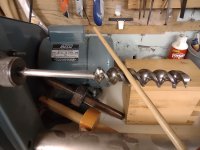
 
Jumping in several pages too late ...

Mike G":1on2jig0 said:
I know that this is what people do if they have access to a morticer, or similar. As I'll be chopping these out by hand, the mortices will be vertical.

When I had to cut angled mortices into some square table legs, I made a set of blocks with a birds mouth notch in them, so one lot cradled the leg at the correct angle, the others provided a flat surface to clamp them down with. Then the mortices are vertical and quite straightforward, just take care for the first cuts into the sloping surface.
 
AndyT":334k63m8 said:
AJB Temple":334k63m8 said:
Oddly enough, I am lying in bed as a write this and at the end of my bed (4 poster) are two spiral cut posts, cut in opposite directions. It made me think, I wonder if it would be easier to do one of the cuts standing on the other side of the lathe? I imagine the lathe is used merely as a convenient means of holding the work - rather than powered up.

A right or left hand twist would look just the same from the back of the lathe, wouldnt it?
Just like the way a letter N is the same upside down. (Think of the thread as NNNN when seen from above.)

Well, manoeuvring around my obviously vertical bed posts, from the pillow end the left post spiral angle slopes up right to left from inside to outside, and the right post from left to right. To have my rasp working in the same direction for both posts, with me as a right hand dominant user I could achieve that by standing on different sides of the lathe.
 
Well, you are indeed right. I was thinking only from the perspective of someone with a lathe accessible only from one side. So yep, these mirrored carvings could indeed have been made by the same person.
 
Take a big bolt, hold it horizontally. Turn it round 180 degrees (easier than walking round the back of it). Thread looks the same. Going round the back of the lathe is like flipping the workpiece. Doesn't help, unless I've confused myself.
 
Yep, you're right Tony. I was right in the first place....scrap my last answer. It doesn't matter which way you see this carving on the lathe, the "thread" is going in the same direction. So, we're back to having two different carvers making the mirrored pairs.
 
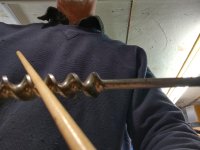
It's really hard to visualise but I'm in the workshop right now and have done an experiment.

Here are two photos of a big Russell Jennings auger bit in the lathe, with a stick to represent a rasp or whatever.

IMG_20220203_110556470.jpg

and from behind

IMG_20220203_110707426_HDR.jpg

I hope that helps!
 
Yes but in your picture you are using the same drill bit. Whereas you are trying to make an opposite drill spiral.
 
Imagine you are looking at the work in the first picture. Your sawcuts and rasping both go at 45 degrees to your left. You're making a right hand twist.

If you want to make a twist that goes the other way, you need to swing your tools around, so you are cutting at 45 degrees to the right. We think that would be awkward. Let's go round the back and see what changes. If you cut at the same "easy" angle that you used at the front, you still get the same, right-hand twist.

You can't get the opposite twist without cutting at the awkward angle.
 
Exactly Andy. To cut the opposite twist you really need to be left handed.
 
Luckily, being a pianist, I am ambidextrous :lol:

Left or right handed sawing or rasping or screwscrewdrivingdriving is much the same to me. :eusa-whistle:
 
AJB Temple":2tuju0gl said:
Luckily, being a pianist, I am ambidextrous :lol:

Left or right handed sawing or rasping or screwscrewdrivingdriving is much the same to me. :eusa-whistle:

I'd give my right arm to be ambidextrous. :D
 
Back
Top