GaryR
Nordic Pine
I'm attending a week long workshop on Japanese plastering near Berea, Kentucky, USA. Berea has a long history as an artist and craftsperson community and also a vibrant community of back-to-the-land and natural building aficionados. The workshop is hosted by South Slope Farm, (online search for "The Year of Mud") which also hosts classes on Western timber framing and Japanese timber framing. The class is taught by Kyle Holzhueter, who is an American who has lived in Japan for the last 20 years and is a plastering master there.
Here is the farm from a hill up the slope. The topography here is very "Lord of the Rings." Limestone knobs and dense forest. Class is taught in the pavilion, the large building on the left, and the kura, the smaller storehouse to the left of the pavilion. Both building were partially plastered and students in the workshop are doing further plastering on the buildings as part of the training.

The pavilion. Partly western timber framed and partly Japanese timber framed. The walls are meant to be mostly open. Oak framing with sassafras ceiling and engawa (veranda) boards. Rafters were blackend with oil tinted with soot. The lath in the gable end is pine. That area was plastered with its base coat of earth plaster and straw today. You can see the corner shear wall (plywood) has already been lime plastered.


We made earth plaster yesterday and today from soil removed to make a Japanese style ground gutter next to the pavilion.

The dry soil was shoveled into wheel barrows. The clumps were broken up with sledges and the then screened with 1/4" mesh for the base coats or 1/8" mesh for the brown/scratch coats. The sieves were rolled back and forth over a section of PVC pipe. Very clever.

The straw was either baled or bagged and run through a cheap chipper/shredder depending on what length fiber was needed. Longer for base coat, shorter for brown/scratch coat.

Then earth and sand was mixed in vertical mixer. This little guy is getting a big workout.

So far it has been learning about earth plasters and the base and brown coats. When to add sand and when add fiber, how to use a hawk and trowel. I'm still learning how to get the mud from the hawk to the trowel and onto the wall instead of my shoes. A humbling experience.
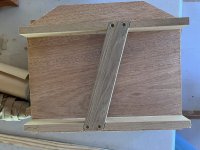
Here is a classic Japanese hawk from below. Plywood and scrap wood. About 1 foot by 1 foot, a little wider horizontally.
We will move on to various finish coats including shikkui lime plasters. More pictures tomorrow. The class runs through Thursday.
Here is the farm from a hill up the slope. The topography here is very "Lord of the Rings." Limestone knobs and dense forest. Class is taught in the pavilion, the large building on the left, and the kura, the smaller storehouse to the left of the pavilion. Both building were partially plastered and students in the workshop are doing further plastering on the buildings as part of the training.
The pavilion. Partly western timber framed and partly Japanese timber framed. The walls are meant to be mostly open. Oak framing with sassafras ceiling and engawa (veranda) boards. Rafters were blackend with oil tinted with soot. The lath in the gable end is pine. That area was plastered with its base coat of earth plaster and straw today. You can see the corner shear wall (plywood) has already been lime plastered.
We made earth plaster yesterday and today from soil removed to make a Japanese style ground gutter next to the pavilion.
The dry soil was shoveled into wheel barrows. The clumps were broken up with sledges and the then screened with 1/4" mesh for the base coats or 1/8" mesh for the brown/scratch coats. The sieves were rolled back and forth over a section of PVC pipe. Very clever.
The straw was either baled or bagged and run through a cheap chipper/shredder depending on what length fiber was needed. Longer for base coat, shorter for brown/scratch coat.
Then earth and sand was mixed in vertical mixer. This little guy is getting a big workout.
So far it has been learning about earth plasters and the base and brown coats. When to add sand and when add fiber, how to use a hawk and trowel. I'm still learning how to get the mud from the hawk to the trowel and onto the wall instead of my shoes. A humbling experience.
Here is a classic Japanese hawk from below. Plywood and scrap wood. About 1 foot by 1 foot, a little wider horizontally.
We will move on to various finish coats including shikkui lime plasters. More pictures tomorrow. The class runs through Thursday.