• Hi all and welcome to TheWoodHaven2 brought into the 21st Century, kicking and screaming! We all have Alasdair to thank for the vast bulk of the heavy lifting to get us here, no more so than me because he's taken away a huge burden of responsibility from my shoulders and brought us to this new shiny home, with all your previous content (hopefully) still intact! Please peruse and feed back. There is still plenty to do, like changing the colour scheme, adding the banner graphic, tweaking the odd setting here and there so I have added a new thread in the 'Technical Issues, Bugs and Feature Requests' forum for you to add any issues you find, any missing settings or just anything you'd like to see added/removed from the feature set that Xenforo offers. We will get to everything over the coming weeks so please be patient, but add anything at all to the thread I mention above and we promise to get to them over the next few days/weeks/months. In the meantime, please enjoy!

John’s workshop

JohnH

Seedling
Joined
Apr 7, 2025
Messages
47
Reaction score
15
Name
John
LOCATION
Medway, Kent
Hello! Greetings from a currently damp and dreary corner of NE Kent. But a corner with a plan!

So, I’ve long harboured a desire to build a workshop in the back garden. Somewhere to tinker, somewhere to get creative, somewhere to do a bit of work (writing), somewhere to dream (over a mug of tea or perchance a foaming ale). The space will be shared by me and my long-suffering missus.

I’m an average DIYer with an array of basic tools. This’ll be by far the biggest project I’ve ever undertaken. I’ve this venerable forum to thank for 90% of my workshop design and build knowledge - the hours I’ve spent poring over others’ workshop builds here! An invaluable resource.

I’ve a small-ish budget and will aim to do all the work myself. I’ve managed to amass some materials over recent months: bricks, sand, doors, windows, membrane. All have either come free (skip-diving, Freecycle, Facebook Marketplace) or cheap s/h. I aim to use as many reclaimed or s/h materials as possible - for reasons both ecological and economical. Hopefully the workshop won’t end up looking like a dog’s dinner as a result…

The site: Our back garden is that of a typical Victorian terrace - i.e. quite narrow (4.5m). The planned workshop will be 3m by just shy of 5m (so a little under 15m2) and be within 1m of the boundary on the two long sides, and form the boundary on the far, short side. Here’s an aerial view of the site:
IMG_0691.jpeg

At just under 15m2, I understand there’s no need to comply with Building Regs. And if I keep to the 2.5m overall height, I’ll be within PD limits.

I’m thinking of a timber frame on a brick plinth, clad in feather edge weatherboarding (possibly painted black - I like that look, it’s in keeping with a strain of Kentish vernacular). I’m currently considering a pent roof (EPMD?), probably sloping west to east (not in keeping with the aforementioned vernacular, but hopefully won’t look too out of sync with what’s below; apart from the roofline itself, it won’t really be visible anyway). I initially thought about roof lights but have reconsidered (roof pitch, complexity, height, security, water ingress…). There’ll be natural light from glazed double doors opening out onto the garden and from a couple of windows down the eastern long side, which will look out onto some shrubbery in a raised bed parallel to it; there’ll be solid (i.e. unglazed) double doors at the far end opening onto the alleyway. I’m thinking an insulated floating floor to provide a little comfort (relatively speaking!) underfoot while not sacrificing too much headroom.

I’ve got about 50cm down each long side for maintenance (can’t afford more than that as we want to keep the raised bed).

The idea is to divide the space into roughly 2/3rds workshop and 1/3rd home office, partitioned by a stud wall (more wall space to hang stuff!). I’ve not shown this on the plan below to avoid overlaying it with too much (unnecessary at this point) detail. Ignore the Veluxes on this plan - reckon I’ll forgo them and maybe opt for a couple of those LED panels instead.

IMG_0677.jpeg
 
Hi John. Saw your welcome post, too. I built my 'shop based on mike G's how to and a thing out two I designed myself. A couple of things I learned myself (from a previous life) try to avoid windows where you can't see them from the house. I note you have an alleyway behind. Those are the sort of places burgers like to enter your property from.

Another is the I light my 'shop with 600x600 40w LED panels. I think they're better than daylight in there, and you might find they're cheaper to install and maintain rather than Velux windows.

One thing I didn't do, which I wished I had done when it was advised on this forum, was to run communication cabling in the ducting along with the power cabling. I can only sometimes get a wifi signal from my house, but not always.

Anyway, it seems you're off to a good start. Good luck.
 
Cheers for the reply, Malc.

Re windows and security: good point. I did consider it, but the alleyway actually ends just beyond our garden and with the portion of fence there that’ll be retained and the rampant shrubbery, the glazed side of the ‘shop won’t be visible from there.

Re LED panels: yes, I think it was your thread I saw them on. They do look good, provided a natural-ish light, and a lot cheaper and less hassle to install than Veluxes. So that’s the way I’ll probably go. The view onto the shrubbery from the proposed windows will be lovely and green but the foliage is quite dense and there won’t be an awful lot of daylight flooding in. Especially on grey days like today!

Great advice re cabling. I’ll deffo bear that in mind. (y)
 
Hi John. Saw your welcome post, too. I built my 'shop based on mike G's how to and a thing out two I designed myself. A couple of things I learned myself (from a previous life) try to avoid windows where you can't see them from the house. I note you have an alleyway behind. Those are the sort of places burgers like to enter your property from.

Another is the I light my 'shop with 600x600 40w LED panels. I think they're better than daylight in there, and you might find they're cheaper to install and maintain rather than Velux windows.

One thing I didn't do, which I wished I had done when it was advised on this forum, was to run communication cabling in the ducting along with the power cabling. I can only sometimes get a wifi signal from my house, but not always.

Anyway, it seems you're off to a good start. Good luck.
+1 for LED panels
. Had them in my last workshop and a visitor refused to believe they weren’t Velux. Even went outside to check!
 
Sounds fun, John. A couple of minor points.....

Two windows means a lot of wall you can't use for storage. You won't need them for light if you have 2 Veluxes, but Veluxes have their own down-side: they're a potential weakness in your security, if that's a concern. Personally, I'd lose a window and a roof light.

The 1m from the boundary thing applies to all boundaries, including to the alley. Are there other properties along the alley which have outbuildings backing right onto the alley? If so, I suggest you take photos, and approach the local council planners and ask whether you need permission.

For building regs, the area which counts is Internal Floor Area, not footprint area. Therefore, you can measure inside your walls to ascertain the area, not outside. There's good reason my workshop is 29.96 sq m internally!

On LED panels.....LED striplights can put out more light than a panel, and cost less money. I've just replaced 2 failed panels with strip lights, and I was very surprised when the wholesaler told me of the numbers (output and money). They also these days come with a little selector switch to set the colour "temperature" and the lux levels.
 
Many thanks Roger and Mike for your input and the good points you raise. Re your points, Mike:

I’ve more or less decided against the Veluxes (security, complexity, extra roof height with the increased pitch necessary, etc).

The windows in the wall won’t be huge (I already have them - secondhand double-glazed aluminium units which are only around 40cm wide x 70cm tall. The idea is to partition the space into workshop and home office, so a (modest) window either side of the partition will be worth sacrificing a bit of wall space for, I think. There’ll be extra wall space on either side with the partition stud wall.

There are a dozen other properties which back on to the alley (from our road and the road parallel) and I must admit that none of them have outbuildings which form part of the rear boundary - though I can bring to mind a few on streets not too far away that do. Hmmm, yes, I should check that out with the local planning dept…

Given the constraints of our narrow garden - and the fact that I can’t come too far down the garden towards the house as there’s an apple tree in the way - I’m not going to quite get to 15m2 externally, let alone internally. But I won’t be too far off! It won’t be a huge space but it’ll be a big improvement on working from the kitchen table.

I’ll look into LED strip lights as an alternative to the panels. That part of the build seems a loooong way off!

Ok, off to bed to sleep some more on all this. Exciting!
 
Morning all, my main initial questions for anyone who’d care to respond concern the base. Because that’s where all the fun will really start once I transition from page to reality!

I have an existing slab but it’s too small (roughly 4m x 1.6m) and, from what I’ve read, too thin (approx 100mm) to extend it by drilling/epoxying rebar into it and joining it to a new portion of slab.

I’ve accepted the fact that I’ll have to smash up the existing base - and the paved area adjoining it. At least it’ll provide a handy source of hardcore for the new sub-base…

Casting a new slab - around 2.5m3 of concrete - would be very difficult due to:
a) access restrictions for getting concrete pumped or even barrowed in. Anything larger than a LWB van has great trouble getting down our road. The bin lorry, for example, just waits at the end of the road for the bin men to wheel rubbish down to them.
b) a very limited storage area for bulk materials (if I were to attempt mixing the concrete myself). There’s nowhere for a builders merchant to dump tonne bags (we’ve no front garden and the alley opens on to an unmade road where again there’s no space) and I don’t fancy struggling through the house with hundreds of 25kg bags of sand, cement and aggregate.

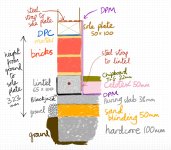
So, with a new slab possibly ruled out, thoughts turn to alternatives. I’ve looked at Mike G’s ‘How to build without a concrete slab’ approach - which I’ve attempted to modify (hoping I’ve not been too presumptuous or even sacrilegious!) for reasons explained below. Here’s a sketch of my idea for the base:

IMG_0692.jpeg

Mike, I’ve pinched your brainwave of using pre-cast concrete lintels (I have several 1500x100x65 that somebody was throwing out) but have tried to come up with an alternative to employing a suspended timber floor due to the height restrictions imposed by building under PD rules. I’ve aimed to give a reasonably solid and level base to build an insulated floating floor off by using common or garden paving slabs (600x600x38) above a sub-base of hardcore and sand.

I’m hoping it’d be strong and stable enough for a modest-sized workshop with no heavy machinery in it… ?? Also, I’m on chalk and there are no major trees in the immediate vicinity.

One potential weak point I could see in my initial design was the lowest mortar line (i.e. the one that beds the lintel to the paving slabs) and the potential for water ingress, so in the sketch above I’ve replaced this mortar line with a couple of coats of Blackjack or Synthapruve or similar. The Blackjack could also be painted up the exposed outside edge of the lintel (if there’s any benefit to that?). I figure that the ‘blackjacked’ lintel (with one or two courses of brick above it) will be more effective at countering water ingress than building a purely brick plinth off the paving slabs…

Mike, I’ve taken on board your advice about getting the timber frame off the ground and will adhere to your other ‘essentials’ (OSB on the inside, ventilation behind the cladding and under the eaves, etc). Many thanks to you and all the other contributors, by the way, for sharing these pearls of wisdom and detailing your builds - it’s an incredible resource for a novice like me to draw upon.

So, what do people think of this plan? All feedback gratefully received!
 
My shed is on concrete pads- 10" cubic holes filled with concrete spaced around the floor area
Floor joists held off them by galvanised brackets.
I made good use of VPM throughout building the walls and roof so I now benefit from a bone dry working environment
 
Building your own workshop is a fantastic project. When I built mine (previous house, a decade ago) I wasn't very well upstairs and I made lots of stupid decisions - like spending an absolute fortune on a fantastic worlshop! I didn't regret it, everything about was top quality. I expected it to be my last-ever workshop. But now I have a workshop with a stupidly low ceiling, with a leaking roof. I went in this morning to find a puddle of water on the floor. And that building is now someone else's gym :(
Yours is a smaller, and more achievable, project. But one thing I recommend you pay attention to is the floor. My floor, from the bottom up, was:
Concrete slab
DPM
50cm polystyrene
18mm OSB
22mm Caberfloor

I discovered Caberfloor by accident. Some stuff was being delivered and there was this grey board on the wagon. I asked what it was and the driver gave it to me. It is T&G and pre-finished with a coat of polyurethane. It can be stored outside and can be used in multistory buildings, the floor at lower levels finished before the roof goes on. Good for 3 months like that, I believe.

It's not much more expensive that ordinary chipboard flooring, but as it doesn't need finishing, I reckon it was cheaper than ordinary chipboard flooring and then a couple of coats of paint.

I has a nice feel to it on the feet, a bit like a sprung ballroom floor (I don't mean it's bouncy, it's not, just easy on the feet) and it's also non-slip.

If I were to do the job again, I would have no hesitation whatsoever in doing exactly the same again.

Caberfloor

Bon courage!
Steve
 
Last edited:
Finding roofers is not the problem. Finding roofers who come and do what they say they will come and do, when they say they will come and do it, now that's another matter.
I'm currently waiting on a quote for my open barn, which has a roof that is already falling in. I was promised a quote by the end of last week...
My trailer is in there, I would not dare put my car in there.

In this neck of the woods, tradesmen have no shortage of work. They can pick and choose and charge pretty much what they like.

If I were 30 years younger and working here, I'd be laughing.
S
 
Thanks all for the input thus far. At least nobody has said my plan is bonkers - yet…

Fuse - good point, I’ll look into concrete pads. I’m trying to avoid a suspended timber floor in order to keep headroom as tall as possible.

Steve - Caberfloor rings a bell… I probably came across it reading about your build! It does sound like a good option for me. Thanks, I’ll add it to the list. Hope you get your leak sorted (as men of a certain age are prone to saying).

Malc - thanks, yes, my builder friend recommended ground screws. Thing is, I have the bricks (scored for free), I like the look of a brick plinth (or possibly two-thirds brick plinth in my case), and I fancy having a go at bricklaying (am I mad?!). But, who knows, I might come back to the idea of ground screws (although going into chalk might not be too much fun…?)
 
A concrete slab floor was far too much of a faff for me, so I installed a suspended one, with plenty of thick 'council' concrete slabs underneath to support the weight. Provided your machines stay in one place it's easy to install local supports under the floor, which is chipboard 'ordinaires' topped off with sheets of hardboard which soon scuff up to become non-slip. A suspended floor is easy on the tootsies and warm; it's been down now for 20+ years with little sign of wear - Rob
 
I also had a concern around the overall hight versus headrom but luckily it was on a slope so a little excavation got the project sitting below the surrounding ground level
 
Must be ver
Finding roofers is not the problem. Finding roofers who come and do what they say they will come and do, when they say they will come and do it, now that's another matter.
I'm currently waiting on a quote for my open barn, which has a roof that is already falling in. I was promised a quote by the end of last week...
My trailer is in there, I would not dare put my car in there.

In this neck of the woods, tradesmen have no shortage of work. They can pick and choose and charge pretty much what they like.

If I were 30 years younger and working here, I'd be laughing.
S
Hopefully you will solve your problem soon.
 
A concrete slab floor was far too much of a faff for me, so I installed a suspended one, with plenty of thick 'council' concrete slabs underneath to support the weight. Provided your machines stay in one place it's easy to install local supports under the floor, which is chipboard 'ordinaires' topped off with sheets of hardboard which soon scuff up to become non-slip. A suspended floor is easy on the tootsies and warm; it's been down now for 20+ years with little sign of wear - Rob
Hi Rob, yes, ‘council’ slabs are what I’m after (though my back’s groaning at the thought of schlepping 40 of them through the house and garden or up the alley to site…Still less back-breaking than casting a slab, I guess). I’m aiming to avoid a suspended floor due to limited headroom; hopefully the floating floor I’ve got in mind won’t be too hard on the old tootsies. I’ve never heard of chipboard ‘ordinaires’ - sounds like a good name for a group, The Chipboard Ordinaires… 🤔
 
I also had a concern around the overall hight versus headrom but luckily it was on a slope so a little excavation got the project sitting below the surrounding ground level
Hi Martin, thanks for the comment. Glad the cunning plan of digging down worked out for you but I think I’d be too scared of damp/water ingress issues to do the same… 😬
 
I built a 'summerhouse' in a corner of the garden about 8 years ago (?... it's a age thing 😉). For the flooring 'base' I used concrete blocks (18"×9"×4" - I'm still old school) laid on to dpm and sand then some laminate underlay type stuff before the laminate. Easier to carry the blocks through the house than bags of sand/cement - or 'council' slabs. Ive no rear access to my place so everything has to come through the front door.
 
I built a 'summerhouse' in a corner of the garden about 8 years ago (?... it's an age thing 😉). For the flooring 'base' I used concrete blocks (18"×9"×4" - I'm still old school) laid on to dpm and sand then some laminate underlay type stuff before the laminate. Easier to carry the blocks through the house than bags of sand/cement - or 'council' slabs. Ive no rear access to my place so everything has to come through the front door.
Thanks for the input, Frank. It’s true that blocks would be easier to get through the house / up the alley and easier to manoeuvre about on site. The main reason for the paving slabs I’ve spec’d, though, is that they’re only 38mm thick, which means a bit more headroom inside - every mm counts as I’ll be building under PD restrictions on height.
 
Many thanks all for the input thus far, some really useful suggestions. (y)

So, can anyone see any problems with this plan for the sub-base & base?

IMG_0692.jpeg
Fundamentally, I’d like to check -
a) whether this base will be strong and stable enough (15m2 workshop, timber frame, no heavy machinery, chalk bedrock)
b) whether my floor and walls will be dry with this arrangement!

Obviously, there’ll be a breather membrane and cladding overhanging the top brick course as per the ‘classic’ MikeG build plan :)

A minor alteration I might make is to lose the gravel on the eastern side as I’ll get a lot of leaf fall there in autumn and it’ll be a pain not being able to rake or sweep it… Could replace with brick path, maybe, or just leave the ground level a bit higher (up to the paving slab).
 
Mike is your man for advice on this - he's forgotten more about building than most of us ever knew. I would tend to say that if you don't have heavy machinery then your base does not have to be super thick. I would prioritise insulation of floor, walls and roof. Condensation is the enemy of tools. Plan for some racking for wood - the roof space may well help with that. People often forget that workshops need space to handle longish boards and sheet materials - not just tools and gear.

I would look out for a cheap chest of drawers / cupboards that you can use for tools and sundries. Once you get into woodwork you automatically acquire tool collector syndrome.
 
Thanks for the input, Frank. It’s true that blocks would be easier to get through the house / up the alley and easier to manoeuvre about on site. The main reason for the paving slabs I’ve spec’d, though, is that they’re only 38mm thick, which means a bit more headroom inside - every mm counts as I’ll be building under PD restrictions on height.
Totally understand John. I'd the same issue - re height - with doing the summerhouse. It did mean I had to dig out a couple of inches but, as the area is on a raised section at the bottom of the garden, I've got good drainage.

We think this raised area at the bottom of the garden had been an outhouse at some point in the past. Sadly it had been filled in with all sorts of rubbish and rubble which I didn't fancy trying to dig out by hand, sort through and get rid of elsewhere. Levelled it off and paved over the rest of it for a raised patio that gets good evening light.
 
Many thanks all for the input thus far, some really useful suggestions. (y)

So, can anyone see any problems with this plan for the sub-base & base?

View attachment 36872
Fundamentally, I’d like to check -
a) whether this base will be strong and stable enough (15m2 workshop, timber frame, no heavy machinery, chalk bedrock)
b) whether my floor and walls will be dry with this arrangement!

Obviously, there’ll be a breather membrane and cladding overhanging the top brick course as per the ‘classic’ MikeG build plan :)

A minor alteration I might make is to lose the gravel on the eastern side as I’ll get a lot of leaf fall there in autumn and it’ll be a pain not being able to rake or sweep it… Could replace with brick path, maybe, or just leave the ground level a bit higher (up to the paving slab).
John,

I think you may be missing the point of the concrete fence posts from my original scheme, which was to take the place of the bricks in forming an upstand to raise the timber frame off the ground. Your sketch shows a fence post/ lintel lying on paving slabs, and that just won't work. It needs to be bedded on something...so either directly onto Type 1 or 2 (say road planings), or, it will need bedding on mortar onto a foundation (and it's whole point was to remove the necessity for a foundation). You're trying to get conc posts to act as a foundation for brickwork, and trying to get paving slabs to bear the loads, dry, of the building. Slabs can take a timber frame directly, but you cannot successfully build masonry direct onto slabs.

Bricks laid on short lengths of concrete posts/ lintels will crack above the ends of the lintels. The principle of your idea is flawed. Timber is flexible enough to cope with the end-joins of concrete posts, but brickwork is not and will break. If you are to have a solid floor (rather than a suspended one) with a building on PCC posts as the plinth, then it will need to be entirely within the building, and not extending out from under the plinth to the outside. Your floor level is 160mm above the ground level. Well, that's just about the same as it would be if you did a suspended timber floor as per my original concept.

Trying to use the slabs as a foundation as you show leaves a direct route in for water (between the conc lintel and the slab), which will mean water pooling under the DPM/ insulation. There's a useful expression to bear in mind with water: "if water can, water will". Which means that if there is a possible route into the building for water, it WILL get in.

The vertical DPM won't work, either. You'd actually be better off letting the bricks get damp and dry off into the room rather than ending up with water pooled at the bottom of the interface between plastic and brick. Exposed plastic is soon destroyed, so you can consider its existence to be very temporary.

This detail needs a re-think, and depending on getting the structure right it's then easy enough to organise the details of the damp proofing arrangements.
 
John, I’d be thoughtful about dividing up the space with an extra wall. On the plus side, as you say, it gives more wall space but the resulting two spaces are going to be quite small.

Lots of good woodwork does get done in small workshops but it can add some challenges.
 
John,

I think you may be missing the point of the concrete fence posts from my original scheme, which was to take the place of the bricks in forming an upstand to raise the timber frame off the ground. Your sketch shows a fence post/ lintel lying on paving slabs, and that just won't work. It needs to be bedded on something...so either directly onto Type 1 or 2 (say road planings), or, it will need bedding on mortar onto a foundation (and it's whole point was to remove the necessity for a foundation). You're trying to get conc posts to act as a foundation for brickwork, and trying to get paving slabs to bear the loads, dry, of the building. Slabs can take a timber frame directly, but you cannot successfully build masonry direct onto slabs.

Bricks laid on short lengths of concrete posts/ lintels will crack above the ends of the lintels. The principle of your idea is flawed. Timber is flexible enough to cope with the end-joins of concrete posts, but brickwork is not and will break. If you are to have a solid floor (rather than a suspended one) with a building on PCC posts as the plinth, then it will need to be entirely within the building, and not extending out from under the plinth to the outside. Your floor level is 160mm above the ground level. Well, that's just about the same as it would be if you did a suspended timber floor as per my original concept.

Trying to use the slabs as a foundation as you show leaves a direct route in for water (between the conc lintel and the slab), which will mean water pooling under the DPM/ insulation. There's a useful expression to bear in mind with water: "if water can, water will". Which means that if there is a possible route into the building for water, it WILL get in.

The vertical DPM won't work, either. You'd actually be better off letting the bricks get damp and dry off into the room rather than ending up with water pooled at the bottom of the interface between plastic and brick. Exposed plastic is soon destroyed, so you can consider its existence to be very temporary.

This detail needs a re-think, and depending on getting the structure right it's then easy enough to organise the details of the damp proofing arrangements.
Mike, huge thanks for your feedback. I very much appreciate your generosity in taking the time to point a novice workshop builder like me in the right direction.

So, if I’ve understood correctly, anything needing mortar joints (brickwork or block work) requires a ‘proper’ foundation - eg a proper concrete slab (as opposed to my paving slabs). Is that right?

My poor or unconventional drawing has resulted in a misunderstanding, I think. Apologies for that. It was meant to be a cross-section - I wasn’t envisaging the solid floor extending beyond the plinth; it was to have been completely enclosed within the lintels and brickwork. And I tried to counter the potential water ingress issue between lintels and paving slabs by applying Black Jack between them. Anyway, all that is academic if it ain’t gonna work!*

So to summarise: if I want a brick plinth, I need a proper foundation and for that I need to cast concrete.

I would really like a brick plinth, I think they look great. Hey-ho, back to the drawing board!

* I take a crumb of comfort from the fact that the two areas of concern I had - stability and water ingress - are the two main problems you’ve highlighted!
 
John, I’d be thoughtful about dividing up the space with an extra wall. On the plus side, as you say, it gives more wall space but the resulting two spaces are going to be quite small.

Lots of good woodwork does get done in small workshops but it can add some challenges.
Thanks, yes, it won’t be a huge space but that’s all we’ve got to work with. Guess I can always rethink/get rid of the partition if it’s not working out with the little home office in there too. My wood-bothering/tinkering doesn’t generally take up too much space, though…
 
Mike is your man for advice on this - he's forgotten more about building than most of us ever knew. I would tend to say that if you don't have heavy machinery then your base does not have to be super thick. I would prioritise insulation of floor, walls and roof. Condensation is the enemy of tools. Plan for some racking for wood - the roof space may well help with that. People often forget that workshops need space to handle longish boards and sheet materials - not just tools and gear.

I would look out for a cheap chest of drawers / cupboards that you can use for tools and sundries. Once you get into woodwork you automatically acquire tool collector syndrome.
Yep, there’ll be insulation in floor, walls and roof - as deep as I can afford, space-wise.

Already got some battered cabinets waiting in the wings for tool storage 👍
 
John, for your insulation, you might like to look at Seconds and Co. If you can get the right thickness, you might be able to get a pallet.
 
John, for your insulation, you might like to look at Seconds and Co. If you can get the right thickness, you might be able to get a pallet.
Thanks, mate. Yes, I’ve come across mentions of Seconds & Co while perusing other threads. Will deffo have a look at what they’ve got when I get to that point (I haven’t got the space to store a pallet-load of insulation, unfortunately).
 
Morning all.

Question for Mike - and anyone else who knows their stuff re foundations:

If I want a brick plinth, is there any alternative to the usual concrete slab for foundations for a workshop of this size?

I’m wondering if a trench or strip foundation (not sure of the correct terminology, sorry!) would be ok and require less concrete (depending on how wide and deep it would need to be)?

The issue is that access is tricky and I’d have to mix the concrete myself (could potentially get a mate to help) - so trying to minimise the amount of concrete needed to make the concreting more feasible.
 
A slab is a somewhat unorthodox foundation. Strip footings are much more common. Not sure it'll save you much work or concrete, though. Let's have a look....

5m x 3m by 150mm is 2.25 cubic metres. (slab)

16m x 300mm x 300mm is 1.44 cubic metres. (strip)

So, the strip footing wins in terms of volume, but you'll have to dig deeper, and the size is entirely a guess as I have no idea of your ground conditions. Take that as a bare minimum. Assuming 4 courses underground you'll need around 500 bricks for a strip footing, as compared with about 150 for building off a slab.

Don't underestimate the amount of "muck away" (spoil for removal).
 
My SiL has just had an office/workshop built (by contractors) in his back garden. No access except by shared 3' pathway under first floor of a mid terrace and no access at rear of garden. The contractors used ground screws because of limited access for heavy/bulk materials.

I keep thinking that given your situation, ground screws are the way to go of you. No muck away, and much less sand, ballast and cement.
 
Mike - many thanks for your reply and for the rough calcs. Hmmm, lots to ponder there.

Malc - yep, perhaps I’ll have to let go of my vision of a beautiful brick plinth and go the ground screw route. I’ll look into it.

Yes, ‘muck away’* is indeed a big consideration. We have an allotment nearby which would happily receive some soil but it’d be a question of barrowing it round to the road (for starters)…

Cheers, gents.

* Never heard this term before - learn something new every day! (Isn’t ‘muck’ also what brickies call mortar?)
 
....Malc - yep, perhaps I’ll have to let go of my vision of a beautiful brick plinth and go the ground screw route. I’ll look into it.....

They can be a great answer, but you really have to design quite carefully to not leave a void and easy access for vermin under the floor. You're essentially putting a building on short legs......so you have height issues, but importantly, a difficult job keeping stuff from moving in underneath. Do-able....but not easy.
 
They can be a great answer, but you really have to design quite carefully to not leave a void and easy access for vermin under the floor. You're essentially putting a building on short legs......so you have height issues, but importantly, a difficult job keeping stuff from moving in underneath. Do-able....but not easy.
Yes, something to consider. I guess some strong mesh all around would deter the wildlife - but aesthetically, not so sure!

Re height - the more I think of it, the more I think I might apply for PP. Especially with my plan for the rear of the ‘shop to form the rear boundary (with the alley). If I get PP, I’d probably go with a pitched roof and build a bit of storage room into it (trussed rafters). God knows I’ve got enough junk looking for a better home than stuffed under sofas, on top of kitchen cabinets, etc etc!
 
Would ground screws be ok with the weight of a tiled roof? Concrete tiles (eg Redland 49) seem pretty easy to get hold of cheap/free round these ‘ere parts and would match what most houses in the vicinity have…
 
Would ground screws be ok with the weight of a tiled roof?....

Yep. Even in poor soil, if there was an issue you'd just use more of them. In normal soil, the limiting factor is going to be the span of the beams between the screws, not the weight of the building.
 
Back
Top