
-
Hi all and welcome to TheWoodHaven2 brought into the 21st Century, kicking and screaming! We all have Alasdair to thank for the vast bulk of the heavy lifting to get us here, no more so than me because he's taken away a huge burden of responsibility from my shoulders and brought us to this new shiny home, with all your previous content (hopefully) still intact! Please peruse and feed back. There is still plenty to do, like changing the colour scheme, adding the banner graphic, tweaking the odd setting here and there so I have added a new thread in the 'Technical Issues, Bugs and Feature Requests' forum for you to add any issues you find, any missing settings or just anything you'd like to see added/removed from the feature set that Xenforo offers. We will get to everything over the coming weeks so please be patient, but add anything at all to the thread I mention above and we promise to get to them over the next few days/weeks/months. In the meantime, please enjoy!
You are using an out of date browser. It may not display this or other websites correctly.
You should upgrade or use an alternative browser.
You should upgrade or use an alternative browser.
John’s workshop
- Thread starter JohnH
- Start date

Mike G
Petrified Pine
Yep. They'd need to be chunkier than the ones in your drawing.....but then they'd need to be bigger anyway to get the timber frame further off the ground.Mike, would your ‘concrete lintels laid on compacted hardcore’ method be suitable for a heavier roof (eg concrete-tiles) on a workshop my size? Sorry if that’s a stupid question!

JohnH
New Shoots
- Joined
- Apr 7, 2025
- Messages
- 52
- Reaction score
- 17
- Name
- John
- LOCATION
- Medway, Kent
Yep, understood - 100x150 lintels. This certainly seems like the most economical route; just been looking at the cost of ground screws - even as a DIY installation it ain’t cheap…
Anyway, plenty to occupy my thoughts with for the time being!
Cheers, have a nice evening.
Anyway, plenty to occupy my thoughts with for the time being!
Cheers, have a nice evening.
JohnH
New Shoots
- Joined
- Apr 7, 2025
- Messages
- 52
- Reaction score
- 17
- Name
- John
- LOCATION
- Medway, Kent
Evening all, thought I’d share some updates. Well, still no actual building work has taken place - but I have dismantled the old shed at the back of the garden and carried it down to the allotment, where it’s been re-erected and re-purposed as a potting shed. So the existing slab is now clear(ish) and thoughts are once again turning to how best to go about casting a new slab in its place… A big consideration will be height/headroom, if the workshop is to be constructed within PD limitations. However, I’ve applied for planning permission to gain some extra height (3.2m ridge line) so we’ll see…
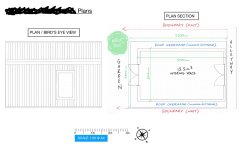
For the planning application, I did the drawings myself and cobbled together a supporting statement. I consulted the neighbours and the eventual plans were based on (understandable) concerns that one of them had about being overshadowed. I had originally designed a fairly standard-looking symmetrical dual-pitched roof but ended up with an asymmetrical one so as to move the ridge line away from this neighbour. I guess it’ll take a bit more head scratching to construct, but I quite like the look of the new design:
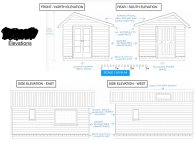
The resulting off-centre doors also suit the situation of the workshop within the garden better (away from the beds and more central to the lawn).
Here’s a pretty rough ‘n’ ready rendering (from back when the garden was much neater and less full of junk…):
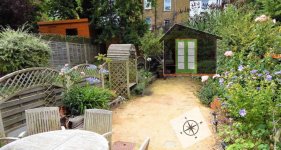
Anyway, the Planning Officer came over the other day and literally spent two minutes in the garden, taking a couple of snaps. I should get a decision within the next 4 weeks. Fingers crossed!
For the planning application, I did the drawings myself and cobbled together a supporting statement. I consulted the neighbours and the eventual plans were based on (understandable) concerns that one of them had about being overshadowed. I had originally designed a fairly standard-looking symmetrical dual-pitched roof but ended up with an asymmetrical one so as to move the ridge line away from this neighbour. I guess it’ll take a bit more head scratching to construct, but I quite like the look of the new design:
The resulting off-centre doors also suit the situation of the workshop within the garden better (away from the beds and more central to the lawn).
Here’s a pretty rough ‘n’ ready rendering (from back when the garden was much neater and less full of junk…):
Anyway, the Planning Officer came over the other day and literally spent two minutes in the garden, taking a couple of snaps. I should get a decision within the next 4 weeks. Fingers crossed!

Steve Maskery
Old Oak
I hope that your BCO is as helpful and constructive as mine was when I built SCW* He solved more than one unfrrced errorsfor me. Great bloke.
Famous quote: "I go to see houses that are not being as well-built as this is".
I'll take that.
S
*Steve's Cathedral of Woodwork, (Copyright Pete Maddex).
Famous quote: "I go to see houses that are not being as well-built as this is".
I'll take that.
S
*Steve's Cathedral of Woodwork, (Copyright Pete Maddex).
JohnH
New Shoots
- Joined
- Apr 7, 2025
- Messages
- 52
- Reaction score
- 17
- Name
- John
- LOCATION
- Medway, Kent
Compared to your cathedral, Steve, my humble workshop* is a mere priest hole (about 13.5m2) - so no BCO involvement. I’m relying on you lot to solve - or, even better, prevent - any errors (of which there’ll be many) on my build!I hope that your BCO is as helpful and constructive as mine was when I built SCW* He solved more than one unfrrced errorsfor me. Great bloke.
Famous quote: "I go to see houses that are not being as well-built as this is".
I'll take that.
S
*Steve's Cathedral of Woodwork, (Copyright Pete Maddex).
* referred to as a ‘garden room’ in my planning application, in an effort to sound less noisy, dirty, dusty, etc
JohnH
New Shoots
- Joined
- Apr 7, 2025
- Messages
- 52
- Reaction score
- 17
- Name
- John
- LOCATION
- Medway, Kent
Afternoon all, some thoughts about the workshop base I’d like to run past you. I had been thinking about using Mike G’s concrete lintel approach (ie no concrete pour), but I’ve got my heart set on having a brick plinth upon which to plonk my timber frame (for durability and aesthetics), so have been thinking of options for a new slab. This is my current thinking about it…
The footprint of the proposed workshop currently covers:
Rough sketch:

My plan is basically to retain the existing slab and patio and cast a new slab on top of them. They both appear to be sound and plenty solid enough, so it seems unnecessary to break them up…
I’ll need to remove the raised bed and sleepers, of course. Then excavate under the latter and dig out the lawn within the area of the footprint to a depth of 150mm, and fill these areas with hardcore (not forgetting to embed some kind of trunking for utilities first). This will bring hardcore, slab and patio to the same (ground) level.
Then sand blinding on top of everything, DPM, cast new slab.
‘Work flow’ sketches:

So, before getting into too many specifics, the big question is: What do you think of this general plan?
The footprint of the proposed workshop currently covers:
- an existing concrete slab (that the old shed was on). No cracks, good condition. Around 100mm thick (judging by the only side I’ve so far exposed).
- a paved patio area. Paving stones cemented in. Rock solid.
- Three railway sleepers laid to ground level; one to separate slab and patio and two as a kind of border between these and the lawn.
- Lawn
- Raised bed
Rough sketch:
My plan is basically to retain the existing slab and patio and cast a new slab on top of them. They both appear to be sound and plenty solid enough, so it seems unnecessary to break them up…
I’ll need to remove the raised bed and sleepers, of course. Then excavate under the latter and dig out the lawn within the area of the footprint to a depth of 150mm, and fill these areas with hardcore (not forgetting to embed some kind of trunking for utilities first). This will bring hardcore, slab and patio to the same (ground) level.
Then sand blinding on top of everything, DPM, cast new slab.
‘Work flow’ sketches:
So, before getting into too many specifics, the big question is: What do you think of this general plan?
Mike G
Petrified Pine
I would only do that with a reinforced conc slab. You have three main bearing surfaces, all of a different nature. There's every chance that if you cast a slab over them, that you'll get structural cracks at the junctions. Again, I'm an architect, not an engineer, but I suspect our stuctural engineers here will be saying the same thing, or will just tell you to excavate in the normal manner. And with the need for reinforcement at the top and the bottom of the slab thickness, it will beed to be an absolute minimum of 150mm thick.
JohnH
New Shoots
- Joined
- Apr 7, 2025
- Messages
- 52
- Reaction score
- 17
- Name
- John
- LOCATION
- Medway, Kent
Hi Mike, many thanks for your input. A reinforced slab, minimum 150mm thick is pretty much what I was anticipating (from my research on the topic). So, good to have confirmation 
For the reinforcement, are we talking wire mesh or thicker rebar, would you say?
For the reinforcement, are we talking wire mesh or thicker rebar, would you say?
Mike G
Petrified Pine
Again, wrong profession....but I'd be happy enough with A142 mesh for a little outbuilding like that, without any calculations. Unless there is a big tree/ trees near by, in which case, consult an engineer. As always with mesh, big overlaps tied in to each other, and spacers to hold them up above the bottom. Normally you'd want 50mm concrete cover (top, bottom and edges), but if you are doing the job yourself, and you are assiduous with the placement such that there was no possibility of a route in for moisture, then you could relax that to 30/ 35mm.
I'm not sure there's a lot of point in a DPM under a slab like that, standing entirely above ground. It could actually do more harm than good.
Reinforced concrete should be vibrated. My experience is that the little electric jobbies are useless, and that the pneumatic ones are overkill. See what your local hire shop has available, but I have heard tell of petrol powered back-pack-type pokers.
I'm not sure there's a lot of point in a DPM under a slab like that, standing entirely above ground. It could actually do more harm than good.
Reinforced concrete should be vibrated. My experience is that the little electric jobbies are useless, and that the pneumatic ones are overkill. See what your local hire shop has available, but I have heard tell of petrol powered back-pack-type pokers.
JohnH
New Shoots
- Joined
- Apr 7, 2025
- Messages
- 52
- Reaction score
- 17
- Name
- John
- LOCATION
- Medway, Kent
Thanks, Mike. Really useful info. There is a big cherry tree about 10m away, and an increasingly big sycamore a bit further in the other direction. But there doesn’t seem to be any cracking/movement in the existing slab.
Regarding the DPM: its secondary - or, given what you say about it being unnecessary in terms of keeping moisture out above ground - primary purpose would be to keep the new concrete from bonding to the old, as I’ve read that’s good practice (to avoid any issues in the old telegraphing to the new). Although, as I’ve said, I’ve not noticed any cracks in the old... What harm do you think it could do?
Regarding the DPM: its secondary - or, given what you say about it being unnecessary in terms of keeping moisture out above ground - primary purpose would be to keep the new concrete from bonding to the old, as I’ve read that’s good practice (to avoid any issues in the old telegraphing to the new). Although, as I’ve said, I’ve not noticed any cracks in the old... What harm do you think it could do?

Lons
Old Oak
Hi John
Why the double doors onto the alleyway?
Why the double doors onto the alleyway?
Mike G
Petrified Pine
Another purpose a DPM can serve is simply to retain the pour. Otherwise, leakages can occur around your formwork. It's downside is that it can't be exposed to light, so it has to be cut off at the bottom edges of the slab, and that can mean it can actually trap damp.
There isn't a perfect answer to this design. It's a whole series of compromises. If you want a perfect job, you'll need to excavate, build dwarf walls on strip footings, and have a ground bearing slab with the DPM lapped with a DPC in the walls. That's a massive overkill for a garden shed.
There isn't a perfect answer to this design. It's a whole series of compromises. If you want a perfect job, you'll need to excavate, build dwarf walls on strip footings, and have a ground bearing slab with the DPM lapped with a DPC in the walls. That's a massive overkill for a garden shed.
JohnH
New Shoots
- Joined
- Apr 7, 2025
- Messages
- 52
- Reaction score
- 17
- Name
- John
- LOCATION
- Medway, Kent
Hi Bob,Hi John
Why the double doors onto the alleyway?
Double doors onto the alleyway to make it easier getting bulky things in and out - including bikes, which will be stored in the workshop (and when you’re wheeling a bike out - ie not sitting on it - it takes up a chunk of space!). Our house is a Victorian mid-terrace, no side gate or anything.
I already have the doors, incidentally - nice chunky oak ones, possibly older than me, that were someone’s front doors till recently. So they’ll also be pretty secure. I’m really looking forward to giving them a new lease of life.
JohnH
New Shoots
- Joined
- Apr 7, 2025
- Messages
- 52
- Reaction score
- 17
- Name
- John
- LOCATION
- Medway, Kent
Hmmm, hadn’t thought about the DPM actually trapping moisture. I can see how that might happen. Maybe there’s some product I can paint onto the old concrete instead that’ll stop the new concrete bonding. Or maybe I shouldn’t worry about it too much - I dunno…Another purpose a DPM can serve is simply to retain the pour. Otherwise, leakages can occur around your formwork. It's downside is that it can't be exposed to light, so it has to be cut off at the bottom edges of the slab, and that can mean it can actually trap damp.
There isn't a perfect answer to this design. It's a whole series of compromises. If you want a perfect job, you'll need to excavate, build dwarf walls on strip footings, and have a ground bearing slab with the DPM lapped with a DPC in the walls. That's a massive overkill for a garden shed.
You’re right that this design is a compromise. I’m just hoping to avoid, if at all possible, the backbreaking and disruptive (to us and also our neighbours, to whom we’re in close proximity) work of smashing up what’s there, when it seems perfectly sound. But I take your points and appreciate the wisdom in what you say - many thanks for taking the time to consider my ideas and share your thoughts. Decisions, decisions…
On a more architectural note, what do you think of the asymmetrical roof design, Mike?

Acrypol, perhaps.Hmmm, hadn’t thought about the DPM actually trapping moisture. I can see how that might happen. Maybe there’s some product I can paint onto the old concrete instead that’ll stop the new concrete bonding. Or maybe I shouldn’t worry about it too much - I dunno…
......
JohnH
New Shoots
- Joined
- Apr 7, 2025
- Messages
- 52
- Reaction score
- 17
- Name
- John
- LOCATION
- Medway, Kent
Thanks, Roger. I’ll look into that.Acrypol, perhaps.
Thinking about it, though, I’ll need a DPM anyway for those parts of the footprint outside of the old slab & patio area (ie where it’s just hardcore on top of the soil), so might as well cover the whole footprint with the DPM. As Mike pointed out, it’ll be necessary anyway for containing the pour within the formwork. I’ll just have to be careful to trim the DPM afterwards in such a way that it doesn’t trap any moisture, or seal round the perimeter after the pour somehow.
Lons
Old Oak
Ah Ok John, just seemed like a security risk and of course loss of a wall.Hi Bob,
Double doors onto the alleyway to make it easier getting bulky things in and out - including bikes, which will be stored in the workshop (and when you’re wheeling a bike out - ie not sitting on it - it takes up a chunk of space!). Our house is a Victorian mid-terrace, no side gate or anything.
I already have the doors, incidentally - nice chunky oak ones, possibly older than me, that were someone’s front doors till recently. So they’ll also be pretty secure. I’m really looking forward to giving them a new lease of life.
JohnH
New Shoots
- Joined
- Apr 7, 2025
- Messages
- 52
- Reaction score
- 17
- Name
- John
- LOCATION
- Medway, Kent
Got two of the three sleepers out yesterday and started digging out the section in front of the slab & patio. Good to be making a start, albeit a modest one. (Pots are from where my 6 year-old was collecting the centipedes I was unearthing, and re-homing some mystery bulbs.)

The nascent spoil heap nestling under a bush in one of the adjacent beds. I’ll be transporting this down to our allotment to build up some beds there once I’ve fixed the errant wheel on the wheelbarrow.

The nascent spoil heap nestling under a bush in one of the adjacent beds. I’ll be transporting this down to our allotment to build up some beds there once I’ve fixed the errant wheel on the wheelbarrow.
JohnH
New Shoots
- Joined
- Apr 7, 2025
- Messages
- 52
- Reaction score
- 17
- Name
- John
- LOCATION
- Medway, Kent
Thanks, appreciate your input. I did consider the loss of wall space but - fear not - I’m sure I’ll be hanging some stuff on the back of the doors!Ah Ok John, just seemed like a security risk and of course loss of a wall.
Mike G
Petrified Pine
...... primary purpose would be to keep the new concrete from bonding to the old.....
If the new was entirely based on the old, and the old was substantial, then yes. But actually, thinking about your situation, I can't see any harm at all in the new binding to the old. The new concrete will be stronger than the old, and the old conrete is more stable than the paving, and new chippings area, so I frankly can't see the harm in concreting directly onto the old.
I think, however, that I might be tempted to lift the paving slabs, and whack (literally) some type 1 or chippings in their place to cast the slab onto. Obviouisly, with a blinding layer.
JohnH
New Shoots
- Joined
- Apr 7, 2025
- Messages
- 52
- Reaction score
- 17
- Name
- John
- LOCATION
- Medway, Kent
Thanks, Mike. Yes, maybe lifting the paving slabs and replacing with hardcore is the way forward.If the new was entirely based on the old, and the old was substantial, then yes. But actually, thinking about your situation, I can't see any harm at all in the new binding to the old. The new concrete will be stronger than the old, and the old conrete is more stable than the paving, and new chippings area, so I frankly can't see the harm in concreting directly onto the old.
I think, however, that I might be tempted to lift the paving slabs, and whack (literally) some type 1 or chippings in their place to cast the slab onto. Obviouisly, with a blinding layer.
As far as the new concrete bonding with the old - good to know you don’t think it’d be a problem. But, as you pointed out, I’ll need the DPM in between the new and old to contain the pour - as I’m pretty confident my formwork won’t be of a seep-proof standard.
@Mike G Which strip lights did you go for please, can you share a link?Sounds fun, John. A couple of minor points.....
Two windows means a lot of wall you can't use for storage. You won't need them for light if you have 2 Veluxes, but Veluxes have their own down-side: they're a potential weakness in your security, if that's a concern. Personally, I'd lose a window and a roof light.
The 1m from the boundary thing applies to all boundaries, including to the alley. Are there other properties along the alley which have outbuildings backing right onto the alley? If so, I suggest you take photos, and approach the local council planners and ask whether you need permission.
For building regs, the area which counts is Internal Floor Area, not footprint area. Therefore, you can measure inside your walls to ascertain the area, not outside. There's good reason my workshop is 29.96 sq m internally!
On LED panels.....LED striplights can put out more light than a panel, and cost less money. I've just replaced 2 failed panels with strip lights, and I was very surprised when the wholesaler told me of the numbers (output and money). They also these days come with a little selector switch to set the colour "temperature" and the lux levels.
Mike G
Petrified Pine
@Mike G Which strip lights did you go for please, can you share a link?
That would involve me standing on something in the workshop to search for a make and model........

I don't know, Mark. I bought it in my local electrical wholesaler. I think that would be my suggestion to you, too, because buying online doesn't really allow you to differentiate between quality and crap.
Lons
Old Oak
Any excuse,That would involve me standing on something in the workshop to search for a make and model........
 people would think you're incapacitated .
JohnH
New Shoots
- Joined
- Apr 7, 2025
- Messages
- 52
- Reaction score
- 17
- Name
- John
- LOCATION
- Medway, Kent
Morning all. Firstly, good news: Planning Permission granted. My lovely neighbours were supportive and it went through with no objections.
Now I’ve got the green light, I’m doing a bit of head scratching about the rear of the planned workshop. I’m planning on building it right up to the rear boundary, where there is an alley - shared by all the houses which back on to it (from my road and the road parallel to ours). The alley is simply earth (i.e. no tarmac/concrete).
The problem is that the alleyway rises from west to east and is higher than our garden, the back of which must’ve been dug out and levelled at some point in the past. At its highest point, the alley is roughly 90cm higher than the garden. There’s currently a raised bed at the back of our garden which is acting as a retaining wall, but that’ll be removed to make way for the workshop. So the options I’ve been toying with are:
1) Build a new retaining wall from bricks and use that as the rear wall of the workshop. Obviously, damp is the main concern here - plus the retaining wall would need to be higher than the slab-plus-3-courses-of-bricks I’ve planned for the rest of the plinth (though there might be scope for reducing the height of the alley a bit).
2) Dig away the earth of the alley from that section and concrete that instead. Then this concreted section would be up against the brick plinth at the rear of the workshop - and with judicious use of DPM, hopefully shouldn’t transfer any damp into the workshop. I could cover it with slate chippings (which are already there) to help it blend in with the rest of the alley.
3) Dig away the earth and replace with some kind of ramp resting on some blocks to have a bit of a void (thereby minimising damp? I’m imagining some air will get in there…). For the ramp, I’m imagining something a bit like the ones you see utilities contractors putting down as temporary replacement for paving when they’re digging trenches in the street). Again, cover with those slate chippings.
Rough sketch to try to illustrate what I’m talking about. Red cross hatch is the section of the alley in question; red single hatch wouldn’t be right up against the workshop - as I’m planning to have a narrow path up the side of the workshop - but will still need a retaining wall.
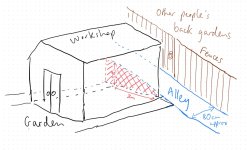
Of course, I could move the workshop away from the alley but it isn’t a huge workshop and I’m keen to avoid losing a foot (?) off the length of it if there’s a way around the problem.
Would appreciate any comments on my (possibly crazy) ideas - or if you’ve better ideas, I’m very keen to hear them!
Now I’ve got the green light, I’m doing a bit of head scratching about the rear of the planned workshop. I’m planning on building it right up to the rear boundary, where there is an alley - shared by all the houses which back on to it (from my road and the road parallel to ours). The alley is simply earth (i.e. no tarmac/concrete).
The problem is that the alleyway rises from west to east and is higher than our garden, the back of which must’ve been dug out and levelled at some point in the past. At its highest point, the alley is roughly 90cm higher than the garden. There’s currently a raised bed at the back of our garden which is acting as a retaining wall, but that’ll be removed to make way for the workshop. So the options I’ve been toying with are:
1) Build a new retaining wall from bricks and use that as the rear wall of the workshop. Obviously, damp is the main concern here - plus the retaining wall would need to be higher than the slab-plus-3-courses-of-bricks I’ve planned for the rest of the plinth (though there might be scope for reducing the height of the alley a bit).
2) Dig away the earth of the alley from that section and concrete that instead. Then this concreted section would be up against the brick plinth at the rear of the workshop - and with judicious use of DPM, hopefully shouldn’t transfer any damp into the workshop. I could cover it with slate chippings (which are already there) to help it blend in with the rest of the alley.
3) Dig away the earth and replace with some kind of ramp resting on some blocks to have a bit of a void (thereby minimising damp? I’m imagining some air will get in there…). For the ramp, I’m imagining something a bit like the ones you see utilities contractors putting down as temporary replacement for paving when they’re digging trenches in the street). Again, cover with those slate chippings.
Rough sketch to try to illustrate what I’m talking about. Red cross hatch is the section of the alley in question; red single hatch wouldn’t be right up against the workshop - as I’m planning to have a narrow path up the side of the workshop - but will still need a retaining wall.
Of course, I could move the workshop away from the alley but it isn’t a huge workshop and I’m keen to avoid losing a foot (?) off the length of it if there’s a way around the problem.
Would appreciate any comments on my (possibly crazy) ideas - or if you’ve better ideas, I’m very keen to hear them!
JohnH
New Shoots
- Joined
- Apr 7, 2025
- Messages
- 52
- Reaction score
- 17
- Name
- John
- LOCATION
- Medway, Kent
I should also point out (in case it’s not clear) that the alley is the other side of our property’s boundary, so not my land to mess about with. As such, and although the neighbours I’ve spoken to are fine about me working on it, I need to maintain the slope of it pretty much as is. Not least as their back gates open on to it!
Mike G
Petrified Pine
.....The problem is that the alleyway rises from west to east and is higher than our garden, the back of which must’ve been dug out and levelled at some point in the past. At its highest point, the alley is roughly 90cm higher than the garden. There’s currently a raised bed at the back of our garden which is acting as a retaining wall, but that’ll be removed to make way for the workshop. .......
There is no good ad-hoc solution to your retaining wall issue. You need a properly designed wall, on proper foundations. This rules out using a slab as a raft from which to build the workshop. A retaining wall 900 high will need to be of the order of 225 wide (thick), and because it needs to be designed with tanking or DPM contiguous with a DPM in the slab it may well end up thicker than that.
JohnH
New Shoots
- Joined
- Apr 7, 2025
- Messages
- 52
- Reaction score
- 17
- Name
- John
- LOCATION
- Medway, Kent
Mike, thanks - as always - for your input. I feared that may be the case.
If I move the the workshop away from the alley, what would be the minimum ‘safe’ distance to leave between the alley’s higher ground (with the new retaining wall I’d have to construct) and the rear elevation, would you say?
If I move the the workshop away from the alley, what would be the minimum ‘safe’ distance to leave between the alley’s higher ground (with the new retaining wall I’d have to construct) and the rear elevation, would you say?
Mike G
Petrified Pine
Mike, thanks - as always - for your input. I feared that may be the case.
If I move the the workshop away from the alley, what would be the minimum ‘safe’ distance to leave between the alley’s higher ground (with the new retaining wall I’d have to construct) and the rear elevation, would you say?
You just said you've received planning permission, so you shouldn't really be moving things around. The answer will depend on whether you can introduce drainage between the retaining wall and the shed, otherwise, as I see it, you are creating a trench which will simply fill up with water.
JohnH
New Shoots
- Joined
- Apr 7, 2025
- Messages
- 52
- Reaction score
- 17
- Name
- John
- LOCATION
- Medway, Kent
Re moving things around: I was assuming - perhaps wrongly! - that, if you end up smaller than the design PP was granted for, but essentially the same design, it wouldn’t be a problem… But happy if I’m wrong to be put right! (I can’t go any further into the garden - for a couple of reasons - so I’d be reducing the length of the workshop if I move away from the alley.)
I realise now that I should’ve thought this part through more before doing the design… Mistakes of the novice workshop designer/builder!
Re drainage: yes, I guess I’d need a French drain (is that the right term?) in between the alley’s higher ground and the rear elevation. Would around a foot wide be enough, do you think?
I realise now that I should’ve thought this part through more before doing the design… Mistakes of the novice workshop designer/builder!
Re drainage: yes, I guess I’d need a French drain (is that the right term?) in between the alley’s higher ground and the rear elevation. Would around a foot wide be enough, do you think?
Mike G
Petrified Pine
I'd put a gulley in rather than a French drain. French drains always fail in the end, when silt clogs up the stones, membrane, or holes in the pipe. But any sort of land drain needs somewhere to drain to. You'll need to connect up with an existing surface water system, or direct it to a large sump or soakaway, so levels are critical. You'll need a gap wide enough to stand in to work on the wall. And yes, I had assumed you meant literally move the building, rather than reduce it by moving the end wall, so a smaller building is OK.Re moving things around: I was assuming - perhaps wrongly! - that, if you end up smaller than the design PP was granted for, but essentially the same design, it wouldn’t be a problem… But happy if I’m wrong to be put right! (I can’t go any further into the garden - for a couple of reasons - so I’d be reducing the length of the workshop if I move away from the alley.)
I realise now that I should’ve thought this part through more before doing the design… Mistakes of the novice workshop designer/builder!
Re drainage: yes, I guess I’d need a French drain (is that the right term?) in between the alley’s higher ground and the rear elevation. Would around a foot wide be enough, do you think?
There is another issue. If you build a retaining wall to a public path, with a 15 or 18" gap to a 3 foot drop, you are creating quite a serious falling hazard. Imagine a toddler going over that edge. You will need to put quite a substantial handrail and balustrading on the wall to keep it safe.
JohnH
New Shoots
- Joined
- Apr 7, 2025
- Messages
- 52
- Reaction score
- 17
- Name
- John
- LOCATION
- Medway, Kent
Thanks, Mike. Next stop on my build journey: researching gulleys, soakaways, etc. I still haven’t actually done any building yet…
And, fear not, I won’t be leaving a dangerous drop anywhere. In fact, a potential silver lining to the retaining wall cloud is that I could have a fence and garden gate along the top of the retaining wall, thereby improving security. I might just need to figure out a system of sliding the garden gate open as I’m not sure there’d be space to open it in the conventional way. More research!
And, fear not, I won’t be leaving a dangerous drop anywhere. In fact, a potential silver lining to the retaining wall cloud is that I could have a fence and garden gate along the top of the retaining wall, thereby improving security. I might just need to figure out a system of sliding the garden gate open as I’m not sure there’d be space to open it in the conventional way. More research!
JohnH
New Shoots
- Joined
- Apr 7, 2025
- Messages
- 52
- Reaction score
- 17
- Name
- John
- LOCATION
- Medway, Kent
Morning all, just been offered a used Velux window for free. I’m wondering if this could be installed vertically as a window in one of the workshop’s walls.
It’d be protected - to an extent - by the roof overhang above it and would be in a not-very-exposed-to-the-elements position anyway. It’s a wooden framed one and of the sort of size and orientation (landscape) I’ve been looking for. There’s no flashing with it, but I could source the appropriate flashing kit if necessary - ie if the planned feather edge cladding (plus sill, etc) wouldn’t suffice to prevent water ingress.
I can’t find much info on using veluxes in this way - perhaps unsurprisingly, as they’re not designed for this use! - but I haven’t managed to source a suitable ‘normal’ wall window secondhand (I don’t want UPVC, and there don’t seem to be many of the right size/orientation wooden- or aluminium-framed double-glazed windows out there that aren’t hugely expensive).
Any thoughts on the suitability of using a Velux in this way? Cheers
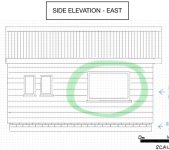

It’d be protected - to an extent - by the roof overhang above it and would be in a not-very-exposed-to-the-elements position anyway. It’s a wooden framed one and of the sort of size and orientation (landscape) I’ve been looking for. There’s no flashing with it, but I could source the appropriate flashing kit if necessary - ie if the planned feather edge cladding (plus sill, etc) wouldn’t suffice to prevent water ingress.
I can’t find much info on using veluxes in this way - perhaps unsurprisingly, as they’re not designed for this use! - but I haven’t managed to source a suitable ‘normal’ wall window secondhand (I don’t want UPVC, and there don’t seem to be many of the right size/orientation wooden- or aluminium-framed double-glazed windows out there that aren’t hugely expensive).
Any thoughts on the suitability of using a Velux in this way? Cheers
fuse
Nordic Pine
- Joined
- Sep 4, 2025
- Messages
- 528
- Reaction score
- 418
- Location
- Herefordshire UK
- Name
- Martin
- LOCATION
- Uk
One of the break-ins we've had was executed through a roof-light.
You have to weigh up the loveiness of natural light against the potential of scumbag-ingress.
You have to weigh up the loveiness of natural light against the potential of scumbag-ingress.

Accipiter
Nordic Pine
- Joined
- Oct 16, 2025
- Messages
- 855
- Reaction score
- 636
- Location
- Frome, Somerset
- Name
- Frank
- LOCATION
- Somerset
John, I can't answer the question re this window but have a suggestion - which you may already be trying? Contact the local window installers in your area - also any firms making this stuff - and ask them if they are doing any replacement units of the size you're looking for... or if they have any miss sized ones that you can adapt the opening for. That's how I got the DG door unit and windows for my workshop. Also try your local Facebook marketplace... which you may already be doing... (bit under the weather today and haven't looked up in your thread to see if that's so)
Cabinetman
Sequoia
- Joined
- Oct 11, 2020
- Messages
- 5,810
- Reaction score
- 1,457
- Location
- Lincolnshire Wolds + Massachusetts
- Name
- Ian
Personally I can’t think of a reason why you shouldn’t position a Velux vertically.
Or re-use the DG panels from old windows and fit them into a wood frames, they sell really good quality sticky foam tape to bed it all down with too.
Ian
Or re-use the DG panels from old windows and fit them into a wood frames, they sell really good quality sticky foam tape to bed it all down with too.
Ian
JohnH
New Shoots
- Joined
- Apr 7, 2025
- Messages
- 52
- Reaction score
- 17
- Name
- John
- LOCATION
- Medway, Kent
Thanks for the input, Martin. This wouldn’t be used in the roof but in a wall beyond a fence and a locked door. Still a weak point security-wise, I know, but I am willing to sacrifice a little security for natural light and a view onto greenery that this would provide.One of the break-ins we've had was executed through a roof-light.
You have to weigh up the loveiness of natural light against the potential of scumbag-ingress.

Woodbloke
Sequoia
Coupla pics of the way I built mine, using 'council slabs' and proper 'old skool' railway sleepers:Hi Rob, yes, ‘council’ slabs are what I’m after (though my back’s groaning at the thought of schlepping 40 of them through the house and garden or up the alley to site…Still less back-breaking than casting a slab, I guess). I’m aiming to avoid a suspended floor due to limited headroom; hopefully the floating floor I’ve got in mind won’t be too hard on the old tootsies. I’ve never heard of chipboard ‘ordinaires’ - sounds like a good name for a group, The Chipboard Ordinaires…
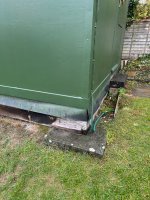
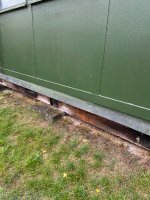
The slabs form concrete piers down each of the sides, with the gap spanned by the railway sleepers resting on the narrow edge. The 'shop is built on top from modular panels, the outer skin being 8x4 marine ply, and the inner surface is just harboard. There are five panels down the length and three in the width, simply nailed together with 100mm wide strips of ply. The paint spattered dpc you can see is tucked under the the horizontal lower strip and deflects rain water away from the dpc which is laid on top of the sleepers. Some care was taken sealing up the panels to make them waterproof and I originally used silicone which wasn't ideal, so eventually some sections leak. All I do is wait for a hot, dry spell, clean out the old sealant and replace it with CT1 which is infinitely better. The only thing I need to do each year is to slap on a coat of Ronseal 'Ducksback' which takes a couple of days. A pic of the current state of play:
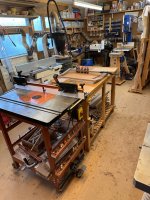
...showing the suspended chipboard floor with scuffed hardboard over the top which effectively makes it non-slip. I had a new felt roof professionally fitted a few years ago with 100mm fibre glass in it, also 50mm Rockwool slabs in the walls. Stuff isn't obviously fixed to the hardboard inner skin but to the uprights in the panels. Heating comes from a single 1.5Kw oil filled rad under the window which is sufficient except when it gets really chilly; it's warm, there's no condensation (look at the cast iron machine surfaces). It was relatively cheap to build and has been up now for well over 20 years - Rob
Edit - you can see behind the big cyclone where I had an infuriating leak all through last winter, which stained the hardboard. During the summer, I let it dry out for a month, cleaned out all the old sealant from outside and once I did I could see immediately where the leak was, then resealed it with CT1. Dry now as the proverbial bone
Last edited: