• Hi all and welcome to TheWoodHaven2 brought into the 21st Century, kicking and screaming! We all have Alasdair to thank for the vast bulk of the heavy lifting to get us here, no more so than me because he's taken away a huge burden of responsibility from my shoulders and brought us to this new shiny home, with all your previous content (hopefully) still intact! Please peruse and feed back. There is still plenty to do, like changing the colour scheme, adding the banner graphic, tweaking the odd setting here and there so I have added a new thread in the 'Technical Issues, Bugs and Feature Requests' forum for you to add any issues you find, any missing settings or just anything you'd like to see added/removed from the feature set that Xenforo offers. We will get to everything over the coming weeks so please be patient, but add anything at all to the thread I mention above and we promise to get to them over the next few days/weeks/months. In the meantime, please enjoy!

Keeping out water?

RogerS

Moderator
Staff member
Joined
Jul 21, 2014
Messages
15,271
Reaction score
1,012
Location
And off to pastures new
Neighbour has just had these gates installed so I went for a nose.
20260515_093217.jpg

The verticals go into a mortise..not sure if it goes through or not.

20260515_093125.jpg

I got to thinking if there was a better way to do it as I could see water tracking down very easily. Certainly if it wasn’t a through mortise then that would compound the problem
 
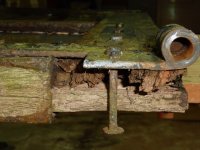
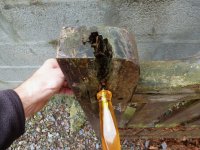
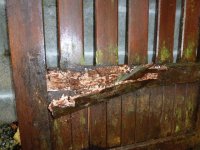
I have a thing about gate design ever since I was presented with this mess

Bottom of the stile, hinge side:-
IMG_4801.jpeg
Top of the stile hinge side,
IMG_4805.jpeg

Middle rail:-
IMG_4802.jpeg

My solution with to fix the rails on top and below the stiles thereby reducing end grain exposure
IMG_4804.jpeg

And pining the vertical cladding so if one piece did rot it could be replaced easiliy.
IMG_4803.jpeg
The horizontal faces of the mid rail were all chamfered to shed water.

That was 13 years ago and there is no sign of rot. Chestnut was used throughout.

Not the typical design but I am damn sure it will last longer than the original.
 
Overall it does not look like a substantial gate, but that might be just the photo. Also would you supply anything with the pencil marks still present ? The better way would be to have a shoulder tennon like @AndyP has said, that way no water soaking into the rail and his gates look far more solid and durable.
 
Looking at Roger's pic, it seems like the top and bottom rails are pegged (drawbored possibly), but not the middle one. Also there's no sign of any diagonal bracing, although there may be one on t'other side, out of view.

If 'none', I'd expect it to sag fairly quickly.
I'll have a closer look and report back. I didn't see any pegs TBH.

These are single bolts going through to the hinges.20260515_093217.jpg
 
There are three pegs used for the top rail which is an assembly which you might expect. Photos not brilliant but you can just about make out the wedge lines of the component pieces. Reliant on glue for the most part.
20260516_153455.jpg

They are NOT through tenons and so any water running down those verticals will fill the holes. Caveat...they could argue that they filled the holes first with Gorilla Clue (their first choice for glue) although I can see no evidence of squeeze out.

There is a brace the other side. Two gates...approx 6ft high x 9ft wide. Rebates on the middle and bottom rails into which the T&G (?) is glued and nailed

20260516_153713.jpg
 
The stable doors I had made many years ago had a rebate on the bottom rail of each half door with a slope on it to the outside with a corresponding slope on the bottom of the T&G so that water ran off the slope. It didn't stop the T&G rotting from the inside of the top doors which were usually left open and there wasn't much of an overhang on the roof to stop the rain.
 
Back
Top