• Hi all and welcome to TheWoodHaven2 brought into the 21st Century, kicking and screaming! We all have Alasdair to thank for the vast bulk of the heavy lifting to get us here, no more so than me because he's taken away a huge burden of responsibility from my shoulders and brought us to this new shiny home, with all your previous content (hopefully) still intact! Please peruse and feed back. There is still plenty to do, like changing the colour scheme, adding the banner graphic, tweaking the odd setting here and there so I have added a new thread in the 'Technical Issues, Bugs and Feature Requests' forum for you to add any issues you find, any missing settings or just anything you'd like to see added/removed from the feature set that Xenforo offers. We will get to everything over the coming weeks so please be patient, but add anything at all to the thread I mention above and we promise to get to them over the next few days/weeks/months. In the meantime, please enjoy!

Longcase Clock...Dun

Woodbloke

Sequoia
Joined
Jul 22, 2014
Messages
7,354
Reaction score
1,321
Location
Salisbury, UK
I've always had a hankering to build a long case clock with a proper 'old skool' mechanical chiming movement, but having done a little research it appears that they're prohibitively expensive, require a lot of maintenance but they are pretty and do sound rather fetching. However I bottled out and decided to fit a straight forward, decent quality, German made (none of yer cCc :eusa-whistle: ) UTS quartz movement.
The clock is based on John Makepeace's 'Blondel' clock which I rather like, minus the weird 'headgear' and even weirder feet:
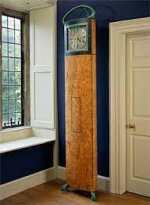
download.jpg

The total height of that thing is about 3m; mine will be an approx 'granddaughter' size although there's no exact distinction between the species, so around 1.6m. In order to work out how to build it, I made a half-scale model of the top bit:
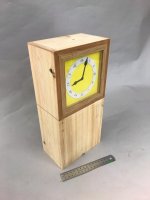
IMG_5090.jpg

...which Matt Platt from WH has called the 'Not the 9 0'clock News' clock' :lol: The mitred oak frame round the outside of the dial will be in highly figured Birds Eye Maple from Matt whilst the rest of the mahogany detailing will be in Bog Oak and this replicates to some extent JM's original design.

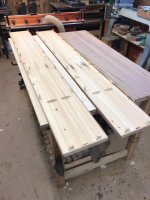
The case itself is made from laminated, quarter sawn pine boards (so little movement, in theory :eusa-pray: ) with 2mm thick, bandsawn English Walnut veneers (bookmatched on the front) as a face and 2mm thick pine backing veneers. Lipping and veneering in the vacuum bag was relatively hassle free but I did the face and back of each piece at the same time to prevent the boards from cupping.

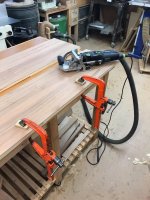
Jointing was done with biscuits and doms:
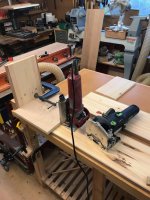
IMG_5128.jpg

IMG_5131.jpg

IMG_5132.jpg

Note that 'falsies' are fitted instead of actual, real doms.

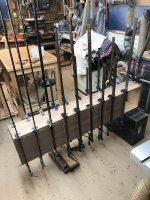
The first side was incredibly difficult to glue up and get square.
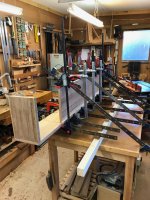
IMG_5137.jpg

When it came out the cramps yesterday it was totally skewed so overnight I glued in four humungous blocks of pine....
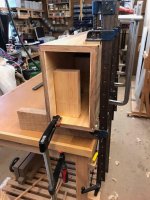
IMG_5138.jpg

...to sort it out. It did :eusa-dance:

With the first side (the back) now dead square, the remaining side was glued in place with the other side cramped dry (with 'falsies') to ensure the eventual location....
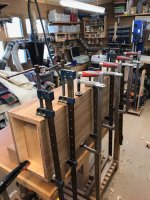
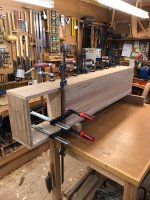
IMG_5139.jpg

IMG_5141.jpg

There will be a solid panelled back on the clock to allow access to change the battery and time. SWIMBO bought me the dial some time ago and it's a rather nice, engraved, solid brass German jobbie from Cousins, who do loads of trade clock bits. To finish, the whole thing will sit on a Bog Oak plinth.

The next thing to do is to take off the side, remove the 'falsies' and glue it back on again, but somehow I've got to contrive a way of getting clamps both sides :?: I need a pair of Mike's saw horses! - Rob
 
I wonder if Makepeace used the more traditional IIII rather than IV on his clock.

Hope you find the time to finish it.
 
Andyp":20ncxhzu said:
......Hope you find the time to finish it.

:lol: :lol: Carruthers. There's a man punning again......
 
I'm jealous. One of the things I am really keen to make is a long case clock. As always, our tastes vary, but that doesn't reduce my respect and admiration.

The Makepeace clock is bow fronted, is it not? From what I see yours won't be. Is that right?
 
MattS":30dti4kx said:
That's going to look great in walnut! What do you mean by the term falsies?

Fake dominos made from pine; very handy when the job has to come apart umpteen times

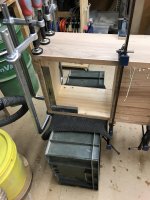
The final side has gone on and I've used up all my sash cramps :shock: :

IMG_5142.jpg

...but at least the clock face opening is square :D

IMG_5144.jpg

Cleaning up next once the glue has set - Rob
 
Mike G":vruhb7km said:
I'm jealous. One of the things I am really keen to make is a long case clock. As always, our tastes vary, but that doesn't reduce my respect and admiration.

The Makepeace clock is bow fronted, is it not? From what I see yours won't be. Is that right?
It is Mike, which means that it's beyond the remit of a hobbyist 'shop (probably) It also means that the glass is bowed which definitely puts it out of reach :lol: - Rob
 
Watching with admiration, Rob.

You seem to have exactly the right number of clamps!

On the subject of curved glass, I was once lucky enough to see a rather fancy Victorian bay window reglazed. It had glass which curved gently round a corner, on a radius probably about the same as a litre paint tin. The very professional glazier ran his blowlamp from side to side on the glass and let the weight of the rest of the sheet make it droop naturally into the exact curve he needed. No jig, no former. It took only a couple of minutes to do. (I think it probably took a bit longer to learn!)
 
Interesting. It's not really a long case clock if it is electric though.... 8-). It is a long box with a clock on top. What is going in the case?

As a matter of interest there are frequently long case mechanisms on eBay quite cheaply, though needing fettling no doubt. I've seen them go for under £100.

My father was a bit obsessed with clocks and the family house is full of them. This includes an 8 day long case that has been handed down through the family since 17 something. It has a very loud tick, and it's timekeeping is off by around 3 minutes a day. At some stage I will have to rehome or sell it. However, clocks have been superseded by mobile phones and Alexa.
 
AJB Temple":21cxfa0n said:
Interesting. It's not really a long case clock if it is electric though.... 8-). It is a long box with a clock on top. What is going in the case?

As a matter of interest there are frequently long case mechanisms on eBay quite cheaply, though needing fettling no doubt. I've seen them go for under £100.
I disagree completely. Just as there's no specific definition of what is a granddaughter, mother or grandfather clock, they're more correctly called 'longcase clocks'. Similarly, the dial determines what sort of mechanism goes into the clock and some are clearly meant for mechanical movements, such as this one with holes machined in the front. However, the one I'm using here can be used with any ''quartz or chain driven movement" The dial here is obviously meant to be fitted to a longcase clock with either a mechanical OR quartz movement.
Having seen Steve Fletcher on 'The Repair Shop' mess around with these mechanical movements, it really did put me off trying to faff around with one, 'cos I just don't know enough about them.
So yes, in my book, it is a longcase clock even though it uses a modern, super accurate, quartz movement which is easy to change if need be. As to what goes in the case, it's four huge blocks of pine and fresh air :lol: - Rob
 
AndyT":2ars9w0c said:
Watching with admiration, Rob.

You seem to have exactly the right number of clamps!

On the subject of curved glass, I was once lucky enough to see a rather fancy Victorian bay window reglazed. It had glass which curved gently round a corner, on a radius probably about the same as a litre paint tin. The very professional glazier ran his blowlamp from side to side on the glass and let the weight of the rest of the sheet make it droop naturally into the exact curve he needed. No jig, no former. It took only a couple of minutes to do. (I think it probably took a bit longer to learn!)
Well who would’ve thought it, I’ve done it with Perspex in an oven before now but I wouldn’t have guessed you could do it with glass.

What sort of glue are you using Rob, it looks very runny if you don’t mind me saying. Ian
 
Cabinetman":2wk2aipk said:
AndyT":2wk2aipk said:
Watching with admiration, Rob.


Well who would’ve thought it, I’ve done it with Perspex in an oven before now but I wouldn’t have guessed you could do it with glass.

What sort of glue are you using Rob, it looks very runny if you don’t mind me saying. Ian
I've bent Perspex before and glass can be bent but it's a specialist job. The glue used in here is just bog standard TB3 - Rob
 
AndyT":2yv4ozs0 said:
........I was once lucky enough to see a rather fancy Victorian bay window reglazed. It had glass which curved gently round a corner, on a radius probably about the same as a litre paint tin. The very professional glazier ran his blowlamp from side to side on the glass and let the weight of the rest of the sheet make it droop naturally into the exact curve he needed.....

I've had a thought in the back of my mind to do a few panes like this when I do the leaded lights for the porch and inside the house. I thought I might bend a few panes into a curve, and then bend them back again to near-enough flat, and hope that this induces those little wrinkles and bubbles which are reminiscent of blown glass.
 
Mike G":1gx0vgbd said:
AndyT":1gx0vgbd said:
........I was once lucky enough to see a rather fancy Victorian bay window reglazed. It had glass which curved gently round a corner, on a radius probably about the same as a litre paint tin. The very professional glazier ran his blowlamp from side to side on the glass and let the weight of the rest of the sheet make it droop naturally into the exact curve he needed.....

I've had a thought in the back of my mind to do a few panes like this when I do the leaded lights for the porch and inside the house. I thought I might bend a few panes into a curve, and then bend them back again to near-enough flat, and hope that this induces those little wrinkles and bubbles which are reminiscent of blown glass.
Mike, a trick they used to use a few years ago to simulate old glass was to buy glass destined for greenhouses, as they use the cheapest glass they can find, it’s usually of uneven thickness wavy and pretty malformed in places. Ian
 
I know, Ian, but unfortunately horticultural glass has got a lot "better" in recent years, and the difference isn't so great any more. When I specify leaded lights for other people, I sometimes specify 1/3rd horticultural glass, 1/3 blown glass, and 1/3rd float glass, to keep the cost down but retaining the mixed effect you get in old windows. I have even specified a pane or two of a slightly yellow glass to be mixed in.
 
Mike G":38c4qnpe said:
I know, Ian, but unfortunately horticultural glass has got a lot "better" in recent years, and the difference isn't so great any more. When I specify leaded lights for other people, I sometimes specify 1/3rd horticultural glass, 1/3 blown glass, and 1/3rd float glass, to keep the cost down but retaining the mixed effect you get in old windows. I have even specified a pane or two of a slightly yellow glass to be mixed in.

This guy is excellent.

http://www.norgrovestudios.co.uk/plain_glazing.html
 
Nico Adie":2yxfh9g5 said:
Looking very nice so far, the sort of work I aspire to. Very much looking forward to seeing this progress.
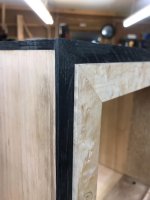
Thanks Nico. Here's a 'sneek peek' at one (unfinished) corner of the clock...

IMG_5163.jpg

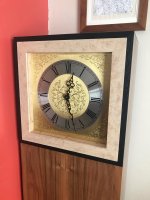
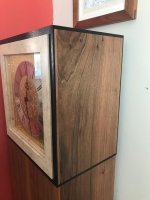
...showing the Birds Eye Maple frame to contain the clock dial and the Bog Oak frame that surrounds it, which is also mirrored on the back. The edge of the BYM looks dirty (BO dust) but it's had three coats of Raw Osmo so all that black stuff will just wipe off - Rob
 
This was done n'dusted a few days ago, but like a numpty :eusa-doh: , I forgot to synchronise the hands before I put in the battery, so this morning it's been up on the dining room table for a bit of 'adjustment' :eusa-whistle:

Back firstly. There's a panelled door with a small turned Bog Oak handle for access to the movement....

IMG_5227.jpg

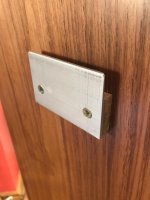
...and a 'french cleat' thingie (one half shown) to hold the clock against the wall. It's been so designed that it just slides together:

IMG_5228.jpg

It's probably completely unnecessary but I really don't want the clock to fall and with this bracket it's held tightly against the wall. I did a bit of research to find out how these clocks were secured to the wall but I came across 'stony ground' and couldn't find out any info. The back is made from one decent bit of English Walnut veneer with three narrower bits of stuff slip matched to form the panel:

IMG_5226.jpg

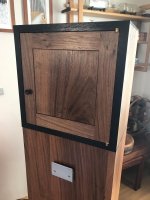
Secondly, the front. Two quite respectable leaves of walnut veneer were bookmatched to make the front:

IMG_5231.jpg

IMG_5232.jpg

IMG_5233.jpg

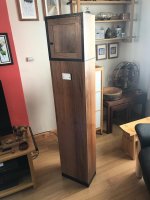
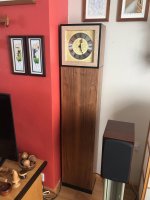
The Birds Eye Maple surround is 6mm thick and the Bog Oak is 3mm so there's a 'step' effect on the face. The Bog Oak inlay creates the illusion of a hood which can be seen on Makepeace's original. The plinth is made from four bits of Bog Oak dowelled together and held onto the case with six buttons. The dial is solid brass, made in Germany by Hermle and it also has a German made UTS quartz movement. Finished with several coats of satin Osmo with wax over the top - Rob
 
simply and not fussy which means the finer details do all the leg work. very nice and rather elegant. a assume there is room inside for a small, highly trained child with a very little hammer, in order to give the tick tock effect?
 
novocaine":11y8jaov said:
simply and not fussy which means the finer details do all the leg work. very nice and rather elegant. a assume there is room inside for a small, highly trained child with a very little hammer, in order to give the tick tock effect?
Nope, no children needed; the mechanism is silent. If SWIMBO and I were engrossed in a film, a 'tic-tock' in the background would be intensely irritating :evil: - Rob
 
Mike G":2qgmm7q6 said:
......and the secret compartment? ;)

Isn't it obvious? That big empty space at the bottom is where Rob is going to keep his sash cramps! No risk of any rust and always handy... :D

Seriously though there's some impressive precision work and timber selection in that. :eusa-clap: :eusa-clap:
 
Up to the usual standards that I have come to expect and enjoy.
Can I say that the location doesn’t do it justice, in a corner like that. It deserves to be seen on all 3 sides.
 
Andyp":1q7bsu1b said:
Up to the usual standards that I have come to expect and enjoy.
Can I say that the location doesn’t do it justice, in a corner like that. It deserves to be seen on all 3 sides.
Fast running out of space Andy and there was just enough room to shoe horn this little job into one corner of the chimney breast; I'm currently drawing up plans for another display case in London Plane to go on the other side - Rob
 
Very nice mate.

Not to my personal taste but as always the workmanship and attention to detail are unquestionable. Thanks as always for sharing.
 
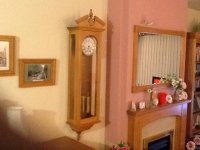
I had always fancied a long case clock but didn't like the space which would be taken up. I spent a lot of time looking at old examples of the regulator before making this one. You can have all of the attractive bits while using no floor space at all. Mine is now about twenty years old, is an excellent time keeper and I now prefer the appearance to the long case. The main drawback was the high cost of a quality movement.
image.jpeg
 
That's a very nice clock Mike, but as you say, a decent high quality mechanism is going to cost an arm and both legs. I was researching some German made ones and there's a bewildering variety of different sorts; if you don't know what you're doing (which I don't) it would be incredibly easy to buy the wrong thing and at £600 and up :shock: it's not the sort of mistake I would ever want to make - Rob
 
Thanks for that, mine is a German made Kininger ? Movement which cost £400 twenty years ago. It chimes the hours and half hours.on most of the older clocks I looked at the crest rail is made to lift off. I assume this is for easy transport. Many apparently had a brass eagle at the top centre but most were removed as offensive during WW2.
 
Rob, I love the use of contrasting woods and the quality of the finish.

It's probably completely unnecessary but I really don't want the clock to fall and with this bracket it's held tightly against the wall. I did a bit of research to find out how these clocks were secured to the wall but I came across 'stony ground' and couldn't find out any info. The back is made from one decent bit of English Walnut veneer with three narrower bits of stuff slip matched to form the panel:

Most of the antique long case clocks I have looked in (and the one sitting across the dining room from me) have a very basic back panel, usually a simple pine plank. In every case this is full of holes where a nail or screw has held it to a batten or even directly to the wall.

Certainly our clock is screwed to the wall behind the mechanism with a spacer block (because of the skirting board), the perils of an active 3 year old when we acquired it!

Mechanical mechanisms must be set up level so they run 'in beat' so not being able to move around is important.

While I appreciate the quality of the finish on the back face I have never seen on with a finished back panel.
 
Rob posting his finished clock has given me the impetus to finish the other longcase clock thread here which I spun off having originally hijacked Rob's thread :oops:
 
Mike Jordan":2b0yoedd said:
Thanks for that, mine is a German made Kininger ? Movement which cost £400 twenty years ago.
Those were the ones I was looking at (I think) on the Cousins website; they're now about £600 but when I was doing my research, there seemed to be literally dozens of different sorts from a variety of German makers, so it was pretty mind-boggling :D

Stargazer":2b0yoedd said:
Rob, I love the use of contrasting woods and the quality of the finish.

It's probably completely unnecessary but I really don't want the clock to fall and with this bracket it's held tightly against the wall. I did a bit of research to find out how these clocks were secured to the wall but I came across 'stony ground' and couldn't find out any info. The back is made from one decent bit of English Walnut veneer with three narrower bits of stuff slip matched to form the panel:

Most of the antique long case clocks I have looked in (and the one sitting across the dining room from me) have a very basic back panel, usually a simple pine plank. In every case this is full of holes where a nail or screw has held it to a batten or even directly to the wall.

Certainly our clock is screwed to the wall behind the mechanism with a spacer block (because of the skirting board), the perils of an active 3 year old when we acquired it!

Mechanical mechanisms must be set up level so they run 'in beat' so not being able to move around is important.

While I appreciate the quality of the finish on the back face I have never seen on with a finished back panel.

Thanks for that info. I'm now glad that I secured this one to the wall, but I guessed that the old antique clocks must have had some way of doing the same thing. Whenever I do a project, I attempt to make the back as good as the front, even though it's rarely, if ever seen. The point is that I know that I haven't done a 'lash up' on the back and if I had skimped it in any way, it would always, but always irritate and sooner or later I'd have to fix it - Rob
 
Andyp":h29ou13x said:
Up to the usual standards that I have come to expect and enjoy.
Can I say that the location doesn’t do it justice, in a corner like that. It deserves to be seen on all 3 sides.


:text-+1:

The corner location just does not do justice to the clock.
 
Phil":3sclnp28 said:
Andyp":3sclnp28 said:
Up to the usual standards that I have come to expect and enjoy.
Can I say that the location doesn’t do it justice, in a corner like that. It deserves to be seen on all 3 sides.


:text-+1:

The corner location just does not do justice to the clock.
As I said to Andy, ain't got nowhere else to put it! :lol: - Rob
 
Back
Top