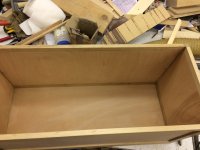
• Hi all and welcome to TheWoodHaven2 brought into the 21st Century, kicking and screaming! We all have Alasdair to thank for the vast bulk of the heavy lifting to get us here, no more so than me because he's taken away a huge burden of responsibility from my shoulders and brought us to this new shiny home, with all your previous content (hopefully) still intact! Please peruse and feed back. There is still plenty to do, like changing the colour scheme, adding the banner graphic, tweaking the odd setting here and there so I have added a new thread in the 'Technical Issues, Bugs and Feature Requests' forum for you to add any issues you find, any missing settings or just anything you'd like to see added/removed from the feature set that Xenforo offers. We will get to everything over the coming weeks so please be patient, but add anything at all to the thread I mention above and we promise to get to them over the next few days/weeks/months. In the meantime, please enjoy!

"machine made" drawer box

9fingers

Moderator
Staff member
Joined
Jul 21, 2014
Messages
10,414
Reaction score
163
Location
Romsey Hampshire between Southampton and the New F
I've got a single drawer box to make around 300 x300 x 800mm. It will have a separate front panel attached so this is a simple rectangular box.

It will run on full extension ball bearing slides and wondering what joining techniques to employ.

Look away now all you hand tool chaps, :lol: this will be machine made only. no discussion!
Options considered so far.

Jig cut dovetails
box/finger joints
Dominoes - might be a chance to use my recently acquired Domino? How many dominos per 300mm joint?
Pro-cons etc
Any others? I've not got a mitre-lock cutter bit (or the desire to get one really)

Bob
 
What material?

If I was using MDF like the toy boxes I made at Christmas, I'd consider biscuits.
 
I made some draws from 12mm ply and biscuits about a meter wide and they are still holding up.

Pete
 
Malc2098":2tel4y6l said:
What material?

If I was using MDF like the toy boxes I made at Christmas, I'd consider biscuits.
Good question.
Biscuit jointing is another possibility - thanks Malcolm & Pete

The drawer box sides will be 9mm ply but lipped all round with oak taking the joint regions to 16mm ish oak to oak. So think of each face as rail and stile panel. Base will be 9mm fitted into a groove.
This might sound a bit strange but I am using 9mm ply for the rest of the project and will have plenty left over and I also have a lot of recycled 18mm oak flooring. I feel 9mm ply will be too thin to use alone for the box and don't want to get a sheet of 12mm birch just for this job.

Bob
 
When you say lipped all round, Bob, do you really mean on all 4 sides of each "panel"? If that is the case then you are gluing long grain to long grain at the corners of the box, (or, even, sharing corner pieces) and a simple glued butt joint would be all that is necessary. You could stick a couple of dowels or Dominos in each joint if you wanted, or, as I said, eliminated the joint by just sharing the corner pieces.
 
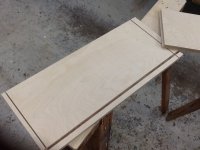
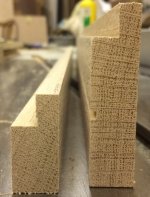
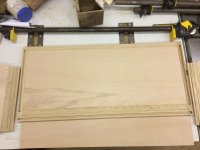
image.jpegimage.jpegI have some in the making at the moment that may fit the bill, they are made in 12.7mm birch ply because they must be very resistant to changes in size caused by moisture levels.
The sides are grooved with the RA cross cut and the tongues are made on a spindle moulder.
With glue blocks all round the edges of the 6mm bottom and up the back corners they will be plenty strong enough. I thing the pics are self explanatory but if I've missed anything just shout.
 
Mike G":2h2ehbgy said:
When you say lipped all round, Bob, do you really mean on all 4 sides of each "panel"? If that is the case then you are gluing long grain to long grain at the corners of the box, (or, even, sharing corner pieces) and a simple glued butt joint would be all that is necessary. You could stick a couple of dowels or Dominos in each joint if you wanted, or, as I said, eliminated the joint by just sharing the corner pieces.

Yes Mike each corner will indeed be long grain to long grain.
My recycled flooring is only 18mm before preparation so the largest corner "post" would be about 16/17mm square and by the time its grooved for 9mm ply might be a little on the weak side. But i might try and develop that idea.
Thanks.
Bob
 
Box joints using a table saw sled is a very easy way of doing this. Its not clever but it is effective.
But you really should get a lock mitre bit, they are magic! :eusa-clap:

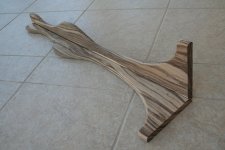
These 2 zebrano shelf supports were joined with full length lock mitre, over 3 ft tall, and it literally snapped and locked together without any other work.
IMG_3091.JPG
 
9fingers":1s4rbp9z said:
......My recycled flooring is only 18mm before preparation so the largest corner "post" would be about 16/17mm square and by the time its grooved for 9mm ply might be a little on the weak side......

Does it actually need to be square, though? Couldn't each piece be, say 40 x 17 in section?
 
sunnybob":2s5nf57d said:
Box joints using a table saw sled is a very easy way of doing this.....

Your lock mitre suggestion is a better one than box joints, because this junction is long grain to long grain.
 
Elucidation please maestro. :lol:
Does that mean the grain will be vertical? Cutting into the side of the grain?
If so, then yeah, scrap the box joint idea.
 
Mike G":ibmxnn9c said:
9fingers":ibmxnn9c said:
......My recycled flooring is only 18mm before preparation so the largest corner "post" would be about 16/17mm square and by the time its grooved for 9mm ply might be a little on the weak side......

Does it actually need to be square, though? Couldn't each piece be, say 40 x 17 in section?

That thought went through my mind just after I hit send Mike!

Bob
 
A good mate of mine (Andy Pickard, Devizes) recently made a rather special box using a mitre lock cutter in his router table. Although I've never used one, Andy said it was a brilliant bit of kit and well worth the investment - Rob
 
Thanks to all who chipped in and helped crystalise my thoughts on this drawer box.

I've done some sectional drawings for my own purposes which might not be 100% comprehensive but hopefully will show where I'm heading.
At the moment I needed these to define the plywood pieces I'll need to add to my cutting list for the rest of the project.

Firstly the recycled oak flooring that is 125 x 18 overall with dings and scratches etc that I will reduce to 16mm thick. I'll be using two sections A and B chosen to fit around the useful timber in the flooring.

The outline in red is my starting point and will be sawing and planing to form the two sections in green as shown below.

Oak flooring section.JPG


Each drawer panel will have a B section along the bottom edge and A section along the top. additionally the long sides will have A section on each vertical edge. This not only covers the raw ply edges but gives hardwood onto which the ball bearing slides will be fixed. All joints will be glued and will be long grain to ply in each instance.
The ends will be reduced to the ply thickness of ~8.5mm and be glued into grooves cut in the oak sections. The base will be fitted in the same way into grooves cut into the B sections.

Here is the plan view , Red is Oak and black is the ply.

Drawer box plan view.JPG

this is a section through a draer side, colour scheme as above and the blue parts are the ball bearing full extension slides.

Drawer box section.JPG

The oak sections will intrude into the inside of the drawer corners but only by 8mm and given the overall dimensions of 300 x300 x800 ish ithe storage space lost will be minimal.

I'll not be building this for a while but plan to add to this thread when I start making sawdust.

Bob
 
I've worked off of a lot plans in my time, but I have to admit this has me beat and I have no idea what youre building :?
Did you realise your long "B" section has a cut out of the top of it?
 
sunnybob":2rvrw3xh said:
I've worked off of a lot plans in my time, but I have to admit this has me beat and I have no idea what youre building :?
Did you realise your long "B" section has a cut out of the top of it?
Its a drawer box, just one part of a bigger project which I plan to write up later.
Yes the B section will have one of the original anti curl kerf cut in it but will be covered by the ball slides on the sides and the false front on the face. It will be uncovered on the back but no one will see that.

These are my working drawings for the purpose of the detail and dimensioning materials. There is no GA as I don't need one and don't use 3D cad unless I'm desperate as it takes me too long to beat it into submission.

Bob
 
I dont think I've ever made a working drawing with a straight line in it :eusa-hand: :eusa-clap: :eusa-clap:

I'm still puzzled what the outcome will be though.
I shall watch and learn :lol: 8-)
 
That all looks feasible to me, Bob. How much of this wood have you got? Because it strikes me that just edge-joining some boards together would give you a solid box rather than a panelled one, and many of your complications would disappear. Particularly as your ratio of solid to ply is so high.
 
Mike G":2841vvxf said:
That all looks feasible to me, Bob. How much of this wood have you got? Because it strikes me that just edge-joining some boards together would give you a solid box rather than a panelled one, and many of your complications would disappear. Particularly as your ratio of solid to ply is so high.

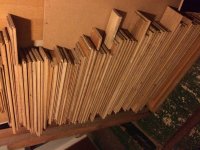
This is my stash of flooring.

oak pile.JPG

About the rightmost 30 boards would be long enough for the drawer but to be honest I'd rather keep it for other projects unspecified. This current job (under stairs storage) will need a sheet or two of 9mm ply and almost certainly enough offcuts to complete the drawer box.

I've been on the lookout for solid oak flooring on Gumtree for about 18 months and it has either been rubbish, laminate or silly prices. This lot was free apart from the diesel to go and collect it (60 miles so just over a galleon). I just don't know when I'll find any more.

I've got a dresser to make for the same room so I expect quite bit will go into that.

Bob
 
9fingers":3dsbcc64 said:
sunnybob":3dsbcc64 said:
I dont think I've ever made a working drawing with a straight line in it :eusa-hand: :eusa-clap: :eusa-clap:

I'm still puzzled what the outcome will be though.
I shall watch and learn :lol: 8-)

Ah yes I recall your shoe storage box drawing :D

Bob
Yeah, I made a special effort for Mike. I dont normally use a whole page 8-)
But this really does seem a lot of work for a drawer that no one will see.
 
sunnybob":hyirkosl said:
9fingers":hyirkosl said:
sunnybob":hyirkosl said:
I dont think I've ever made a working drawing with a straight line in it :eusa-hand: :eusa-clap: :eusa-clap:

I'm still puzzled what the outcome will be though.
I shall watch and learn :lol: 8-)

Ah yes I recall your shoe storage box drawing :D

Bob
Yeah, I made a special effort for Mike. I dont normally use a whole page 8-)
But this really does seem a lot of work for a drawer that no one will see.

Rewind a bit Bob,
I knew I would have left over 9mm ply from the rest of the job.
9mm ply is too flimsy for an 800mm long drawer.
I did not want to buy a sheet of 12/18mm decent ply just for this drawer. Here cut sheets are nearly as dear as full sheets to buy.
I have the oak anyway.
As the design is based on two sections A & B that can be made with a few swipes through the table saw most at the same setting it will be pretty quick. A few passes through the planer will bring a decent surface to the oak.

Here is a sneak preview of the undertairs frame made for my "quercus pinus" https://www.thewoodhaven2.co.uk/viewtop ... 76&p=80426. The drawer box fits in the lower left aperture in the frame.

frame2.jpg

Bob
 
Following with interest Bob that's a fair old stash of oak. :eusa-dance:

I've made a number if items from oak t&g and have just started a new TV stand of which will probably be 80% from what's left of my stash of surplus boards, I fitted many oak floors before I retired so it's a right old mix but as you said a few passes through a planer changes everything.

It will be pretty simple around 800 x 450 x 450 high a shelf and long drawer. I've cut the bits today and glued up the top. In true Sunnybob style it's rough sketches only. ;)
 
Just messing with you Bob. Its a slow news day here :lol: 8-)

But honestly, that drawing with boxes connected by other boxes left me completely bemused. I have no idea what style of plan that is. But then again I have no computer drawing skills whatsoever (I can actually make a reasonable technical drawing old school type if really really need to.)

I can get BB ply in 12 mm here for around 30 euro a full sheet.
 
sunnybob":30tji2kz said:
Just messing with you Bob. Its a slow news day here :lol: 8-)

But honestly, that drawing with boxes connected by other boxes left me completely bemused. I have no idea what style of plan that is. But then again I have no computer drawing skills whatsoever (I can actually make a reasonable technical drawing old school type if really really need to.)

I can get BB ply in 12 mm here for around 30 euro a full sheet.

Its nought to do with computer drawing, it is how manufacturing drawings have been done for centuries - well at least a couple!
A plan view in drawing terms is what you see looking directly downwards onto the object. No perspective
So when you say boxes connected to other boxes, you are looking at the cross section of the components.
At the corners, you see the oak pieces (made from section A) and the the other four pieces are the view of the plywood edges.
The drawing is not to scale as the plywood pieces are much longer than shown on the final object but if drawn strictly to scale the corner sections would be too small to show the detail.
A section view is what you would see by sawing something along a specified line and often shows internal detail not otherwise visible.

To find out more, a google for Isometric Projection should give you a steer.

HTH
Bob
 
:lol: :lol: :lol:
I did tech drawing in 1962- 64, aint gonna do it all again. 8-)
 
I've been quite impressed with hardwood ply from wickes on a couple of recent projects.
It has very few voids and is finished with outer veneers of beech.
it currently £27 for 9mm nominal thickness. Add to that most stores have a sheet cutting service so it is easy enough to get it broken down into car sized pieces.
The guys trained to do the cutting are normally quite interested in what you application is and are very helpful. I took my cutting diagrams from Max Cut sheet optimiser which made it easy for him and he did a load more cuts than the free limit (2 per sheet I think). I bought 4 sheets, 14 cuts and he charged for 2 extra £1!

Here is my stack for the current project.

Ply stock.JPG

A rather poor close up of the edge -sorry

poor close up of ply.JPG

the outer veneers are very very thin.

stock thickness 8.5 mm
8.5 mm thick.jpg

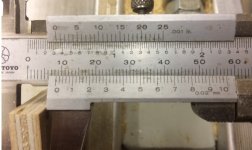
After careful sanding, the thickness between the arrows was measured
Sanded.JPG
thickness was 8.35mm
8.35mm after sanding.jpg

So as best I can measure, the veneer is 0.15mm or 6 thou in real money

This does mean there is little or no chance of machine sanding after the event. An overzealous application of 320 grit and you will be thorough it !
This sets me the accuracy I need to work to in the project.

A little tip when cutting ply. If you have to cut across the grain of the outer layers of amost any ply you are likely to get tearout splinters.

Unless your saw has a scoring blade and I'd bet that very few of us are that lucky and you don't have a perfectly set up track saw, you can still make a great cut.

Set the saw cut depth to around 0.5mm.
Scoring cut half mm.jpg

Run a scoring cut on both sides
first side
score cut.JPG
both sides
score both sides.JPG

Raise the blade to a gnats over the thickness of the ply
9mm cut.jpg

Perfect cut
top side
Clean cut top side.JPG

and underside
clean cut underside.JPG

I did loads more today but will upload later or tomorrow.

Bob
 
9fingers":354l2ifl said:
I've been quite impressed with hardwood ply from wickes on a couple of recent projects.
It has very few voids and is finished with outer veneers of beech.

Bob
That's been my feeling about Wicke's ply for a while; certainly appears to be a cut above the B n'Poo stuff across the road :D - Rob
 
The following is my way of doing things that is sometimes unconventional but follows a few principles all aimed at accuracy.
These include the absolute minimum of measuring but instead refer cuts to other datum points to make things fit where they need to. Every measurement is potential source of error and every transfer of measurment off the rule onto a workpiece is another source of error. If you must mark one workpiece off another then remember to make the cut so the pencil or knife mark is removed. If you can still see the mark then the piece will be the wrong size.

Here is half of the recycled oak flooring I'm starting with. Why half I hear you ask? well I mis-calculated and only sorted out half what I needed from the stash and had to go back for more :lol:
Some starting stock.jpg
Next it was out with the four post planer to remove the surfaces and bring it down to 16mm
Planer.JPG
For a larger batch I might leave the last o.2mm to come off with the thickness sander but this time a quick whip over with the ROS was adequate.
Quick sand.JPG

First cut was aligned to the existing relief cut
Align cut to relief cut.JPG
After a few more passes over the table saw I had embryo A sections ripped to 35mm wide and B section to 64mm wide.

A & B sections ripped to width.jpg

I then needed to cut the rebate into which the ply would fit. Both A & B sections need this.
The rebate is 11mm deep and as wide as the ply which is 8.5 mm.
However I'm using an alternate top bevel saw blade which gives a typical W shaped kerf. as shown below

detail of ATB kerf.JPG
so to avoid the ridge that would otherwise stop the ply seating properly, the saw depth was set to 9mm
9mm cut.jpg

The A section required the fence to be set to 24mm and the B section 53mm ie 11mm less than the original widths. The aim is to have as much of the flat surface down on the table between fence and blade to minimise any tendency to rock and allow the waste free to fall away to the left of the blade.
I seemed to forget to take some pics but here are the resulting sections.

Sections A&B.jpg

All ready for the next stage

A&B stock ready to use.jpg

more to follow
 
Now onto the next step.
To get the drawer box to the height I wanted, the ply sides need to be 303mm tall so once set on the saw all four pieces were cut at the same setting. then trimmed to length.
Side and end ply cut.jpg

The ends are nearly but not square so I marked an arrow to indicate top and bottom.
I wanted the ply to protrude 8mm on each side for the joints into the box sides to the oak sections need to be trimmed to 16mm less than the width of the ply.
Following my principle of minimum measurement, use the ply itself to butt up to one of the blade teeth. Remember this is an ATB blade so only alternate teeth will have cut that edge so line up on one of the cutting ones.
Clamp on a stop block to the mitre fence.
Set up to cut sections to length.JPG

insert a 16 mm spacer - an offcut from either oak sections and make the cuts on 2 A sections and 2 B sections
add spacer.JPG

When these pieces are glued onto the box ends we want to set the 8mm offsets easily again without measuring. One of the ply scraps from when I sanded down through the veneer earlier was just right.
simply slipping in place and a fingertip touch confirms the correct offset.

thinned down for 8mm gauge.JPG

After a dryfit check, all ready for glue x2
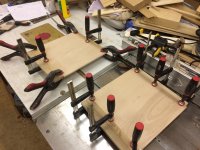
Ends glued.JPG

I will confess to a hand tool use here. A chisel is very useful to remove glue squeeze out in corners where a damp cloth wont reach after clamping - so hand tools can have their uses. :lol:

Moving on to the long sides, the A and B oak sections need trimming to fit. This time they need to be the same length as the sides. So again set a stop on the fence using the ply and the blade tooth and make the 4 cuts.
set up repeat cut to length.JPG
Stop detail built into the mitre fence.
stop detail.JPG

The box sides also need pieces of A section fitted to the ends. These need both cutting to length and the ends nibbling to fit in the corners.

use offcuts of A section to set the fence so the width of A to align fence and cutting side of the blade.

Set up fence referred to far side of blade.JPG

Set the blade height to 11mm and nibble away. Remember these pieces are handed. Doing the nibbling for the A section first does mean errors can be rectified by cutting a B sized cutout later to correct.

Nibble the waste away. The fence acts as a stop and the mitre gauge guides the work.
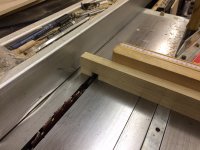
nibbling in progress.JPG

nibbling complete.JPG

Use a similar process for the clearance for the B sections on the other end.
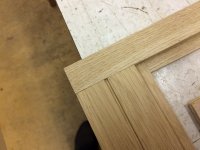
nice tight fit after nibbling.JPG

Ready for glue up now.
Always do a clamp dry fit so you know everything will fit, pull down nicely and you have all the clamps to hand and set to the approximate position needed.
Glue-ups are always a bit stressful at the best of times so the dryfit really helps

Here are the sides at the dry fit stage but could equally be after glue.

Dryfit the clamps.JPG

Thats caught up with yesterdays work. Now time to look at the results and prepare to turn it into a 3D box today.
Bob
 
Not been any response so far so either my methods have horrified/dumbfounded everyone or I did not describe it well enough to give readers scope to comment :lol:

I did consider using my dado head for the assembly grooves but that might upset the more delicate flowers here so instead I used the router table.
I needed clearance fit for the 8.5mm ply and the advantage of the dado set is that it can be shimmed to an exact size whereas the router table method is constrained by the cutter size. However the router is easier for stopped grooves so the router won the day. I did two depth passes 4mm and 8mm and two at different fence settings to end up with 8.7mm wide 8mm deep grooves.

Here are the panels with grooves all cut and ready for glue.

IMG_2921.JPG

IMG_2922.JPG

I missed out the glue application as i guess we all know about that!

Now all assembled and surround by 16 clamps - you can never have enough!

IMG_2923.JPG

IMG_2924.JPG

With all the panel made with satisfying precision, the assembly went very smoothly and ended up all square, true and no wobbles.

Not much progress today and domestic duties were pressing. a quick and very light sanding and a coat of my favourite water based floor varnish brushed out nice and thinly was about all I did.

Fitting tomorrow with luck.

All comments welcome

Bob
 
Rest assured Bob I am following with interest. What is not clear to most of your readers is quite how small and cramped (IIRC) your workshop is.
 
Today was fitting day.

Here are a few shots of the drawer box minus the clutter of the clamps.

IMG_2925.JPG

IMG_2926.JPG

IMG_2927.JPG

IMG_2928.JPG

Here is where the drawer will go - its the bottom left aperture

IMG_2929.JPG

I'm using standard full extension ballslides the longest my supplier had was 700mm but this will still give easy access to the full length of the drawer which is a fraction over 800mm.

These a a doddle to fit. I screwed them about 10mm from the bottom of the aperture and offered up the drawer in place with a couple of 3mm shims underneath. With the drawer out by about 100mm I could fit the first screw on each side, then I slid the drawer out about half way, slipped in the shims and inserted the second screw on each side. Finally I unclipped the drawer on both sides and with it removed completely, could fit the final pair of screws at the back of the drawer.

Here it is all slid back in and it now moves nice and freely.

IMG_2930.JPG

IMG_2931.JPG

IMG_2932.JPG

So that is the first bit of the project done now. Eventually the oak panels will be made one of which will be a false front for this drawer.

Looking in from the right hand end gives a side view of the drawer. A ply panel will be fitted to close this off.
IMG_2933.JPG

The triangular aperture above the drawer just can't easily be put to good use so that will be blocked off.
IMG_2934.JPG

The next stage still needing a lot of design is a large special drawer to fill the central aperture which is 495mm wide x 1300 mm high and 800mm deep This will run on 4 ball slides as it will potentially carry a lot of weight.

Here I'm starting to make a rod or full size pattern of the centre aperture. This will enable me to test and check dimensions as I build this next drawer unit.

IMG_2935.JPG

There will be a gap now whilst I sit down with a bottle of aspirins and think about the design.

Thanks for reading

Bob
 
Back
Top