• Hi all and welcome to TheWoodHaven2 brought into the 21st Century, kicking and screaming! We all have Alasdair to thank for the vast bulk of the heavy lifting to get us here, no more so than me because he's taken away a huge burden of responsibility from my shoulders and brought us to this new shiny home, with all your previous content (hopefully) still intact! Please peruse and feed back. There is still plenty to do, like changing the colour scheme, adding the banner graphic, tweaking the odd setting here and there so I have added a new thread in the 'Technical Issues, Bugs and Feature Requests' forum for you to add any issues you find, any missing settings or just anything you'd like to see added/removed from the feature set that Xenforo offers. We will get to everything over the coming weeks so please be patient, but add anything at all to the thread I mention above and we promise to get to them over the next few days/weeks/months. In the meantime, please enjoy!

Making knives

rxh

Sapling
Joined
Nov 29, 2020
Messages
270
Reaction score
370
The recent thread "knife making" discusses bandsaws for metal cutting and also mentions linishers. No doubt these machines would be very useful but might be considered rather costly for an occasional knife maker to obtain. This thread will be about how I made a pair of knives without using a bandsaw or linisher.

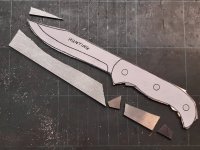
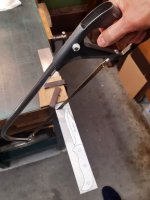
| began by sticking paper copies of the intended shape to 1/8" thick O1 steel ground flat stock (gauge plate) and removing as much waste as possible using a hacksaw (I find it better to clamp the metal to the bench for this operation rather than holding it in the vice).
20230813_195809.jpg
20230813_203419.jpg
20230813_204341.jpg

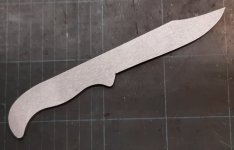
Then I filed the edges down to the line.

20230813_204819.jpg20230813_211535.jpg

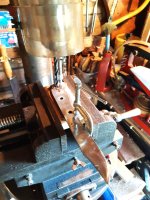
I drilled three holes in each blank.
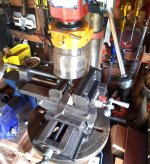
20230814_105515.jpg

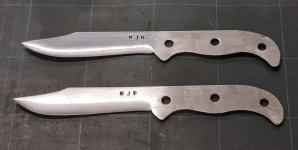
Then I stamped the initials of the intended recipients of the knives.
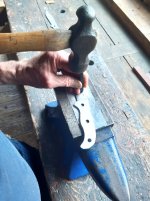
20230814_111845.jpg
20230814_112113.jpg

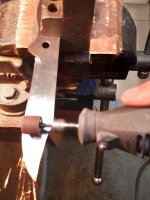
Then I filed the bevels, leaving an edge about 1 mm thick (it is considered undesirable to go down to a sharp edge before heat treating).
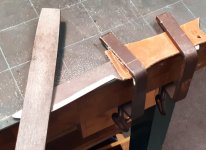
20230814_114627.jpg

To be continued. The next installment will cover heat treating and finishing the metalwork.
 

Attachments

  • 20230813_204854.jpg
    20230813_204854.jpg
    179.4 KB · Views: 3
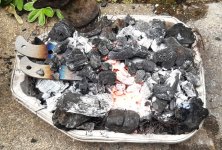
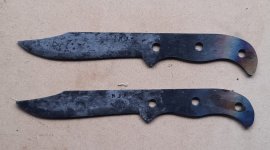
The story continues. I hardened the knives by heating them to red heat in a small barbecue encouraged with a hot air gun.

20230814_143754.jpg
 
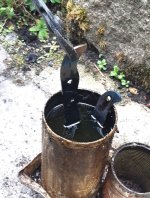
When they were so hot that a magnet would not stick to them (i.e. the Curie point had been reached), I quenched them in cooking oil, lowering vertically to reduce the risk of distortion occurring.

20230814_144328.jpg
 
I cleaned off the scale with a wire brush wheel and abrasive paper.

20230814_150255.jpg
 
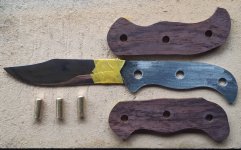
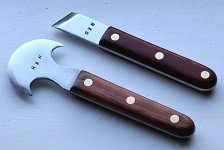
I made blanks of panga panga wood for the scales and drilled them to accept the studs.

20230817_164849.jpg
 
I cut the outlines of the scales slightly oversized and also cut the studs from brass round bar stock.

20230816_161029.jpg
 
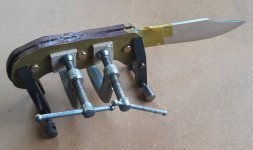
After cleaning and de-greasing all relevant surfaces I glued everything together using epoxy adhesive.

20230816_165233.jpg
 
Then I shaped the scales with files and abrasives.

20230817_173851.jpg
 
Nice thread. I still have a few damascus large kitchen knife blanks that Will Catcheside taught me to make (in reality he did 2/3 of the work :cool: ) when I did the course with Gary. I finished one but not the others as my intention was to get a proper linisher. Then life intervened.

Your've done well with very little kit. I find using a grinding wheel quite tricky as I don't have a low speed one.

Would be interesting to know what degree of steel hardness you are achieving. Rockwell calibrators are expensive though.
 
  • Like
Reactions: rxh
Really helpful thread - thank you!

I wondered about the hardness question, I was just looking at the cost of Rockwell-rated hardness files, they seem worth the money to get an approximate idea.

rxh - Did you get any distortion on the blades while heat treating? I think our plan for the first knife is to heat them in a small forge made from firebrick, hole in the ground with air supply from a hair dryer, but I wondered about how even the heat could be. I think ours could do with a couple more bricks and a deeper fire, but as is it heated the steel bar enough to beat it to a shape.

IMG_20251208_143406.jpg
 
  • Like
Reactions: rxh
Nice thread. I still have a few damascus large kitchen knife blanks that Will Catcheside taught me to make (in reality he did 2/3 of the work :cool: ) when I did the course with Gary. I finished one but not the others as my intention was to get a proper linisher. Then life intervened.

Your've done well with very little kit. I find using a grinding wheel quite tricky as I don't have a low speed one.

Would be interesting to know what degree of steel hardness you are achieving. Rockwell calibrators are expensive though.
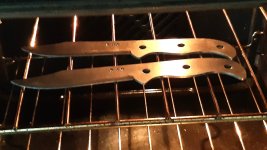
Thanks - I think 200 deg. C corresponds to 62 HRC for O1 steel but I don't have a way of measuring hardness. It seems to be a satisfactory temperature for plane irons, wood chisels and knives.
 
Really helpful thread - thank you!

I wondered about the hardness question, I was just looking at the cost of Rockwell-rated hardness files, they seem worth the money to get an approximate idea.

rxh - Did you get any distortion on the blades while heat treating? I think our plan for the first knife is to heat them in a small forge made from firebrick, hole in the ground with air supply from a hair dryer, but I wondered about how even the heat could be. I think ours could do with a couple more bricks and a deeper fire, but as is it heated the steel bar enough to beat it to a shape.

View attachment 37702
Thanks - I haven't had much trouble with distortion. I think the main risk is when quenching, and lowering vertically into the oil helps to avoid the problem. I haven't done any hammer forging, except for small items but I hope others will comment concerning this.
 
Brilliant thead, thanks. The cost of having a go to see if you like it plunges down to the minimum and you've clearly got great results.
 
  • Like
Reactions: rxh
Thanks - I haven't had much trouble with distortion. I think the main risk is when quenching, and lowering vertically into the oil helps to avoid the problem. I haven't done any hammer forging, except for small items but I hope others will comment concerning this.
I've done a little bit: a few knives in Japan (maybe a dozen or so) with both hand hammering and power hammering with a small unit, and a bit using Will Catcheside's quite scary big power hammer. I think the main benefit of power hammers is making the folded Damascus patterns from steel blocks forged in the workshop. There is quite a skill to this, especially if trying to get feather or rain drop effects - as opposed to just more straightforward folded Damascus layers. I've "helped" ;)o_O skilled people to do it and I think you need a fair bit of experience (years) to judge how it will turn out.

I also spent almost a whole day sat on the floor in Japan with my wife, watching a renowned sword maker in the middle of nowhere turn rusty iron / steel into bar suitable for making a sword. Basically much the same process but a lot slower.

There is also a considerable art to making fancy J knife handles for burnt in tangs. I think the Japanese do this much better than the UK knife makers.

Oddly enough my very best J knives are plain Hitachi white or blue paper steel, and simple handles with buffalo horn ferrules. Shigefusa and Aritsuga among others. But I am a proper knife nerd :)
 
  • Like
Reactions: rxh
Rxh, your way of making knives has inspired me to give it a go in the future. I like your forge.
Very good. I prefer to use real charcoal as I feel it burns hotter than the briquettes (I have no scientific evidence for this).
 
Brilliant thead, thanks. The cost of having a go to see if you like it plunges down to the minimum and you've clearly got great results.
Thanks Andy. Yes, many people will already have the tools needed if they fancy trying knife making.
 
I've done a little bit: a few knives in Japan (maybe a dozen or so) with both hand hammering and power hammering with a small unit, and a bit using Will Catcheside's quite scary big power hammer. I think the main benefit of power hammers is making the folded Damascus patterns from steel blocks forged in the workshop. There is quite a skill to this, especially if trying to get feather or rain drop effects - as opposed to just more straightforward folded Damascus layers. I've "helped" ;)o_O skilled people to do it and I think you need a fair bit of experience (years) to judge how it will turn out.
I also spent almost a whole day sat on the floor in Japan with my wife, watching a renowned sword maker in the middle of nowhere turn rusty iron / steel into bar suitable for making a sword. Basically much the same process but a lot slower.

There is also a considerable art to making fancy J knife handles for burnt in tangs. I think the Japanese do this much better than the UK knife makers.

Oddly enough my very best J knives are plain Hitachi white or blue paper steel, and simple handles with buffalo horn ferrules. Shigefusa and Aritsuga among others. But I am a proper knife nerd :)
Having access to a proper forge, big anvil and power hammer would open up so many possibilities - maybe one day :)
So much to learn - I'm thinking of making a higonokami knife but not of laminated or Damascus steel for a first attempt.
 
Back
Top