• Hi all and welcome to TheWoodHaven2 brought into the 21st Century, kicking and screaming! We all have Alasdair to thank for the vast bulk of the heavy lifting to get us here, no more so than me because he's taken away a huge burden of responsibility from my shoulders and brought us to this new shiny home, with all your previous content (hopefully) still intact! Please peruse and feed back. There is still plenty to do, like changing the colour scheme, adding the banner graphic, tweaking the odd setting here and there so I have added a new thread in the 'Technical Issues, Bugs and Feature Requests' forum for you to add any issues you find, any missing settings or just anything you'd like to see added/removed from the feature set that Xenforo offers. We will get to everything over the coming weeks so please be patient, but add anything at all to the thread I mention above and we promise to get to them over the next few days/weeks/months. In the meantime, please enjoy!

Mental Health benefit of woodwork

Blackswanwood

Old Oak
Joined
Jun 27, 2020
Messages
1,472
Reaction score
969
Location
North Yorkshire
Name
Robert
I spotted an article in the local BBC news about The Viking Boat Company.

In short they offer support to ex servicemen and women with mental health by teaching/involving them in woodwork.

It made me think about how woodwork has probably been a counter balance to the pressures of life for me over the years. Arguably the education system has dumbed down woodworking and similar subjects leading to lower DIY skills and fewer people going into the trades. I wonder if it also contributes to the increase in mental health that we have seen over the last couple of decades?

Here’s the article from the BBC and website for the organisation. A very worthwhile endeavour in my opinion.

Veterans build Viking boat to boost mental health https://www.bbc.com/news/articles/ckgxyex781jo

https://planesailing.org/
 
I have no doubt that building my workshop after I retired and the starting to woodmangle at the beginning of lockdown, and then developing luthier projects have been a massive benefit to me. I'm not sure what I would have done to fill my time otherwise.

I also zoom work online with retired fire-fighters and staff and some of them build airifx type models with other retirees, mainly armed and emergency retirees, online together to provide mental health support.
 
At the risk of being thought to bare all in public, I concur, though my experiences have not been as physically threatening nor as mentally disturbing as those for some veterans
I have had profound mental problems for several years, as some of you on here know. Having an outlet (in my case, volunteering at a heritage railway) has been an anchor and allowed a modicum of recovery.
I am struggling, on several fronts, with daily necessities that I previously found routine, but aspire still to 'get fully back to normal' and achieve some personal woodworking output.
I know there are at least two posters on here that will identify with what I am writing about, and have posted about same, but it is their privilege to engage with this thread, I will not name them.
One observation I will put "out there" in concordance with BSW and Malc above, is that the spatial calculations to process a piece of wood, then the 3D control of a tool or tools to execute same, brings about a small frisson of satisfaction that dispels what some call "the black dog". In that respect, woodworking helps. If you ask a psychologist or similar, "Behavioural Activation" is your starting point. There are some very good downloadable resources to explore this personally.
As a tangential comment, possibly taking the thread sideways, may I please share something I found out on Friday? Anyone with Diabetes Type 2 has a very strong chance of developing depression. In three years of active treatment for both, not one practitioner (until Friday) mentioned it.
 
It seems hard enough for some who have endured a lifetime of 9-5 working to find a purpose after retirement. For armed service veterans where so much of their life was regimented and built around the company of others it must be immeasurably more difficult. What seems key to me is having a purpose, and excuse to get up, working and interacting with others. I have no doubt that the creation of something, anything, gives a far better and long lasting sense of achievement, something that the ups and downs of playing sport may not to the same degree.
 
Facinating, and so insighful.

I'm lucky enough to be absolutely fine, but a friend of mine had a brief affair, then punished himself so much in the months that followed that he ended up in a deep, paralysing depression. He was in danger of losing his business, his family, and his friends. He started smoking, and piled on weight. This chap eventually confided in me, and asked for help (my goodness what a step......and to ask me, of all people....). I had seen my brother go through troubles with his mental health, and had seen what exercise had done for him. There is also some good science on the matter, so I got my friend into cycling. Luckily, he got hooked. He set himself some targets, and entered some big events, and now rides thousands of miles a year.

Six or 8 years on, he is now healthy, both physically and mentally. He has forgiven himself, and when his black puppy starts nibbling at his heels, he goes out for a long ride. It's far too easy to say that exercise cured him.....it didn't, and he isn't cured. But it was a big part of the process of healing, and a useful tool in helping to deal with the problem.
 
....... I have no doubt that the creation of something, anything, gives a far better and long lasting sense of achievement, something that the ups and downs of playing sport may not to the same degree.

Sport only gives a short lived sense of achievment. It can be extremely deep and distracting, but it passes quickly. If only I could make something which was spot-on, and where I couldn't find fault, I might get a longer-lasting sense of pride in woodwork. But I'm surrounded by stuff which drives me on to try to do better....."maybe this next one will be The One". For me, then, the mental benefits of woodworking are in the process, not the product. In enjoying the practising of skills, rather than in the result.
 
I'm sure there are mental health benefits to it, I was not in a good place at all mentally when I first started woodworking, it has helped me a lot.
 
Sport only gives a short lived sense of achievment. It can be extremely deep and distracting, but it passes quickly. If only I could make something which was spot-on, and where I couldn't find fault, I might get a longer-lasting sense of pride in woodwork. But I'm surrounded by stuff which drives me on to try to do better....."maybe this next one will be The One". For me, then, the mental benefits of woodworking are in the process, not the product. In enjoying the practising of skills, rather than in the result.
I tend to agree Mike. Wood mangling for me is something that I've always done, both professionally as a teacher, pro maker (for a short time) and amateur hobbyist. The problem is that you're always seeking 'The One' but because we're all human beans, we never, ever achieve it; there are errors, mistakes (says he who's just made one:ROFLMAO:) and niggles in every piece. The casual observer may think a job looks 'perfick' but to the maker, who knows where the 'issues' are it's not. The metal processes though in producing it are equally as important as the finished job. I take solace from the late Jim Krenov who's reputed to have said that... "I've never made a square piece of furniture in my life" (or similar) - Rob
 
It seems hard enough for some who have endured a lifetime of 9-5 working to find a purpose after retirement.
And on the flip side, I'm still working 9-5 and will be for many years yet, but that work is all computer based and has little tangible product at the end of it. The ability to see something physically take shape in front of me is a huge counter to the sense of inevitable futility that easily sets in otherwise.
 
..... If only I could make something which was spot-on, and where I couldn't find fault, I might get a longer-lasting sense of pride in woodwork. But I'm surrounded by stuff which drives me on to try to do better....."maybe this next one will be The One". For me, then, the mental benefits of woodworking are in the process, not the product. In enjoying the practising of skills, rather than in the result.

If perfection was not nigh impossible we would end up like Forest Gumpand bored saying right I've done that move on to something else? Agreed the process, problem solving and just trying to improve and do the best I can is motivation enough for me.

I've seen serious depression with family members and a good friend and no-one is immune it seems but it's very difficult to understand for those who haven't experienced it, certainly my early reactions were along the lines of "pull yourself together" which is completely the wrong approach.
 
No experience of depression etc, but I certainly have always known that going into my workshop and making things is good for me. The sense of achievement flowing from designing something and then having it come together is huge for me. When I’m thinking of novel ways to get around problems or when designing is also something I thoroughly enjoy.
 
Agree with the general themes above. For me the kind of woodwork/DIY I mainly do is a bit too much like hard work, but is still useful. Teaching people to gain confidence in their abilities through classical (mainly) piano is rewarding and music has tangible health benefits I find. We probably have a greater need to find purpose in our lives as we age.
 
7
It's far too easy to say that exercise cured him.....it didn't, and he isn't cured. But it was a big part of the process of healing, and a useful tool in helping to deal with the problem
Spot on. Many things contribute, but exercise (as opposed to sport, as you say above) is a facilitator for other aspects of recovery. It's easy to tailor to you, and nearly always immediately available. Even a short walk counts.
May I please also say, it is heart warming, and encouraging (supportive) to see such a strong immediate set of empathic contributions from fellow forum members.
 
While I don't have any direct personal experience of this, my other half has. She has always struggled with "the black dog" and used to find that running (up to and including coast path ultramarathons) helped an enormous amount with her state of mind. Then she got M.E. which basically meant that she couldn't run any more: in the space of a few months she went from running 30+ miles along a hilly coast path to being told by her doctor not to do more than 10 minutes of gentle walking a day. That had an inevitable impact on her state of mind.

She doesn't do woodwork, but she knits, crochets and makes stuff out of leather and I've noticed a big improvement in her mental health since she's taken up those crafty hobbies. Making stuff is good!
 
I find making something allows me to be fully present, just me, the thing and the tools - and a clearly delineated space which the world generally can't impinge upon. All the nonsense out there tends to disappear for a while. When I'm having treatment, I sometimes picture myself in the workshop. Excepting a disaster, I know I'll be there again, present to myself and my immediate loved ones. Presence is all we really have, I think.
 
When I was working (at a job I came to hate), I swear woodworking was the only thing that helped keep me sane. The sense of achievement and something to look forward to at the end of the day made a world of difference to me.

It also eased the pressure on my poor family who were directly in the firing line.

Now I’m lucky enough to be retired and I can’t imagine not woodworking in some way, shape or form. It’s just a part of me now and one I happily embrace.
 
I documented my own journey at the other place. Building my dream workshop was a life-saver after divorce. I was not in a good place and not really functioning properly; not just for months, but for years. Eventually I pulled through (I miss that workshop!) and now life is good. Not without its problems, of course, but those problems are ones I can deal with.
I wrote for many years and that was very therapeutic, as was my filming, and I can't imagine a life without making stuff and solving problems. I suspect I'm in my twilight years, I can't imagine making Old Bones, but I hope I continue to be creative until the end. It is one of the best things in life.
Talking of Old Bones, today I told my French tutor about making the coffin for Stuart. She was impressed and asked if I would make hers. She is 77, but looks at least 10 years younger and is fit and healthy (as far as I am aware), but we all ponder our demise, eventually, do we not, so I was surprised, delighted and humbled when she asked me if I would make hers. I've sent her a link to the video, we'll see if it results in an actual commission.
S
 
I think this is the first thread in which I've "liked" every post!

Hobbies have always been massive for me. My problems are insignificant compared to some on here and armed forces veterans and the like, but I did have a stressful job with stupid hours. Having hobbies to "lose myself in" have been really important. Those have included target rifle shooting, a bit of DIY, building a car and now woodworking. I think getting stuck into something which is removed from the things that get you down is, for your brain, the equivalent of rebooting a computer. You come back a bit refreshed and ready to take on the next problem. I know that's a simplistic thought on what can be extremely complicated problems, but having hobbies definitely does me a lot of good.
 
Take today f'rinstance. I was completely immersed in the particular task in hand; no background 'muzak', no other distractions, just me and the OF1400 router (plus ear muffs and face mask) and thereafter a set of chisels and quite a lot of concerted effort at the bench. Along came 5.00pm and I'd had enough for the day so it was time to close up the 'shop and think about getting on a bit of tea for when 'er indoors came in from work. The overall effect was of a day not wasted but usefully taken up with meaningful, productive and worthwhile activity - Rob
 
Just as an aside to Steve's post re making a coffin for his pal.
When my dad died I was persuaded by my siblings to make an oak box for his ashes. I didn't want to do it and as there was to be a burial, time was very short so I set to and despite the tears and how difficult I found it to be it helped me far more than I could ever have imagined to be able to do that.

A few years later my mum who I was very close to asked me to do the same for her and I wouldn't commit. She asked me every week for many months and eventually I made it but without telling anyone. A few days after it was completed while visiting he she said "I've been thinking maybe don't make me a box just yet as I'm not ready to go". - WOMEN :ROFLMAO: I never did tell her.
 
Excellent thread and lots of good advice.

One has to keep busy especially after retirement. I took early retirement at 56, did a bit of contract work for a year and then 10 years at a company on contract.

Very rewarding work (also money wise). The only issue was travelling to factories, fly or drive sparrows on a Monday, and then only back Friday night, or only following week Friday. Weekend slogged it out in the garden with some wood time late afternoons. Rinse, repeat.

In 2015 we moved into a retirement estate and that is when I saw old people just getting older, no hobbies or other interests, both husband & wife. Very sad.

We both try to keep busy, especially the mind, the body does not always cooperate (me)!

The estate also offers lots of activities for the residents, but again you can drag a donkey to the water but cannot force it to drink.
 
And on the flip side, I'm still working 9-5 and will be for many years yet, but that work is all computer based and has little tangible product at the end of it. The ability to see something physically take shape in front of me is a huge counter to the sense of inevitable futility that easily sets in otherwise.
This...
 
Yep. 100% agree. We may follow careers that are remunerative but look back and see what we did as entirely transient then think it was all a bit pointless. It may just be human nature though playing imagination and regret off against each other. Our very presence on a forum such as this suggests inherent creativity within us.
 
Our very presence on a forum such as this suggests inherent creativity within us.
It was my birthday last month and as the date was on the astrological 'cusp', the card SWIMBO presented me with mentioned that Acquarians were 'intelligent' (debatable in my case) and 'creative'. I rest my case m'lud :ROFLMAO: - Rob
 
It was my birthday last month and as the date was on the astrological 'cusp', the card SWIMBO presented me with mentioned that Acquarians were 'intelligent' (debatable in my case) and 'creative'. I rest my case m'lud :ROFLMAO: - Rob
Had one of those evaluations done on me once, it said I scored low on practical things! Me!!
So I have been able to dismiss all such results ever since haha.
 
I was at a party once, Boxing Day, it must be at least 35 years ago. I was a hanger on, never having met the hosts before, but tagging along as a visitor of their friends. Over the mixing of some cocktails in the kitchen (a Gigolo's Delight, one part gin, two parts sweet vermouth, one part dry vermouth, OJ, if memory serves), the Hostess asked me what Sign I was. I pointed out that it rather depends on which horoscope you read. I'm different depending on the Astrolger.
It was only afterwards that I realised she was actually trying to seduce me. I was very naïve (I still am), it's not something that happened very often (then or now). One more of life's missed opportunities. It was probably written in the stars. Sigh.
S
 
I think hobbies in general are more important than just woodworking, or perhaps simply just doing something different once in a while.

When you're doing it professionally, it's a bit different. Of course, you can get significant pride from a job well done especially something that is a bit different to the norm, but for the most part it's just like any other regular job with deadlines and people chasing you constantly. I think a lot of people found this out over the pandemic when they converted from their current job to pursuing woodworking as a profession, often influenced by online gurus who promote "Lifestyle Woodworking", they had gained a preconceived idea that woodworking was going to be significantly more rewarding and easier than their current job only to find the opposite, it's dusty, it's loud, and your chances of cutting pieces of you off are much higher than sat at a desk! It can also be quite lonely, especially if you work alone, I have known many extroverted joiners give up working in workshops to work on building sites instead simply just to have company.

When I was a teenager, woodworking for me started as a strong hobby, then it became a job and now I very rarely produce anything out of work hours in wood. It's not to say that I don't enjoy woodworking but when you've spent a whole day or week working with wood, it's nice to do something different in the evenings or weekends.
 
.....When I was a teenager, woodworking for me started as a strong hobby, then it became a job and now I very rarely produce anything out of work hours in wood. It's not to say that I don't enjoy woodworking but when you've spent a whole day or week working with wood, it's nice to do something different in the evenings or weekends.

When I retired from cricket, one of the things I considered doing was making furniture full time. I'd spent 3 or 4 off-seasons making furniture and selling it. Deciding not to do that, for the very reasons you give, was one of the best decisions of my life. I would have ruined a good hobby, and would inevitably have had to go down the route of mechanising everything. Feeding machines all day, and sanding, just didn't appeal.

The big deal, though, was selling the stuff you make. It's easy to think you'd be a "maker", but to succeed you'd need to be a "seller".
 
When I retired from cricket, one of the things I considered doing was making furniture full time. I'd spent 3 or 4 off-seasons making furniture and selling it. Deciding not to do that, for the very reasons you give, was one of the best decisions of my life. I would have ruined a good hobby, and would inevitably have had to go down the route of mechanising everything. Feeding machines all day, and sanding, just didn't appeal.

The big deal, though, was selling the stuff you make. It's easy to think you'd be a "maker", but to succeed you'd need to be a "seller".
People often ask me if I'm going to turn my woodworking into a business. I always say the same thing: that it seems a good way to spoil a hobby! However, I always add that if someone wants to pay me to make something I want to make, then of course I'd do it. I say that in the hope that they'll ask me to do just that! No bites yet though.
 
I cannot imagine that any seller gets the same sense of achievement, fulfilment and pleasure that I get from just giving.
Agreed Andy; also to be a 'seller' you have to go through the whole rigmarole of dealing with HMRC (as SWIMBO explained to me last night) so:

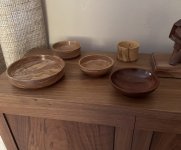
IMG_4412.jpeg

...these little bowls, turned from offcuts and oddments (Olive Ash, a chunk of Ian's mahogany and boxwood), together with a few pens will be off to Salisbury Hospice next Tuesday - Rob
 
It’s interesting to see the perspective people have on this. I hadn’t thought about the distinction between hobby and professional woodwork but can see how it’s different when woodwork combines with all that comes with runnng a business.

The Viking boat that they’ve built looks pretty spectacular and I’m looking forward to seeing it when it’s on display.
 
Retreating to the workshop area is relaxing, even if there is no project on the go.
I can sit at the workbench and think.
Sometimes I just sit ................
 
It’s interesting to see the perspective people have on this. I hadn’t thought about the distinction between hobby and professional woodwork but can see how it’s different when woodwork combines with all that comes with runnng a business.
When I was working briefly as a pro maker, it was very obvious that we were working against the clock; time was everything and the woodwork came a long way second. I found that very stress inducing:( - Rob
 
Back
Top