
-
Hi all and welcome to TheWoodHaven2 brought into the 21st Century, kicking and screaming! We all have Alasdair to thank for the vast bulk of the heavy lifting to get us here, no more so than me because he's taken away a huge burden of responsibility from my shoulders and brought us to this new shiny home, with all your previous content (hopefully) still intact! Please peruse and feed back. There is still plenty to do, like changing the colour scheme, adding the banner graphic, tweaking the odd setting here and there so I have added a new thread in the 'Technical Issues, Bugs and Feature Requests' forum for you to add any issues you find, any missing settings or just anything you'd like to see added/removed from the feature set that Xenforo offers. We will get to everything over the coming weeks so please be patient, but add anything at all to the thread I mention above and we promise to get to them over the next few days/weeks/months. In the meantime, please enjoy!
You are using an out of date browser. It may not display this or other websites correctly.
You should upgrade or use an alternative browser.
You should upgrade or use an alternative browser.
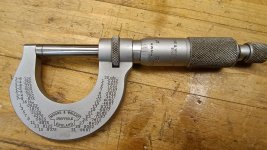
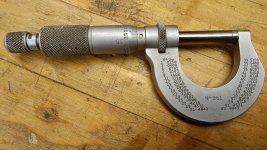
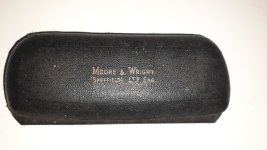
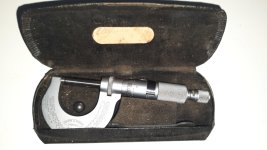
Moore & Wright # 961, 1" micrometer.
- Thread starter duke
- Start date
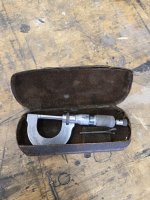
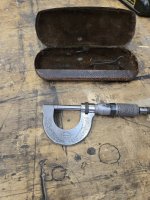
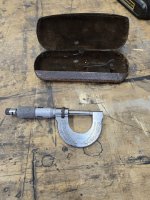

Snap!
My grandfather was an engineer and I remember him showing me how he could measure the thickness of a sheet of paper. This isn't his micrometer - a brother has that - but it's close enough.
And just to show that the trade isn't all in one direction, here are two more:
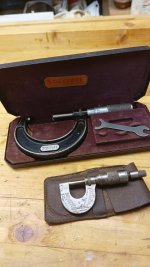
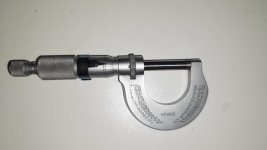
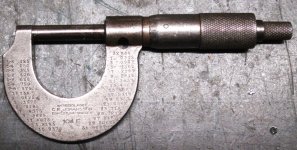
A 25-50mm Starrett and a half inch Brown and Sharpe. Every home should have one!
PS - What's the purpose of the extra (user-made?) pointer on yours?
My grandfather was an engineer and I remember him showing me how he could measure the thickness of a sheet of paper. This isn't his micrometer - a brother has that - but it's close enough.
And just to show that the trade isn't all in one direction, here are two more:
A 25-50mm Starrett and a half inch Brown and Sharpe. Every home should have one!
PS - What's the purpose of the extra (user-made?) pointer on yours?

Is it show us your micrometer day?
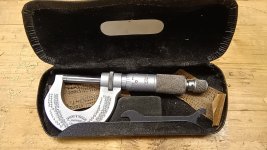
Here’s mine, mint condition, never used, still boxed with case and spanner! Bought from my old company in the mid 80’s when they closed the tool store.
A Starrett 436 1in
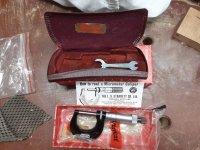
I don’t really now why I bought it or when I will ever use it but having kept it for 40 years it has a kind of sentimental value.
Here’s mine, mint condition, never used, still boxed with case and spanner! Bought from my old company in the mid 80’s when they closed the tool store.
A Starrett 436 1in
I don’t really now why I bought it or when I will ever use it but having kept it for 40 years it has a kind of sentimental value.
duke
Old Oak
I suspect would be set to the desired dimension , but I wouldn't rely on it as it could be easily nudged when taking a measurement.Snap!
My grandfather was an engineer and I remember him showing me how he could measure the thickness of a sheet of paper. This isn't his micrometer - a brother has that - but it's close enough.
View attachment 33511
View attachment 33512
View attachment 33513
And just to show that the trade isn't all in one direction, here are two more:
View attachment 33514
A 25-50mm Starrett and a half inch Brown and Sharpe. Every home should have one!
PS - What's the purpose of the extra (user-made?) pointer on yours?
NickM
Old Oak
As my dad would say: it will come in handy even if you never use it!Is it show us your micrometer day?
Here’s mine, mint condition, never used, still boxed with case and spanner! Bought from my old company in the mid 80’s when they closed the tool store.
A Starrett 436 1in
View attachment 33515
I don’t really now why I bought it or when I will ever use it but having kept it for 40 years it has a kind of sentimental value.


Doug
Old Oak

duke
Old Oak
Well this is my lot.
Wonder what the improvements and or differences are compared to the 961?This is my 961B, regularly used ever since its presentation as a prize 67 yrs. ago.
View attachment 33519 View attachment 33520 View attachment 33521
duke
Old Oak
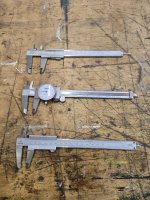
Ok, the game is on! I'll raise you four more micrometers and three vernier calipers. That's it I'm all in.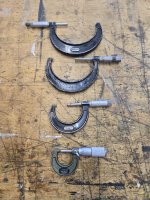

Lons
Old Oak
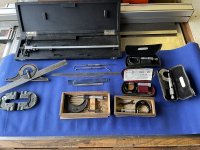
I have the odd one or two, here are some of them among other stuff. my verniers are elsewhere as in regular use.
Well this is my lot.
Wonder what the improvements and or differences are compared to the 961?
As far as I know the 961 is .001" reading scale. The 961B suffix has .0001" reading scale.
But as with all Manual Micrometres the accuracy of measurement is down to the operator, its calibration, wear etc.
This small shop-made micrometer is a real curiosity. It is made of brass, copper and steel with some parts soldered together. The measuring screw is 6.7 mm diameter and has a pitch of about 44½ TPI or 0.57 mm, which is not any standard size that I have been able to discover. It has a circular vernier scale that allows readings of 1/100 th of a turn to be taken. It is capable of accurate measurement but is not exactly convenient to use as the turns reading needs to be multiplied by a conversion factor to obtain a figure in mm or thousands of an inch. Maybe this multiplication would have been done using log tables, which is rather a tedious operation as I well recall.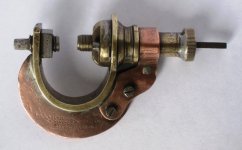
Gents, I think we have clear proof that old measuring devices are too nice to throw out, or turn down if thrown out by someone else.
And if one design did everything, there'd be no need for all this splendid variety, would there!
And if one design did everything, there'd be no need for all this splendid variety, would there!
duke
Old Oak
This is very unique!This small shop-made micrometer is a real curiosity. It is made of brass, copper and steel with some parts soldered together. The measuring screw is 6.7 mm diameter and has a pitch of about 44½ TPI or 0.57 mm, which is not any standard size that I have been able to discover. It has a circular vernier scale that allows readings of 1/100 th of a turn to be taken. It is capable of accurate measurement but is not exactly convenient to use as the turns reading needs to be multiplied by a conversion factor to obtain a figure in mm or thousands of an inch. Maybe this multiplication would have been done using log tables, which is rather a tedious operation as I well recall.View attachment 33538
duke
Old Oak
Lons, are the left bottom items go and no go gauges? I once owned a starrett combination square set and would like to buy one but they go for nearly $600. I keep looking.I have the odd one or two, here are some of them among other stuff. my verniers are elsewhere as in regular use.
View attachment 33537

Pete Maddex
Old Oak
Not wanting to be left out here is my £15 from a charity shop Moore and Wright.
 Moore and Wright by Pete Maddex, on Flickr
Pete
Moore and Wright by Pete Maddex, on FlickrPete
Pete Maddex
Old Oak
A NSK 0-25mm
Box, spanners and magnifier.
 NSK Micrometer by Pete Maddex, on Flickr
All
 Micrometers by Pete Maddex, on Flickr
Pete
Box, spanners and magnifier.
NSK Micrometer by Pete Maddex, on FlickrAll
Micrometers by Pete Maddex, on FlickrPete
duke
Old Oak
I like the digital readout on the Mitutoya.
I was naively thinking that the bargains were only for those of us willing to still work in inches, but a brand new metric mic from M&W, for the price of a battery -eating Chinese caliper is a hell of a good deal!
Lons
Old Oak
Yes as far as I know anyway. I have more in other sizes.Lons, are the left bottom items go and no go gauges? I once owned a starrett combination square set and would like to buy one but they go for nearly $600. I keep looking.

toolsntat
Nordic Pine
Well done Doug for digging this out, it was great to see the two of you venture down to the wilds of Fleckney for our Working Weekend.Mr @toolsntat ’s micrometer held by a chap who knows a fair bit about engineering
View attachment 33524
For clarification this has the capacity to measure 100mm and reads in metric.
I only know of one other similar example.
Cheers, Andy