• Hi all and welcome to TheWoodHaven2 brought into the 21st Century, kicking and screaming! We all have Alasdair to thank for the vast bulk of the heavy lifting to get us here, no more so than me because he's taken away a huge burden of responsibility from my shoulders and brought us to this new shiny home, with all your previous content (hopefully) still intact! Please peruse and feed back. There is still plenty to do, like changing the colour scheme, adding the banner graphic, tweaking the odd setting here and there so I have added a new thread in the 'Technical Issues, Bugs and Feature Requests' forum for you to add any issues you find, any missing settings or just anything you'd like to see added/removed from the feature set that Xenforo offers. We will get to everything over the coming weeks so please be patient, but add anything at all to the thread I mention above and we promise to get to them over the next few days/weeks/months. In the meantime, please enjoy!

Mower. Still not right

AJB Temple

Sequoia
Joined
Apr 15, 2019
Messages
7,824
Reaction score
1,293
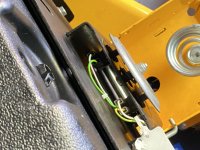
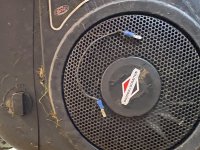
Can anyone suggest how I override this seat switch please. It is on a Stiga Park 540P ride on front deck (120cm) mower, with electric deck lift. When I bought it, the supplier showed my how to override the very annoying seat switch with a jump wire pictured. I had to do it myself and am aware of all the safety stuff so we don’t need to go there. I need to get on and off this machine quite a lot and want it to keep running when I do. I disengage the deck when I do this and wear steel toe caps anyway.

Unfortunately the supplier retired and the outfit who replaced a deck pulley removed the wiring and I have lost the diagram. They went full jobsworth (understandable I suppose).

There are two switches under the plate beneath the seat. No idea why there are two. I have tried a bit of random plugging in and ended up with the mower not running at all. Replaced the battery anyway (5 years old so had done well) and it runs now but starts a bit unhappily.

There is a white wire on the left switch and a grey wire on the right hand switch, plus a green wire and a green and yellow wire. Any idea where I should plug the black wire which stops the cutting out issue?
IMG_2143.JPG
IMG_2144.JPG
IMG_2146.JPG
 
It looks like you have two switches in parallel, so linking either the two black connectors or the two white connectors with your jumper wire should do the trick. If you have a multimeter we could check the behaviour of the switches to make sure. If you don’t, I highly recommend you get one. A very handy tool.
 
I've got a multimeter, but the problem is I have no idea what I am checking for.

By linking the twin connectors, do you mean unplug the cables and connect them together with the jumper, or push the jumper into where the connectors go alongside them? I can try both and see what happens. My cage recollection is that the jumper cable was on the white side before.
 
You might prefer a mechanical solution. When you sit on the seat, it pushes that round plate down operating the switches. The smaller spring you can see under the plate pops it up when you get off the seat. If you undo the nut, lift off the round plate, remove the spring then re-assemble without, does the weight of the seat trigger the switches on it's own ? If so, job done.

Edited to add - I'm looking at upside-down pictures of the seat, so "up" and "down" need to be interpreted in that context ...
 
I originally tried that Tony and it doesn't work. Nor does putting wedges between the plate and the switch (internet warns not to do that as it hackers the switches). The switches have a very long throw and it would seem only a tiny point between circuit closed (motor runs) and open (cuts out).
 
Are you sure they're both switches? Could one actually be a warning buzzer?

It LOOKS from the parts diagram as if there's only one switch (with two wires) - but there's a buzzer take-of.
If that's the case - work out which is the switch - unplug it, and connect the two prongs from your multi meter to the contacts on the switch. Press the switch down, and check if it makes a contact, or breaks it.
If it makes contact when pressed down (Most likely) connect the black wire with two spade connectors in to the two socket holes of the plug you removed.

Hope that helps
 
I think the wiring diagram on page 131 of this manual is the right one for your model - if that's the case, then one of the switches should be shorted closed and one of them disconnected in order to simulate the seat being always down. Either try to trace the connections to identify them, or use trial and error; at most it'll take you two attempts (and, by that diagram, if you get them the wrong way around then it won't start at all, so the trial and error shouldn't pose a huge hazard).

Standard words here about not advising anything, just observing what might happen.
 
It's the wires you need to connect so it gives continuity to the circuit as would a closed switch (bum on seat).
It will most likely be either the white and the green, or the white and the yellow as a pair. But you only have 4 wires so 6 options and it's hard to tell from your photo but one looked piggybacked so even less possibilities.
 
Thanks guys I will try it tomorrow.

As far as I know, there is no buzzer. The mower cannot be started without pressure on seat, and the brake pedal pressed down, and a twist of the key. I suppose therefore that one of the under seat switches is something to do with the foot brake switch, and the other one is the seat cut out.

Although the mower has lights, annoyingly it has no horn. Sometimes I need to attract attention (for example, to suggest a cup of tea might be nice).
 
AJB Temple":2c0k8dqx said:
Thanks guys I will try it tomorrow.
Although the mower has lights, annoyingly it has no horn. Sometimes I need to attract attention (for example, to suggest a cup of tea might be nice).

Ha! If I tried hooting a horn to summon a cup of tea I'd just get laughed at (or beaten to death...).

My ride on (Husqvarna) has the same seat switch arrangement but I can get off and leave mine running provided that I have the blades up and foot brake engaged so it's not too much aggro. Occasionally I get off having forgotten to put the brake on and when the seat switch cuts out the engine it invariably backfires incredibly loudly. Scares the daylights out of me every time!
 
My husqvarna does the same backfire, doesn't half make you jump.
 
NickM":1chfv7ph said:
AJB Temple":1chfv7ph said:
Thanks guys I will try it tomorrow.
Although the mower has lights, annoyingly it has no horn. Sometimes I need to attract attention (for example, to suggest a cup of tea might be nice).

Ha! If I tried hooting a horn to summon a cup of tea I'd just get laughed at (or beaten to death...).

My ride on (Husqvarna) has the same seat switch arrangement but I can get off and leave mine running provided that I have the blades up and foot brake engaged so it's not too much aggro. Occasionally I get off having forgotten to put the brake on and when the seat switch cuts out the engine it invariably backfires incredibly loudly. Scares the daylights out of me every time!

:D My Honda is exactly the same and I also would get short shrift from the powers that be. :eusa-naughty:

It's dead easy to rig up a 12v horn via a small push switch, if you dare, why not go the whole hog with loud musical trumpets? :eusa-whistle: https://www.amazon.co.uk/FIAMM-921973-M ... 3DVY&psc=1
 
I hate that sort of interlock. Obviously I can see why they exist, but they are still infuriating.

We have a tiny lawn and a similarly tiny Flymo, which ridiculously requires two hands to switch it on, every time you stop for something (such as moving the power cable out of the way). This was unacceptable... fixed with a plastic "spring" replacing the interlock button.

Your seat switches seem like an easy "fix" but I have to wonder why the maintenance company interfered with it. Did you ask them to? If not they don't sound like a firm to do business with in future, unless unavoidable.

By the way, from the pictures the connections look like the "Lucar" type (spade connectors). If so, you can easily get two-into-one "piggyback connectors from car parts stores:
lucar-piggyback-connectors.png
You almost certainly need to jumper across one or each microswitch. Making up your jumper cable with those "piggyback" connectors lets you do that neatly and reversibly (the male lug bends easily to the position it needs to be in), so your mod can be put back to factory spec. at any time, for example if it has to go in for more repairs. The pictured ones need a crimp tool, but those can be had cheaply too.

I'm not sure the plastic shrouds around the connectors on the mower leave enough room, but if they do...

E.
 
Thanks for the input.

However, I must have done something stupid as it is still not right. I can bypass the white switch block set with the jumper wire and that works.

However, even with a brand new, fully charged battery, the machine will not start unless I connect up to my heavy duty charger / starter.

The new battery makes the mower chug, slowly turning over once or twice, but will not start it. If I connect the big mains unit it misfires once and then starts.

When I first looked at the seat switches I disconnected all four. Maybe I didn't plug them back in the right places. It is very frustrating as this is normally an extremely reliable machine, that is used at least twice a week.

This all started when I had to take the mower deck off to replace the belt. I managed to damage the cable to the deck lift motor and simply made up a new one that works fine, and decided to by-pass the seat switch at the same time. I left the start switch in the on position for a few hours I thing, and assumed that this is what knackered the original old (5 years) battery.

Any ideas?
 
Measure the battery terminal voltage during cranking. My hunch is that it will be too low suggesting that your "new" battery might be old stock or perhaps might have been a return to the dealer for having too high internal resistance and passed on to you?
A second thought is that the ignition system might be now unhappy at being left on for several hours to cook without the engine running.

Bob
 
Thanks Bob. I will do as you suggest with the battery. It did start the machine when I first fitted it (supposedly delivered fully charged), but not easily. Otherwise I suppose it is change the components in the ignition system.
 
If it will start and run when the booster battery is fitted, then the ignition by definition has to be fine. New batteries can often be bad from the start.
look for a battery supplier and get them to dead short test it.
NO, do not do this at home :shock:
 
Thanks. I will take it in to a battery dealer that I know is sensible.

I was wondering if the mower is no longer charging the battery in use. A full mow takes maybe 45 minutes which has always been ample to keep a battery fully charged.
 
Quite likely the regulator/rectifier is fecked on the alternator and isnt Charging the battery. First take the battery off and stick it on the charger overnight. Then......
With it running put your multimeter in volts 50v (or what ever is close to that) and across the battery terminals. It should read 15 to 18v ish. Any lower and you have your answer any high anf the battery would have melted already.
 
Thanks Dave. Will do.

Is the regulator / rectifier easy to spot? This is a standard (I think) Briggs & Stratton motor.
 
AJB Temple":2ohs2p0s said:
Thanks Dave. Will do.

Is the regulator / rectifier easy to spot? This is a standard (I think) Briggs & Stratton motor.
No idea. We used to take all that off, it weighed to much for racing.
It will be with the alternator and maybe a replacement alternator jobbie if it's fried.
Found this with a quick Google.

https://www.briggsandstratton.com/eu/en ... -test.html
 
You don't need to identify the regulator separately, unless/until you have identified it's faulty by looking at the voltage across an OK battery* whilst the engine is running - as Novocaine said:

1: Check the battery is OK (i.e. get it properly tested) and charge it fully with a decent charger.

2: When the machine is running check the voltage across the battery. That's created by the alternator and rectifier pack. If it's not north of about 14.7V it won't recharge the battery well (lead acid batteries should always be stored fully charged).

3. If you want to be certain,check the charge current too, but this really needs a clamp-on current meter.

Many alternators have the diode pack (rectifier/regulator) on the back - It superficially looks like one piece, but there's a removable section at the back of the alternator, to which you connect the main leads. On some alternators it's integral, so you have to swap out the whole thing.

*This assumes alternator-to-battery leads are in good condition and not high resistance anywhere. If the battery terminal reading is low, try the back of the alternator, if you can get to it. For a definitive test, either measure the resistance of the alternator-battery leads, or the voltage drop across them when working.
 
Thank you. I will do these things but not until Friday when I usually mow. I need to whip the battery off after that and get it tested as first job. In the meantime I will disconnect it and connect to an Optimate.
 
AJB Temple":3evy7g4f said:
connect to an Optimate.

thus named because you are being optimistic if you think it will charge the battery mate. :lol:
 
There's a few possibilities. You mentioned that you had left the ignition on for some time - with many dumb alternators, in the absence of rotation the regulator will turn the rotor current up to full - maybe 5A. As well as flattening the battery, it is possible it might harm the regulator, or the alternator rotor winding might overheat (no cooling from air flow, max current).

Your multimeter will diagnose a duff battery, and whether the alternator is trying to charge it.

Another possiblity not yet mentioned is a lazy starter motor - so it starts with the added boost of the charger connected, but not at the unaided battery voltage under cranking, which might be only 9-10v.

BTW - I think 14.7v mentioned is about the upper limit for battery charging ? 15v is to high, 18v far too high. I wouldn't worry it it were 14.0.
 
yer, sorry I got my numbers wrong. the battery will tolerate 15v, 18v and up and it's going to be a hot bottom. sub 14 volts and it's unlikely to charge during normal operation.
 
Anything much above 14.7V will ‘boil’ the battery - you’re looking for 13-14.5V or so for charging voltage.

The B&S engines I’ve worked on haven’t had a separate alternator, but rather a charging coil under the flywheel and a simple rectifier. These are relatively feeble, so if the battery is duff, it will pull the charge voltage down and falsely lead you to suspect the charging system.

After charging the battery, measure its voltage, put it on the mower and switch on the headlights for 30 seconds. Report how the voltage recovers after you switch them off. This will give a rough idea of the state of the battery.

Watch the voltage while cranking, as advised. Measure the cranking voltage at the starter motor itself. Measure the charge voltage at the battery after a few minutes of running. Don’t disconnect the battery while the engine is running.

Feel for excessive heat at all the heavy connections down to the starter motor.
 
OK. Thank you. I don't need to take the battery off to charge it? It's very accessible. I can undo the terminals if I need to and just put the charger on.

I will have to put the jumper wire on to do these tests, as it is the only way to keep the engine running with the seat out of the way. I might pop the engine cover off as well until I have this lot sorted out.
 
OK. I am confused now. I usually plug the motorbikes and a special car I have into Optimates as they seem to be recommended. Are they unstable for this?

I have a much bigger Sealey charger that I've used for many years, that will also start cars and even lorries, and has a number of settings. However, I don't think that this has any mechanism to prevent over charging.
 
Also I am not positive about cooking the components. In order to start the mower you have to twist the key clockwise and then it springs back once you let go, to the run position. I can then turn it anticlockwise to the off position.

I might have left it in the run position, because I was re-wiring the motor unit on the mower deck (which raises and lifts it). This is just a guess though as I can't think of any other reason why the battery would have been flattened that day. Clearly I have done something wrong. Although I am entirely confident with mechanical rebuilding, as is evident, I know nothing about engine electrical systems.
 
The fact that you can start it with a booster battery suggests the ignition/spark side could be OK

The fact that your battery is flat or flattening to the degree where it can't start the engine is either down to a poor battery in the first place, too many attempts to start with insufficient run time to re-charge the battery in between and/or a defective charging system.

As for battery charging from a charger, I suspect the battery will be not too dissimilar to a motor bike battery in capacity so the charger you use for your bikes ought to do the job. Anything designed to be able to start trucks and recharge their batteries should possibly be avoided for charging small batteries.

I would be considering calling in favours from local knowledgeable friends preferably with a clamp ammeter and the knowledge of how to use it.
I would not suggest going to the dealership for the mower as they might not have good analytical skills/time to understand the fault and do what the Americans call "fire the parts cannon" a fit lots of new parts until it behaves just telling you the old ones were worn out!

Bob
 
The battery on my mower died very suddenly and I was surprised just how quickly it fell off a cliff.

The mower wouldn’t start - the solenoid was just clicking. I didn’t think it could be the battery (there had been no signs of sluggish turning over on starting) so changed the solenoid but it was the same. I could jump start it from the car which showed the battery was the likely culprit. I charged the battery and it was showing 12.8v I think (around normal). However, it could do more than make the solenoid click and, after a single attempt to start, the battery was down to around 10v. It just couldn’t hold the charge at all. New battery and all was well again.
 
Thanks Nick. I suspect I have the same problem. As we are expecting rain I have been doing outside building jobs rather than prioritising mower, but battery will be popped in for a check later this week. I bought it on-line. It was cheap. At first sight.
 
It did come from Tayna as it happens. Very well packaged. An 896 Powerline lawnmower battery.
 
Back
Top