• Hi all and welcome to TheWoodHaven2 brought into the 21st Century, kicking and screaming! We all have Alasdair to thank for the vast bulk of the heavy lifting to get us here, no more so than me because he's taken away a huge burden of responsibility from my shoulders and brought us to this new shiny home, with all your previous content (hopefully) still intact! Please peruse and feed back. There is still plenty to do, like changing the colour scheme, adding the banner graphic, tweaking the odd setting here and there so I have added a new thread in the 'Technical Issues, Bugs and Feature Requests' forum for you to add any issues you find, any missing settings or just anything you'd like to see added/removed from the feature set that Xenforo offers. We will get to everything over the coming weeks so please be patient, but add anything at all to the thread I mention above and we promise to get to them over the next few days/weeks/months. In the meantime, please enjoy!

Multimeter / s

Phil

Old Oak
Joined
Jul 23, 2014
Messages
4,156
Reaction score
369
Location
Southern Africa 0054
Anyone own a multimeter?
Make?
Features?
What to look out for?

I have a very small el-cheepo one which I bought when building the burglar alarms at our old house more than 20 years ago.

I have some Xmas-vouchers to spend for one of the multi-product-warehouse-tools- shops and a replacement unit would be a good buy.
(no tools and even less consumables!)
 
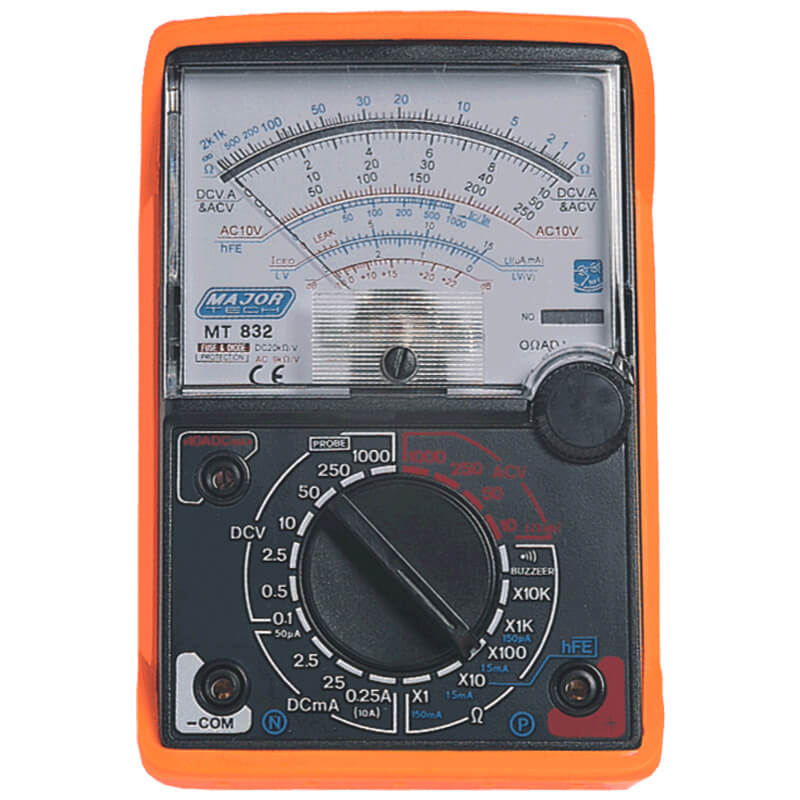
Can’t recommend a brand as I don’t remember the make of mine but I much prefer the old needle type, tried a digital one but soon went back to my old faithful 🙂
 
This one is mine, had it for yers so likely discontinued but extremely reliable......If only I could remember how to use the darned thing without having to read the instructions every time. :(

IMG_3122.JPG
 
Fluke are top but expensive, if it’s not going to be used much a cheap one will do have a look on Amazon, never buy the cheapest or the most expensive.

Pete
 
Can’t recommend a brand as I don’t remember the make of mine but I much prefer the old needle type, tried a digital one but soon went back to my old faithful 🙂

Old needle type does not even show when searching local supply.

This one is mine, had it for yers so likely discontinued but extremely reliable......If only I could remember how to use the darned thing without having to read the instructions every time. :(

I have to do the same with the small one, and then still struggle to read the display.

Fluke are top but expensive, if it’s not going to be used much a cheap one will do have a look on Amazon, never buy the cheapest or the most expensive.

Pete

Fluke are expensive locally (my son has one)
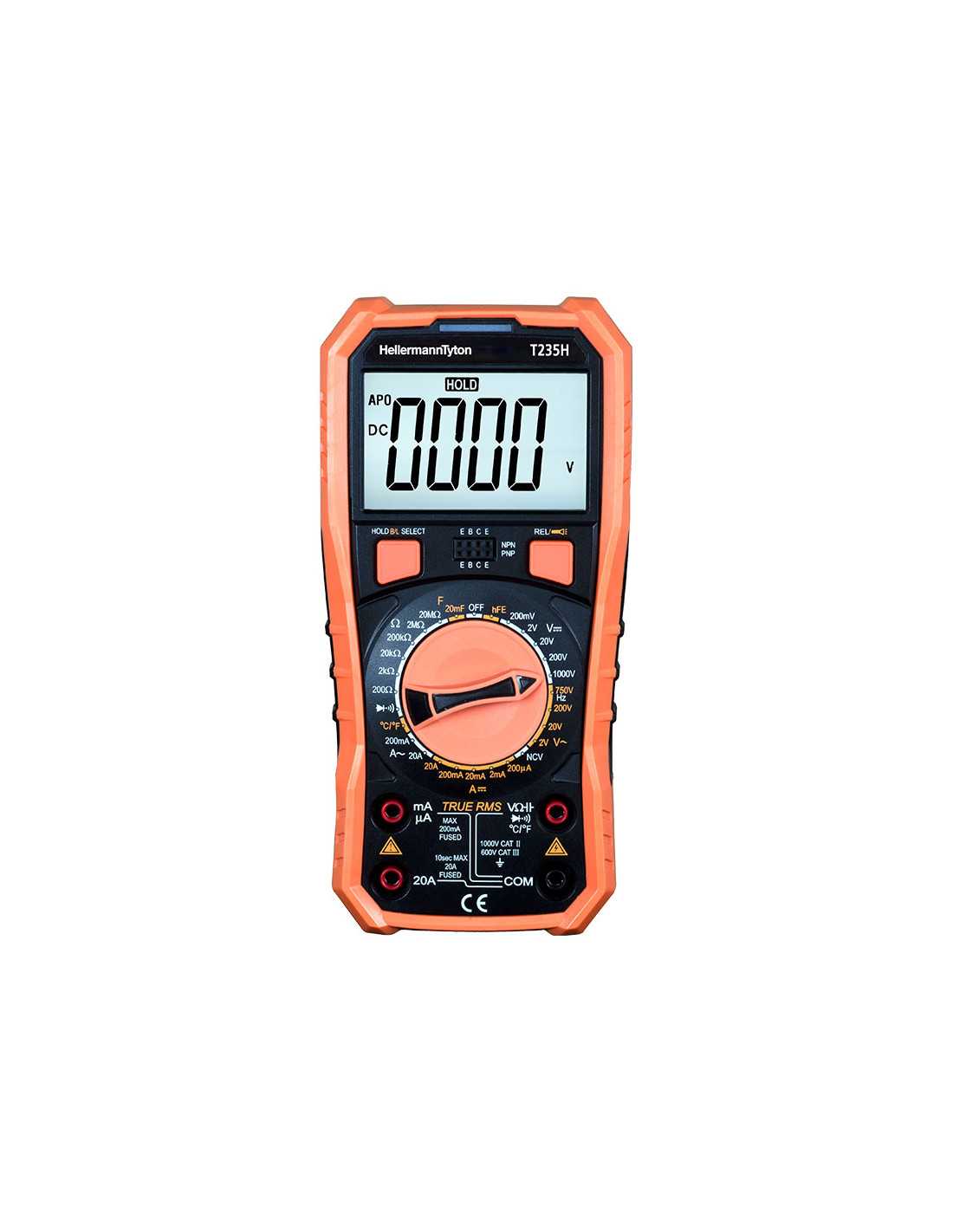
Local supply seems to be more Hellermans and MTD.
The cheepos start at ZAR200.00 similar to what I have.

I looked at this one this morning which retails at ZAR700.00

 
I bought this one a few months ago as I needed a clamp meter to diagnose a current draw problem on a motor, It's not particularly expensive and I think it covers 99% of what a DIY user would need. A nice feature is the no-contact voltage tester, which gives you an indication if a cable is live or not without probing, but it shouldn't be used as a definitive test.

https://www.amazon.co.uk/dp/B0CVXCFMLY/ref=sspa_dk_detail_1?psc=1&pd_rd_i=B0CVXCFMLY&pd_rd_w=xKmus&content-id=amzn1.sym.46187d6a-4306-4bc6-830c-7b2085e0e39f&pf_rd_p=46187d6a-4306-4bc6-830c-7b2085e0e39f&pf_rd_r=VV4GZXTP0GR4DYGHVMD4&pd_rd_wg=PPqgO&pd_rd_r=e1956ce4-6fb6-4dd3-83fc-54da269def8c&s=diy&sp_csd=d2lkZ2V0TmFtZT1zcF9kZXRhaWw
 
Just a thought, how about an old AVO meter on FB market place or other pre-used sales platforms?
 
I bought this one a few months ago as I needed a clamp meter to diagnose a current draw problem on a motor, It's not particularly expensive and I think it covers 99% of what a DIY user would need. A nice feature is the no-contact voltage tester, which gives you an indication if a cable is live or not without probing, but it shouldn't be used as a definitive test.

I did look at some this morning at the store, but a bit too bulky and pricey.
Amazon This item cannot be dispatched to your selected delivery location. Please choose a different delivery location.

Just a thought, how about an old AVO meter on FB market place or other pre-used sales platforms?

Malc, thanks, BUT I do not even have an FB account! :D Let alone wanting to surf there.
We do have some local on-line market sellers in SA and I have bought train spares through them as well as my 2 scroll saws.
It was a couple of hours drive to check and test the saws, then pay, then another couple of hours to collect. On the plus side there is an excellent Dutch store and restaurant!
Something like a multimeter I would prefer a store where any problems with the purchase can be dealt with.
 
The Kaiweets Clamp Meter I bought from Amazon is much more compact than my Amprobe AM-520 Multimeter.

I procrastinate when spending money like this, so will be visiting and eyeing the stock and prices at at the 3 local big shops (7km radius) I see them on another website.


Thanks, your surfing is a lot better! :cool:

I will shop and surf, but at the end of the day can only buy from the one store where the vouchers are valid. :rolleyes:
They have another large store couple Km away and could have more stock.
I can get from the electronics shop but would have to outlay cash and then still sit with the vouchers.

{Edit - add info}
 
A couple of mine.SAM_0004.JPGSAM_0001.JPG

The bottom one has a DC clamp meter rather than an AC clamp meter, for use on 12 volt boat systems.
Bod1.
 
I have a few. Including a Megger full test rig (MFT 1721) and a Megger MM used for work on point to point wired valve amps. Couple of cheap Amazon sourced ones as well. Useful things. Also have a clamp meter - can't recall the brand (French). Not an expert - just an amateur trying to improve knowledge.
 
I have a Fluke 87V, which is reliable but not value for money. In your case, a UNI-T meter might suit. They seem to balance price and quality nicely for the occasional user.

I have their clamp meter for AC and DC. I’ve tested it against the Fluke and it does pretty well.
 
Reminds me, there is an AVO 8 in the loft.
Will get it out and check it over, it was ok when I put it away.
They seem to be fetching good money.
 
Reminds me, there is an AVO 8 in the loft.
Will get it out and check it over, it was ok when I put it away.
They seem to be fetching good money.
Had a couple of those. They were the gold standard back in the day!

No frequency or capacitance ranges, though, which are almost ubiquitous on digital multimeters these days.
As well as a couple of digital multimeters, I have one of those microcomputer based things that will identify and measure inductors, resistors, capacitors, transistors and diodes. Cheap and very handy.
I don't have anything clamp based, though.
 
Last edited:
I have a decent modern meter.
Before I retired, the company used quite a number of meters and they had to be calibrated.
It reached a point where it was cheaper to buy a calibrated meter than get meters recalibrated. So they were sold off every year to the employees and money went to charity.
 
I spent years looking at Avo8s cracking meters, the only disadvantage is the input impedance is not very high so they can affect the circuit you are measuring but I have only had that problem once.
Here are a couple of mine.


I think I have three.

Pete
 
I have an ordinary AVO8 (love it - they're usually not expensive secondhand), A UNI-T clamp meter (only AC, not DC, sadly), A Maplin small toolkit analogue multimeter that looks almost identical to Mr. P's one, and a 'cooking DMM' I've had for years, used for general mains stuff.

I've also got various bench power supplies that are calibrated, and a 6-digit HP bench meter, which I use as a reference. It doesn't get out very often though.

Pete picked up on the AVO's impedance - you need current flowing to make the needle move, which means moving-coil meters usually have a fairly low impedance (resistance). They're better at making low resistance measurements, than higher ones, and you need to keep them tuned-up if you need accuracy. Like my cooking DMM, useful for mains work, AVOs are useful for checking earth resistances, etc., but they are fragile (and have no peak hold function!).

I have to replace my DMM soon, as it's drifting and I can't adjust it (as far as I can see). I'll probably go either UNI-T or Fluke (if I can afford it!), as both have a good reputation. DMMs have come on hugely since I first bought a Radio Shack one in the early 1980s.

Have a look at the EEV-blog channel on YouTube - he does lots of reviews and sells special versions of the Brymen meters, which also have an excellent reputation.

E.

PS: There were special high-impedance versions of the AVO 8 and Taylor moving coil meters (I have a Taylor), but they were expensive, a bit more fragile than the standard units, and nowadays a DMM is much more practical, and usually has an impedance up in the megohm range, compared to the 10k Ohms of the 'special' moving-coil ones.
 
Before I retired, a lot of stuff I built and programmed was very low power, so measuring coulombs over extended periods was more important than instantaneous values. At the time, that was not a feature of multimeters. Maybe times have changed?
 
I have a Fluke 87V, which is reliable but not value for money. In your case, a UNI-T meter might suit. They seem to balance price and quality nicely for the occasional user.
I have their clamp meter for AC and DC. I’ve tested it against the Fluke and it does pretty well.

My el-cheepo is a UNI-T UT10A. Cost less than ZAR150 in those days.
Bought when I built the first alarm system at old house, about 2008.

Yesterday afternoon decided to check out the 2 power adapter units to be used in the LED circuits.
#1 - DC 6V, 7.5V and 9V
On the 6V the meter registered 8.5V DC then 12 on the 9V.

#2 - DC 3V, 4.5V, 6V, 7.5V, 9V, 12V
On the 3V the meter registered 4.5V DC then 6 for the 4.5V and 12V on the other 9. The 12V did not give a reading.

It is handy having the old laptop in the workshop as I could do a quick surf.

"Meter is faulty" - yes, well, stating the obvious.
Battery could be faulty - yes positive feedback. Check and replace.
I did replace the battery a couple of years ago.

Open up the unit.
Battery and fitting corroded.
Sh1t, not what I wanted to see.
Remove and dispose battery, and clean with Meths.
New battery in and repeat tests above.
Same results.

Clamp a 3V round battery between the leads - reads 3V DC!
Now confused.

Both power adapters have been in use last couple years.
#1 the 6V ran the flip-flop circuit (the unit is so old the LED's broke off when cleaning them, bought replacements)

#2 used for the electric train lighting and sound.

I will not rush out and buy a replacement yet (not enough procrastination!)
Also see if someone here has a multi meter that I could use to test the power supplies, or a visit to the electronics shop.
 
On any small power adapter the voltage will be higher without a load so it’s not a good way to test a meter.

Pete
 
On any small power adapter the voltage will be higher without a load so it’s not a good way to test a meter.

Pete

Thanks, not thought of it like that.
I will repair the flip-flop and then test the adapter supplying 6V.
Certainly do not want to fry the LED's.
 
Okay, after the usual procrastination I went and spent the vouchers ZAR550.00

I bought the MTD80 with money still left on cards and added some blades for the Stanley knives.

The MTD80

MTD80.png

Unpacked yesterday afternoon, insert batteries, plug in leads. ready to test.
Yes, read the instructions!
Tried some flat coin sized 3v batteries. Really struggled to get a reading.
Tried another one, similar results. Third one the same.
Ready to box it and return.
THEN discovered that the leads plugs have to be inserted all the way down. :mad:
It works. Nice readable display.

The blades are "ROSS" made in Sheffield England.
Heavy duty blades.
 
Old needle type does not even show when searching local supply.


I have to do the same with the small one, and then still struggle to read the display.


Fluke are expensive locally (my son has one)
Local supply seems to be more Hellermans and MTD.
The cheepos start at ZAR200.00 similar to what I have.

I looked at this one this morning which retails at ZAR700.00

Google Avometer if you want a moving needle.
 
I had an EICR fail due to an open ring circuit.
If I had known I could have checked and rectified beforehand.
Im guessing they would put a meter on each end of the cables and test for continuity.
Would my cheap meter have the oomph with its 9v battery or would I need proper kit?
Could I have done this with a car battery and a lamp????
 
I had an EICR fail due to an open ring circuit.
If I had known I could have checked and rectified beforehand.
Im guessing they would put a meter on each end of the cables and test for continuity.
Would my cheap meter have the oomph with its 9v battery or would I need proper kit?
Could I have done this with a car battery and a lamp????
All of the above
 
I had an EICR fail due to an open ring circuit.
If I had known I could have checked and rectified beforehand.
A ring circuit is tested for both continuity and bridging, for continuity most meters would suffice but for the bridging test you need a very precise low ohm meter. Rings can be a right PITA to test and an even bigger PITA to rectify when faults are found because people just love to mess around with domestic wiring, just because something works does not mean it is safe and it is under fault conditions that many bodges will reveal themselves but not in a good way.
 
It turned out to be just one wire popped out in a socket (house has a penchant for loose screw terminals it appears).
Took another £300 to find the culprit and reissue certificate.
At least I didn't have to wade through the tenants detritus myself.
 
It turned out to be just one wire popped out in a socket (house has a penchant for loose screw terminals it appears).
....
You're not alone. Years ago, one of the mains distribution panels inside a BBC CMCR (Colour Mobile Control Room) aka 'scanner' 'cos in the early days, the vehicles were dark green and looked similar to WWII vintage radar scanners. Turned out that one of the screws, like at yours, had worked loose ...I guess with all the vibration on the roads. Thereafter it was a monthly check for tightness.

Maybe Herefordshire is on a seismic plate junction. :unsure: :unsure:
 
Years ago, one of the mains distribution panels inside a BBC CMCR (Colour Mobile Control Room) aka 'scanner' 'cos in the early days, the vehicles were dark green and looked similar to WWII vintage radar scanners. Turned out that one of the screws, like at yours, had worked loose ...I guess with all the vibration on the roads. Thereafter it was a monthly check for tightness.
My introduction to this was probably ten years or so later than Roger's:

CMCR3 (Bristol's Scanner) decided not to work on Christmas eve, in either 1978 or 79 (can't remember which), at Wincanton racecourse, in a hailstorm.

I was a young audio guy and couldn't contribute to the technical activity, but watched as equipment modules, and then entire racks formed a tarpaulin-covered growing pile in the car park (the rigger-drivers had the tarp and were responsible for stopping it blowing away).

Murray, one of my older engineering colleagues, was relentless in his quest for the fault, and finally found it in the mains distribution for one rack (probably identical fault to Roger's one), and all the kit went cautiously back in, with just enough time for a power-on test before we finally lost the light around 1630h. And yes, Boxing Day Grandstand that year still included racing from Wincanton.

Fun fact: the initial CMCR series (only three vehicles of the type) weighed 13 tons on two axles (six wheels altogether) and as vehicles they were woefully underpowered and with poor brakes. But they were MoT-test exempt! CMCR3's drive train gave out at some point in 1979 (it was replaced in 1980), and it had a lot of rust, so was actually towed to its last few outside broadcasts before it was finally scrapped.

OBs were only at week-ends usually, as, during the week, CMCR3's four cameras were used in Bristol's main TV studio, which didn't then have cameras of its own (the Points West studio did (only three though), as it was in daily use). Studio A did things like Animal Magic, and Vision On, and later Hartbeat, and lots of other stuff. One of my jobs as a sprog was to help plug it all back into Studio A, at 0700h on Monday mornings when it returned overnight from covering Rugby matches, etc.
 
Last edited:
One of my fun facts was how we got fed at open golf tournaments if we were at the 9th tee. The problem was that by the time we had walked back to the main building where the catering was it was time to turn round and walk back again.

We solved it by having a barbecue. As soon as we arrived on site to rig, we asked one of the engineers to go to the butchers and buy, for example, four fillet steaks, five rump, ten sirloin, eight T- bone. Then go to the fishmonger and buy sides of salmon and other fish. And lastly to the local brewery to buy a barrel of beer. And that was how we got our very, very good lunch.:)

Until one day, the barbecue caught Fire. Smoke drifted across the fairway much to the annoyance of the professional golfers. From that day on our barbecue was banned.:cry:
 
Maybe Herefordshire is a seismic plate junction
Well as you mention it - it is!
Minor tremors at Checkley are commonplace, a slightly noticeable jolt( sometimes with a boom) followed by all the birds squawking and taking flight.
About 15 years ago there was one that got onto the Richter scale and the national news.
I was in my then garage at Yarkhill and the floor shook for about ten seconds and I got showered with the junk stored in the rafters.
Teenage son slept through it.

The sparky suggested it was AC supply vibrating at 50hz was more to do with the loose terminals.
its a rough feed in any case - the line is the original -around 70 yrs old ,fed from a tired looking transformer at the farm with daisychained repairs all the way up.
Electronics dont last long unless on spike protection.
Village didnt have 'leccy until the 50's and telecoms until the 60s
Every house was still on a party line when I was a kid-got clipped ears for joining in with the neighbours conversations.
 
Last edited:
Back
Top