• Hi all and welcome to TheWoodHaven2 brought into the 21st Century, kicking and screaming! We all have Alasdair to thank for the vast bulk of the heavy lifting to get us here, no more so than me because he's taken away a huge burden of responsibility from my shoulders and brought us to this new shiny home, with all your previous content (hopefully) still intact! Please peruse and feed back. There is still plenty to do, like changing the colour scheme, adding the banner graphic, tweaking the odd setting here and there so I have added a new thread in the 'Technical Issues, Bugs and Feature Requests' forum for you to add any issues you find, any missing settings or just anything you'd like to see added/removed from the feature set that Xenforo offers. We will get to everything over the coming weeks so please be patient, but add anything at all to the thread I mention above and we promise to get to them over the next few days/weeks/months. In the meantime, please enjoy!

My cyclone set up

AndyP

Moderator
Staff member
Joined
Jul 22, 2014
Messages
14,385
Reaction score
1,944
Location
14860 Normandy, France
With such a lot of talk around Rob’s(Woodbloke) cyclone set up I thought I would share my own system with perhaps more than a nod to Mr H Robinson.

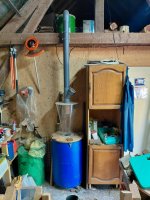
My workshop is part of a large barn which gives me the opportunity of having a twin motor camvac above and outside the workshop. Workshop door is to the right.
IMG_5125.jpeg


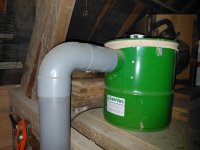
By way of 100mm plastic soil pipe the camvac attaches to a Cyclone Central (sadly now defunct) cyclone which sits atop a 200l plastic barrel; the top of which I cut off and replaced with a wooden lid grooved to fit the barrel sides and held down with sprung clips.

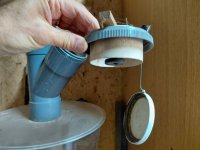
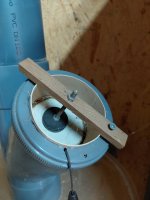
PRV is a magnet and jam jar lid fitted into a angled section of soil pipe.
IMG_5117.jpeg
IMG_5119.jpeg

To empty the barrel the angled section is slid upwards and the barrel which sits on a wheeled dolly slides away from the workshop wall .

IMG_5120.jpeg

All the grey plastic soil pipe fittings are push fit; no glue nor sealant

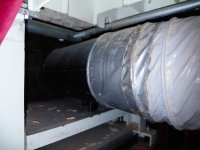
The inside of the camvac. Probably a year since I last looked in there.
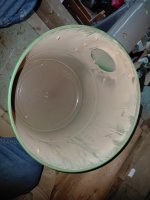
IMG_5121.jpeg

Inside the workshop is more soil pipe with blast gates for lathe and bandsaw, table saw and planer/thicknesser and one for hand held power tools
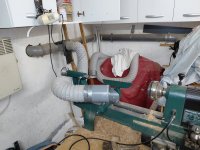
IMG_5123.jpeg

IMG_5124.jpeg

And a wee video.
 
Last edited:
That looks great Andy.
Can I ask how you've connected the soil pipe to the vac and the machines? I've got a section of soil pipe going spare that I was thinking of using but I don't know how to couple it to anything as it doesn't fit!
 
The camvac has a 4” outlet so standard fittings for that attachment.

IMG_5133.jpeg

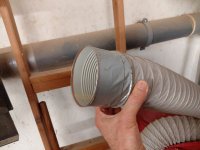
The trick, did I mention Heath Robison earlier?, is connecting standard 4” flexi hose to 4” blast gates and the big machines. My solution is this.
IMG_5129.jpeg

I have to have everything flexible and removable so permanently fixing 4” hose was not possible.
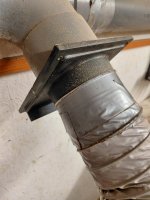
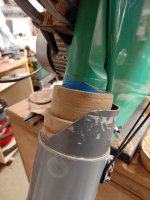
On the end of each hose one of those tins is attached with duct tape.
20260930_101631_resized.jpeg
Which provides a slid fit onto the blast gates.

20260930_101708_resized.jpeg

The planer thicknesser.
IMG_5126.jpeg

The bandsaw is neede some reducing rings and a bungy and is just shaped 4” pipe as this doubles up for the lathe.
20260930_101956_resized.jpeg

Hope this helps..
 
This is very inventive and the topic completely new to me. I had never heard of these cyclone units before but now feel I need to have one (though still not entirely sure why!). I have a camvac attached directly to my bandsaw and that's it. Does the cyclone protect the vacuum unit?
 
This is very inventive and the topic completely new to me. I had never heard of these cyclone units before but now feel I need to have one (though still not entirely sure why!). I have a camvac attached directly to my bandsaw and that's it. Does the cyclone protect the vacuum unit?
A cyclone basically sits in between your dust source and your vac. The cyclonic process spins all the chips and a large % of the dust around, dropping it into the bin below, then the really fine stuff carries on through (ideally through a fine dust filter) on to the vac. If set up properly you end up with a bin full of chips/dust, a fine filter that need occasional cleaning to keep the airflow good, and a vac with barely anything at all in it.
 
As I think someone pointed out on Woodbloke’s thread ideally for maximum efficiency all joints from machines, the hoses, pipes, cyclone, and vac should be sealed. For the amount woodwork I do I am happy with the push fit and any fine dust that may get through the joins. Even so no wood chips end up in the vac, only the finest of fine sawdust. Next time I empty the barrel I’ll take a photo of it’s contents and again the inside of the Camvac.

As an aside I’ve given up trying to catch all the wood chips from the lathe, they just fly everywhere. I only have the vac on when I am sanding as the stream on the lathe.

I also use a remote socket to switch the vac on and off. Actually with a lot of help from folks here the remote switches a relay on and off which in turns controls the vac. DIY shed remote sockets it seems cannot cope with the load from a twin motor vac. There is a thread around here about all that which I’ll dig out if anyone is interested.
 
Here it is Dave

Read with caution as I am no expert. Bob ( 9fingers) who is sadly no longer with us held my hand for much of that relay set up.
 
This is very inventive and the topic completely new to me. I had never heard of these cyclone units before but now feel I need to have one (though still not entirely sure why!). I have a camvac attached directly to my bandsaw and that's it. Does the cyclone protect the vacuum unit?
Cyclones come in different configurations for different purposes. One is the High Volume Low Pressure (HVLP) used for bulk collection from large machines. The HVLP systems typically have a large blower assembly mounted directly to or near the cyclone with the output of the blower routed to a filter. Most of the collected chips and dust fall into the collection drum and any fine dust that doesn't fall into the drum is stopped by the filter. Ideally, the filter material will be suitable to stop dust particles less than one micron.

The other popular system is the High Pressure Low Volume (HPLV) used for smaller machines. The HPLV uses a smaller cyclone and collection drum and a vacuum cleaner providing the suction. As with the HVLP system, the collected dust and chips fall into the collection drum and any fine dust is (hopefully) stopped by the bag and filter in the vacuum machine.

I use both systems in my shop. The HVLP system is permanently installed and currently uses 120mm ducting to connect to the large machines.

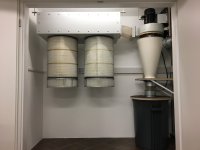
The 3HP 400V blower assembly is mounted to the top of the Oneida cyclone, and the output of the blower goes to the plenum and filters. As the dust stream enters the cyclone on the far right, it swirls around the inside of the cyclone and eventually drops into the plastic trash barrel.

20171002-1.jpg


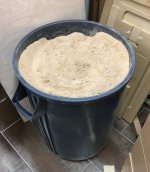
This is what the trash barrel looks like after a few days of heavy use. The jointer/planer and shaper will fill the barrel much faster than the table saw, router table, or bandsaw. If the seal on the barrel is broken, which happened once, most of the stuff in this barrel will be quickly sucked back through the blower assembly and into the plenum and filters. Also, when the barrel is full, the dust and chips will start filling up the cyclone. When this happens, everything collected goes to the filters. One time for each event was enough to learn my lesson and keep an eye on the filter efficiency gauge and the barrel level.

20201125-1.jpg

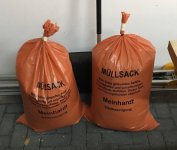
My current setup requires me to take the barrel outside and manually empty it into trash bags for collection. The recycling centers will not accept the sawdust, so it goes to the landfill in pre-paid bags. When I upgrade my system, the dust collection will use disposable bags and save me the effort of transferring the waste from the barrel to the bag.

20201125-5.jpg


This is what the inside of one filter stack looks like after heavy use.

20201125-3.jpg

The HPLV system I use is mobile and connects to all of the powered hand tools. The collection tub is attached to the top of the vacuum, and the cyclone is attached to the top of the tub. After six years of use, I have not needed to change the filter or bag in the vacuum, but lost count of the number of times I changed the bag in the tub.

Oneida-1.jpeg
 
For anyone new to these things and are wondering how on earth they work (and to show off what a clever clogs I am) here is a simple explanation.

1 Dust stays airborne when the air is fast moving, like houses tossed during a tornado.
2 When the air reach the cyclone the pressure drops dramatically, because the air goes from being in a relatively small pipe, and moving fast, into a much larger chamber, where the air is moving much slower.
3 So the dust just falls out of the air and into the tub.
4 The now less-dust-laden air continues on to the vac and the vac's filter traps the remaining fine dust.
5 The vac itself therefore has very little to collect and Robert is your father's brother.

Simples.
S
 
Back
Top