• Hi all and welcome to TheWoodHaven2 brought into the 21st Century, kicking and screaming! We all have Alasdair to thank for the vast bulk of the heavy lifting to get us here, no more so than me because he's taken away a huge burden of responsibility from my shoulders and brought us to this new shiny home, with all your previous content (hopefully) still intact! Please peruse and feed back. There is still plenty to do, like changing the colour scheme, adding the banner graphic, tweaking the odd setting here and there so I have added a new thread in the 'Technical Issues, Bugs and Feature Requests' forum for you to add any issues you find, any missing settings or just anything you'd like to see added/removed from the feature set that Xenforo offers. We will get to everything over the coming weeks so please be patient, but add anything at all to the thread I mention above and we promise to get to them over the next few days/weeks/months. In the meantime, please enjoy!

Mystery lathe.....

toolsntat

Nordic Pine
Joined
Apr 4, 2021
Messages
767
Reaction score
441
Location
Leicestershire
Name
Andy
IMG-20221018-WA0004.jpgIMG-20221018-WA0018.jpgIMG-20221018-WA0007.jpgIMG-20221014-WA0004.jpgIMG-20221018-WA0017.jpgIMG_20221022_094416.jpg

Posted here because we haven't got a "hand and foot toolery" section....
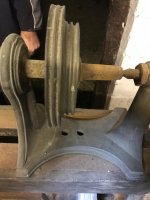
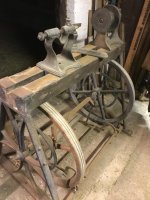
So, here we have a twin flywheel treadle lathe with some of the most ornate tailstock, headstock and tool rest I've ever seen.
It's super heavy with the two 30 inch flywheel being lead lined.
The bed is of a cast iron core faced off with an exotic timber.
Any information would be greatly appreciated.
Cheers, Andy
 
No idea at all really but it just looks French to me. Can’t imagine trying to stand on one leg whilst pumping up and down with the other and at the same time keeping your hands doing the clever stuff without being affected.
 
Cabinetman":38gefz76 said:
No idea at all really but it just looks French to me. Can’t imagine trying to stand on one leg whilst pumping up and down with the other and at the same time keeping your hands doing the clever stuff without being affected.

It has been suggested before that it could be a continental offering.
It could be a one off or at least made individually from any others that may exist as there are no assembly/manufacturing numbers on any of the parts.
I have other treadle lathes and to be honest I can get a very effective rhythm going which I become unaware of.
Cheers, Andy
 
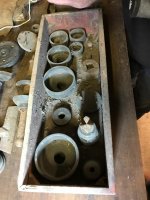
Andy, there's a vital picture in this set that I haven't seen before. It makes me think even more that your lathe was primarily used for making balls. Maybe ivory billiard balls, but possibly of other hard materials.

The photo in question is your third one, showing the box of cup chucks, in a graduated range of sizes.

Have a read of Holtzapffel's description of turning hardwood or ivory balls in Volume 4 Chapter VII Section V:

https://archive.org/details/in.ernet.dl ... ew=theater

He describes it fully and accurately, but I'll try and summarise.

Ball turning.png

Fig 431 shows the preliminary stage; a ball being roughed out, still held on a stump.

In fig 432, it's wedged in a metal cup chuck of specific size, just right to hold it on a rim slightly smaller than the required diameter of the ball. You have a set of those chucks.

In fig 433 it's being checked for size with a "ring gauge" - which has a tapered hole, with the larger side matching the required diameter. You have one of these, with a set of different sized holes. I think some of your chucks will match the holes in the gauge.

In addition, the text describes the cutting action of the "flat tool" which is used "always flat upon the rest". Your tool rests are, indeed, entirely flat, so ideal for use in this way. One of your rests has two arms meeting at a right angle - I think this might be useful for getting close to a ball, minimizing the amount of tool overhang and avoiding any need to shift the tool rest horizontally.

The chuck shown in Fig 432 is described as being made of boxwood, not metal, but this chapter is about hard wood turning. Later, in Chapter XII, at page 413 onwards, there's a detailed description of turning ivory billiard balls. Figure 549 in that chapter is similar to fig 432, but the text says it's a "strong wood or metal plain chuck".

Unfortunately, the scanned text I linked to stops short at page 417. The full text goes on with another 8 pages of detail about exactly how to make a perfectly spherical ball. I won't summarise it all here, but I'll pull out two extra points.

The ball gets repositioned frequently, and only needs gentle pressure to hold it in the chuck - a plain metal chuck like you have a set of is the right chuck for the purpose.

And for the final, finest cuts, where the turner needs complete control of his body to position the freshly honed edge just right, "the operator removes his foot from the treadle, standing still on one or both feet, while guiding the tool around the ball." What could be better at that stage in the work than a special lathe with not one, but a pair of lead-weighted flywheels?
 
Fascinating Andy thanks for that. I’ve an old croquet set that is missing a ball. One day that round tuit will reach the top.
 
Sorry about that Andy, I should have pulled that box out as well the other night. I cannot at this stage remember what pictures I've shared and with whom....
The similarities you are highlighting are making it look like it was used for turning "sports" balls at some point.
There is a mandrel in there as well for holding something with a pre-bored hole.
Picture needed....
Cheers, Andy
 
If you mean the mandrel on the left of the box, I wonder if it could have been for a grindstone? That's just my speculation.
We still need a reason for the second driving belt pulley at the tailstock end and I think a drilling or grinding facility is one possible explanation. Not sure how it would have been installed though.
 
AndyT":149khcg5 said:
Compelling argument for it being all about a load of balls snipped
:text-goodpost:

The array of cup chucks piqued my interest too, but sadly Holtzapffel has been neglected reading in recent years and no connections were made. A fine and handsome machine. Makes my knee ache just thinking about using it...
 
I used one of those photos for a google lens search and came up with a link to Lathes.co.uk

http://www.lathes.co.uk/kennan/

There are images there of lathes with two fly wheels, one driving some sort of overhead gadget that I am sure someone here could explain.

HTH
 
toolstnat
hope u get it working....
if u ever find a BIG bandsaw of that era pls let me know.....def early 1990 or even earlier.....
ta....
 
AndyT":1otcb4tl said:
If you mean the mandrel on the left of the box, I wonder if it could have been for a grindstone? That's just my speculation.
We still need a reason for the second driving belt pulley at the tailstock end and I think a drilling or grinding facility is one possible explanation. Not sure how it would have been installed though.

Yes Andy, I'm not dismissing any options at this point in the proceedings, all very plausible.
Cheers, Andy
 
Alf":2tc56h0u said:
AndyT":2tc56h0u said:
Compelling argument for it being all about a load of balls snipped
:text-goodpost:

The array of cup chucks piqued my interest too, but sadly Holtzapffel has been neglected reading in recent years and no connections were made. A fine and handsome machine. Makes my knee ache just thinking about using it...

Thank you Alf, once it's is up to ramming speed I'm sure it'll be nigh on effortless :eusa-pray:
Cheers, Andy
 
Andyp":250mftzc said:
I used one of those photos for a google lens search and came up with a link to Lathes.co.uk

http://www.lathes.co.uk/kennan/

There are images there of lathes with two fly wheels, one driving some sort of overhead gadget that I am sure someone here could explain.

HTH

Yes Andy that one had shown up on the searches and it's quite easy to see that parts may be missing on my lathe.
 
The journey to position and reassemble the lathe is slowly progressing.
Space is a bit tight but enough has been created 8-)
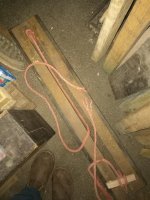
Moving the bed on my own is easier said than done so I grabbed my trusty bit of polypropylene rope and made a sling to help lift it while over my shoulder.
Disaster narrowly averted as the rope was rotten :o


Assembly on halt as I need to sort out a missing bolt
Alas Toolstation don't stock em... :evil: :eusa-doh:
Square head, 5/8" UNC (?) ThreadIMG_20230104_155803.jpg
Cheers, Andy
 

Attachments

  • IMG_20230107_114938.jpg
    IMG_20230107_114938.jpg
    239.5 KB · Views: 1,997
  • IMG_20230104_183544.jpg
    IMG_20230104_183544.jpg
    225.1 KB · Views: 1,997
toolsntat":11dqxoui said:
Square head, 5/8" UNC (?) Thread

I'm perfectly willing to have a go at making one or two replacements if you want to confirm the length and other dimensions.

It's a suitable job for another, less mysterious treadle powered lathe quite nearby... ;)
 
Trevanion":ybnst947 said:
toolsntat":ybnst947 said:
Square head, 5/8" UNC (?) Thread

More likely to be BSW, can you read the thread pitch (TPI)?

I believe it's 10.
That puts it in both camps I think.
I believe these have been fiddled with somewhat as even though the pitch is nigh on the same the diameter varies by about 3 mm.
Cheers, Andy
 
AndyT":3tzuaazc said:
toolsntat":3tzuaazc said:
Square head, 5/8" UNC (?) Thread

I'm perfectly willing to have a go at making one or two replacements if you want to confirm the length and other dimensions.

It's a suitable job for another, less mysterious treadle powered lathe quite nearby... ;)

Many thanks for the kind offer Andy, much appreciated.
Let's see how I get on this end first.
Cheers, Andy
 
Looks like Whitworth 10 x ?
Found a Whitworth thread dresser and it drops in nicely.
Cheers, AndyIMG_20230108_020337.jpgIMG_20230108_020219.jpg
 
Looks about right, Whitworth has rounded crests and valleys whereas UNC has sharp points, as well as BSW being 55-degrees and UNC being 60-degrees but this usually isn't too much of an issue and usually the bolts are interchangeable on non-critical applications, aside from the 1/2" sizes as one is 12tpi and the other 13tpi if I remember correctly.

I was going to offer to have a crack at it as well, but now I really want to see AndyT make one up on the treadle lathe :D
 
Trevanion":2qkvuhz8 said:
Looks about right, Whitworth has rounded crests and valleys whereas UNC has sharp points, as well as BSW being 55-degrees and UNC being 60-degrees but this usually isn't too much of an issue and usually the bolts are interchangeable on non-critical applications, aside from the 1/2" sizes as one is 12tpi and the other 13tpi if I remember correctly.

I was going to offer to have a crack at it as well, but now I really want to see AndyT make one up on the treadle lathe :D
Cheers, I'm going speak to a couple of chaps tomorrow and see what transpires.
Andy
 
Andy, among the bits of pieces you have with this, there's a tool rest with a right angle bend in it. I was speculating that it might be for a missing grinding wheel, so you could use the rim and the side of the wheel. While looking for Geoff's Keen brand drill, I spotted this picture of a bench grinder. Obviously it's much later and electric, but it's a sliver of evidence that grinding on the side of the wheel has been something designed to be possible, even if I was under the impression it was unwise.

BookReaderImages.php


https://archive.org/details/MCGoodingAndCoBenchGrinder
 
AndyT":1vcl77bj said:
Andy, among the bits of pieces you have with this, there's a tool rest with a right angle bend in it. I was speculating that it might be for a missing grinding wheel, so you could use the rim and the side of the wheel. While looking for Geoff's Keen brand drill, I spotted this picture of a bench grinder. Obviously it's much later and electric, but it's a sliver of evidence that grinding on the side of the wheel has been something designed to be possible, even if I was under the impression it was unwise.

BookReaderImages.php


https://archive.org/details/MCGoodingAndCoBenchGrinder

Yes Andy, that's so close to definitely be worth considering. :eusa-clap:

Cheers, Andy
 
So, I've been fiddling around with the thread dilemma and can confirm that the 3/4" x 10 split die I have will cut the threads on these 11/16" bolts when I close up the two halves a bit more.
This should mean that I can make the missing bolt :eusa-dance:
Making the nut is another story because as far as I know adjustable taps aren't a thing :eusa-think:
I have a friend up the road who has offered to run a matching thread on the inside of a nut if his lathe has the right change wheels.
I feel guilty about not letting those, who offered, in on the action but hopefully this means no posting backwards and forwards. :oops:
Now if this falls through I'll probably have to eat my words and look at the situation again..... I do like the idea of a Vintage Barnes treadle lathe keeping one of the brotherhood alive Andy and thanks for the offer. 8-)

Just had another thought, perhaps a Whitworth 10 internal thread chaser is a thing? :eusa-think:

Cheers, Andy
IMG_20230104_211328.jpg
https://us02web.zoom.us/j/88247626092
 
toolsntat":3qkwqta8 said:
Just had another thought, perhaps a Whitworth 10 internal thread chaser is a thing? :eusa-think:

Cheers, Andy

No need to feel guilty Andy. I may be able to help anyway... Which one of these would you like? I really don't think I need two of them ;)

IMG_20230111_091608009.jpg
 
IMG_20230111_075506.jpg
AndyT":2bn8ld7x said:
toolsntat":2bn8ld7x said:
Just had another thought, perhaps a Whitworth 10 internal thread chaser is a thing? :eusa-think:

Cheers, Andy

No need to feel guilty Andy. I may be able to help anyway... Which one of these would you like? I really don't think I need two of them ;)

View attachment 1
quote="AndyT"]
toolsntat":2bn8ld7x said:
Just had another thought, perhaps a Whitworth 10 internal thread chaser is a thing? :eusa-think:

Cheers, Andy

No need to feel guilty Andy. I may be able to help anyway... Which one of these would you like? I really don't think I need two of them ;)

View attachment 1[/quote]

Soon after posting this I remembered that a recent auction lot I purchased had all sorts in it, including 2 internal thread chasers.
Now, I've never had much interest in this sort of tooling so had dismissed them as just other "bits". That is until now....
Alas they are an 11 and a 12.
Having said that I may have others lurking in the box's of time that have become buried :eusa-whistle:
Thank you Andy for your kind offer of a 10 and without any other options I'd definitely be up for accepting but I'll hold off for the moment until I hear back from the other chap.
Writing this I've just had a lightbulb moment :idea:
Let's say you had a surplus Whitworth 3/4 X 10 tap and ground off all but one set of cutting teeth, would it work as a thread chaser?
Cheers, Andy
 
It's possibly worth adding that the normal approach would be to cut the internal thread in the nut with a single point tool, then use the multi tooth chaser to clean up any roughness and refine the thread form.

Apologies if I'm just stating the obvious.
 
AndyT":2ahpkpoj said:
It's possibly worth adding that the normal approach would be to cut the internal thread in the nut with a single point tool, then use the multi tooth chaser to clean up any roughness and refine the thread form.

Apologies if I'm just stating the obvious.

I hadn't realised this was the case and makes more sense in metalworking why they are called "thread chasers" as opposed to thread cutters.
Sorry Andy, I was hoping to bring you into a chat on Benchtalk101 about this but I left it too late and you had just left.
Richard Hughes mentioned the same as I was telling him that a model engineering chap I know has the correct wheels to run a thread inside a nut for me on his lathe.
Just waiting now for an appropriate old square nut to rework for the job. My other mate who has many vintage stationary engines etc,etc is going look in his box of bits.

Cheers, Andy and
 
Back
Top